


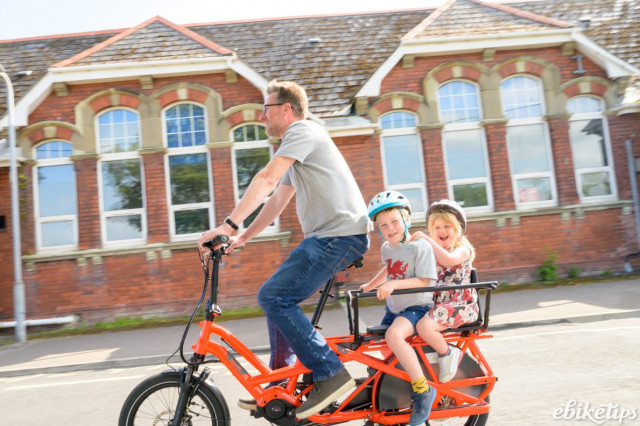

New research published amid the ongoing soaring fuel prices due to the conflict in the Middle East has estimated families could save £4,000 a year by swapping their car for a cargo bike.
Campaign groups Solve The School Run and Clean Cities are urging councils and policymakers to support more people switching to cargo bikes, the latest research coming alongside a statistic that “even in London, which often has better bike storage facilities than other parts of the country, there are just two secure spaces in on-street cargo bike hangars”.
Campaigners also note that in the UK in 2022 there were 4,000 e-cargo bike sales, significantly fewer than in other similarly sized European countries, such as France and Germany where there were 70,000 and 90,000 respectively.
Amid soaring fuel prices being driven up by the war in the Middle East, the new research estimates that families using an e-cargo bike and public transport could save £4,000 compared with families using a second-hand car and public transport.
Solve The School Run explained the analysis took into account purchase price, depreciation, running costs, and additional transport costs.
Solve The School Run and Clean Cities have urged local authorities and government to help people access these savings with the introduction of hire programmes and greater secure parking options.
“Although e-cargo bikes are cheaper than cars to buy and run over time, the upfront cost can be a barrier,” the groups said. “A family-sized e-cargo bike and accessories typically cost around £6,000. Unlike cars, which are widely available through finance or leasing schemes, families often struggle to find the initial funds.
“Council support schemes – such as discounted hire programmes like the one available in Richmond could make e-cargo bikes far more accessible and transform everyday journeys for families.
“Even in London, which often has better bike storage facilities than other parts of the country, there are just two secure spaces in on-street cargo bike hangars, one for every 4,500,000 people in the capital.
“With secure storage for just two cargo bikes in the whole of London, in a dedicated cargo bike hangar provided by Westminster City Council, families are unable to safely store their cargo bikes, which are too big for standard bike hangars.”
BAFTA-winning TV presenter and medical professional Dr Chris van Tulleken has backed the groups’ work and explained his family “have never looked back” since switching to an electric cargo bike.
“It’s way cheaper and faster than a car, and our favourite way to get all three kids around London — they love it, and I love it. It’s great for our health, our happiness, our climate and our community.”
Nicola Pastore, co-founder of Solve The School Run, a grassroots network of parents concerned about the road danger and air pollution of the school run said: “In a cost-of-living crisis, we don’t think it’s fair that families are locked out of savings in this way. Families want a practical, affordable alternative to the car. Councils set aside kerbside space to park cars, why not do the same for a form of transport that is cleaner and cheaper?”
Dr Ian Philips, Associate Professor at the University of Leeds added: “Cargo bikes help people keep active, do activities with family that they might not otherwise have done and they replace car trips — showing great potential for health benefits and carbon savings. Add to this the financial and convenience benefits of these bikes and you have a very strong case for cargo bikes to become a more mainstream form of family travel — as they are in other European countries.”










6 thoughts on “Drivers could save £4,000 during fuel crisis by swapping to a cargo bike, new research suggests”
The issue is largely one of cost and convenience. I just bought one second hand and its amazing. Its still cost me £2300 to buy it and get it set up to transport my 2 children and I still wouldn’t take them on any sketchy back roads on it. It still doesn’t replace a car for us. We have a car but I was pretty adamant that I didn’t want a second one for the tiny use case of getting our children to nursery and whenever the other car is in use and I want to get somewhere non-trivial.
If I bought this brand new it would have set me back £6500ish. Thats a huge sum of money that most people will struggle to justify and thats ignoring the utter twats on our roads that make it unpalatable for many people.
Unfortunately, a car is far more versatile and people already have their lifestyle set up around their car(s) and everything infrastructure wise is enforcing that right now.
It does if you go for a Tern GSD or similar (though even they are available for around £5k, so those would be some expensive accessories) but there are plenty of good cheaper alternatives, e.g. the B’twin E3 for £2500 with much the same load capacity. I know it’s the researchers’ benchmark, not road.cc’s, but it would be a shame if people were put off thinking about getting a cargo bike because they thought £6k was the cost of admission.
I agree that you can get on a cargo bike for less, but it wouldn’t actually take *that* much to spend a grand on accessories (especially Tern) – e.g. I felt it was essential to step up to an angle-grinder resistant lock to protect our investment (£250+). Clubhouse: £165. Madpad: £45. Stirrups: £60. If you want panniers and/or weather proofing for your cargo, you’re into the high hundreds.
I also agree with mctrials – for a lot of people, the comparison is not between buying a cargo bike and buying a car. We’re a one-car family, and our cargo bike was never competing against a second car, it was just to replace (not replace, actually N+1) a regular bike when our child outgrew their child seat – so it was always just additional spend.
Yeah, the UK is nowhere near where it needs to be for people to consider it a proper car replacement for the whole family for many reasons.
The other thing I forgot to mention is the risk of some oik stealing it. I have the GSD S00 and with all the bits on it, I reckon its 50kg plus. I have to take it in and out of the house whenever I use it. Plenty of people will have the same issue or be trying to squeeze it down the side of their house.
A car sits outside your house, generally safely. A bike is a prime target for thieves who know its a safe crime because no one ever comes after them and they have good resale value.
For *some* people in some places this might work. I agree that “it doesn’t work for *me*” will be very common – but that isn’t limited to the UK. I’ve no doubt people were saying the same in NL say 25+ years back! (When they were already at a far more advanced position in terms of cycle infra, numbers cycling – and probably availability of public transport etc – than even the least “car-dependent” locations in the UK).
The motor car is “good enough” for a very wide range of tasks. The problem here is for a century we’ve both fixed places so it *is* really convenient and established “what you can do with a motor car” as the baseline for judging “acceptable mobility” in our minds and culture.
Cycle parking and security will be a big thing (when we get there…) Although I hear bike theft is also pretty common in NL there are rules on minimum levels of cycle storage provision in new buildings, and there’s a lot of “public cycle parking” – some very high quality.
Way too pricey for many people. Too vulnerable to theft and weather damage as well if you haven’t got a side entrance or a front garage. Making the school run into the school walk will be even more cost effective.