



The publication of a report claiming to be “the biggest assessment of walking, wheeling and cycling in the UK” has laid bare the impact of active travel, with estimates included about huge economic and health benefits.
Active travel charity Walk Wheel Cycle Trust, formerly named Sustrans, today published its Walking and Cycling Index for 2025, the report an in-depth look at walking, wheeling and cycling across 22 cities and regions in the UK and Ireland.
The charity believes it provides high-quality evidence which “captures public attitudes towards active travel” and can help inform policymakers’ investment decisions.
The report is bullish that “everyone gains when more people cycle” and highlights modelling of the costs and benefits of cycling journeys which estimates the total annual economic benefit from all trips cycled in UK Index areas is £1.81bn.
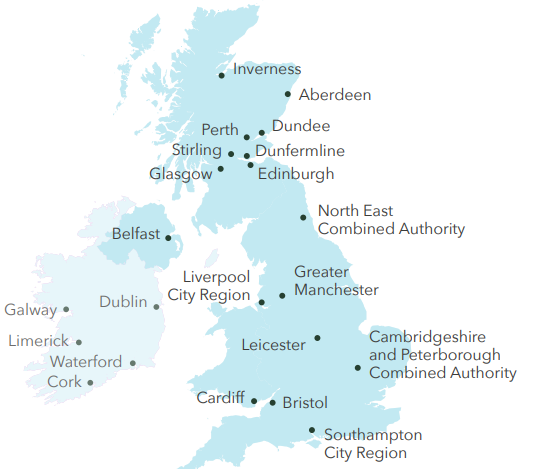
Index areas [full map below] include major regions, such as Greater Manchester, Liverpool City Region and North East Combined Authority, but with Leicester the sole Midlands representation and nothing included from London and the South East, the nationwide figures would almost certainly be higher.
The Walk Wheel Cycle Trust comes to its total annual economic benefit figure by using a ‘Societal Gain model’, which includes travel time, vehicle operating costs, health benefits, air quality and taxation.
“For these journeys, between £1.25 and £1.84 is saved for each mile cycled instead of driven,” the report states. “Over a year this adds up to £1.11 billion in economic benefit for residents and society from 688.9 million miles cycled by those that could have used a car.”
Likewise, the picture of cycling’s impact on the NHS is positive too, the index suggesting that cycling in the included areas saves the NHS £72.7m per year, the equivalent cost of 1.6m GP appointments.
The report also estimates that 5,736 long-term health conditions are avoided each year thanks to cycling, and 545 early deaths are prevented annually.
Walk Wheel Cycle Trust also reports cycling instead of driving saved 190,000 tonnes of greenhouse gas emissions, equivalent to the carbon footprint of 170,000 people taking flights from Heathrow to New York.
The charity also highlighted “considerable appetite” to start cycling from residents who do not currently, around 26 per cent putting themselves in this category.
When looking at support factors which could increase the number of people cycling, 54 per cent highlighted access to secure cycle parking at or near home as important.
More than three-quarters raised improved and increased off-road active travel routes as significant too — while 58 per cent backed building more cycle paths physically separated from traffic and pedestrians, even if this means less room for other traffic.
Cycling was viewed as less safe than other forms of transport, 45 per cent of residents stating they feel it is safe to cycle in their local area, compared to 80 per cent and 74 per cent in relation to driving and public transport respectively.
More than half (54 per cent) expressed support for shifting investment from road-building schemes to fund walking, wheeling, cycling and public transport.
“Walking, wheeling, and cycling are among the best, and cheapest, ways we can improve our health, our wellbeing, and the world around us. They are everyday actions with a big impact,” Louisa Dale and Fiona MacLeod, Walk Wheel Cycle Trust’s two directors said in a joint statement.
“It’s exciting to welcome this report as the newly named Walk Wheel Cycle Trust. More than ever, the report highlights a need for long-term funding and stronger policies so that together we can build an inclusive and integrated transport system, one that connects safely to new developments and existing communities.
“The 2025 Walking and Cycling Index shows that if we make active travel easy, safe and accessible, everyone benefits, with improvements to our health, our wellbeing and our world.”
The full report is available here.



















27 thoughts on ““Everyone gains when more people cycle”: New report suggests cycling saving the NHS more than £72m per year”
Only one third of
residents cycle at all and 14% of residents cycle at least once
a week
Cycling once a week indicates a non-cyclist and ‘I’m a cyclist myself’ status. I’m guessing that 1-3% can be legitimately described as cyclists. Neither version of the report includes the words: police, policing, enforcement or anything else that suggests any appreciation of the attacks most real cyclists experience regularly. The government’s recent ‘Road Safety Strategy’ will moulder collecting digital dust in a file folder until it’s soon forgotten – that is clearly intended to be the case, as implementation has been put into the hands of the DVLA’s very own ineptster Lillian Greenwood. If you don’t believe that, look up BF64 TGE and HY66 ZZB, both seen very recently – her response to those and numerous other VED evaders was ‘we make VED easy to pay and difficult to avoid’.
So, 1000 NMotD cases on and Kent Police have actually declared (we’re told) ‘No proven KSI’d cyclist – No Action’ and that’s the policy followed by numerous forces without declaring it. Lancashire is certainly among them. The only thing that’s going to increase the number of cyclists is a Monster oil crisis, and more and longer massive traffic jams
This photo exemplifies (and is a test to see if the image upload actually works) one of the reasons why our roads are more dangerous than they need to be: despite the government Road Safety Strategy referring to increased policing of MOT law, the police aren’t interested. This is tonight’s offender- no MOT since early January, MOT failed mid January for 5 serious safety defects, still driving around untroubled by the police.
Yes, images are still working! Nearly back to normal- all we need now is editing and ‘replying to…’
I just tried adding an image and nada.
The commenting here has been a disaster since RoadCC tweaked things recently. Have they employed ex-Facebook interface designers to ‘improve’ the UI.
Still working well here. Are you outside the UK? All we’re really missing now are post editing and attribution of replies
And comment sorting that works.
And a carousel that doesn’t show every single comment.
And forum comments in the carousel.
And replying to work on offroad.cc.
etc.
And replying not to cut off after a handful of levels.
And, most importantly, proper pluralisation on ‘like(s)’.
This is a great report, quantifying some of the benefits of Active Travel, but it’s hard to treat it with due gravity when it’s produced by the Walk Wheel Cycle Trust.
Royal Mail dropped Consignia, so surely they can drop that awful name.
Not by much then. NHS budget is around 220bn, so this is saving slightly less than 0.36% of the NHS budget. Possibly. From a group who are always likely to accentuate the positive…
Old and cynical, that’s me.
That’s 0.36% of the NHS budget with only a tiny proportion of the population cycling. If you build more infrastructure, more people will cycle, you’ll get bigger and bigger savings. Some estimates suggest that in the Netherlands there is a 3800% ROI for expenditure on cycling, approximately €600 million per year returning around €19 billion in benefits.
Nope. Not exactly. Because you have to pay for the infrastructure, so in the short to mid term at least, it’s a net cost and may never deliver the savings required to pay for its construction. Particularly if land has to be purchased or bridges/crossings built.
Multiply it up. If they increase cycling etc 10 fold that’s a potential 3.6% saving (700m) to the NHS, but an increase in budgets elsewhere. Nett benefit? Dunno. I suspect this will work out to be closer to robbing Peter to pay Paul.
How much do cycle lanes cost per km in urban areas?
Depends very much on the context and design. According to a DfT review, while at the top end the most challenging and complex ones can approach £1.5m per km, at the lower end, where existing space just needs to be surfaced to make it suitable for cycling, it can be had for ~£0.14m.
Of course, that neglects the fact that work is going on significant amounts of the road network all the time, as well as new road building, presenting opportunities to include cycling facilities in those spaces as part of those works at much reduced cost.
Also, we are not the Netherlands . There would also have to be a cultural shift.
I’m also disinclined to believe figures from any group interested in promoting it’s cause…
I think a cultural shift is what we want, isn’t it? The do nothing case isn’t a good option.
Look up the history of car use and the ‘Stop de Kindermoord’ campaign from the 1970s in the Netherlands.
We can argue the toss, or recognise that active travel is just a ‘good thing’.
If you look at the Netherlands in the 1970s, they were very much a car oriented culture, so if they can change things around to become a poster-child for cycling, then I’m sure we can at least improve the situation here.
Building cycling infrastructure has a great return on investment, so why wouldn’t we want to maximise that? It’s like free money.
Indeed. Of course they never went quite as far in the direction of the UK – they didn’t lose cycling completely as a normal mode of transport in most places, nor AFAIK create public transport deserts.
But the similarities in where they got to are well- documented (building urban motorways, happily demolishing residential areas and historic buildings…)
not the old “we are not the Netherlands” brush off…?
You might as well say “we are not Stockton or Darlington, why would we want railways?”
@stevecrook “we are not the Netherlands . There would also have to be a cultural shift.”
Well we’re not Silicon Valley here. So we won’t get the web, mobiles or AI. There would also have to be a cultural shift.
And eg. Glasgow is not Los Angeles – so it won’t get freeways through the city. The streets are too narrow! People would never stand for all the building demolitions required … and the cost!
(or … Utrecht:
)
And London … largely has a rather ancient historic street plan. Streets are winding and far too narrow for efficient motor vehicle transport. That won’t happen… (etc.)
@stevencrook of course perhaps what you mean is “how would this happen if the change isn’t acting as a massive cash concentrator for a few?” *That* is certainly a good question! That is normally a feature of such changes.
That allows those promoting change to buy the necessary politicians (if only through the carrot of “growth in your area”). And to overcome start-up costs and convince enough of the population that this new thing is now an essential cost because everyone else is doing it.
Plus human attention being what it is change normally needs “new” and it has to be made “shiny” – bikes are old and not currently prestigious technology!
The Netherlands was a car choked hell too.
The only things stopping change here is the folk who say it can’t be done.
A small percentage of a big number works out as a big number. We learnt that during COVID.
The challenges for the NHS go beyond funding. Yes, it needs more financial resources, but there are practical limits to the availability of trained staff and how many beds you can fit into an existing hospital, and whether building new ones require new roads to be built.
It also assumes that treating people after they get ill for the same cost as investing in cycling infrastructure is just as good as having a healthier population that didn’t need to trouble the NHS in the first place.
That’s only the direct costs – you also need to take into account that fewer people needing to use the NHS means less queuing for those who go need those services. Less queuing means faster treatment. Faster treatment means less illness. Less illness means less demand on the NHS services.
It’s a virtuous circle
The numbers are far too precise given how imprecise the methodology was. Instead of saying “72.7 million pounds saved” they should at least use a vague range such as “50 to 100 million”, but more realistic is probably “between 10 and 300 million” because there are so many assumptions and estimates involved that the confidence interval should be massive.
I half agree with you Chris. It would have been better to use a round number in the headline, such as £70 or £75 million with the qualifiers ‘about’ and ‘could’, and save any discussion on uncertainties for those who wish to dig deeper.
I recall reading about the difference in communication requirements for scientists vs activists a number of years ago, I think in the book “The Geek Manifesto”. The book was mainly complaining about the lack of scientific literacy from our decision makers, and probably also the media. However, it came with the caveat that too many scientists don’t know how to communicate to the general public, and the result is that the messages from less knowledgeable people travel further, and you can also include less sincere amongst that group. The problem being that scientists, who rightly include information on uncertainties when talking to other scientists, make the mistake of including them when talking to the general public.
But the general public sees any detail on uncertainties, and instead of thinking ‘this person is being honest with me’, they think ‘this person is guessing and I shouldn’t trust the message’. We see this all of the time with messaging on climate change.
Scientists with important messages to impart to the general public need to decide whether they are wearing their ‘scientist’ or ‘activist’ hat that day (or something in between) and use the appropriate language to go with it. A lot of the time that means being more relaxed about using imprecise language.
The flip side is people using too many, unearned, decimal places. For a report like this, a good compromise is sticking to round numbers, and focus on qualitative descriptions of the benefits, with some numbers for context of the potential scale of benefits.
People moaning about the costs of investment in cycling infrastructure don’t get bogged down in detail, or even if the investment is actually for cycling or for drainage or resurfacing a road that was wrecked by cars.
“…and the result is that the messages from less knowledgeable people travel further, and you can also include less sincere amongst that group.”
Yes, as the saying goes “a rumour is half way round the world, while the truth is still getting it’s boots on”
But the numbers of regular cyclists is dropping in most areas. https://bristol-uncovered.uk/cycling-in-bristol-compared-across-the-uk/