


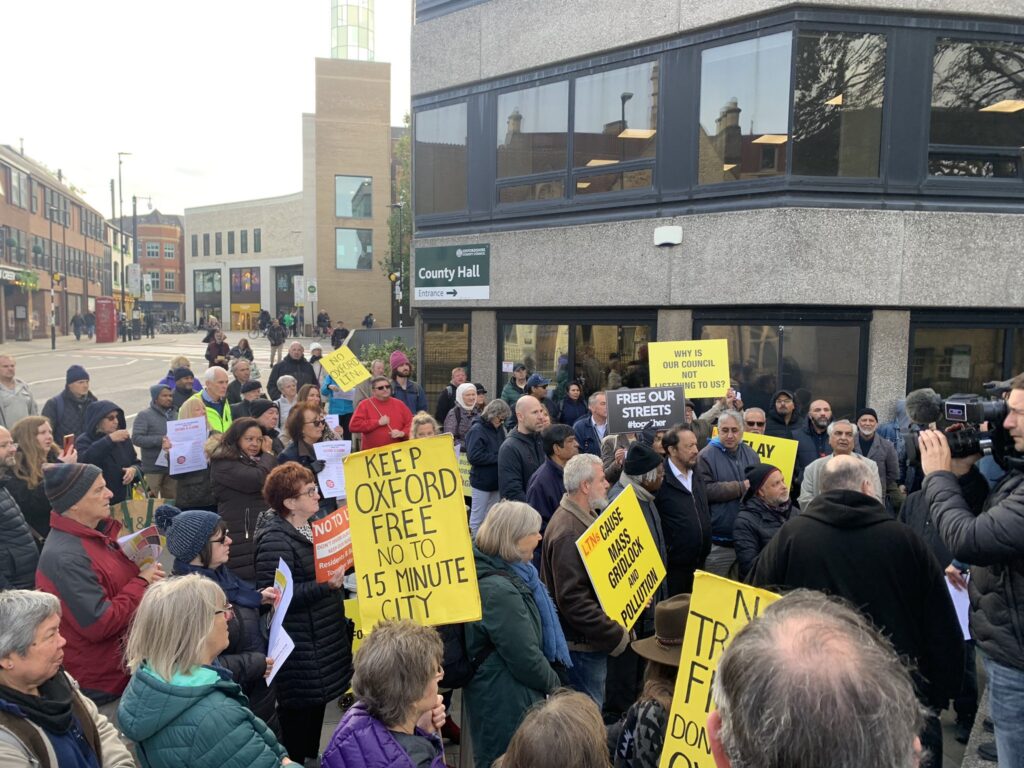

Society is not using its “finite” road space responsibly and needs to change, a councillor in charge of highways management told Oxfordshire County Council yesterday, as the local authority voted to make permanent three controversial low traffic neighbourhood schemes in Oxford, despite angry protesters claiming that the traffic-calming measures have increased congestion and that they “can’t get on bikes”.
Andrew Gant, Oxfordshire County Council’s cabinet member for highways management, was speaking at an often heated and rowdy meeting as the local authority voted to approve and make permanent the Traffic Regulation Orders for the three LTNs introduced in east Oxford in May 2022.
Implemented to prevent rat-running motorists from driving through residential streets, making them safer for cyclists and pedestrians, the LTNs in the Divinity Road, St Clement’s, and St Mary’s areas have instead become the epicentre of what some have described as a “civil war” in Oxford, and the subject of protests, conspiracy theories, vandalism, arson attacks, and television documentaries.
Following yesterday’s vote, the planters and bollards that signalled the entrance to the LTNs – and which have been driven over, stolen, and set on fire over the past year – will be replaced by Automatic Number Plate Recognition cameras, while taxi drivers, emergency services, bin lorries, and post van drivers will be permitted to use the streets.
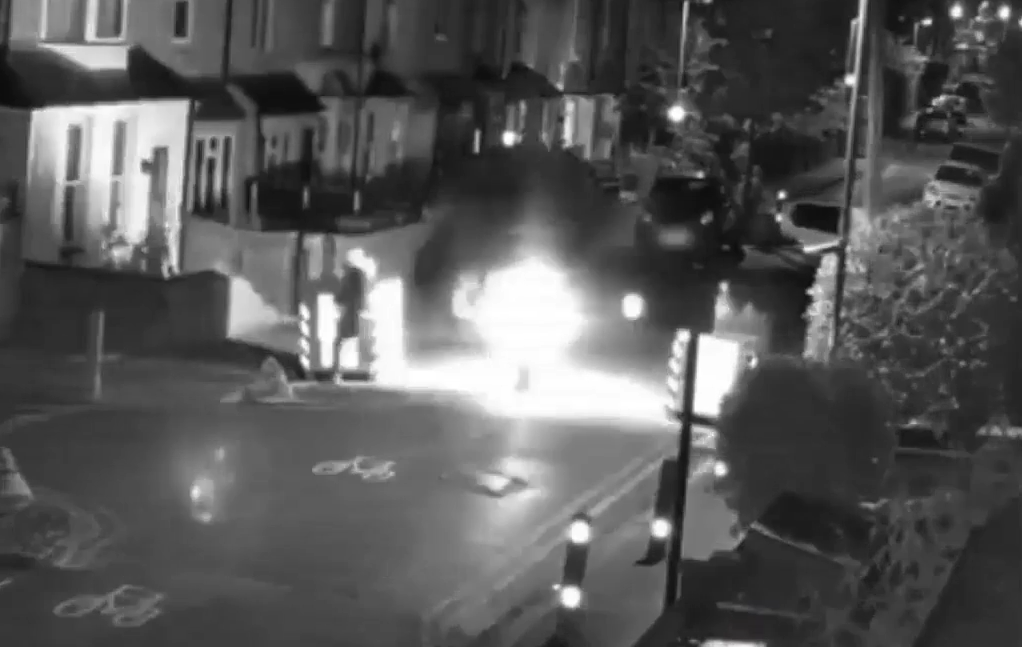
> Active travel campaigners release footage of anti-LTN vandals setting bollards alight
A recent report into east Oxford’s LTNs found that the schemes have led to an increase in cycling numbers by 20 percent, with one boundary road even seeing the percentage of cyclists increasing by 51 percent, while car use is down by 10 percent.
While air quality has improved for the most part, the report also found that congestion has increased overall, with bus journey times towards the city centre and the busy Plain roundabout rising.
“The LTNs are not a silver bullet,” Green councillor Chris Jarvis told yesterday’s meeting. “But we need to take meaningful action.
“Air quality has improved, cycling is up, road collisions are down, walking is more pleasant, teenagers are playing football in the street. These are real, tangible benefits.”
James Schumann, from the Divinity Road Area Residents Association, said that the LTNs had created “quieter streets and better neighbourhoods”, and that residential streets – which were “not designed for high traffic levels” – were now “safe for pedestrians, people on mobility scooters, cargo bikes, and cyclists, who can now use these narrow streets to get to school, work, and the shops”.
“Until the LTNs went in I was too scared to cycle to work in Marston,” added resident Katie Mills.
“The Cowley and East Oxford LTNs have made it safe. I have two children at schools in East Oxford, and I now have the confidence to cycle on the roads with them. The LTNs have been transformative.”
> Why is the 15-minute city attracting so many conspiracy theories?
However, other residents were scathing of the impact the LTNs have had on congestion and local businesses, arguing that they can’t simply “get on a bike” to take advantage of the traffic-calming measures.
Some protesters gathered outside County Hall yesterday, meanwhile, were pictured clutching signs which appeared to conflate the LTN debate with the much-discussed – but entirely separate – issue of 15-minute cities, an urban design policy which aims to ensure that all residents live within a short walk or cycle from daily necessities and the subject of a demonstration in Oxford in February.
Criticising what she deemed a “mock show of democracy”, resident Anne Stares told the meeting that “the people and businesses of the city will not forget your disregard of their pleas and suffering in favour of a selfish minority of idealists who whine that they want to amble in the road.”
“I want to look Andrew Gant in the face and tell him there has been no thought for the elderly,” said Maggie Brown, who was pictured holding a sign labelling the council’s transport chief a “tyrant”.
“We can’t get on bikes and scooters.”
“I’m not young enough to go on a bike,” 81-year-old Jane Buckland added. “I’m past my sell by date.”
“I recognise that there remain concerns,” Liberal Democrat councillor Gant said at the conclusion of yesterday’s meeting.
“As a council we are prioritising measures to reduce bus journey times. We have also heard from businesses operating in a complex commercial environment, and residents struggling with difficult personal circumstances.
“However, an increase in dangerous congestion with no plan for change helps no-one. As a council, we are committed to offering people meaningful choice in how they travel.
“We are working to preserve essential journeys by car, while also encouraging safe travel for all by walking, scooting, biking, and greater use of public transport. LTNs are one step towards less reliance on private car journeys.”
He continued: “Should we take a large amount of Oxford’s congestion and put it back on residential roads? No. Going back is not realistic.
“There is a lack of any alternative vision from those who oppose LTNs. We have all got too used to the idea that road space is something we can help ourselves to, as much as we like, whenever we like.
“It is a finite resource, and it is full. It comes at a cost. As a society, we are not making responsible use of it. We need to change.”





















26 thoughts on ““Going back is not realistic”: Councillor stresses “need to change” as Oxford LTNs made permanent – but angry residents say “we can’t get on bikes””
Perhaps at 81 you aren’t
Perhaps at 81 you aren’t really fit to be driving a multi-tonne vehicle in residential areas where fast reactions are required to avoid “accidents”. Just kidding, as long as you can push that pedal you are safe to drive!
Standard example of people who can’t fathom why anything should change if it doesn’t benefit them directly or even it it does, they idealogically don’t associate with the people who are behind it.
The great irony being that they use crap arguments like “think of the elderly” who are a small minority whilst claiming that these changes only benefit a small minority…
They also haven’t closed down Oxford to cars, they have just made certain areas no go for cars. Take the long way around. Or, you could do something radical and walk, cycle or take public transport. Crazy.
“I’m past my sell by date.”
“I’m past my sell by date.”
Then stay off the roads altogether, for christs sake.
Really important to state
Really important to state that they haven’t made any areas no go for cars. Every house and business that was accessible by car before has access now. The route may be a little different, but of course the benefit is that through traffic cannot pass through those residential roads.
I fully support LTNs but (at
I fully support LTNs but (at the risk of sounding like Victor Meldrew) I don’t think I would use teenagers playing football in the streets as an argument in their favour.
I’ll bet the residents whose houses they were playing outside would either.
Unless of course it’s their
Unless of course it’s their own homes?!
You should be asking why can
You should be asking why can’t they just get on a bike? Oh yes it’s because they have spent so much money on the excrement they call a car. Beep beep
46 and two wrote:
Probably there’s a bit of Sunk Cost fallacy there too. When someone spends a lot of money on something, it’s common for them to try to justify the expenditure by making more use of it than they would otherwise do. Realising that a £500 bike can out-perform a multi-thousand pound car for most journeys makes people feel a bit foolish.
Looking it up, it appears that Sunk Cost fallacy is better described as Escalation of Commitment which can be summed up as “It’s never the wrong time to make the right decision” or “If you find yourself in a hole, stop digging”.
And what happens when a
And what happens when a Number Plate has been Automactically Recognised?
Sweet FA?
A penalty notice
A penalty notice
Criticising what she deemed a
Criticising what she deemed a “mock show of democracy”, resident Anne Stares told the meeting that “the people and businesses of the city will not forget your disregard of their pleas and suffering in favour of a selfish minority of idealists who whine that they want to amble in the road.”
How fortunate that these protestors aren’t suffering from undeserved entitlement. Where did these people get the idea that driving a car entitles them to drive anywhere at any time and never mind the people who live there.
The articles don’t seem to mention how many of residents rather than rat-runners are in favour, but if other LTNs are anything to go by, residents overwhelmingly approve, but that is clearly a “mock show of democracy.”
Why are these protesters’
Why are these protesters’ (who also protest against covid vaccines; ULEZ; cashless transactions etc) signs always yellow. Who supplies them with these standard yellow signs, wherever they are in the country?
Steve K wrote:
Are you sure that’s not just a pigment of your imagination?
hawkinspeter wrote:
No, it’s just a jaundiced opinion…
They are probably drivers –
They are probably drivers – they think their sign can’t be seen if it isn’t hi-viz yellow…
Why are these protesters’
Why are these protesters’ (who also protest against covid vaccines; ULEZ; cashless transactions etc) signs always yellow. Who supplies them with these standard yellow signs, wherever they are in the country?
Because it has been clinically proved that yellow helps you focus if you are swivel eyed.
Surely these ‘protestors’ are
Surely these ‘protestors’ are just standard Rent-a-Nutter crazed loons? They look like it. I’m hoping for one of them to be interviewed on camera complaining about being trapped in their homes by 15 minute cities.
There needs to be greater
There needs to be greater punishment for vehicle drivers that put cyclists lives at risk not jus a slap on the wrist and a driver’s education course. It really does extract the urine
Over the years, I’ve noticed
Over the years, I’ve noticed when theirs been roadworks and the roads closed, the area is quiet, the traffic takes other paths. And I wonder, if it can take that then more areas could be quiet. As for the “can’t get on bikes” brigade are concerned, they just don’t want to admit that bikes can be better in a good few instances…as we know ?
You don’t need to force the
You don’t need to force the issue by eliminating cars. If public transport saves time and money, people will use it. If walking is quicker, people will do it. If walking involves meeting people and socialising, people will do it.
I used to walk my daughter to school. We both now use public transport as our commutes to school and work. But it’s expensive and we only use it because it’s convenient.
We don’t cycle because it’s a useless form of transport for us.
I use my car for journeys over 10 miles where public transport is both cost prohibitive and inordinately time consuming or isn’t available.
You try to stop me using my car for those journeys and you’ve got a big bloody battle on your hands, Mr LTN Advocate. If there’s no effective alternative provided, you can shove your LTN…
That’s the problem which is even admitted here. Public transport currently doesn’t work and there’s no suitable plan to make it work speedily and cheaply. And using bikes takes you beyond the confines of your safe LTN and back into the now even more congested area beyond it.
LTNs are a local dream for local people.
PS I’ll fully support them when I retire and don’t need to travel anywhere. Then a nice peaceful road area for my daily walk to the coffee shop would be great, thanks.
LTNs don’t “eliminate’ cars.
LTNs don’t “eliminate’ cars. They prevent though traffic (rat running) Cars can still get through to access homes etc. but it’s local traffic and therefore less of it and less dangerous – people tend to respect their own environment.
Well we certainly need “pull”
Well we certainly need “pull” (alternatives to cars) as well as push. That needs to be lots of things, because we’re several generations in to motor dependency.
So public transport yes – but that is never likely to covet “replaces car” for everything as the car is a private mode.
Public transport PLUS cycling though – maybe like NL with integrated cycle hire at transport hubs? A bit better.
It will take change to the location of amenities in some places though – as these already changed because cars…
Tell us you don’t understand what LTN means without telling us.
Define NIMBY…
You’re accurately portraying how many see this though. And (because local authorities) I can’t say it’s always the case that they’ve sorted out all the attractive stuff before applying
a push to reduce traffic.
But without some traffic reduction there is almost zero chance of change…
Well done Oxford. The roads
Well done Oxford. The roads are a finite resource and do need to be managed and not just to preserve of through traffic.
If you are incapable of
If you are incapable of riding a bike or walking or catching a bus, then you should be driving a mobility scooter not a car.
Christopher TR1 wrote:
I’ve often wondered why more people don’t take that option, many who complain about LTNs claim they only need the car for the hospital and the supermarket, usually within a couple of miles at most (in large towns), if incapable of walking/cycling or taking public transport why not have something that costs next to nothing to run, doesn’t need insurance or MOTs and that can be used to get you round the hospital or supermarket when you get there.
Because then they’d suddenly
Because then they’d suddenly care a lot about dropped kerbs and people leaving their bins on the pavement.
That said the law needs to be changed to allow mobility scooters on cycle paths (where available).
Scared to cycle prior to the
Scared to cycle prior to the change?
These people wouldn’t last a day in London. All these stories I hear around cycling news with people being terrified is pathetic. You want to cycle, but are terrified of anything.