


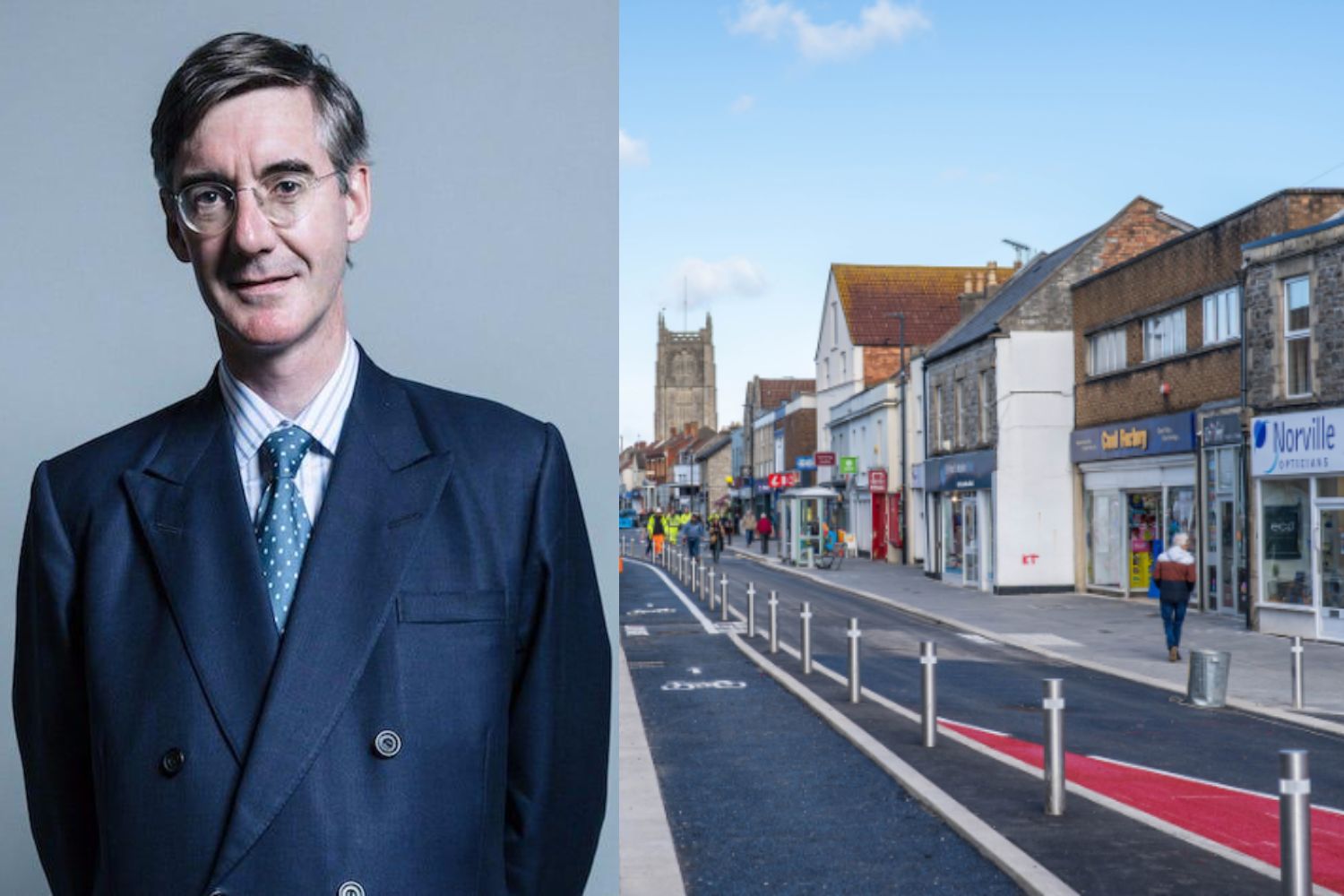

Councillors in Bath and North East Somerset have once again called for action on a cycle lane dubbed “the most dangerous street in the UK” that caused 59 injuries in its first year in use after pedestrians repeatedly tripped on an “optical illusion” caused by unobvious changes in kerb height.
The cycling infrastructure on Keynsham High Street has attracted national attention since its installation in March of last year, with at least 76 injuries reported since then. In April, Conservative MP Jacob Rees-Mogg weighed in on the situation in his North East Somerset constituency, calling the lane a “failed experiment” after a Freedom of Information request unveiled the number of injuries reported.
It should go back to being a two way street. This experiment has failed.https://t.co/WFHQpj8HHl
— Jacob Rees-Mogg (@Jacob_Rees_Mogg) April 26, 2023
Rees-Mogg called for the route to return to a two-way street, while locals reported tripping due to the “optical illusion” caused by a “pale-coloured kerb and a pale-coloured line that look exactly the same” but are at different heights.
In the past year, works have been undertaken to reduce the trip risk — with tarmac painted red in August last year before it appeared the infrastructure would stay in place after a cross-party group of councillors recently withdrew its plan to commit the council to investigate works on it.
However, Bristol Live today reports that while the council has agreed to further works in January, committing to painting markings to warn people, councillors have also begun to float the idea that the high street could be pedestrianised and those on bicycles banned from riding through.
That would require a public consultation, Keynsham East councillor Hal McFie telling a council cabinet meeting that it has been “agreed that the best way out of the current impasse was to pedestrianise the High Street, with the ward councillors pushing to make it a cycle-free area”.
He said: “This could only happen if there was a positive attitude by shopkeepers and residents so the first step was to draw up an outline plan and present it to the Keynsham population in the 2024-25 financial year.”
In the meantime, a meeting between Keynsham ward councillors and the council “agreed to apply more visual cues that would warn residents of an impending change in ground level”.
Liberal Democrat Mr McFie has formed a cross-party alliance with other councillors, Conservative figure Alan Hale adding that if the next works do not improve the situation “then clearly I would want to see some physical measures taken”.
Keynsham North councillor Alex Beaumont asserted he is “all in favour of pedestrianising the high street”, but admitted there was a need to consider how disabled people’s access could be accommodated.
Acknowledging the pressure from councillors, cabinet member for transport Manda Rigby said “there will be consultations around what any potential pedestrianisation of the High Street could look like as there has already been a desire for this expressed by ward councillors talking with the local community”.
“We are taking short-term measures via putting more painted lines to further mitigate any incorrect perception of pavement/bike lane/roadway levels,” she said.
At the time of Rees-Mogg’s spring comments, one person injured while walking along the high street said they had rolled their ankle and “landed on my right knee, wrist, and shoulder in the road” after “expecting a flat surface which wasn’t there”.
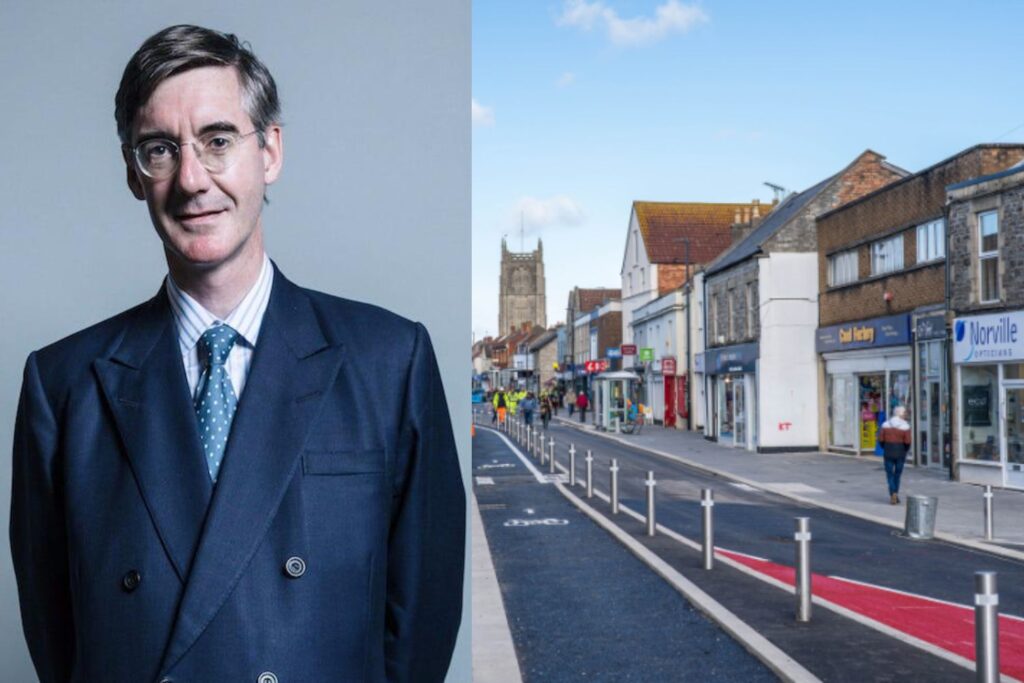
By the time the lane was painted red in August 2022, five months after opening, 46 people had been injured. The most recent figure is at least 76, that despite more works in June of this year to repair broken paving slabs.
As of June, 21 people had pursued legal action against the Liberal Democrat-run Keynsham Council having claimed to have been injured by the lane, with seven of the personal injury compensation claims being rejected. The remaining 14 are under investigation.



















17 thoughts on “Pedestrianisation considered to address safety concerns about “optical illusion” cycle lane that caused 59 injuries in a year”
Can’t argue with the number
Can’t argue with the number of injuries, but it needs the context of the number of lives improved by cycling and the number of injuries avoided by properly separating bikes from murderous drivers. Only failure in this experiment was not making it even bigger.
bigwheeler88 wrote:
I’d say that the cycle lane design was a bit of a failure – it’s not beyond the wit of people to design a lane that doesn’t have lots of people falling over it.
Indeed. Just because a lot of
Indeed. Just because a lot of people will moan at the mere mention of bike lanes and invent all sorts of imaginary problems doesn’t mean that there aren’t ever real problems with some of them.
Sometimes the problem is that not enough people know how to walk or drive in the vicinity of cyclists, and it would help if there was more consistency to the implementation of cycling infrastructure. But sometimes well intentioned plans are not good and we need to admit to that and work to make things better.
I’m not familiar with the area, but if pedestrianisation is being seriously considered then I’d suggest there would be a way of making it work for cyclists and allow access for those with disabilities too. Having it essentially a pedestrianised area with a speed limit for cyclists and/or warnings to give way to pedestrians, bike storage (so the shops benefit) and limited access for deliberies and to blue badge holders (giving way to pedestrians and speed limit also applies) should be considered.
Would be interesting if we
Would be interesting if we had the stats on how many of those 76 injuries had their attention divided by their phone or any other devices.
Also if we had stats on how
Also if we had stats on how many pedestrians were wearing helmets and hiviz just to be sure they were mitigating the effects of any incidents.
And how many have been since
And how many have been since the subsequent changes were made.
This is stone-agers trying to nobble something before it becomes accepted.
Yep – doesn’t mean that it’s
Yep – but that doesn’t mean that it’s not deficient in some respects though:
– because UK so “make it up as you go”.
– because our “guidelines” are still that, and we likely need a collection of actual examples which are all the same.
And even after that – because there’s so little cycle infra, even if it were all the same (it’s not) people don’t get the frequent and regular reinforcement they need to “learn” it.
It’s not rocket science. But it is civil engineering. Strangely enough for roads, railways etc. we have professionals who are equipped with professional bodies and libraries of standards (not “guidance“), templates, regulation (not exhortation) etc…
Clone the Ranty Highwayman already!
I put this on the live blog,
I put this on the live blog, but I’ll put it again here:
These people appear to hate cyclists so much that they would rather spend all that money on digging back up the cycle lane and then pedestrianising the High Street (but allowing disabled people to continue to drive along there).
Aston Way (Ashton Way?) appears to be the road along the back of the shops, so not much use if you are – you know – cycling to the shops…
I’ve nothing against
I’ve nothing against pedestrianisation. If done where appropriate it should be mostly self-regulating as regards cyclists and blanket bans are not needed. (Motor vehicles *do* need careful regulation of course!). And anyone who can’t figure out that it’s not only antisocial but actually really slow to force your way through a crowd on a bike? That’s an enforcement issue. Likely “yoof” and “I’m prepared to go to gaol over it” types who few will defend.
However…
Is there any nearby route through the town which feels safe and convenient to cycle? How do you access the area or get past it (from either side) by bike? Can you safely leave your bike and shop?
The reason people in the UK aren’t cycling to the shops isn’t mainly because they don’t like cycling, or because it takes a bit of effort, or because “we have weather / hills / we go shopping / we carry children with us”. A major reason is because it feels less safe and convenient because we have made it so – because cars.
Town centre spaces are contested space. In the UK people are crying out for places to move without worrying about cars *. Some people freak out around the odd (careful and considerate) cyclist because they’re an unknown – we’ve all been raised on cars. And if there is a cyclist in the same space we’re like prey animals near a speedy predator – because cars.
This suggests to me that the UK at least the “just share the space” cheap fix simply won’t work to change things. Not until a sizeable minority have arrived in a pedestrianised space by cycling.
* Unfortunately, they currently want to drive to them…
What seems so ridiculous
What seems so ridiculous about this is how the council built a cycle lane claiming to make it safer for cyclists to access the shops, some pedestrians say they fell over because the cycle lane is an “optical illusion”, so the council now comes back and says they will remove the cycle lane, pedestrianise the whole area but also ban bikes. Anyone would think that Bath & North East Somerset council knows where to find a Magic Money Tree…
Yeah – but council standard,
Yeah – but council standard, innit? “We have no money for nice things”, then they misspend money, then when complaints roll in all of a sudden there’s plenty of money to rip out things they stuffed up the first time – and sometimes even do something else.
Perhaps pedestrians should be
Perhaps pedestrians should be required to pass some sort of test before being allowed on the high street, along with a recommendation for some PPE?
Moggy knows a lot about
Moggy knows a lot about cycling. Leading expert.
The number of incidents in
The number of incidents in the year is utterly meaningless without the comparable figures from before.
And for a proper comparison, it should include the number of injuries from road traffic collisions with pedestrians pre and post, and the relative severity of the injuries.
50 bruises from trips on a kerb would still be better than 2 concussions and 4 broken limbs from motor vehicle collisions, for instance.
Funny how no-one seems interested to even ask what those figures are though …
I tripped up on a paving
I tripped up on a paving stone the other day. Does that mean we should pull up all the paving stones or does it mean I should have been paying more attention?
brooksby wrote:
Ah – but paving stones are a traditional part of our streets (“in keeping”, you might say). So that’s just an exceptional stumbling block – bit of TLC and it’ll be fine.
Whereas cycles and cycle infra are something totally new in the UK…*
https://www.kickstarter.com/projects/carltonreid/lets-rescue-britains-forgotten-1930s-protected-cyc
https://en.wikipedia.org/wiki/Cycling_demonstration_towns
etc.
* In fairness it always is new in the UK due to having “guidelines, not rules as such” (e.g. LTN1/20) and as we are still unable to just copy what works every day for millions, not very far away.
brooksby wrote:
A bit of both.
If there’s a good quality pavement people will assume that they can walk along it without paying attention and if there’s a single slab that’s sticking up, then there’s a good chance that lots of people will trip over it. Meanwhile, if there’s an old unmaintained pavement with slabs missing or at jaunty angles, then people pay more attention to where they’re walking and the chances are that no-one will be tripping up. So, pavements either need to be in good repair or very bad repair – just not in the middle.