


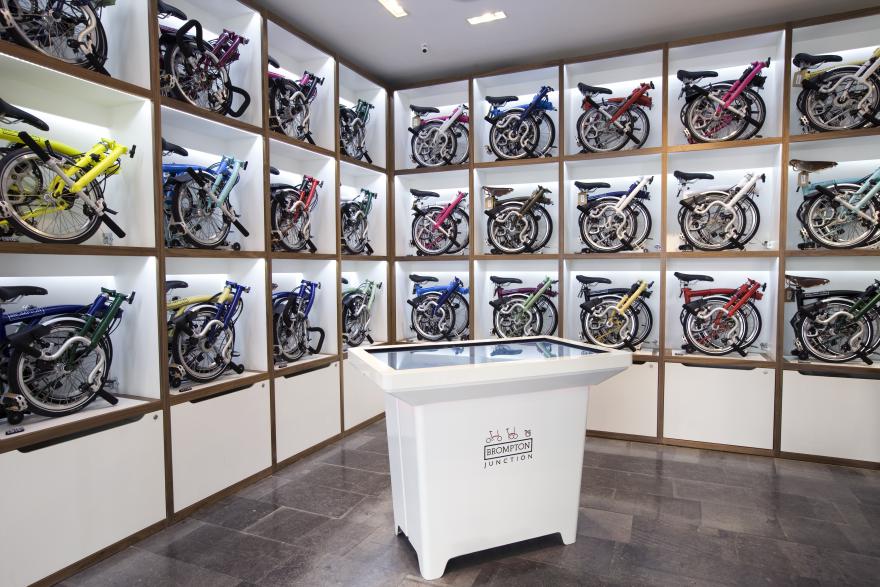

The CEO of folding bike maker Brompton Bicycle has warned that a shortage of raw materials is hitting the cycling industry, and that it could take a year and a half for the sector to recover from the supply chain problems that have hit it since the beginning of the coronavirus pandemic.
Speaking at the Financial Times Future of Manufacturing event this week, Will Butler-Adams said that sourcing raw materials had now surpassed shortages of components as an issue for the industry.
“Over the past 18 months, the supply chain has retrenched further and further back and now the problem is you simply can’t get hold of aluminium, you can’t get hold of steel, you can’t get hold of these raw materials,” he said.
Butler-Adams believes that it will take around 18 months for the situation to be resolved, and outlined some of the problems the company has encountered, such as suppliers requiring payment in advance, or lead times for saddles rising to two years, as well as parts being held up in transit.
“Suddenly our cash has just gone and then the cost of goods has gone through the roof,” he said.
While the coronavirus pandemic has boosted Brompton’s global sales by 20 per cent, it has also resulted in huge increases in shipping costs.
That is exacerbated in the case of the UK – where the bikes are made at the company’s factory in West London – by Brexit, with the shortage of lorry drivers now leading to massive backlogs at major container ports.
In response, Brompton has sought to circumvent those problems by raising its spend on air freight, which stood at £45,000 prior to the COVID-19 crisis to £1.7 million.
The company had already warned at the end of last year, just ahead of the end of the transition period of the UK’s departure from the EU of problems associated with delays at ports, and also warned that parts it had stockpiled in anticipation of potential disruption due to Brexit had already been used up due to the pandemic.
> UK port delays hit Brompton production as parts for its bikes get held up or cancelled
Meanwhile, the company is also looking to reduce its reliance on suppliers based in Taiwan as tensions escalate between that country and China, whose President Xi Jinping has pledged to “fulfil reunification.”


















56 thoughts on “Brompton CEO warns of raw materials shortages hitting bike industry”
Brexshit – the gift that
Brexshit – the gift that keeps on giving.
Quote:
A more nuanced view from primary sources:
[I]“Fundamentally … drivers are worn out, they’re tired and fed up with being treated the way they are,” said Adrian Jones, national officer of the British and Irish trade union Unite.
[I]A similar dynamic is driving workers away in the EU.
[I]”This job is not appealing,” said Pantelimon Octavian Tetileanu, a long-haul trucker from Romania. “You cannot be with your family. There’s no time for lunch, no time for breakfast, or for dinner. You go to sleep in sweat because we are not taking a shower on the highway every day. You don’t wash your clothes. You’re mostly dirty and you smell.”
[I]Security issues also make the job dangerous, he added, citing attacks by migrants trying to get to Britain and fuel theft as major concerns.
[I]Tetileanu, an ex-teacher, has driven a truck for the past decade. Now he’s counting the days until he can quit the trade. “I’m doing this job another two years, and goodbye industry — goodbye. This is not a place where I want to get old.”
[I]Increasingly, the only people willing to put up with the worsening conditions are drivers coming from outside the EU, including Russia, Ukraine and Kyrgyzstan, said Cristina Tilling, political secretary for transport workers’ federation ETF.
[I]The problem starts with the rates that road freight companies charge for their services, she said, which aren’t high enough to cover “a legal labor cost,” including salaries and driver accommodation.[/i][/i][/i][/i][/i][/i][/i]
https://www.politico.eu/article/europes-looming-truck-driver-shortage-trucker-haulier-brexit-hgv/
From 2018 – https://www.bifa
From 2018 – https://www.bifa.org/news/articles/2018/dec/truck-driver-shortage-crisis-now-spreading-across-the-whole-of-europe.
But yeah Brexit – chimes in with the rest of the fake news.
Of course the answer is to raise terms, conditions and pay for truck drivers and train more home grown drivers – but all those things go against the modus operandi of middle class Remainers who are addicted to cheap Eastern European labour.
As was famously campaigned for by a Remainer back in 2016: “Vote Remain, otherwise who is going to serve my Pret sandwiches every day?”
Nigel Garrage wrote:
If ever there was an over-simplified response to a complex situation, this is it.
Brexit is here, its ramifications are kicking in & are only going to get worse. Yes the ability to import goods should improve long term, but whether the improvements compensate for the loss of European free trade & movement is highly unlikely.
I was told by someone in
I was told by someone in Ireland that they have now opened lots of haulage routes from Ireland direct to France, bypassing the UK so any deliveries to or from there don’t have to worry about border checks. Of course this means drivers who used to do multi stops, including to the UK along the old routes now don’t bother. So like with the current energy price crisis, the issue might not be a UK one alone and is happening elsewhere, but the UK decided to double down on the effects by having Brexit.
Nigel Garrage wrote:
Oh do FO you twonk.
https://www.youtube.com/watch
Getting very, very tired of
Getting very, very tired of the continual ‘it’s all Brexit’s fault’. Stirred up by the media all the time – remember it’s little more than clickbait and yes I am most definitely pointing my finger at you Simon MacMichael.
FFS – can people not see what’s going on around them or think for themselves?
Lazy, lazy journalism backed up by lazy, ignorant readers.
Gimpl wrote:
If you’re getting tired of people moaning about Brexit, then rather than moaning about moaning, you could highlight the early benefits of Brexit instead.
I suppose the answer is to
I suppose the answer is to look at each issue from different angles.
If Brexit has caused labour shortages and those labour shortages have caused rapid rises in pay then Brexit has caused rapid rises in pay.
Conversely EU membership enabled us to maintain workforces but in doing so suppressed wages.
Both effects are most evident among the lower paid.
Rich_cb wrote:
The lorry driver shortage seems to be a consequence of the rush to the bottom by logistics companies. Lorry drivers face a tough job with poor working conditions, so we ended up with a large influx of east european drivers as they were more desparate than other demographics. Now that the work situation has become even more onerous to the drivers (partly due to increased paperwork form Brexit, partly due to increased violence from people traffickers etc), they are deciding that the UK isn’t worth the hassle.
The problem is that enticing people back into less desirable jobs will either take a lot of time or a lot of money (or both).
I’d agree but I’d add that
I’d agree but I’d add that haulage companies would not have engaged in such practices if they weren’t confident they’d still be able to get drivers regardless.
The fact that the drivers came from Eastern Europe via Freedom of Movement demonstrates that EU membership can, in certain sectors, severely damage pay and conditions for workers.
Rich_cb wrote:
I think it’s a general problem of capitalism that big organisations can end up squeezing the workforce until something gives. This is ultimately the free market at work and is why I think we need governments to provide some kind of protection to workers although historically it seems that most worker protections have derived from unions/strikes rather than government initiatives (often the government works to protect people with power and money rather than the opposite).
I’d say that the E.U.’s freedom of movement does enable more free market movement and thus easier access to the more desperate employees, but the root problem is having people desperate enough to put up with poor pay and conditions for so long. Splitting up geographical areas may appear to help by shrinking the employment pool, but until we deal with the disadvantaged in society, we’re just moving the problems around.
A set amount of money will
What we would consider ‘poor pay’ in the UK would represent a very good income in many Eastern European countries. It’s not that the people are desperate, it’s that, relatively speaking, the pay is far far greater from their perspective.
It’s therefore impossible to protect ‘low skilled’ workers in rich countries from increased competition whilst maintaining freedom of movement.
Rich_cb wrote:
Personally, I’d consider that lorry driving is a skilled profession (or at least should be) as you do require specific qualifications to do it. The simplest way to protect poorly paid workers is to increase their pay so that they become less desperate for higher paid work. Ultimately, it’s a problem with greed as CEOs get rewarded for keeping employees’ wages low.
That won’t work while the
That won’t work while the cost of living in other countries remains substantially below that in the UK.
If you increase the wages of low paid work in the UK it becomes even more competitive as more people from low wage countries are tempted to move by the higher wages.
Once employers know that they have no problem filling their posts they’ll begin lowering conditions even if they can’t lower pay.
The only answer is to restrict the available pool of workers forcing employers to compete.
I agree that HGV driving is not low skilled, it’s often put in that category though, hence the apostrophes.
I disagree about reducing the
I disagree about reducing the pool of workers – to my mind, the answer is to encourage people to move to wherever their profession is most valuable. If you allow eastern european drivers easy access to the UK, then in theory there will be extra money flowing into eastern european workers which should help their living conditions. The trick is to introduce safeguards that prevent working conditions being a race to the bottom (as naturally happens in a free market).
Ultimately, the segregation of workers into different geographical areas tends to lead to increased exploitation of the poorest (c.f. sweat-shops, factory assembly line workers especially in parts of Asia).
What would you do about the
What would you do about the workers in rich countries who are displaced by better qualified workers from poor countries?
If you guarantee good pay and conditions then the number of applicants for jobs will obviously increase. Employers will choose the best qualified. Graduates from lower income countries will find it pays better to go and wait tables in a rich country than work in their chosen field in their home country.
The low income country suffers brain drain, the high income country suffers high unemployment amongst their low skill workers.
Sweat shops would still exist in a borderless world, they are a product of poor governance, not borders. See for example the poor conditions exposed at Boohoo’s UK operations.
Rich_cb wrote:
Invest some of those riches in helping them improve their skills and qualifications?
That won’t work with open
That won’t work with open borders.
You can upskill all you want, if there are no limits on immigration then, for most roles, there will always be a better qualified candidate from a low income country willing to do the job for less.
But you were talking about a
But you were talking about a situation where good pay and conditions are guaranteed, so competing on pay shouldn’t be an issue.
If another country is able to turn out better qualified candidates, despite a lower income base, that suggests underfunding or unwise investment in skills and education in the higher income country.
It’s not that the low income
It’s not that the low income countries are producing more highly skilled workers it’s just that a graduate career in a low income country may pay less than a ‘low skilled’ role in the UK.
If the pay and conditions are guaranteed then the employers will seek to get the best candidate possible for the job, that will inevitably lead to higher qualified workers from low income countries displacing the current workers.
The end result will be the same as if they were competing on pay.
Rich_cb wrote:
why is a graduate from another country the best candidate for a low skilled job? presumably “waiting tables” benefits from someone speaking the local language without a strng accent, rather than froma graduate who may feel they would like a job more relevant to their qualifications, which challenges them in a different way.
They’re likely to have better
They’re likely to have better literacy and numeracy skills for starters.
I don’t think an accent is that big a barrier.
If you offered most graduates triple their salary to wait tables I’m sure you’d get plenty of interest.
I agree about poor governance
I agree about poor governance – greedy capitalists are going to exploit wherever they can.
Ideally, displaced workers should be able to retrain for better opportunities, but that relies on having a decent social care system. Personally, I like the idea of universal income. I think that ultimately, the most effective way to enable people to make the most of their abilities is to allow them to do what they want and where they want – it just seems to be a waste to force people to live in areas where they have few prospects and are trapped by poverty. Of course, if we even out the money distribution, then maybe we’d have less billionaires going into space.
Open borders sound great on
Open borders sound great on paper but in reality it would be an absolute mess.
You couldn’t have an NHS with open borders.
You couldn’t have universal income with open borders. (With borders it might just work).
People living in the UK are some of the wealthiest people on the planet, most of us are firmly in the top 1% globally.
If we even out money distribution we’re all going to have to get a whole lot poorer.
It’s all a question of degree
It’s all a question of degree. We currently have open borders between cities, counties and even countries within the UK and yes, that produces problems with unequal distribution of money and opportunities.
I think that at some point we need to stop thinking in terms of small geographical regions and instead think globally. It’s becoming clear that global initiatives are needed to address climate catastrophes and it’s no good just having the richest people move to the less affected areas whilst huge swathes of poorer people lose their homes and livelihoods. Similarly, we need to be prepared for greater numbers of climate refugees, so at some point we have to decide between surviving together or just letting the disadvantaged suffer.
I’m a fan of Buckminster Fuller and his spaceship Earth philosophies, though I appreciate that a lot of changes are going to be needed.
This is when it gets a bit
This is when it gets a bit ‘Realpolitik’.
Those of us who live in the UK or other parts of the rich world benefit massively from global inequality.
We live lives of great comfort compared to many of our fellow humans, reducing inequality globally would require us to give up a lot of those comforts.
I’m not sure many people are willing to make the necessary sacrifices even if they acknowledge the worthiness of the goal.
Since the 1980s we’ve had the
Since the 1980s we’ve had the capacity to feed, clothe, house and educate everyone on Earth. I’m pretty sure that once we get the billionaires up against the wall, we wouldn’t need to have a massive change in our comfort levels.
If you took every penny from
If you took every penny from every billionaire on the planet you’d have about £900 each for everyone else.
That’s not going to do a whole lot of feeding, clothing, housing and educating.
It’s easy to blame billionaires but on a global scale the average person in the rich world is insanely wealthy.
In the rich world we are all the 1%. If you want global equality then it’ll be you, me and everyone we know “up against the wall”.
From some random googling, I
From some random googling, I think that if we equalised everyone’s wealth it works out at something like £25,000 per person.
Maybe if we equalised
Maybe if we equalised everybody’s wealth, that’s not just the billionaires.
Given that the median salary in the UK (one of the richest countries in the world) is £30k I’m a bit sceptical about that £25k figure tbh but even if it were accurate you’d still be asking a lot of people to take a significant pay cut.
That’s just a rough ballpark
That’s just a rough ballpark value of wealth rather than necessarily being salary related.
Ultimately, if we want to sensibly approach post-scarcity societies then there’s going to be a lot of upset people, but also a much greater number of much happier people.
All of these figures around
All of these figures around equalisation of wealth are a bit meaningless anyway (except as an illustration of current inequality), because money isn’t a finite resource. It isn’t a resource at all – it’s a social construct. If wealth was equalised across the world, it would have vast impacts on the value of money, and the relative cost of goods and services, so having £25k wouldn’t mean the same as it does to have £25k today.
Absolutely. It’s not a zero
Absolutely. It’s not a zero-sum game anyway, as you’d expect world productivity to increase if resources were better allocated.
Reducing the average person
Reducing the average person in the UK to just £25k total wealth is a pretty savage cut.
Very few of us would even be left with a house.
As Mdavidford points out a lot of ‘wealth’ is pretty ethereal. You can’t eat an Amazon share or one square foot of prime real estate so not sure how we’d decide who gets what.
Yeah, it’s meant more as an
Yeah, it’s meant more as an indication of how skewed the world is. Realistically, you don’t divvy up resources completely evenly, but according to where it’s needed (e.g. metals going to factories), so you’d presumably want higher wages were the cost of living is more expensive. The important point is that development can then happen in areas that are currently neglected due to the people there not being considered important.
No.
No.
But you explain why it is solely Brexit’s fault.
Gimpl wrote:
I don’t think he claimed it was, did he?
He tried to change the agenda
He tried to change the agenda away to what the benfits of Brexit were – it’s not about that but other, more contributing factors.
Gimpl wrote:
I don’t think you’ve bothered actually reading what I wrote about driver shortage being caused by poor pay and conditions – maybe you have some kind of reading difficulty?
hawkinspeter wrote:
I’m replying directly to your question to me, ‘If you’re getting tired of people moaning about Brexit, then rather than moaning about moaning, you could highlight the early benefits of Brexit instead.’ Nothing about driver shortages in that, just you trying to change the agenda to suit yourself.
Gimpl wrote:
You do seem to have a problem with reading and interpreting comments here as my reply to you was not a question, nor was it trying to change any agenda, but an attempt to change your simplistic complaining into something more useful and positive.
If you read my other comments on this page, you may see that I don’t ascribe lorry shortages purely to Brexit – not everything is a simple black and white issue, you know, despite your attempts to polarise the issues.
Gimpl wrote:
You’re absolutely right.
It is a consequence of Brexit, but you can’t say it’s Brexit’s fault.
It’s the fault of Johnson, Gove, Cummings, and of all those people who believed the lies peddled by them.
The problem is that articles
The problem is that articles like this just add on the Brexit angle when it’s largely irrelevant to the content.
If there’s no aluminium available how is this anything to do with Brexit?
If there’s a 2 year lead on saddles how is that anything to do with Brexit?
The only part of this story that can be blamed on Brexit is the lorry driver shortage and even that is largely pandemic related.
13,400 lorry drivers have left after Brexit, 40,000 HGV tests were cancelled due to the pandemic. The pandemic effect is 3x larger than the Brexit effect.
Source: https://www.theguardian.com/politics/2021/aug/29/food-beer-toys-medical-kit-why-is-britain-running-out-of-everything
Rich_cb wrote:
You’re being way too hard on Brexit there – 13,400 lorry drivers have left after Brexit, but you don’t know if they left because of Brexit. To do this, you’d have to compare figures from previous years in the UK adjusted for Covid, as well as similar statistics across similar EU nations such as France and Germany.
For all we know, if we had remained in the EU, a similar or larger number of lorry drivers might have left in disgust at having to obey the dictats of Brussels. And now we are free of the shackles of regulation, we can target labour shortages in these essential areas by subsidising them and improving pay and conditions.
This debate is great for
This debate is great for historians. The landscape has now changed so simply saying “this wouldn’t have happened before” OR “we wouldn’t have been able to do this before” is beside the point – it’s “what now?”
However I’m sure 10 years later it’ll be: “problem x is because of Brexit” from Remainers * and “thanks to Brexit we are free from the shackles of EU regulation so can deal with this problem more effectively” from Leavers.
* which might well be true – some experts estimated the time to work through all the consequences as decades.
This exactly!
This exactly!
Simply ignoring the much wider issues and focusing in on one thing becasue it suits their political agenda.
Ignorant!
Gimpl wrote:
Yeah, because Brexiteers don’t have any political axe to grind…
Try and open your mind – it’s
Try and open your mind – it’s much bigger than simply Brexit.
You’re right of course – its
You’re right of course – its (arguably) our civilisation which is on the slippery slope to us all fighting it out in the Thunderdome…
The irony is that at no point
The irony is that at no point in this article does anybody claim ‘it’s all Brexit’s fault’.
The only lazy one was the reader who chose to believe that claim had been made, that was you.
Just to help you out:
Just to help you out:
‘That is exacerbated in the case of the UK – where the bikes are made at the company’s factory in West London – by Brexit, with the shortage of lorry drivers now leading to massive backlogs at major container ports.’
That’s the only reason mentioned – not the myriad of others that are more appropriate.
For the record, I believe Brexit has an influence certainly, my issue is the way things are being reported and the influence that has on the wider public. It’s exactly the same as the way cyclists are portrayed in the negative (see the excellent Close Passes In Cardiff article yesterday).
Gimpl wrote:
No it isn’t. You’ve just ignored all the paragraphs before that cite other reasons. The phrase ‘that is exacerbated’ wouldn’t even make any sense if there weren’t other factors mentioned first.
Like I said.
Like I said.
“That is exacerbated in the case of the UK –…– by Brexit” is NOT ‘it’s all Brexit’s fault’.
Brexit is undoubtedly a contributory factor in many of the problems UK businesses are currently experiencing. The only one here claiming those problems are entirely caused by Brexit is still you. It’s an accurate and honest piece of reporting that you chose to misinterpret and misrepresent.
The biggest threat to bicycle
The biggest threat to bicycle supplies is probably this throwaway line at the end
…Taiwan as tensions escalate between that country and China, whose President Xi Jinping has pledged to “fulfil reunification.”