


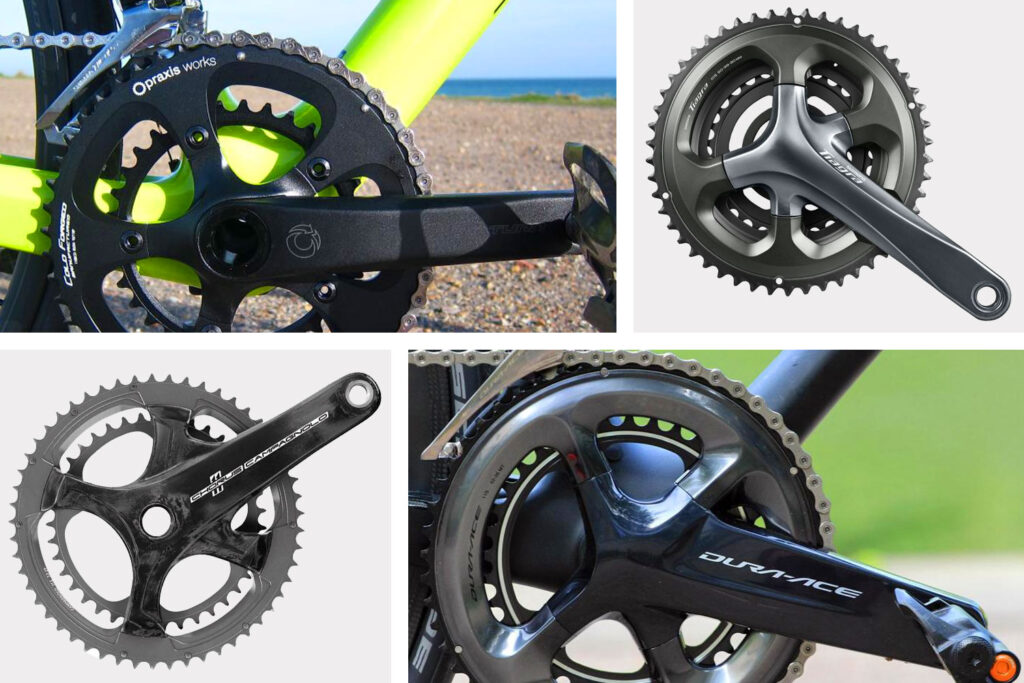

The chainset, called a crankset in some parts of the world, is the name given to the chainrings and the crank arms that turn them, and it helps define your bike’s gearing. Different chainsets make a big difference to the character of your bike and the way it feels when you ride.
> Check out our Beginner’s Guide: Understanding Gears here
Most road bikes come with a double chainset, meaning that you have two chainrings. The larger chainring gives you bigger, harder-to-turn gears that move you further per pedal revolution – so it’s suitable for higher speeds – while the smaller chainring gives you gears that are easier to turn but move you a shorter distance per pedal revolution – so it’s suitable for lower speeds, including riding uphill.
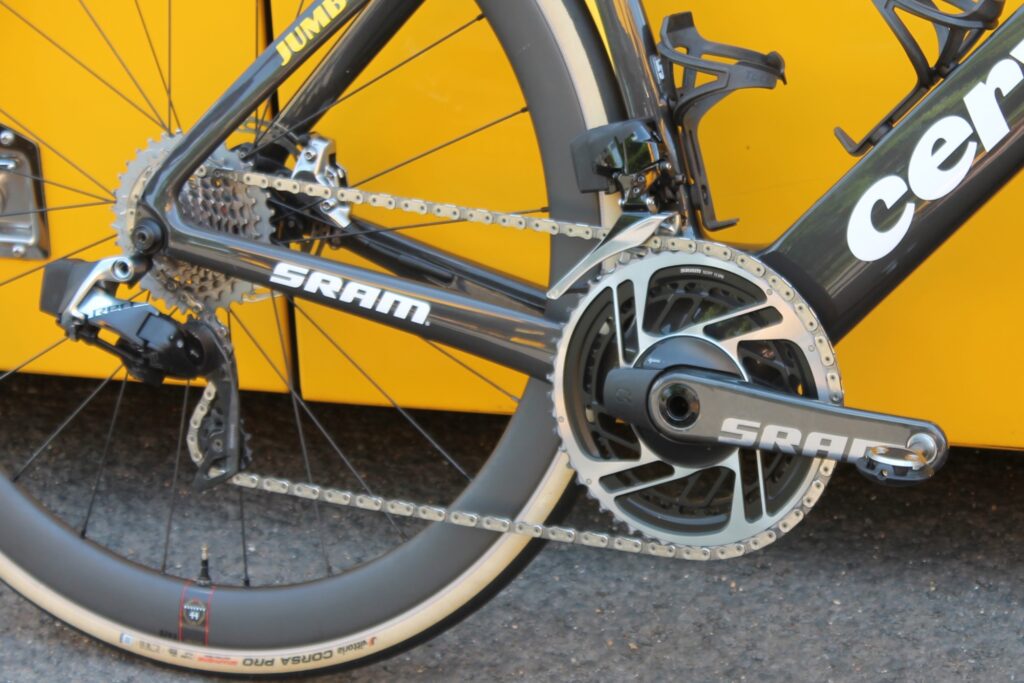
However, some bikes – especially gravel and mountain bikes – come with a single chainring (called a 1x system) matched to a wide-range cassette (the group of sprockets that sit at the centre of the back wheel). Other bikes might use a triple chainset, meaning that you have three chainrings, although these are increasingly rare.
Let’s go through the main road systems in turn.
54/40T
A chainset with a 53-tooth (or 52-tooth) outer chainring and a 39-tooth inner chainring used to be the default option for speed-focused road bikes, but that has changed over recent years with the big brands moving in other directions. In fact, the last bike we reviewed that came with a 53/39 chainset was way back in 2017.
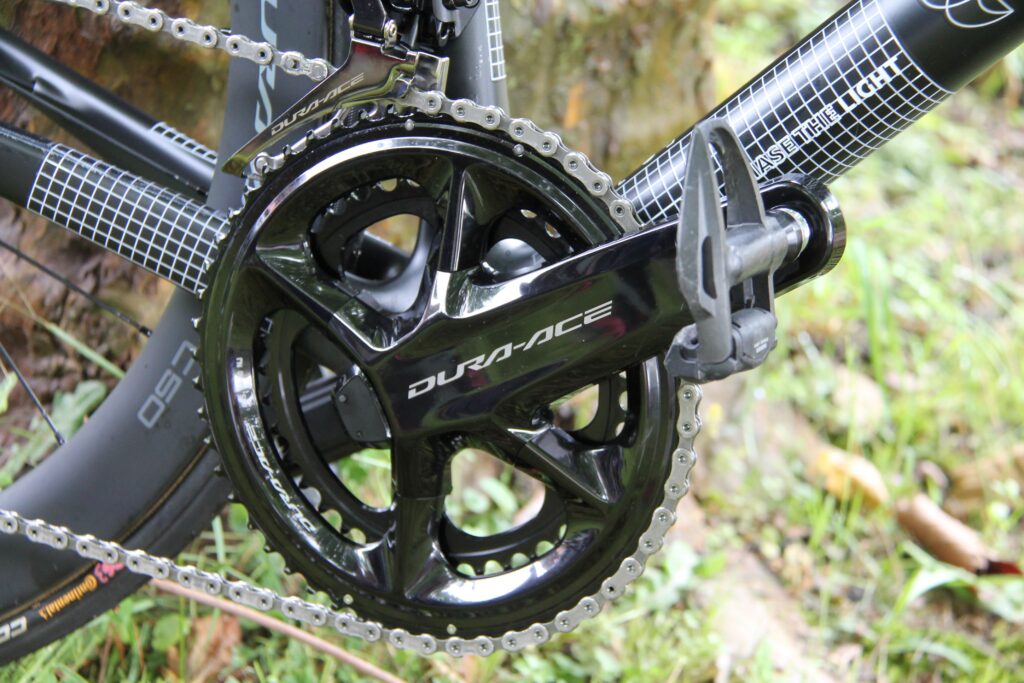
Shimano groupsets don’t offer a 53/39-tooth option anymore. These days, its Dura-Ace top-level road groupset comes in an option with 54-tooth and 40-tooth chainrings (and various other configurations) to satisfy the need for speed among racers. This is rarely specced on complete bikes – although some time trial/triathlon bikes do come with a 54/40 fitted – but it’s available aftermarket. This is the choice of most pro road racers in the majority of circumstances, although there are always exceptions. They often switch to larger chainrings for time trials.
Shimano doesn’t provide this 54/40-tooth option further down its range, and neither Campagnolo nor SRAM offers it. SRAM’s AXS wireless electronic systems have their own take on gearing with smaller chainrings and a 10-tooth smallest sprocket (see below) – although its Red AXS Power Meter Kit does come in 52/39 and 54/41-tooth options (and even a 56/43 option for time trialling).
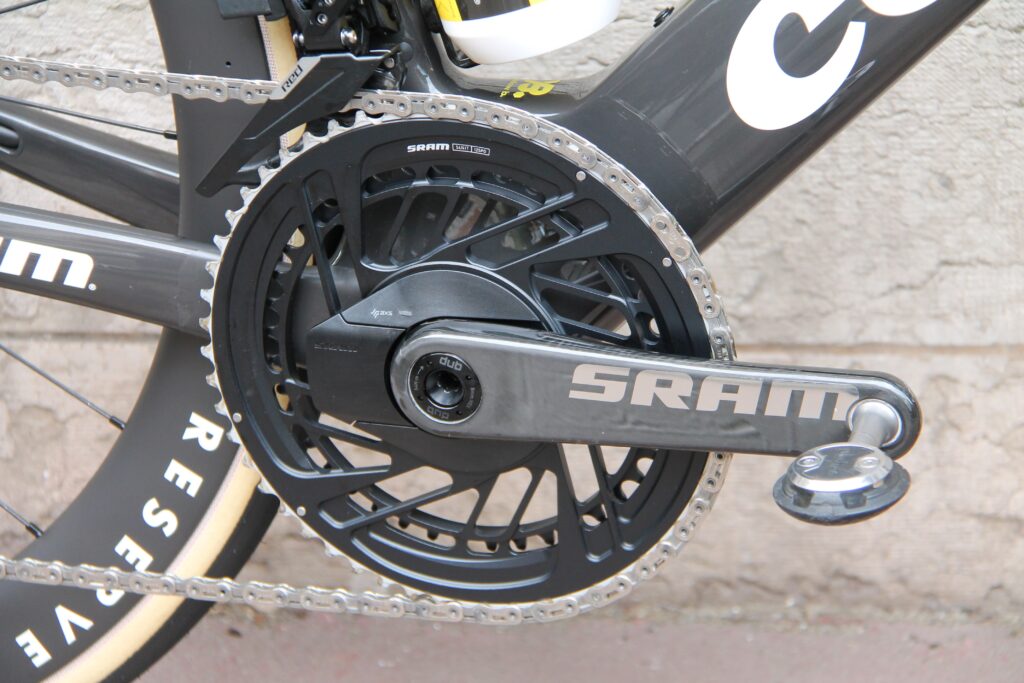
Campagnolo does offer 53/39-tooth and 54/39-tooth chainsets in its Super Record S Wireless groupset, and a 53/39-tooth option in its Record mechanical lineup.
Example bike Cube Aerium C:68X SLT
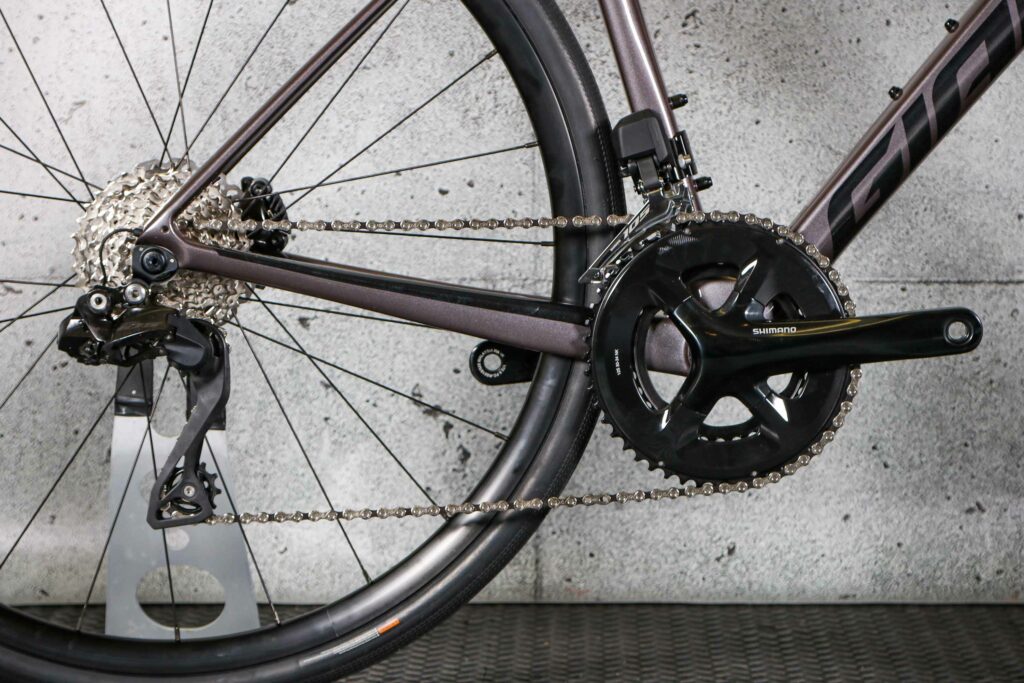
Compact chainset
A compact chainset has a 50-tooth outer chainring and a 34-tooth inner chainring. This means the gears are lower (easier to turn, but they’ll progress you a shorter distance per pedal revolution) than you get with a 54/40 or 53/39 chainset (above) with the same cassette.
For more details on that, see How much difference does a new chainset make? (below).
Compact chainsets have become massively popular because they allow you to keep moving up steep hills, albeit sometimes quite slowly, and many people prefer to turn smaller gears at a higher cadence (the number of pedal revolutions per minute) because it puts less stress on the knees.
The flip side is that you might run out of gears on very fast descents. In other words, you won’t be able to turn the pedals fast enough to make any difference to your speed above a certain point.
Reflecting their popularity, Shimano and Campagnolo offer compact chainsets across all of their road groupsets although, as we’ll see below, SRAM does things differently
Example bike Giant Defy Advanced 1
Semi-compact chainset
A semi-compact chainset, sometimes called mid-compact or faux pro, has a 52-tooth outer chainring and a 36-tooth inner chainring.
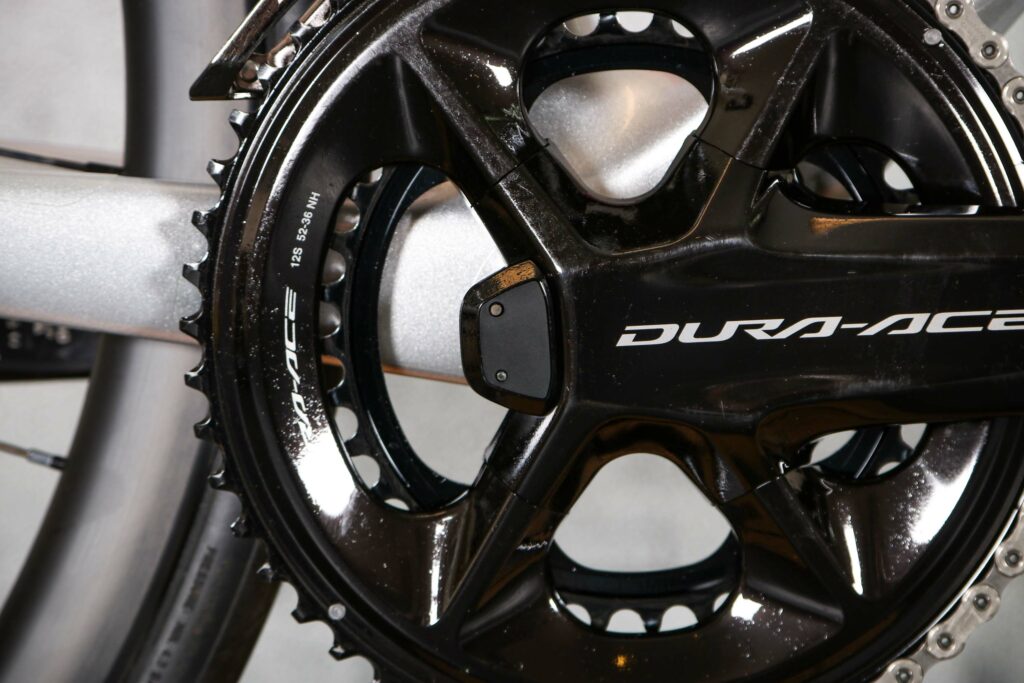
This means that the biggest gears aren’t quite as big as those of a 54/40 or 53/39 chainset but they’re not far off, and they’re larger than those of a compact.
The small gears aren’t quite as small as those of a compact chainset, but they’re smaller and easier to turn than those of a 54/40.
Semi-compact chainsets have become hugely popular over recent years because they offer something for most types of terrain. Many road bikes we review here at road.cc are fitted with these. Shimano, for example, offers semi-compact chainsets across its range of road groupsets, apart from entry-level Cues.
Example bike Orbea Orca M10iLTD PWR
Sub-compact
Want lower gears? A sub-compact chainset is a double with rings smaller than the compact’s 50/34 pairing.
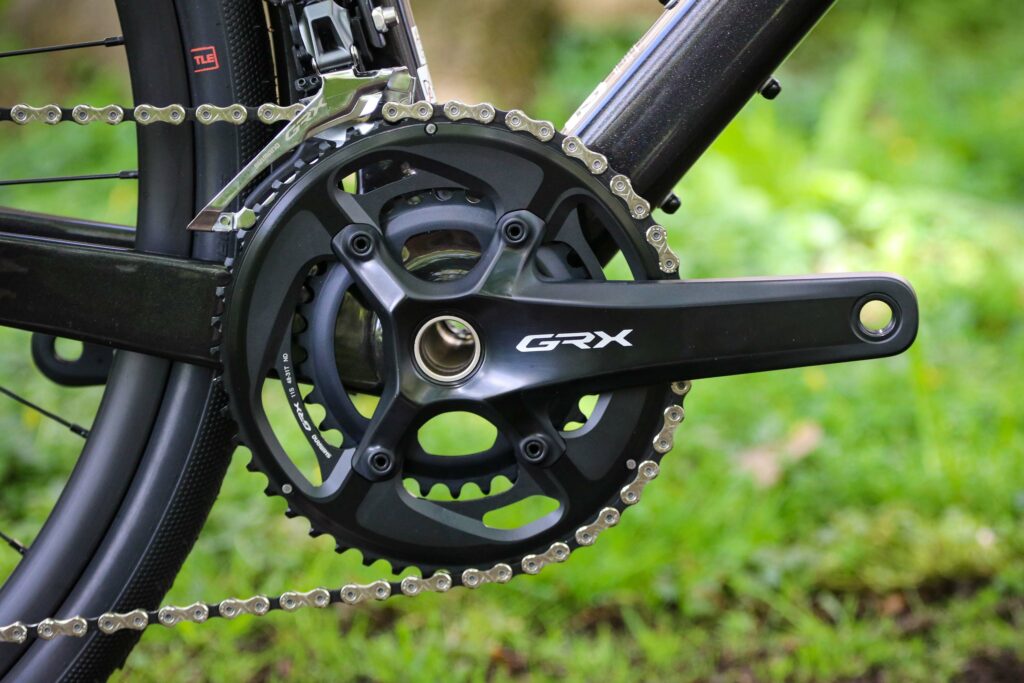
The gravel/adventure bike movement has been the main driver of sub-compact chainsets. Fat tyres and dirt tracks demand lower gears, especially if you’re carrying anything extra, like clothes and so on for an overnight stay.
Shimano offers its GRX RX820 gravel chainset with 48/31-tooth chainrings, for example, while its RX610 chainset comes with 46/30-tooth chainrings.
We think that sub-compact chainsets have a place in general riding too. As soon as you hit seriously hilly terrain, there’s going to come a moment when you need the lowest gear you can get. You might have blown up, you might have hit a 20% grade or steeper. Options like a Praxis Alba X chainset fitted with 48/32-tooth chainrings give you a slightly lower gear range for those situations.
Complicating things a little, Shimano offers 46/36-tooth chainsets in some groupsets – so the outer chainring is smaller than that of a compact, but the inner ring is larger. These are designed primarily for cyclocross, although there’s no reason why they shouldn’t be used elsewhere.
Example bike Bergamont Grandurance RD Elite
Triple chainset
A triple chainset is one with three chainrings. They used to be common – dominating in mountain biking – but they’re ever rarer these days.
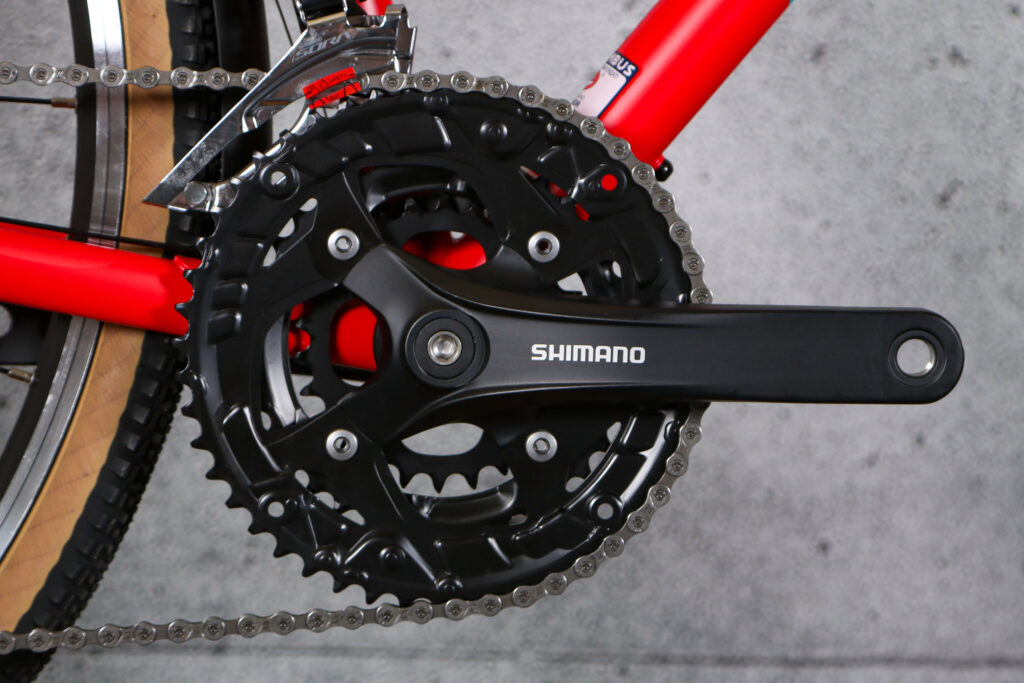
We published an article titled ‘Are we seeing the death of the triple chainset?’ way back in 2017, and they’ve become even more thin on the ground since then.
You do get some very small gears with a triple chainset, but there’s a lot of duplication (different chainring/sprocket combinations giving the same, or virtually the same, gears) and most people find a double chainset with a wide-range cassette ample and more convenient to use.
Campagnolo doesn’t offer triple chainsets anymore – its last one was introduced way back in 2012 – and SRAM never bothered with road bike triples in the first place.
That said, a triple can be a good idea for something like a touring bike where you need those very small gears to climb while carrying a heavy load.
Swapping from a double to a triple, or the reverse, is quite an expensive process because you need to change other groupset components too.
Example bike Cinelli Hobootleg
1x (single) chainset
Bikes with single chainrings are nothing new, of course – there are millions of them out there – but most aren’t particularly performance-orientated. Over recent years, though, single chainring setups have become a popular option, beginning when SRAM introduced its first 1x drivetrain for mountain bikes in 2012, and extending onto gravel and road.
> 1x vs 2x: Are single chainring set-ups the future of road cycling or just another marketing fad?
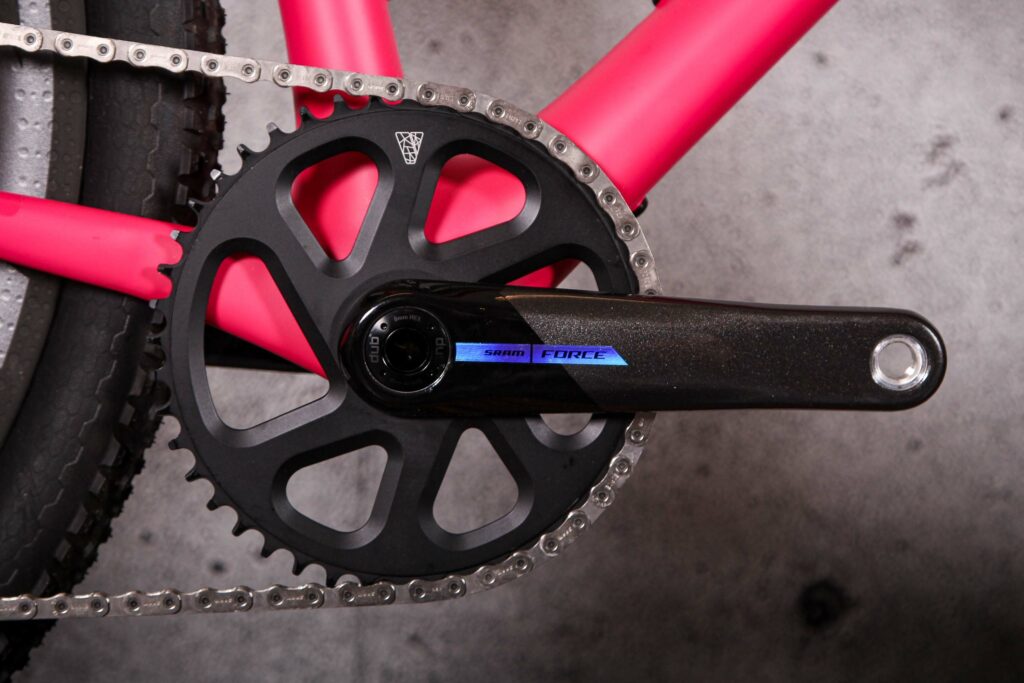
SRAM offers single chainring versions of its road groupsets with wide-range cassettes. 1x groupsets are simpler because there’s no front derailleur or front shifter, there’s no chance of the chain rubbing on a non-existent front derailleur, and they can be quieter on rough surfaces.
A SRAM 1x system won’t appeal to everyone, but for a variety of applications such as gravel, adventure and cyclocross, it makes a lot of sense. 1x has also made an impact on the road. British brand Vielo produces only 1x bikes, for example.
SRAM’s 1x chainsets are available with a variety of different-sized chainrings to suit the riding you do.
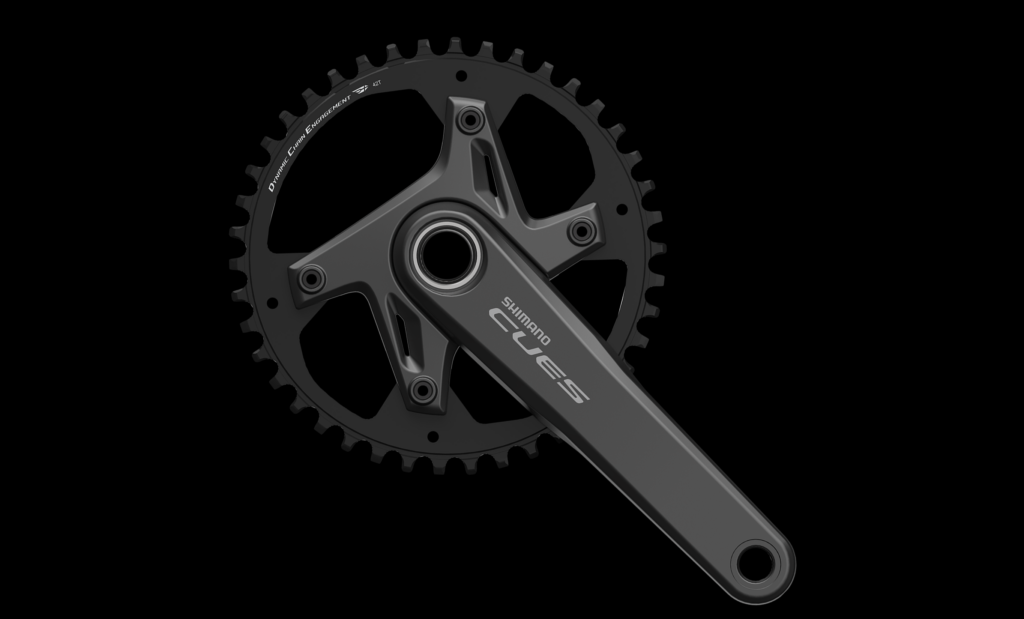
Shimano offers 1x chainsets in its Cues range and also various 1x options among its GRX gravel components, and Campagnolo pairs a single chainring (there’s no double option) with 13 sprockets in its Ekar gravel groupset. Most modern mountain bikes use a 1x drivetrain.
Example bike Vielo V+1 Race Edition Force AXS XPLR
The SRAM double chainset alternative
SRAM turned it up to 12 a few years ago with the Red AXS eTap groupset, quickly followed by a Force version for those without amazingly deep pockets. These days, Rival AXS and Apex (1x only) are 12-speed too.
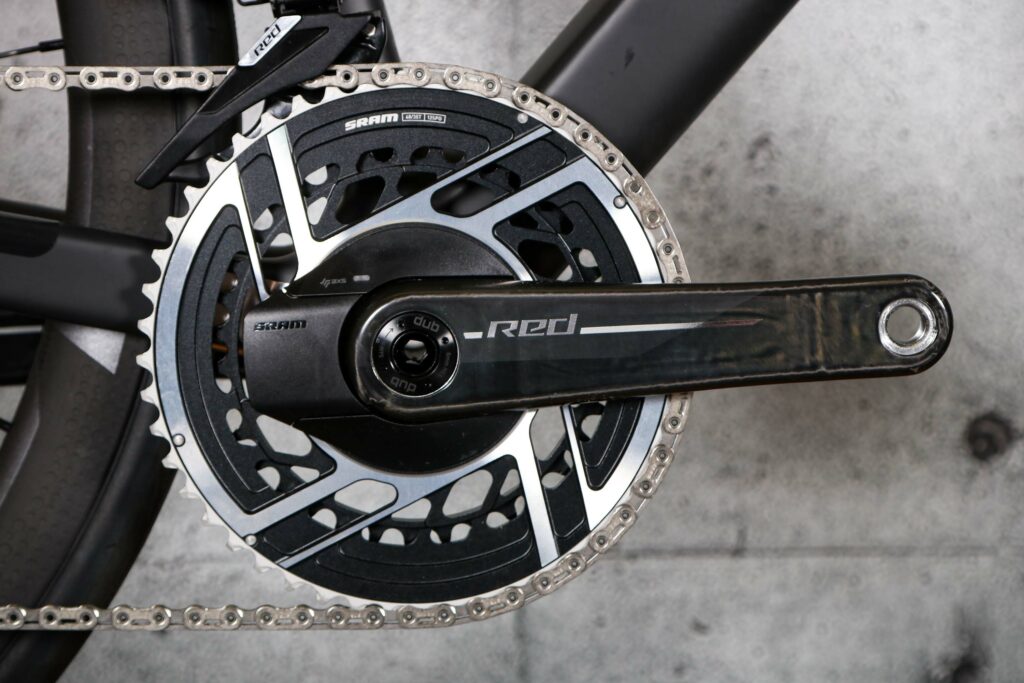
Out back, the groupsets have cassettes that start with a 10-tooth sprocket, so there’s no need for large chainrings to get high gears.
SRAM therefore offers chainring combinations of 46/33, 48/35, and 50/37, plus the Force Wide and Rival Wide systems have a 43/30 chainset.
However, all these chainsets are designed to work only with SRAM’s 12-speed system. In terms of the gearing they provide and how you’d use them, they pretty much map against the double chainsets we’ve discussed. If you’re used to 53/39 you’d choose a SRAM 50/37. Happy with 52/36? Go for SRAM 48/35. The SRAM 46/33 gives a roughly equivalent set of gears to a compact chainset, while the 43/30 is SRAM’s answer to sub-compacts.
As mentioned up top, a SRAM Red AXS power meter kit is available with various sizes of chainring, including 52/39, 54/41, and 56/43. You’d need to add these to an existing chainset.
Of course, the overall gear range you get will depend on the sprockets too, and SRAM tends to offer wide-ranging cassettes.
Example bike Specialized S-Works Tarmac SL8 – SRAM Red eTap AXS
How much difference does a new chainset make?
Say you have a typical 700c wheel fitted with a 25mm tyre, and you’re using an 11-34t cassette. That’s a fairly common setup.
If you have a 52/36 chainset, your smallest gear (36-tooth inner chainring x 34-tooth largest sprocket) is 27.9in. If that doesn’t mean much to you, check out our Beginner’s Guide: Understanding Gears for an explanation. Put another way, if you pedal at 80rpm, you’ll move at 6.6mph.
If you have a compact chainset, your smallest gear (34 x 34) is 26.4in, so quite a bit smaller. That means it’s easier to turn the cranks. If you pedal at 80rpm, you’ll move at 6.3mph, so a bit slower.
At the other end of the speed scale, say the maximum cadence you can hold for a short time is 120rpm. If you pedal a 52/36 chainset in your biggest gear (52 x 11), you’ll be able to pedal up to 44.5mph at this cadence.
Do the same thing with a compact chainset (50 x 11) and you’ll get to 42.8mph.
In short, a compact chainset will give you some small gears for keeping moving up steep hills while a 52/36 chainset will allow you to keep the pressure on for longer on fast descents.
Changing chainrings
What if you feel the chainset you’re currently using isn’t right for you and the riding you do?
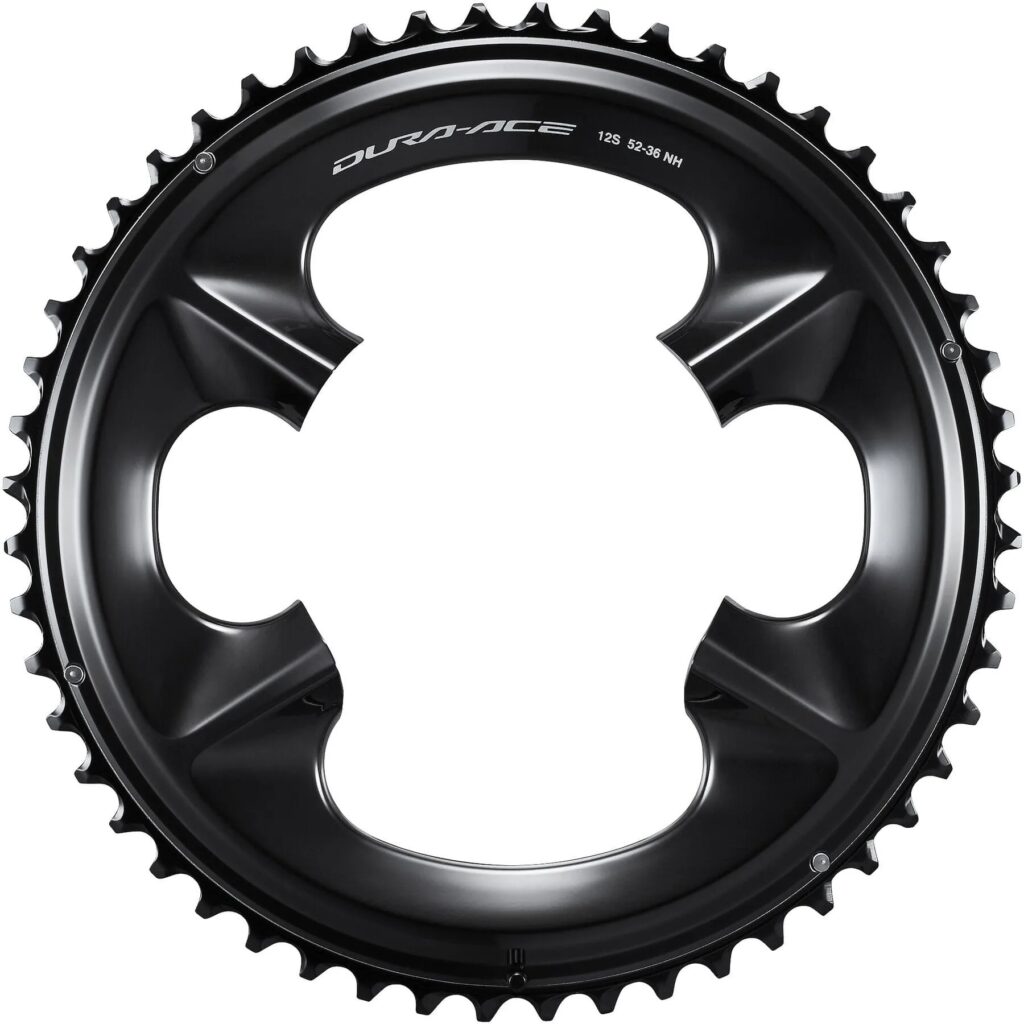
Swapping chainrings can be a relatively straightforward job with basic tools, but you need to make sure you get new chainrings that are compatible with your chainset and the rest of your drivetrain. Chainrings come with different numbers of bolts, bolt circle diameters (BCDs) and bolt spacings, for example.
The point is that you need to be careful to buy replacement chainrings that work with your chainset, and don’t forget that if you change chainring size, you’ll need to adjust the position of your front derailleur accordingly and alter the chain length too.
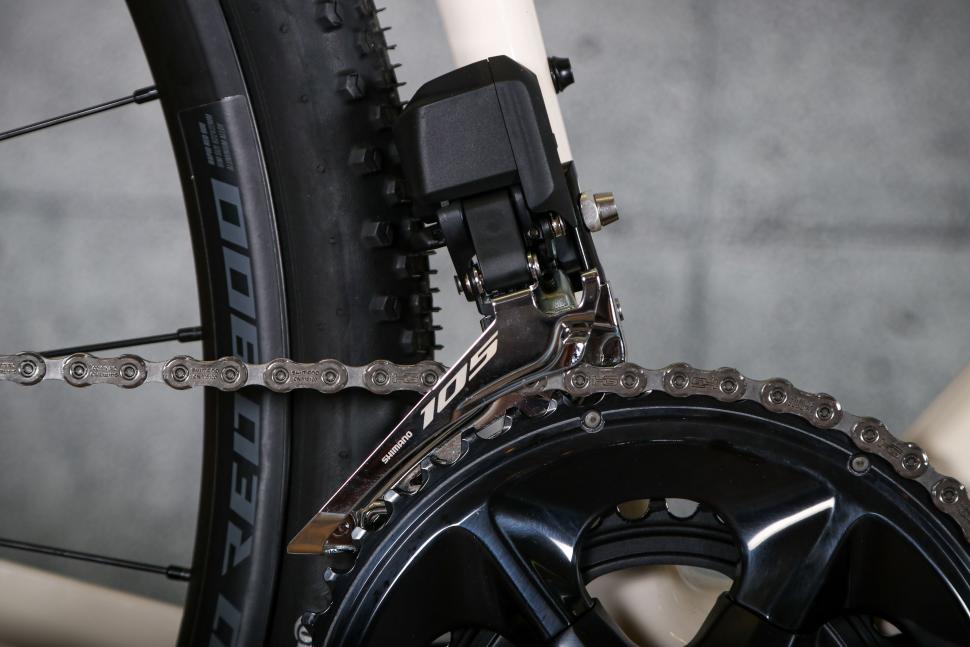 Also, make sure your derailleurs have the capacity to handle the chainring combo you’re thinking of introducing. A Shimano 105 Di2 front derailleur, can handle a large chainring of 50-52 teeth, for instance, and has total capacity (the difference in tooth count between the larger and smaller chainring) of 16. You can look up this info on the relevant manufacturer’s website.



















94 thoughts on “Which chainset is right for you? Should you choose a semi-compact, a compact or something else?”
I have Ultegra 50/34 x 11 on
I have Ultegra 50/34 x 11 on my bike. Can I stick on a 52/36 Dura Ace crank? Or do I need to mess around with derailleurs and a new chain etc?
Feel like 52/34 would be my perfect chainset. Not sure if that can be made to work though.
unconstituted wrote:
Straight swap, assuming everything else like spindle diameter is the same . Are they the same era (ie not swapping 6800 for Dura Ace 7800/7900)?
Shamblesuk wrote:
Yeah it would be Ultegra 6800 to Dura Ace 9000. Straight swap sounds fantastic. Wouldn’t have to take it to the bike shop then, confident I could handle that
unconstituted wrote:
Most of Shimano’s double front derailleurs are meant to work with chainrings with a maximum difference of 16 teeth. 52/34 is just outside that at 18T difference. You might be able to get it to work, but it won’t be ideal.
Mid-compact 52/36 and and compact 50/34 cranks are right at that limit. If you cross-chain in the small-small combination with these chainrings, you can find the chain can foul the inside of the big chainring.
Triple front derailleurs have greater capacity for variance in chainring teeth (22-24T or so) but will need a relevant shifter. With the most recent gruppos, Ultegra and 105 gave up support for triples, leaving only Tiagra 4700 to soldier on as the highest level Shimano gruppo with triples.
unconstituted wrote:
Switching from 52 to 53 requires two extra links of chain, if you do it properly (= according to Shimano’s dealer’s manual). So, from 50 to 52 should require at least as much extra chain length.
Boss Hogg wrote:
Oh no!
Shame, I’ll have to try and get a chain today then. Was going to do the crank swap this evening, have it being delivered and the tools for it today. Thanks, will look into it!
Boss Hogg wrote:
..
tritecommentbot wrote:
Ive just swapped my old Ultegra 50/34 for a 50/36 a few weeks back. it’s a simple and fast job. You do need a new chain though but the gears were simple just loosened the front cage/ cable, moved it up and retightened no real messing with gears was needed ☺
tritecommentbot wrote:
You do need to mess around.
You do need to mess around. The 52 is larger than the 50. So the clearance at the front mech will be wrong. Mech needs raising and may need re-indexing. Chain should be ok.
bendertherobot wrote:
Shame. Ruined my morning.
That doesn’t sound worse than a day’s worth of Youtube and fiddling though.
unconstituted wrote:
It’s definitely no more than that and a useful thing to know., plenty of videos out there too (GCNs youtube channel have some decent stuff but there are others of course).
Would I notice a massive
Would I notice a massive difference on a 53/39 & a 11/28 on the rear as opposed to 50/34 & 11/30 that I have now?
ibr17xvii wrote:
At the top end it’s doubtful, at the other it may depend on how nasty and/or long climbs you do – I can think of a number of real climbs, and endless sims (e.g. Stelvio), that I really wouldn’t fancy doing on a 39/28 but that’s up to your ability and geography to a large degree.
ibr17xvii wrote:
From personal experience, the difference between 34×30 and 39×28 is indeed massive. It’ll definitivelly contribute to building stronger lengs 😉
ibr17xvii wrote:
On steep hills, yes. A really big difference. Anything that gets you down to an 80 cadence now will require you to push 14% harder on the pedals to go the same speed. It’s the same as only having a 26 last sprocket now. however, it will only add 4% to your top spinning (down hill speed)
Kinda off-topic but would it
Kinda off-topic but would it make a noticeable difference if I also went from a 172.5mm crank to 175mm on the new 52/36? Would I have to change my seat height to accomodate?
Quote:
I would take exception to this point, historically MOST chainsets will not let you do this. Shimanos and campagnolos old standards of 130 and 135mm prevent an inner ring of less than 38 or 39 respectivly. Yes some of the newer chainsets have been designed to allow almost anything but that is a very recent thing.
mrmo wrote:
I would take exception to this point, historically MOST chainsets will not let you do this. Shimanos and campagnolos old standards of 130 and 135mm prevent an inner ring of less than 38 or 39 respectivly. Yes some of the newer chainsets have been designed to allow almost anything but that is a very recent thing.
What exactly is your issue with this statement, mrmo? It looks entirely correct to me. In fact, there’s no question about it.
Mat Brett wrote:
“In many”, it isn’t many cases, for most 53/39 chainsets you can’t fit compact chainrings. If you had said in some or in a few cases, or something else fine, but many suggests a lot, which isn’t the case.
mrmo wrote:
As a 53/39 campagnolo chainset user of older models I get what you are saying but in the grand scheme of life the universe and everything I and almost every other human being on the planet would suggest you divert your keyboard energy at something else.
mrmo wrote:
Haha! ‘Most’ doesn’t come into it. No one said ‘most’ apart from you!
To say “In many cases you can turn a standard chainset into a compact chainset simply by swapping the chainrings” is 100% correct. It does actually apply to the majority of Shimano’s current groupsets (Dura-Ace, Ultegra, 105, Tiagra), for example, the majority of Campagnolo’s current groupsets (Super Record, Record, Chorus), FSA K-Force Light, SL-K Light, Gossamer Pro ABS…
I even used the word ‘modern’! “You can take a 53-tooth outer chainring off a modern Shimano 105 chainset, for example, and replace it with a 50-tooth chainring.”
And I even explained, “This didn’t used to be the case. If you had a compact chainset with a 110mm BCD, you couldn’t fit larger Shimano chainrings with a 130mm BCD.”
I also cautioned that, “You need to make sure you get new chainrings that are compatible with your chainset. Chainrings come with different bolt circle diameters (BCDs) and bolt spacings.”
If that lot wasn’t enough to explain it to you, you’re on your own!
Thanks for taking part though.
my road bike now has a 30/39
my road bike now has a 30/39 (a triple, with the largest ring removed).
i was at the back of the queue when God was handing out the suplesse, and i can spin my tallest gear along (ok, down) at 50+kph, snot even *that* spinny. I’m not recommending it for everyone, or criticising anyone elses choice, but it’s an effective option that i’m pleased with.
re crank length: it’s about bloody time they were made in lengths that actually made a difference. 165 is not really all that short, and must be very uncomfortable for anyone shorter than 5’8″.
bumble wrote:
Eh? I’m not even 5’8″ and I have eeny weeny toy legs and I use 170mm cranks on two bikes and 172.5mm cranks on the commuter. No problems here…
vonhelmet wrote:
out of curiousity, have you tried *properly* short cranks? eg 140mm?
(they’re not as weird as you might think – and i’ve got silly long legs)
bumble wrote:
I’ve not, but I’m not uncomfortable on the cranks I’m using at the moment, and I’m not keen to spend money to fix a problem I don’t appear to have!
vonhelmet wrote:
I’m 5’7 34″ and use 172.5 cranks on my road bikes with 50/36 rings and 11/28 cassette. My old MTB has 175 cranks. You just get more leverage with extra crank arm length. Nowt to do with short legs as mine are only 32″ (inside measurements). I find that a 34 chainring on 11/28 cassette too low. There again I don’t like spinning high revs. It’s all personal !
bumble wrote:
Went an ordered the 52/36 in 175mm. 2.5mm longer than my current crank. I have a 31inch inseam and a bit of Googling seemed to suggest that 170mm would have been the best. Was a good price on the 175 though so thought I’d try it. Hopefully won’t regret it..
my road bike now has a 30/39
[quote=bumble]
my road bike now has a 30/39 (a triple, with the largest ring removed).
My road bike/commuter to the shops is currently running an MTB shimano XT double 40/28 with 170 cranks…running to an 11-32 rear cluster.. This gives me shed loads of options re replacment chain rings..great durability..and interchangability with my current stable of MTB bikes.
The obtained gear ratios work fine for me, even hauling the trailer with some 30+k of shopping,
OK so it’s/I’m not quick, but I’ve not had a problem with knee ache since changing from the ‘compact double’, and my pedalling cadence has improved immensely.
bumble wrote:
Not necessarily, I’m 5’7″ and ride 170s and 175s comfortably. I have friends who are nearly 6 foot and ride lower saddles than me because they are all back with short legs.
bumble wrote:
darrenleroy wrote:
They used to do Athena and Centaur in 165mm at least – still get Centaur 165mm under £ 100 (just) from Merlin
https://www.merlincycles.com/campagnolo-centaur-carbon-power-torque-chainset-black-red-55993.html
Just checked Campagnolo tech docs and they don’t list 165mm for any of the groupsets currently – not sure if that’s a quirk of the documentation or not though…
I have a fsa k-force light
I have a fsa k-force light bb386 with 53/39. I have an alpine trip coming up and fancy something spinnier. Can I change the inrng for a 36 and cassette for a 12-27 (currently 11-25 chorus 11s) and make it run smoothlyish? Trying to get a cheap option, don’t mind the practical aspect.
Well I would like to join
Well I would like to join this conversation and throw another type into the mix. I run a cyclocross Ultegra Chainset on my road bike with its 36/46 rings. The 10 tooth jump as opposed to a 16 tooth jump on a compact or semi compact makes front changes so much faster and means when going from the big ring to the little you don’t have such a big jump in cadence (and by shifting the rear a couple of gears you can remove this entirely. I do not miss the change in top speed as 46-11 at 120 rpm gives you 40 mph which is more than I need.
stevie63 wrote:
Hear, hear. My TCX SLR 2 came with an FSA Omega 46/36T crankset as well. I’d argue it’s a great set of ratios for most everyday cycling. Even with a 12-30T cassette, I could cross-chain all day and have zero issues. Pushing the 46×12, I could sustain 48 km/h on the flats (and this was before I adopted clipless pedals).
I think it would be easy enough to replace the 36T small ring with a 34T for better ascending, since they use the same 110 mm BCD.
Unfortunately I desired both lower gearing for climbs and a higher overall top speed, so I ended up swapping it out for a Shimano 105 FC-5750. After almost two years on the Omega, the huge jump between the 50 and 34T rings on the Shimano crank was jarring for the first couple months.
TypeVertigo wrote:
If you can sustain 30mph on the flat then your talent is wasted on a 46/36, or even 50/34!
Try a standard chainset – it would make the most of your abilities over a range of conditions, could make you an even stronger rider, plus no jarring gap of 16 teeth as you have now with the compact..
700c wrote:
Too right. One of the Strava sections on my way home is topped by a guy that held 31 over 3 miles or so and the top 50 is full of club riders. Wasted talent indeed!
Since when was 53/39 the
Since when was 53/39 the standard set that was used on road bikes as default?
I thought it was 52/42 or am I showing my age
Butty wrote:
You certainly are showing your age Butty, as am I. But it’s good to find I’m not the only member who considers the 53/39 to be a modern upstart.
Butty wrote:
A 42 inner chainring is probably sufficient if you live in Holland or have the legs of the Incredible Hulk
Butty wrote:
42 changed to 39 when the racers stopped taking drugs and had to spin up the Alpine passes.
This article could have been
This article could have been a couple of days earlier, for me. My Sabbath just went into the menders, receiving a new semi compact set up. 11 speed (whoopp whoop !) 12 – 30. That should cover me into my 60’s when I guess i’ll be swaping (knee caps, hahhaha) and my chanset out for a triple and maybe a hidden electric motor.
I’ve always used 39/53 but
I’ve always used 39/53 but recently used a hire bike (a Canyon Ultimate) out in Spain whcih came with a 36/52. I’m not a huge fan of low gears on the road, in fact I absolutely hate compact chainsets but I was surprised how good the semi-compact was. Only used the lowest gear (36-28) once though and that was on a steep gravel road climb so it seemed a bit of a waste of that end of the gearing, especially on such a light bike.
Does pedal length alter the
Does pedal length alter the maths?
dafyddp wrote:
Yes, as the longer the cranks, the more leverage you get. However, at the extremes, that can cause problems as the longer the cranks the greater the distance from the top of the stroke to the bottom, so you can only get them so long with any given pair of legs.
Compact for me and a 165mm
Compact for me and a 165mm crank to boot. I’m 5’11 so some people think I’m doing something horribly wrong choosing such a short crank but it’s really helped me rehab my knee and a groin strain that kept coming back. It’s also forced me to up the cadence as I was grinding before.
It can’t be all that bad as I recently knocked 15% off one of my hill times and I thought that would suffer with less torque on a shorter crank. Spin to win!
“It’s the hapless beginners I
“It’s the hapless beginners I’m most worried about”
agree I’ve seen it on some challenge rides that I’ve done – people have presumably put straining in to go the distance but riding a standard road double up anything 10% plus is hard and its sad to see people sat at the side of the road and then getting off and pushing just because club riders with years of hard training can ride 39 / 26 ok on that sort of gradient doesn’t mean the average punter should HTFU with a couple of years in the chain gang and hill intervals
bit biased I run a MTB touring triple 48 36 26 with a 32 out back which will get me up 25% hills OK and gravel roads – so not a standard roadie set up as sacrifices smooth front changes for the range – though recall chatting with a guy as we spun our way past grinders and pushers at an event with a long 10% + climb near the end – he was twiddling away on a very road looking machine with 34 32 and if I only rode on “normal” roads thats the way I’d go and that what I’d advise anyone starting out that wants to enjoy cycling hilly terrain to run with
Surely no discussion on this
Surely no discussion on this subject would be complete without mentioning Wavetrans!
http://www.wavetransmission.com/
Personally, I think this is the future where fixie/single-speed meets commuter and on to infinitry & beyond. But that’s just me.
Could this be the death of the rear derailleur?
I have a triple on my touring
I have a triple on my touring/cross bike with a 28T small cog. Combined with a 34T on the cassette on the back.
Perfect for lugging 15kg+ of full panniers over the Pennines and through the Lakes.
Wouldn’t ever switch to a standard or compact for this type of riding.
I’m definitely a convert to
I’m definitely a convert to the spin brigade now. I’m 5’11 on compact with 165mm cranks and just stuck a 11-32 on yesterday before I hit the hills on the outskirts of Harrogate.
Loved it. I was able to conserve my energy a lot better with 32 on when needed and the power meter was telling me I making better power at times than the next cog with a slower cadence. Took PRs on literally every hill I hit and knocked 20s off a previous 4 minute climb.
Horse for courses I guess but my torque output is probably pretty poor for big ring ascents, so I’m playing to my strengths as my cardio seems to have improved to support the spin.
52 36 and 11 28 cassette I
52 36 and 11 28 cassette I find is right for me.
i have three bikes with different set ups and this one is the best.
I’m 5’7 1/2″ and have 172.5 cranks.
Why are the super-compacts
Why are the super-compacts all so chuffing expensive?
Surely there are enough of us weaklings around to warrant Shimano doing something like a 105 or Tiagra quality in something like 40-26 ?
Instead we’re forced into fugly solutions like triples with the outer removed.
PpPete wrote:
In my view, the issue is more at the cassette end of the drivetrain than with the chainrings.
I’d be more than happy with the compact offering if only the manufacturers would give us a better choice of cassette ratios. 11 at the back is redundant for me and many I ride with. A cassette with 12 – 28 or 12-30 would still give a sufficient top speed, good range and close ratios.
JohnnyEnglish wrote:
I have an Ambrosio 12-28 cassette on my CX bike, paired to a compact chainset.
IIRC Campag also does Chorus cassettes in 12-27 – at least I think thats whats on my “race” bike – with a standard up front it is fine for pretty much everything except XTREME climbing.
On my commuter I’m currently
On my commuter I’m currently running a 38/50 combination, using a 110BCD crankset. On rare occasions I hit about 58km/h, but really never anything above that. Given than I seldom do high speeds on a commute, I am thinking of reducing the big ring to either a 46 or 48.
The rationale for the close ratios is that I neither have to deal with high speeds nor big hills. Close ratios allow me to get the best wear out of my sprocket. Shifting is also smoother with a smaller difference in tooth count on the rings – something that is useful on a bike that gets the cr*p ridden out of it – my commuter currently has over 50000km on the clock.
The types of cranks sets are
The types of cranks sets are really defined by their BCD (bolt circle diameter) which then defines the possible sizes of chainrings that can be used. The BCD determines the smallest chainring that can be mounted. The compact introduced a smaller 110mm BCD which allowed a 34t chainring as it’s smallest ring on a double chainset. You can still put regular 39/52, etc, chainrings on it if you want to, but on a standard 130mm BCD you can only have a 39t as the smallest. Triples use two bolt circles to allow a very small chainring on the innermost 74mm BCD.
So I would have reversed your discussion and started with BCD and gone from there. If you want to change your rings the first question is, what BCD is your chainset.
I’ve found a compact (110 BCD) chainset with a 42/34 works very well, then I can run a small step cassette. I don’t need more than a 42:11 top end gearing, which gives 30mph at 100 rpm. And this avoids the large 50/34 shift on the front that is just awkward to use. See
https://wickwerks.com/product-category/chainrings/cyclocross-chainrings/
for sub-compact chainrings designed to shift nicely.
I run a mtb crankset with a 9
I run a mtb crankset with a 9 speed outer ring to make 44/28. I can climb mountains with a high cadence and average over 21mph on 80 mile runs, so most folk wont really need more.
Got rid of a worn out MTB
Got rid of a worn out MTB triple chainset on a commuter/tourer and replaced it with a Shimano SLX 38/28 chainrings with an 11-42 cassette (new derailleur as well). Great for spinning up steep hills with just enough top-end for cruising on the flat. Doubt a new bike would have been sold with that combo which is the joy of upgrading, rather than replacing the bike.
Hi,
Hi,
Just swapped from a Compact + 11/32 to a Semi Compact + 11/34. Same bottom end and higher top end.
Perfect for all but the silliest of hills.
Ciao,
IMHO for the leisure weekend
IMHO for the leisure weekend warrior a 46 or 48t large chainring with cassette starting with 13t cog is perfectly sufficient.
With this obsession of 11t starter cog and 50-52t chainring people spend too much time with suboptimal oblique chainline and even cadence imitating bullet time effect (ie.: slow motion).
back in the nineties, the weekend-hobbyst group, RSX featured 46-36 chainset with 13-26 cassette.
With 11 speed, a 13-30 cassette would provide everything one can ask for if not racing: fine increments at the bottom, yet wide enough gearing for serious gradients…
At 90rpm
At 90rpm
46-11 combination will attain 29mph
50-11………………………………….32mph
53-11………………………………….34mph
How many people can sustain 29mph on the flat?
Thats why I use 44T chainring, when conditions are optimal, strong tailwind and -1% slope I can attain 27-30mph and hold it- just.
This is on a flat 10 mile section with a tiny tailwind on the above gearing, I was working quite hard
Im in the top 8% for the segment, the vast majority of people dont need 50 or 53 t chainrings
CXR94Di2 wrote:
Thank you for the numbers. I wish more people would see the truth. Though I’ve written different ratios, I was considering cassettes with 12 or 13t initial cog.
The speeds you are quoting are more than enough for the average Joe.
A further experiment to my
A further experiment to my quest for the perfect gearing. I swapped my 44/28 chainset for a triple XT Deore 48/36/26, bought a triple XTR Di2 derailleur. This has further improved the gearing range to now cover both ends. It has allowed me to use one less cog whilst on the 26t chainring(mountains) and when powering along slight declines use less cadence with the 48t chainring.
26×40 4.07 4.32 4.58 4.83 5.09 5.34 5.59 — (min gearing mountains)
26×32 5.07 5.39 5.70 6.02 6.34 6.65 6.97
36×12 18.78 19.95 21.12 22.30 23.47 24.65 25.82
48×11 27.29 29.00 30.70 32.41 34.11 35.82 37.52
I spend most of my time in the 36t chainring around 90-95rpm The chainline is further improved with much less cross-chaining. The Di2 programmed to syncro shift at the relevant points.
Quote:
That fact that it constantly has to be emphasized how the name of this product is prounounced must be a constant, pustulent sore to the SRAM marketing department.
I’m afraid that I couldn’t possibly countenance buying a safety-critical item of equipment from a company that shows such shoddy attention-to-detail.
I see here a lot of comments
I see here a lot of comments about the efforts of people trying to achieve short gearing while I see that the majority of entry level road bikes and even worse gravel bikes have compact 34-50 cranksets and I ask myself whether the bicycle and drivetrain manufacturers are blind.
I use a triple trekking 26-36-48 that is must if you had to face my not that athletic built, 2-digit slopes in my daily commutes and occasional trips with panniers. My needs sound like the most of entry level cyclists and yet the viable gearing options are very few.
A run-down about which speed
A run-down about which speed chainsets work with which speed groupsets would be very helpful for me to read. Seems for example if your bike has an 8 speed groupset (still not at all uncommon on entry level road bikes), your options for chainwheel upgrades are very limited. Is a double 9 speed chainset ok to put with a double 8 speed group? I’ve been told that with a double 8 speed groupset a 10 speed would have issues and 11 speed a no-go with major issues. For 8 and 9 speed chainsets, it doesn’t seem there are a lot of options to chose from. With speeds having increased a lot of over time looks like there are no high spec (lightweight) 8 and 9 speed chainsets made by any manufacturers nowadays though maybe I have missed something.
What about a 9 speed group? (again hugely common today on semi-pro road bikes). Is a 10 speed chainset fine to pair with them, an 11 speed chainset..?
Should one consider a rule of thumb to be that a chainset should not be more than 1 speed higher than the your groupset’s speed?
Any links to info or articles about this subject would be appreciated. Thanks.
As far as I Know 9/10/11 are
As far as I Know 9/10/11 are compatible with chains. There are slight width differences in chains but not so much to affect shifting. I have used 9 speed chainrings with 11 speed cass and used 10 speed chain. It worked fine
CXR94Di2 wrote:
Didn’t think 10 speed chains would work with an 11 speed cassette, and I had tried before, maybe it was the quick link I was using.
But I’ll bow to your experience and see if one of my 10 speed chains will work with my 11 speed set up. Makes sense as there’s bugger all difference between 10 & 11.
Would be handy as 10 speed chains are cheaper than 11’s!
I’ve used 10 speed chainsets on my 11 speed set up for a long while, and I’m using a 10 speed front mech and shifter on my steel winter bike, but with 11 speed rear. That also works fine.
Praxis Works make a 48/32 sub compact chainring set on a 110bcd, which means you don’t need to buy a specific sub compact chainset. The inner mounts on the outer, as it’s the BCD that dictates the smallest size inner chainring possible.
AbsoluteBlack now offer 2 sub
AbsoluteBlack now offer 2 sub-compact oval chainring combinations, this could be perfect for many.
I’m also a fan of 14-28 ultegra 11-speed cassettes. Although I would consider 11-23 on a sub-compact oval chainring… weight and aero reduction!
ChrisB200SX wrote:
Thank you, thank you, thank you. I Googled Absolute Black subcompact and found they do a 46/30 or a 48/32 combination that fits 4 arm Shimano 110bcd cranks.
So I can get the low gearing I want, but keep my road cranks and bsa bottom bracket. Plus they look trick & I can keep them just for my Alpine trips and swap them out for normal 52/36 or 50/34
Those looking for something
Those looking for something sub compact double chainset, the FSA Omega Adventurer range has 48/32 46/30 also 50/34.
I would be inclined to buy the 48/32 and swap out the inner ring for a 30. BCD is 120/90 for rings
CXR94Di2 wrote:
Unfortunately no one seems to make a sub compact chainset that will fit my Trek with its BB90 bottom bracket. I could fit Absolute Black oval rings but even then I’m not sure I can lower the front mech enough. Time for a new frame?
iso2000 wrote:
Sounds like a new more versatile frame essential . Wide tyre capability, disc brakes, relaxed geometry, threaded bottom bracket and no to brazed derailleurs mounts-clamp only.
iso2000 wrote:
Unfortunately, yes, it sounds like it – with a threaded BB (I know they’re getting rarer…)
srchar wrote:
If you’re talking about threaded BB frames in general, there seems to be more manufacturer s using English BBs. They are so much better, easy to replace and cheap
CXR94Di2 wrote:
Don’t think I could back to a steel frame. What bottom brackets do titanium manufacturers use?
iso2000 wrote:
My Kinesis Tripster V2 Ti uses threaded BB. The J ack Laverack Ti bike is threaded. When I first looked at their frame you could specify pressfit or threaded. Planet X Ti are threaded.
iso2000 wrote:
Not necessarily! I currently have a couple of Trek Domane’s both running with absoluteblack 48/32 chainrings. I actually had to raise the FD slightly when I fitted them as the max width of the ovalised section of the 48 ring is slightly larger than the standard 50 shimano ring the Treks came with. The one thing you do have to note with absolute black rings is that they sit about a couple of mm closer to the frame than the shimano rings, which meant ,in my case, that initailly the lower limit onthe FD would not go in far enough. This was easily cured with a 1mm space on the crank, however it is somethingto be aware of if you plan on going this route. Brilliant set of chain rings, would never go back to round rings.
S3dbw wrote:
Thanks that’s reassuring. Can you expand on the 1mm spacer please. Where exactly is this put?
iso2000 wrote:
Place the spacer (if required) on the drive side of your crank, this has the effect of pushing the crank rings out slightly and thus allowing proper adjustment on the lower limit on the FD
Have been pleased by my ultra
Have been pleased by my ultra-low gearing experiment, namely:
11-42 Shimano cassette;
M8000 SGS rear derailleur (47t capacity);
Sugino OX 28/44 sub-compact chainset;
M7000 105 front derailleur; and
Tanpan cable converter at the front near the 105 rear shifter/brake (away from the road and contamination).
Works a treat with a 600% spread from 18 gear inches to 108. I spend most of my time in the large cog but when it gets steep and the load heavy, I drop down to the small chaniring and breathe a sigh of relief.
It’s on a Specialized Diverge which has short chainstays so I cannot use the two smallest cogs while in the small chain ring. Not a practrical problem because after the first few low gears it makes sense to be in the large chainring’s lowest or second lowest gears of 28.3 gear inches or 32.1 gear inches, respectively.
The Sugino OX chainset comes in a range of chainring sizes with the smallest being 30/44, to get the 28t granny I bought their standard 9 speed 28t chainring and chamfered the outer edges of the chainring bolt holes to get proper clearance from the frame – you simply copy the chamfers on the 30t ring. Works a treat as the pins and ramps are on the 44t chainring. The Sugino chainset has performed well.
Can recommend.
Quote:
not any more they don’t
Why is this article still
Why is this article still ‘trending’ or whatever? I thought we’d settled this ages ago. Triples all round!
Can’t believe it’s been 4
Can’t believe it’s been 4 years and the answer is still Standard
“Don’t forget that if you
“Don’t forget that if you change chainring size, you should adjust the position of your front derailleur accordingly, and you may need to alter the chain length too.”
Could you be more specific about altering the chain length? I have a compact 50/32 chainring set that I want to switch to a 52/39. Do I need to lengthen the chain by a few links in this case? Thanks
1×11 SRAM
1×11 SRAM
I’ve got a gravel bike with
I’ve got a gravel bike with GRX, that’s 46/30 with an 11-34t cassette. I prefer the lower gears, even for on-road use. Top speed is limited to about 35mph, but I’m not racing so I don’t feel that’s an issue.
There’s a growing market of
There’s a growing market of super compact chain sets/cassette combos out there now. More folk are realising there’s a lot of ‘aspirational’ gears on most OEM groupsets, and most of us, unless racing, would benefit from losing a few top end gears in favour of some lower spinny spin magic it up the hills gears.
Microshift Sword & Sword Black have a 46/29 with an 11-38 cassette.
Spa Cycles have offered sub compact and super compact chain sets that work on a road chain line for yonks – I’m running a 44/26 with 11-36 cassette road.
New Shimano Cues drop bar will also have a 46/30 or similar, with a wider cassette I think.
Lots of other brands have super compact stuff out there too, with a bit of research.
For normal people, the ratios
For normal people, the ratios on a grx double are perfect, allied to a whacking great cassette. Because nobody needs to actually ride TDF pro gearing.
I’m using 700c, 9-speed 46/30
I’m using 700c, 9-speed 46/30 with a ?-34 cassette for all my cycling including the Bob trailer. It’s about right – I can’t get up everything on my routes even on the road, but I’m usually grateful for the opportunity to walk for a bit when it gets that bad- such as Wrynose and Hardknott last autumn
Now that I’m in my 70s, I don
Now that I’m in my 70s, I don’t have a big chainring larger than 42t on any of my bikes. When I started racing in the early 1970s, standard top gear on a road bike was 52-13, which is exactly the same gear as 44-11, so my 42-11 top gear is very little different. Most bikes sold to the public are way overgeared…
NickJP wrote:
— NickJPAbsolutely. I’ve been considering whether to replace the 50T on my compact for 46T as I find too often I’m cross-chaining on rolling terrain. It’s not as big a drop as people often think. Additionally, shifting from the 34T inner ring will be a smaller jump too (having run a triple for several years I find the 16T gap awkward in either direction).
Although I’m fairly fit now I’m in my late 50s and I expect to move to 46/30 or similar sub-compact gearing in due course.
I also agree with Jimthebikeguy.com‘s comment – it’s about marketing, not real world practical gearing for normal people.
On my all-rounder bike 44-11
On my all-rounder bike 44-11 is the longest gear, with 24-43 being the shortest, this with 150 cranks. I’d generally be using 44-15 on flat road (not much of this in my area) to 24-36 on steep wet bridleway. I have a steep grass slope where 24-43 is useful but not breaking traction (avoid ruining the grass) and keeping the front wheel on the ground takes care.
Now that cassettes are
Now that cassettes are getting bigger i have also rediscovered the benefits of the cx crankset. 46/36 with an 11-36 cassette is absolute goldilocks.