



To begin at the beginning, or at least at the beginning of an era that we still live in… the Rover Safety Bicycle, widely regarded as the first modern safety bike, has pretty much all the identifiable features that we still recognise in a bike today, yet is now over 140 years old. The handlebars directly controlling a front wheel via a fork, a saddle sat partway over the rear wheel, equally-sized spoked wheels, pedals and cranks sat between the two wheels and driving the rear wheel, and a chain drive sitting on the right hand side of the frame. It is only missing a seat tube, pneumatic tyres, a freewheel and rim braking to make it fully recognisable with its modern counterparts. The silhouette is remarkably similar, however, and markedly different from even earlier designs like the velocipede and penny-farthing.
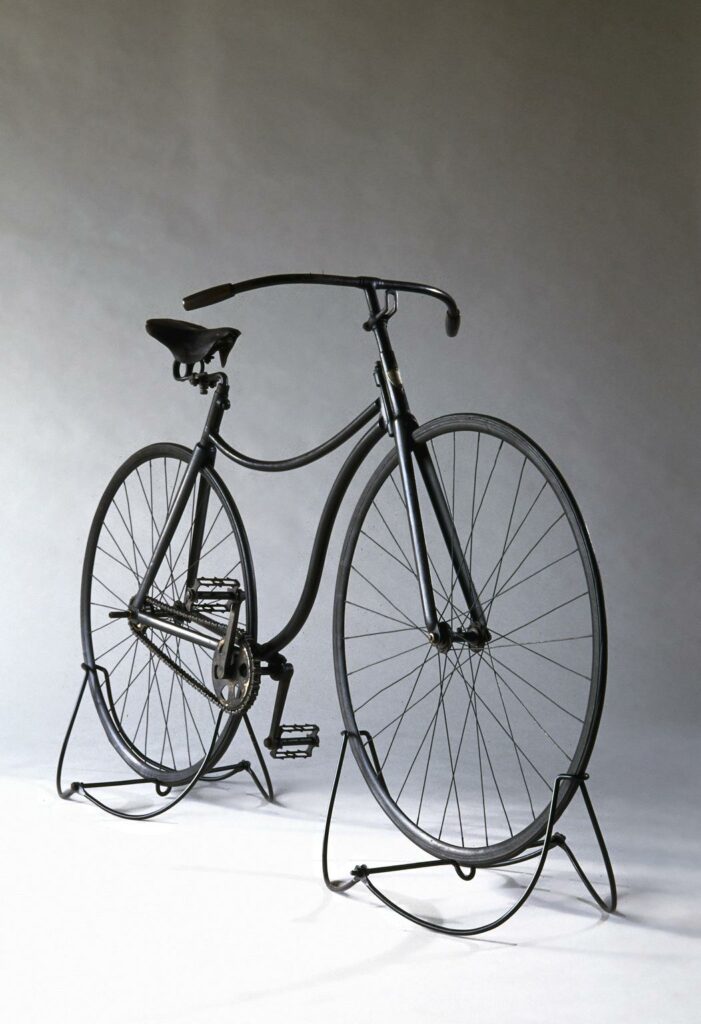
This Mark ii version, from 1885, was the creation of John Kemp Starley, and it brought together the ideas from the previous 15 years of bicycle development and presented them in a coherent, useful and safe product.
Starley wished to “…place the rider at the proper distance from the ground”. This was in stark contrast to the riders of ‘ordinaries’, or penny-farthings as they were nicknamed, who sat high up over the front wheel. They were in danger of having a ‘header’ if thrown off forwards over the bars. Remember helmets were still a long way off…
The original Mark i model from 1884 featured a larger front wheel than rear wheel and indirect steering, where the forks are turned using a rod, which is in turn attached to a handlebar mechanism. Quite cumbersome by comparison to the direct system used in the Mark ii.
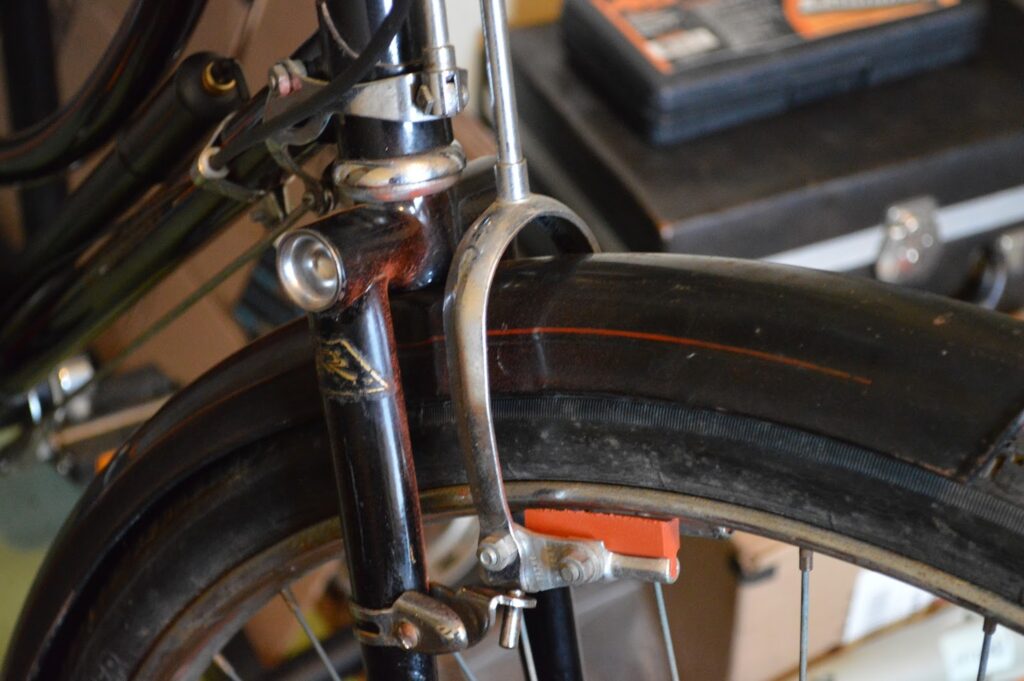
Also note the lack of brake levers on the bars. As the wheel featured a fixed wheel cog, braking was done by the legs. This technique is still practiced by track and ‘fixie’ riders. The introduction of a front rod brake came in over the next few years, and was commonplace by the 1890s.
A rod brake system uses a series of solid rods to pull the brake blocks onto the rim. Ernest Bowden invented the Bowden cable in 1896 in an effort to replace these rigid rods. It is the same Bowden cables that we use today for gears, rim brakes and dropper posts! Although bikes using hydraulic brakes and electronic gears have no need of these trusty old cables any more, many bikes continue to use them.
In addition, the fixed wheel didn’t allow for any coasting or freewheeling. This was standard for bicycles of that era. Despite having been patented in 1869 by William Van Anden, the single wheel freewheel didn’t catch on initially, but started to find favour in the later half of the 1880s. It did require an efficient braking system as the legs could no longer slow the bike down.
The American solution was the coaster brake, where the rider backpedals to activate the brake, whereas the British opted for rim brakes. Not everyone was a fan of the freewheel, though – the irascible Henri Desgrange (creator of the Tour de France) wrote in 1912 that he thought riders were only applying pressure to the pedals for half of stage eleven, and coasting for the other half. This was on a 379 kilometre stage, mostly ridden on the dirt roads of the time! Mind you, he only grudgingly allowed derailleurs to be first used in 1937, saying that they were for touring riders only…
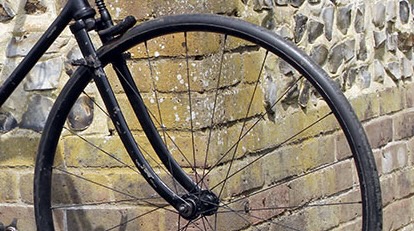
The wheels on this bike used solid rubber tyres, as pneumatic tyres were not yet commonplace. Although patented in 1845 by Robert Thomson, his pneumatic tyre proved to be too ahead of its time, and didn’t take off commercially. It took John Dunlop to independently discover the same technique in 1887, and apply it to race-winning bikes. By 1892, pneumatic tyres were so widely used that bike manufacturers had to retool to accommodate the width of the new tyres. These tyres were not only significantly more comfortable to ride on, but faster too.
Another interesting feature on this era of bikes is the use of a 1″ (one inch) pitch chain. The pitch is the distance measured between the pin centres. Although the 1/2″ chain was invented in 1880 by Hans Renold, it didn’t become popular until the early 1900s, and from there it increasingly became the standard that we still use today.
Although not particularly light by modern standards, and weighing approximately 16.8kg, the Rover used hollow, drawn steel tubing. This provided a lighter weight than the wrought iron commonly used in earlier velocipedes. It wasn’t until 1935, for example, when Reynolds introduced its iconic 531 tubing, which offered a superior strength-to-weight ratio compared to these earlier materials.

John Kemp Starley died in 1901 at the age of 45, but he had seen the enormous success of the safety bike as well as the first British bicycle boom, often known as the ‘Bicycle Mania’. This boom occurred between approximately 1895 and 1897, with a following bust occurring due to an over-saturation of the market. Sound familiar?
The social impact of ‘safety’ cycling shouldn’t be underestimated either, as it allowed women in particular to experience more freedom in mobility. This in turn led to the ‘rational dress’ fashions, which ditched the constraints of corsets and allowed women more freedom of movement. So, it’s often argued the Rover Safety Bicycle was a transformational product for both personal transportation and for the changes that occurred in society at that time.















18 thoughts on “Where it all began: A deep dive into the Rover Safety bicycle, the first commercially successful modern bike from 1885”
Beautiful machine
I dare say back then there were people who railed against the idiocy of pneumatic tires and rim brakes as unnecessary fripperies used to entrap suckers with more money than sense…
Does anyone know the reasoning behind the beautiful curves of the tubing, which presumably were more difficult to forge and simple straight tubes? Was it merely for aesthetics or is there a shock absorbing component involved?
Apologies for the US spelling of tyres – I was doing a job for an American client yesterday and so the autocorrect was set to US!
It’s interesting to note, as we rail against the price of bicycles in our time, that in 1885 the Rover was priced at £20 and 15 shillings, which according to the Bank of England inflation calculator is the equivalent of around £2500 today.
@Rendel Harris and you could buy a much better bike (lighter, better brakes, just as durable) today for probably a tenth that, brand new.
Probably easier to manufacture like that.
If you look at the ‘headtube’ and top tube-seat interfaces it looks like they’re all perpendicular, so only the seat stay -chain stay interface where they meet at the wheels is on an angle. The curved down tube means that they could use one tube for the chainstay and the downtube.
Bending tube probably wouldn’t have been too difficult, especially with the materials of the time, and easier than making multi-directional lugs at the major interfaces.
> It is only missing a seat tube, pneumatic tyres, a freewheel and rim braking to make it fully recognisable with its modern counterparts
To be fair, there are still plenty of bikes being sold and ridden on the road that differ only by the added seat tube, in concept, from this bicycle. Fixed-gears are still somewhat popular with a certain set in urban areas (though, I do think you really should have at least a front brake on the road; ideally 2 independent brakes, aside from whatever braking you can get via the pedals).
It’s remarkable that a mechanical transport device from 19th century is still so popular today, with almost no changes.
Bikes (plus better roads for them) turned out to be such cheap and effective tools that they’ve been hard to improve on.
Although that’s a challenge for marketing and business! Obviously the biggest hit was with cars. But people are still trying.
New materials like CF, tubeless, braking “solutions” now including ABS, ebikes… And generally “stick a computer on it” allows a whole new dimension of sales…
What other tech design has persisted (basic design elements) so long – aside from really basic things like pottery, or a spade? I guess people are still using horse saddles familiar to our ancestors? And indeed shooting a couple of firearm designs that originated over 100 years ago.
@chrisonabike
What bike are _you_ riding?
Just a normal one with two wheels…
@chrisonabike Materials technology has improved a lot. And the advent of cheap yet sophisticated electronic systems has made huge changes.
As regards old technology still being used, yes it’s true that many firearms are old designs. The US Army still uses the .50 Browning machine gun and that dates from the early 1920s, as one example.
True – and doubtless we’d really notice the difference in ride quality between this and say my old Dawes Galaxy (pneumatic tyres, more suitable steps, then freewheel and gears). And the braking would be fairly poor (for those not used to fixies).
And for electronics even going back to the bike lights of my youth would be unpleasant.
BUT on a flat smooth surface * in daylight (and if I didn’t have to carry the thing up stairs) even this ur-bike would still be vastly superior to walking. (And the previous pedal- powered machines, aside from high-wheelers for racing uses).
* Neither often met with in Edinburgh.
“Suitable steps” -> er, “suitable steels” …
@OldRidgeback Colt 1911 still in use by many military and police forces worldwide to this day.
John Moses Browning rather hoovers up here for military weapons (including the action of the FN MAG / L7 (GMPG) / M240)
Hiram Maxim still in with a shout since versions of his weapons have come back out of storage in the horrible version of WW1 happening in Ukraine.
Is the sewing machine (pedal powered for a time) a similar such long-lived basic design as the bicycle?
@chrisonabike The abacus has to be the king, surely? Still in use in many parts of the world after 5,000 years and even in rich nations still a useful training tool – in Japan there are specialist abacus schools where children go to learn mathematical reasoning.
@Rendel Harris The ma deuce is still the US choice for 50 cal.
@Rendel Harris Good point, and the abacus requires a similar (or greater) level of understanding to operate as a motor vehicle does*!
I guess I was wondering about *apparently* similar levels of tech (the abacus is definitely simpler – after all the axe has been around a long time also…).
But maybe I’m on a “how long’s a piece of string” errand? While the basic idea of the bike *seems* simple (compared to a car – or an e-bike or even what many of us might ride) … the more I think the greater the accumulated design hiding behind an apparently simple form there.
Aside from the technology of materials and manufacture ** it needs multiple instances of “compound” tech eg. bearings (ideally ball races), chain and gear drive, wheels (ideally spoked under tension) and (improved) roads.
* Sorry, indulged…
** Metallurgy, lubricants, measurement and tooling allowing mass production of parts, screw threads, tube-forming … could end up going down the rabbit holes that Thomas Thwaites’ “The toaster project” had fun exploring…