



Orla Chennaoui lives and breathes live television. The TNT Sports presenter’s voice stretches across the open-plan office at Stockley Park, her energy and enthusiasm not waning in any conversation.
We’re at TNT Sports’ Headquarters, invited to interview executives, watch The Breakaway, and see how the sausage of live cycling broadcasting gets made. It’s Blockhaus day at the Giro d’Italia, the day Jonas Vingegaard lays down the gauntlet in his battle for pink. And Stockley Park is humming with constant activity.
Chennaoui’s note taking throughout the stage is detailed and intense, despite the race being all-but-guaranteed to come down to the day’s final climb. With Chennaoui now living with her family in Amsterdam, her stay in a London hotel for three weeks at a time, thrice a year, is testament to her dedication. Her professionalism has become a passion. She describes listening to every cycling-related podcast under the sun at double speed the evening and morning after the day before. Her complete investment in the sport is what allows her to emote on behalf of both the riders and the fans so passionately in front of the cameras.
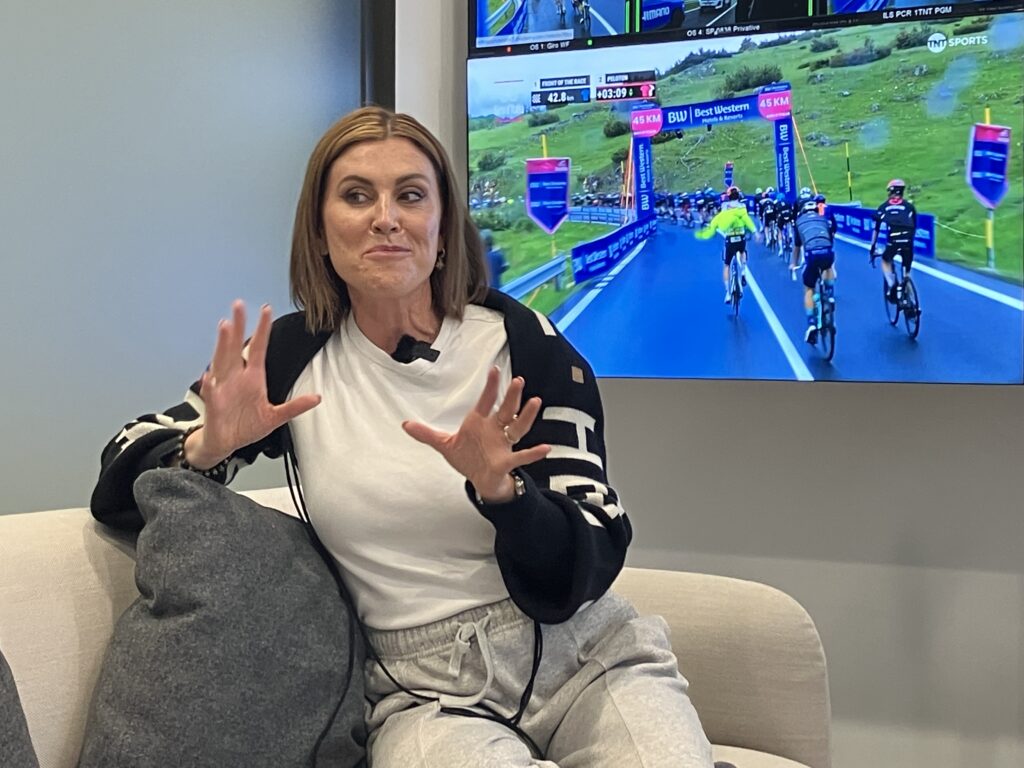
All of this has contributed to Chennaoui’s enduring popularity as a presenter, and explains why Scott Young, Executive Vice President of Warner Bros. Discovery (WBD) Sports, is so enthusiastic before we interview her. WBD have all the rights to the next Olympic Games in Los Angeles, and Young laid out in detail his plans to once again deploy the Northern Irish woman’s talents at the Games, even showing us a villa they were scouting out as a possible studio location.
Chennaoui’s investment in the sport is emblematic of her employer’s all-encompassing attempts to justify its self-proclaimed status as the ‘home of cycling’. We, a handful of representatives of the old-fashioned written word, were taken around a bustling TNT HQ, into meeting rooms, green rooms, and production galleries. Busy directors and editors took time to talk us through their work, allowing us a peek into the gigantic scale of a modern live sports broadcast. The Google Meet of different commentators split across the English Channel is the least of the logistical challenges.
Until really very recently, a broadcaster would pay for the right to witness the director’s best judgement, and a commentator or two to justify the pictures we were shown. Then came the broadcaster’s own interviews, the inserts played over and alongside live pictures of people pedalling, suddenly it was not enough to see what the race looked like but to understand what a rider thought. Now come the motorbikes, mounted with an Iris Slappendel to tell you how a race physically feels, a Jens Voigt with the chutzpah to make a directeur sportif roll down their window and explain to the viewer – via him – what is actually happening.
Then there are the reporters dispatched to describe the final climb, the closing kilometres, the uneven road surfaces, the interviews flying all in at once in a multitude of languages hastily interpreted for broadcast across the Eurosport (yes, still Eurosport) family of channels.
And finally, there is the abdication, the directorial white flag. Why bear the burden and ire of the internet for showing the wrong stuff when you can instead allow the viewer to watch everything, everywhere, all at once? Give them every motorbike camera you can, a helicopter shot for good measure, and then table after table of data. Every single classification, stage profile, clock and weather report before your eyeball, condensed into one ‘multiscreen’ stream. You needn’t move a muscle.
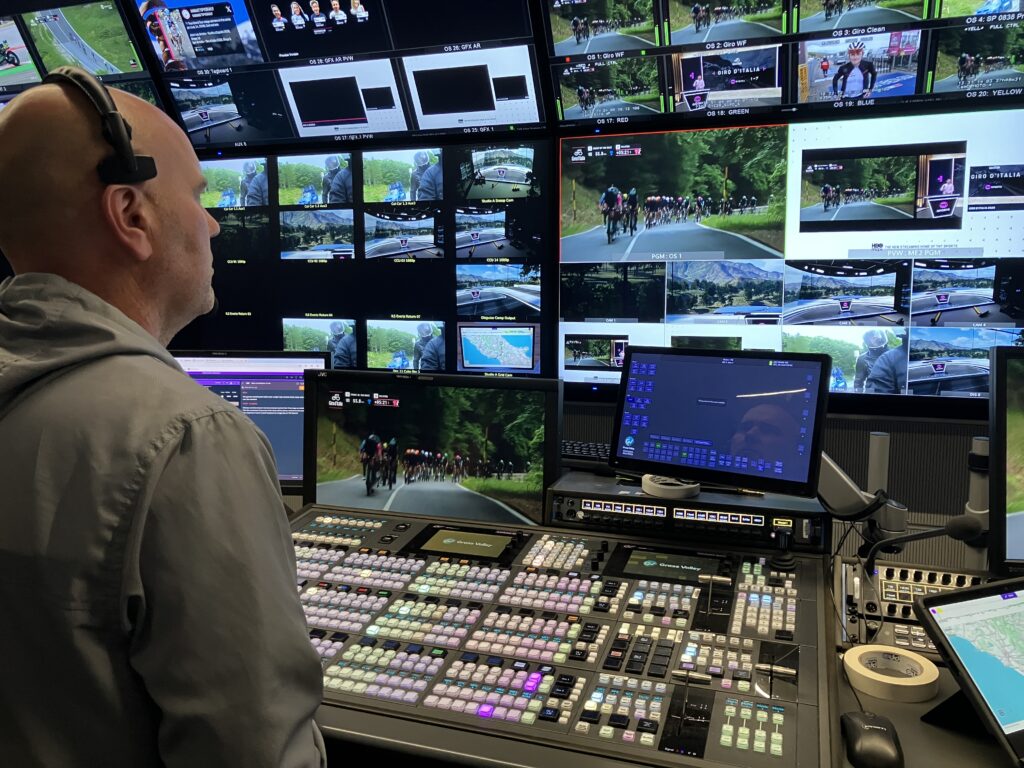
Altogether, it’s really quite a lot. Leaving Stockley Park midway through the post-stage Breakaway show, I was left with a feeling that, for all the talk of cycling being folded into the TNT sports bundle to pay for football, I’m not sure it quite adds up. The cycling audience in Britain remains low, the TNT Champions League rights are expiring, and the investment in cycling coverage is both genuine and impressive. Yet nothing can shift the short-shrift that many cycling fans feel they have been on the receiving end of.
When I asked Scott Young whether he felt in hindsight the Discovery+ and Eurosport packages were too cheap (more or less six quid a month) he wouldn’t be drawn. But there is now a sense that cycling fans in Britain did not appreciate quite how good it was. For a paltry sum you could watch almost all the cycling in the world, in any language you wanted. Some bike races even paid Eurosport/GCN+ to be broadcast on their platform. The gateway to this measly subscription was lowered by an expansive free-to-air offering to enable newcomers to dip the proverbial toe in the water, including ITV highlights of Paris-Nice, the Critérium du Dauphiné and the Vuelta a España. And there was live coverage of the biggest race in the world and the Tour of Britain. Coupled with Team Sky dominance at the Tour de France, weeks later you would watch Chris Froome and Geraint Thomas hang out in Bristol or Barnstaple.

The accessibility was aided by the exceptional quality of the ITV Cycling coverage, that understood cycling’s place within the British sporting ecosystem. Ned Boulting once described road cycling as a “deeply foreign” sport that “never laid down roots” in Britain. It didn’t help that road racing was effectively banned before it had barely begun. That gave Gary Imlach’s wryness and levity all the more resonance, it was an outsider comprehending and articulating oddity to an audience all too eager to lap it up or otherwise be left perpetually baffled.
> Loss of ITV Tour de France coverage “a shame” before UK Grand Départ, says TNT Sports pundit
It was excellent, and their highlights show was a work of beauty, a product that TNT has yet to match. It was also a product of its medium. We no longer live in a world of information shortages, where all knowledge of the strange thing on the telly comes from the white bloke talking on the telly. People can learn about things easier and faster than ever before, they want to understand each intricacy in a personal manner, they want it presented slickly and professionally. And they understandably want to watch women compete as well. And if they’ve got the money to splash out on a nice road bike, surely they’ve got the money to cough up for the one-stop shop for every bit of cycling content you could possibly want? And the bits of tennis and MotoGP on the side.
When the news broke of Eurosport’s exclusivity from 2026, the heart broke slightly for the loss of that gateway of free-to-air live coverage on ITV. When the price jumped from £6 to £30 a month, the frustration came that the drawbridge for the sport’s accessibility was slowly being raised. In truth, cycling is not a working-class thing in Britain, certainly not as a competitive sport. The venues for the Breakaway tour during this Giro d’Italia – Richmond-on-Thames, Putney and the Rapha Clubhouse in Soho – accurately reflect cycling’s audience. If one of the people in the TNT Sports green room was baulking at the cost of some of the cycling kit they saw the day before, what does it say about the accessibility of the sport to a prospective audience?
None of this is necessarily anyone’s fault. Why should a commercial broadcaster do something without commercial interest? Not least in the world of cycling, a sport concocted as a marketing gimmick and sustained by the commercial interest of bike manufacturers, tech companies, Gulf states, and somehow still Cofidis.
With ASO lobbying, next year’s Grand Depart should see some commercialism sacrificed for free-to-air live coverage, at least for the opening stages. Suggestions of free-to-air coverage this summer were not denied, but will likely have to wait until next month for further information. Highlights on Quest or DMAX are all-but-certain but unlikely to attract many unsuspecting channel hopping sports fans when linear television’s steady demise shows little sign of stopping and attention will be focused on the FIFA World Cup.
Then there’s the question of commercial incentive for giving away a product for free. One of my colleagues asked Scott Young about the demise of the ad-free streaming option just before last year’s Tour de France, and was abruptly told “as a commercial sports broadcaster, an ad-free product doesn’t make a lot of sense.” Adverts on a £30/month subscription service don’t make much sense either when alternative viewing habits are available for substantially less money.
TNT’s depth of coverage behind the paywall is exceptional, their output is tailor-made for the cycling fan, for whom everything they could possibly want is there before them. Their own influence in driving increased coverage of women’s racing is impressive. But it has come at a cost that leaves many fans scratching their heads in limbo, wondering how exactly they will pass their July, and this journalist worried for the long-term future of the sport’s growth in Britain.
Even Orla Chennaoui’s enthusiasm might reach its limit trying to solve this conundrum.








10 thoughts on “TNT’s impressive investment in cycling doesn’t hide the sport’s increasing inaccessibility”
Do you know where the venue in Putney is for the second Breakaway show you mention? I think the first was at Sigma Sports.
@johnsonmoog It’s going to be in The Clubhouse, the Raptor bikes place by Putney Bridge, on May 22nd, then the Rapha Clubhouse Piccadilly Circus on May 28th.
Not cycling-related, but pre-empting other comments, TNT were sitting on an opportunity a) do a good thing, b) give their advertisers some extra views and c) “showcase their product” (to the extent it’s a good product) by showing the three impending cup finals (each featuring an English side) free to air. UEFA are coming in for criticism for not making that (free coverage of the finals) a part of the contract.
TNT chose not to, asking people to subscribe for a month which makes each game a few pounds to watch. This is probably the most commercially sensible way to go about it. I don’t see why they wouldn’t do something similar for the TdF on some basis like “you can do it once, but if you want to do it again it gets more expensive for the month or you need to buy an annual subscription”.
@panda You can just subscribe to HBO for a month for the Tour if you want, I’m lucky enough to have a kind friend who lends me his login but we just signed up for a month so my Mother can watch the French Open tennis no problem, just went for a monthly subscription then cancelled it after the first payment had been taken.
The motorbike reporters/interviewers – they’re just copying VRT (Vlaams TV), who’ve been doing that for… forever. The current guy, Renaat Schotte, has been doing this since 2005.
Plenty of us have decent attention span and don’t want a new camera angle or opinion or interview or expert every 10 seconds, we want quality coverage (tick) excellent commentary (tick) and fewer moronic repetitive ads (definitely no tick).
Joe Blogs wins, we see a replay, roving reporter tells us Joe won, then a replay then back to the studio to hear Joe won!!
Spot-on. Personally I find their coverage totally OTT. You need a certain continuity to the coverage but it’s constantly interrupted by tiresome ad breaks with exactly the same ads every few mins. Also cannot stand Hatch’s nerdiness, his ridiculous sensationalisation of everything and constant repetitions. I don’t question Orla or the team’s enthusiasm but i’d rather have calmness and intelligent insight, less overblownness. Matt Stephens alone shines IMO. But then if it was my choice I would bring back Carlton as lead commentator with a carefully managed Sean alongside and Matt on the relief shift. No accounting for tastes I guess.
I live in Switzerland, and when I can’t watch a bike race in English, I watch the local Swiss-French version. Their production is just basic simple coverage with the international TV feed and a pair of commentators in the Swiss broadcast center, and that it’s all I want/need. They don’t need to make the coverage cost 3 times more to produce just so they can charge 5 times more and make more profit. Justifying the price by showing how much money they spend making it doesn’t make me think it’s worth it to me; I also don’t buy Ferraris for the same reason.
I find it hard to look past a VPN (which has many other uses) and France 2
Fair play to Orla. But I just can’t watch her anymore. The Breakaway is my turn-off. Tired of the endless fawning, gushing and tea-pot pouting. Give me Gary Imlach every time. In fact, give me David Millar, Ned Boulting and the entire ITV crew back. Rob Hatch still endlessly grates somehow. Why the prominence of er, Matt Stephens and Adam Blythe. Why too so little tech focus on bikes, equipment and set-up etc? A very dull and expensive monopoly.