
Infinity Cycle with Benny and Emily Zenga
Infinity Cycle with Benny and Emily Zenga (Image Credit: Zenga Bros)

Behold the Infinity Cycle, the world’s first double-decker touring bike

The Zenga Bros’ curious yet ingenious Infinity Cycle lets two riders swap positions mid-ride, carry all the essentials, and keep moving indefinitely. It’s just embarked on a tour, powered by Benny Zenga, his wife Emily, and their twin five-year-old boys
Tue, Mar 24, 2026 21:45
4
Google icon
Add as a preferred source on Google

Benny Zenga, a self-described ‘cinemacyclist’ from Vancouver, Canada, designed the Infinity Cycle 10 years ago – a bike built so two riders can switch positions mid-ride, allowing them to keep moving without stopping. Now, his family has set off on an updated four-person version, touring around Vancouver to promote their Be a Fool Kickstarter campaign. Let’s have a closer look at the two-person design and how it all started. 
Infinity Cycle 1
Infinity Cycle (Image Credit: Zenga Bros)

The Zenga Bros are a family who have spent more than two decades experimenting with unconventional bike designs, particularly tall bikes, and even filmed a short documentary with Red Bull titled ‘Tall Bikes Will Save The World’ . Benny Zenga’s adventures began with hand-me-down bikes, and nowadays, cameras and bikes define how he moves through the world.

“Tall bikes are something my brothers and I discovered through trial-and-error making art bikes,” says Benny.

“They were always really fun and seemed to stick around, so we naturally didn’t stop creating tall bikes – and then at some point, the ridiculous nature of it became ridiculously practical. Almost twenty years later, it’s become the only bike I want to take to the grocery store or travel across the world on.”

Over time, their tall bikes became moving workshops, allowing them to carry all the supplies needed. “You’ll see a bike give birth to another bike and skateboard ramps built in unexpected places,” says Zenga.
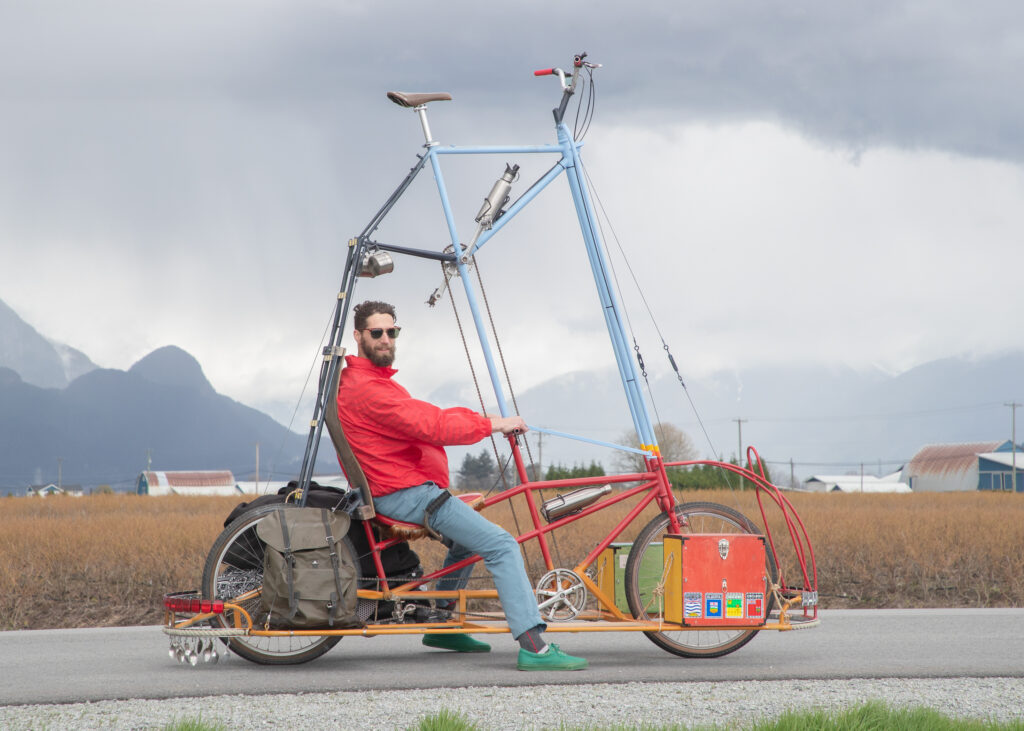
Infinity Cycle riding
Infinity Cycle riding (Image Credit: Zenga Bros)

This passion for reworking and reimagining bicycles eventually led to the creation of the Infinity Cycle around a decade ago – a design that allows two riders to share the workload and keep moving without stopping.

Benny explains the motivation behind the idea: “The only real problem with bicycle travel – tall or otherwise – is that it’s human-powered and humans get tired… Since e-bikes don’t exist in our world, we had to get creative.”

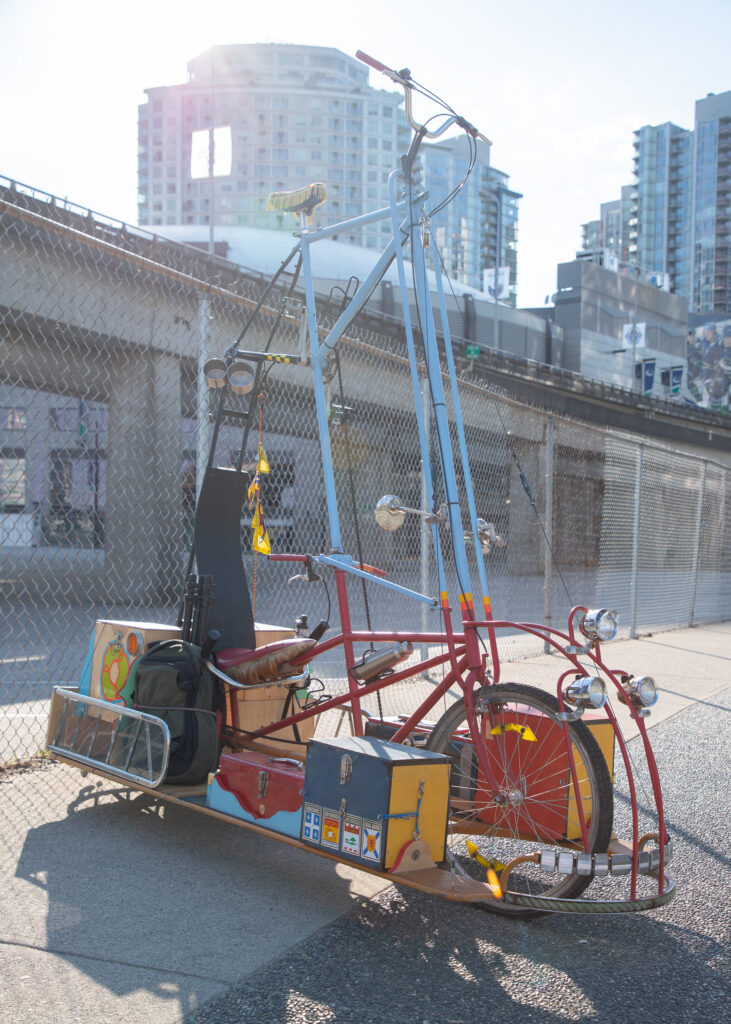
Unlike a traditional tandem, which also lets two riders share the workload, the Infinity Cycle stacks riders on top of one another – essentially a double-decker bike – with space to store supplies, and carry whatever else is needed. The idea is that when the rider on the bottom gets tired, they move to the top, and the rider on top moves to the bottom, creating a continuous cycle that keeps the bike moving forever.
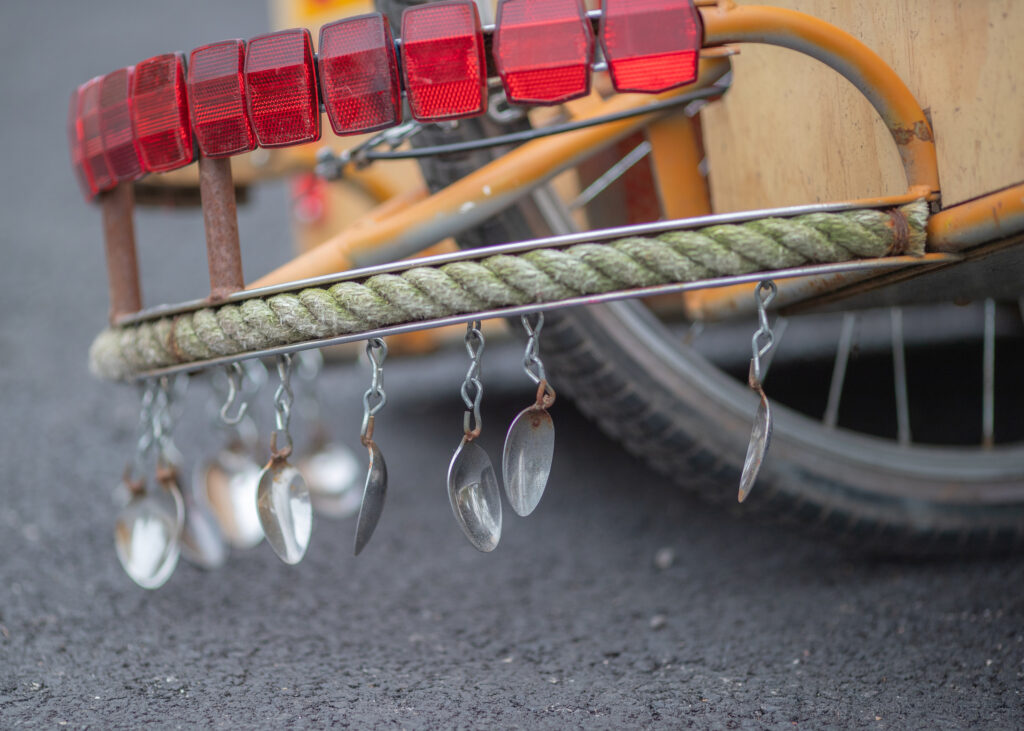
Infinity Cycle Spoon Jingle Truck
Infinity Cycle Spoon Jingle Truck (Image Credit: Zenga Bros)

The Infinity Cycle comes packed with practical and quirky features. It’s equipped with three large front lights, plenty of front and rear reflectors, mirrors, and bottle cages. A ladder at the rear allows riders to climb to the top bike, while panniers and boxes provide plenty of storage. A large undercarriage adds more space to carry supplies.

In true Zenga Bros style, an assortment of spoons dangle from the frame at the rear, adding a playful touch to the touring setup.


Benny, his wife, plus their twin sons Oly and Ike have just started an adventure on the latest version of the Infinity Cycle, mounting four people, as they go on an open-ended tour in Vancouver to raise awareness for the Be a Fool book.

“With two riders, the Infinity Cycle could ride forever – now, with four, it will be able to go even further”, says Zenga.

Benny and his brother Willy Zenga have documented their adventures in the book, which they are currently funding through a Kickstarter campaign. The project is over 60% funded at the time of writing, and aims to inspire readers to tap into their creative potential by sharing 25 years of unconventional projects and adventures.


Emily is our track and road racing specialist, having represented Great Britain at the World and European Track Championships. With a National Title up her sleeve, Emily has just completed her Master’s in Sports Psychology at Loughborough University where she raced for Elite Development Team, Loughborough Lightning. Emily is our go-to for all things training and when not riding or racing bikes, you can find her online shopping or booking flights…the rest of the office is now considering painting their nails to see if that’s the secret to going fast…  

4 Comments

4 thoughts on “Behold the Infinity Cycle, the world’s first double-decker touring bike”

Leave a Comment


Read more...

Read more...

Read more...

Latest Comments

mctrials23 28 minutes ago

@Gd29 I was waiting for the classic "why don't we just ban driving completely by reducing the speed limit to 5mph or 0!" argument and here it is. The statistics are very clear on the benefits of reducing the speed limit from 30-20mph. It doesn't remove bad driving but it mitigates the damage. It also makes fuck all difference to journey times. Everything with driving is risk vs reward. Sure, dropping it to 10mph would save a lot more people but it would make travel by car ridiculous and have minimal benefit vs 20mph. The reward wouldn't be worth the cost.

in: Serious cyclist injuries down 50% and overall road casualties continue to fall since 20mph limit introduced in Wales
chrisonabike 30 minutes ago

@Gd29 "Speed limits are an ineffective tool when the problem is drivers not driving in an appropriate manner for the conditions and environment. Those drivers weren’t following the speed limit and/or paying sufficient attention anyway!" That is a question, not an assertion. What are the relative numbers of drivers who are eg. "don't care" criminals who may never have taken a test or are happy to take life, how many are "criminally negligent" eg. may have a licence and not intend to break the law regardless, but just aren't fussed about basic safe driving (maybe regularly drive while tired, never slow down when conditions require), how many are just normal humans (who occasionally make unfathomable mistakes)? What are the relative rates of collisions? What are the casualty outcomes? What effect does simply changing a number on a sign have? If any, why? (There's the psychological "anchoring effect", if 70% of people *are* below the limit does that slow down others, do the "don't cares" maybe just overtake dangerously (but would they anyway? ) ) etc. Reduced speed is a mitigation in that it leads to better outcomes in collisions, that's a known I believe. IIRC there's also agreement that it can mean that fewer collisions happen as there's more time to react. "If that is the problem and you don’t deal with it, but you want to keep reducing injuries/fatalities, you have to keep dropping speed limits until you prohibit road use entirely" "If" (plus as noted other safety measures are available)

in: Serious cyclist injuries down 50% and overall road casualties continue to fall since 20mph limit introduced in Wales
chrisonabike 42 minutes ago

@Gd29 it's good to "point out potential abuse of stats - and for "keeping it concise for the public" no doubt some measure of "lies, damn lies and statistics" applies. But unless you have your own analysis / evidence, this may sound like a "just asking questions!" rhetorical tactic.

in: Serious cyclist injuries down 50% and overall road casualties continue to fall since 20mph limit introduced in Wales
chrisonabike 45 minutes ago

@Gd29 exactly what variables / controlled experiments would suffice to convince you, and then how would you believe that would still hold in "real world" situations? We all know there are excellent ways to stop motoring-related KSIs - one being stop humans operating vehicles) but that isn't normally seen as realistic. Then there's another "remove the hazard" approach eg. completely isolate motorists from vulnerable road users (and "footways" alone might not be sufficient, as more people are killed there most years by drivers than eg. by cyclists in total, although that fact doesn't say much ). Though that by itself doesn't address motorists killing themselves / other motorists. Currently the UK - like many countries - is mostly doing a "remove the vulnerable road users" approach, partly by design but mostly indirectly by prioritising convenience for motoring (including journey time, which is seen to involve higher speeds).

in: Serious cyclist injuries down 50% and overall road casualties continue to fall since 20mph limit introduced in Wales
jaymack 46 minutes ago

Do you really need an AI tool to tell you that 80% of a cyclist's drag is the rider or that getting in a more streamlined position you'll reduce drag etc.? Fabulous for the professional riders who use this site but for the rest of us our money would be better spent on yoga or pilates classes to help you hold a more streamlined position in the first place.

in: Aero optimisation without the wind tunnel: AiRO launches Vayu AI model to improve your cycling aerodynamics in real time – and Netcompany Ineos has signed up
robgru76 56 minutes ago

Of course drivers need to be responsible and take care but we are in danger of getting a bit high and mighty when police raise issues like this. Since the clocks went back last weekend, I have been commuting home this week in the dark for the first time this year. I am gobsmacked by the number of cyclists I see who have no lights and no reflective gear, often with no helmets either. It's common sense to take precautions and we've got our head in the sand if we pretend all cyclists are taking appropriate steps to protect themselves and others.

in: “How about asking drivers to pay attention?” Police force slammed for hi-vis campaign urging cyclists and pedestrians “to think about what they are wearing”
chrisonabike 1 hour ago

@mdavidford was about to ask them if they thought the law should also been changed to ban the LAs from doing that, so as to save money...

in: Serious cyclist injuries down 50% and overall road casualties continue to fall since 20mph limit introduced in Wales