The Trek Checkpoint SL 7 AXS Gen 3 is the top-level model in the Wisconsin-based brand’s revamped gravel/endurance range and it’s a belter, especially for those who like a ride style on the racier side of things. It’s light, flickable, nimble and fast, while also focusing on comfort for those longer tours, plus the addition of plenty of mounting points, internal frame storage and the ability to run wide tyres doesn’t exclude it from the adventure side of things.
- Gravel racing – what’s next for cycling’s fastest growing discipline?
- Rondo Ruut CF1 G2 gravel bike review
- Best gravel bikes 2024 – drop-bar bikes for off-road riding
Trek Checkpoint SL 7 AXS Gen 3 – Technical details
Trek’s patented carbon-fibre composites are known as Optimum Compaction Low Void (OCLV) carbon. They are available in a range of grades with the 900 series topping the charts with the 800 to follow before we arrive at the 500 series used here on this SL 7.
Summing things up, the higher the level of the OCLV, the less material is required to achieve the same strength as the level below it, so basically this 500 series is a balance of stiffness versus weight and also cost. All OCLV frames come with a lifetime warranty though regardless of the grade used.

The previous SL Gen 2 model also used a 500 series carbon layup but, Trek says that for the Gen 3, the frame has been refined. From an aesthetic point of view, this new version definitely looks more slender with a less bulbous head tube and top tube. Gen 2 didn’t have the IsoSpeed shock absorbing system at the junction between the top and the seat tube either.
This Gen 3 still sports dropped chainstays for increased tyre clearance but that has been improved from 45mm to an impressive 50mm, which adds to that overall versatility.

This bike also has bigger internal frame storage and while it has the same rear rack points and bolting options for four bottle cages as the Gen 2, you now also get front rack mounting points on the carbon fork.
Dropper posts are still catered for, too, but the Gen 3 will also work with a suspension fork should you want to make the switch. Travel is limited to a maximum of 40mm, which I’d say is more than plenty for a gravel bike.

Other neat touches are a hidden mudguard mount should you want to press the Checkpoint into winter trainer mode, or fancy an off-road commuter, plus you get a universal derailleur hanger (UDH), integrated chain guide and a T47 bottom bracket.
From a sizing point of view, the Checkpoint is available in six options ranging from XS to XL, or 49cm to 61cm. Trek give a recommended rider height range of 4’ 8” to 7’ which is pretty impressive.

I gave you a little taster of the geometry earlier, but this seems a good time to give you some exact numbers. This M/L 56cm has an effective top tube length of 578mm, a 151mm head tube and 530mm seat tube. The stack and reach figures are 601mm and 397mm respectively with a fork offset of 49mm. The wheelbase is 1,042mm with 403mm chainstays.
When it comes to the angles it’s 72-degree for the head tube and 73.3-degree for the seat tube. Trek also gives an effective seat tube angle of 72.8-degree to take into account the effects that the IsoSpeed system has on positioning once a rider is seated on the bike.
Trek Checkpoint SL 7 AXS Gen 3 – Componentry
The Checkpoint SL Gen 3 range is made up of three bikes kicking off with the SL 5 priced at £3,700 which includes a SRAM Apex XPLR groupset, alloy wheels and Bontrager Paradigm SL tubeless tyres which gives an all-in weight of around 9.5kg in a M/L size.
The SL 6 makes the jump to Rival for £4,500 while this range-topping SL 7 comes with SRAM’s Force XPLR and Bontrager’s Aeolus Elite 35V carbon fibre wheels for its £6,350 price tag. The whole build comes in at a claimed 9kg for this size.

All of the bikes come with 1x drivetrains with this particular model using a 40T chainring paired to a 10-44T 12 speed cassette. With a 1x chainring, you can fit up to a 44T chainring, or 46/30T with a 2x setup.
SRAM’s latest Force groupset works brilliantly in my opinion. I love the way the shifting works in terms of one lever moving the chain up the cassette while the other drops it down, and regardless of how caked in dirt the chain becomes the rear mech still shifts with plenty of precision and speed.
The braking is also top-notch with loads of power and that all-important modulation continues to be bettered on each iteration.

The rest of the kit hasn’t been scrimped on either. The Bontrager Pro alloy stem has an RRP of £90 and is compatible with Trek’s Blendr accessory range while the Pro Gravel handlebar has a gentle flare and offers plenty of hand positions.
Widths are determined by frame size and this 56cm M/L gets a 44cm offering. A few centimeters wider than I’d use on a road bike, which gives the handling more stability on loose surfaces without slowing it down too much on faster sections.
The seatpost is carbon fibre and you’ll find a Verse Short Elite saddle perched atop. It has a shape that I got on well with and I liked the fact that the padding is firm and reasonably minimal.
The Aeolus Elite 35V TLR wheels have a 35mm deep carbon fibre rim and with a 25mm internal width, the rims are well suited to larger gravel tyres up to that 50mm that the Checkpoint can accommodate.

At a claimed 1,660g, they aren’t the lightest set of gravel wheels out there but they roll well, and I was impressed with their lateral stiffness for hard efforts out of the saddle. More importantly, though their durability is up to the job even if your rides take you over rough sections of gravel. My main testing route has sections of restricted by-ways used for military transport which means the hardcore is on the large and rocky side of which sharp edges become more apparent after heavy rain has washed the dust out of the joints. I hit a few of them, and while the noises weren’t great the wheels stood up to the abuse without issue.
Bontrager’s Girona RSL GR TRL Gravel tyres have a light tread pattern, so they were ideal for those few days in the summer when it wasn’t raining. They also roll well enough on the road sections when threading together a gravel route.

With a 220TPI casing, they feel fairly supple which all adds to the ride feel and as they come already set up tubeless with sealant included you can run them at lower pressures to avoid pinch flats. For the wetter months, you are definitely going to need something with much deeper tread though.
If you fancied building up a Checkpoint to your own specifications Trek offers a frameset option for £2,500.
Trek Checkpoint SL 7 AXS Gen 3 – Performance
If you want to race on the gravel Trek offers the latest Checkmate range where the focus is on point-and-shoot characteristics thanks to an aggressive ride position, low weight and agility. If you want something a little more relaxed, there’s the Checkpoint.
As I mentioned in that opening paragraph though, the Checkpoint is certainly no slouch and, that’s because from a geometry point of view, it’s not wildly different to the Checkmate. The reach is just 2mm less on the Checkpoint, but the stack is 16mm taller and the wheelbase is 7mm longer to calm things down a touch.

All of this gives the Checkpoint added versatility. It’s still quick enough from a handling point of view to take on some flowing singletrack through the woods or fly down a descent on hard-paced gravel while feeling fully in control, but things are backed off just enough that it’s not difficult to ride.
On loose surfaces or when conditions are tricky your more upright body position and confidence-inspiring handling means the Checkpoint always feels easy to control. The 1,042mm wheelbase gives a feeling of stability, and the IsoSpeed system not only improves comfort but also gives the feeling that the rear end is more planted than it is. The IsoSpeed absorbs a lot of the bumps but does it without muting feedback, so you can still feel exactly what the rear tyre is up to.

The whole bike has a balanced nature and gives you the nudge to keep pushing things a little harder. When I found the limit in terms of grip the Checkpoint didn’t rear up and spit me off either; even then, it felt easy to tame and bring back under control.
My longest gravel testing route is around four hours and, while that is not exactly adventure category, it’s definitely long enough to highlight any pain and niggles from my crash-riddled skeleton, and that was something that didn’t happen. The ride quality is really good, helped by the IsoSpeed and the 42mm tyres, but neither of those will be able to fully hide an overly stiff frame. Thankfully, they don’t have to, as Trek has used a carbon layup that works as it should – plenty of stiffness where required, but with compliance in other areas where stiffness isn’t the be-all and end-all.

I spend around half of my cycling time riding road bikes and the Checkpoint is similar from a geometry point of view to an endurance road bike. I could still get plenty of drop from the saddle to the handlebar layout I want, but not by so much that it starts to add too much weight to your neck, shoulders or wrists. This also helps comfort without affecting efficiency.
On longer rides I loved the fact that the Checkpoint is happy just having the pedals turned over, but should the opportunity arise for a bit of fun, like a cheeky downhill it’ll respond straight away and leave a huge grin on your face.
Trek Checkpoint SL 7 AXS Gen 3 – Verdict
Up against the Specialized Diverge STR Expert, which has its own style of bump-taming frame design and internal storage things look pretty good for the Checkpoint.
The STR Pro comes fitted with a 1x Force and SRAM Eagle mullet gearing set up and Spesh’s own carbon Roval Terra CL wheels for a whopping £8,000.
The STR Expert is much closer in price to the Checkpoint SL 7 at £6,250 but you are taking a hit on the spec with a drop to SRAM Rival AXS for the shifters and chainset and the cheaper Roval Terra C wheels. When I reviewed it last year, I was very impressed with the way it rode, but that is a lot of money.

There are some much cheaper options though if you are willing to forgo things like the internal frame storage mind.
I recently reviewed the upgraded Silex from Merida, and it has a lot in common with the Checkpoint. The 700 model I rode used an aluminium frame, but there are many carbon offerings in the lineup.
The geometry is a little different to the Checkpoint with a taller front end with a marginally taller stack height and a longer reach, but it’s a bike that I found to be a lot of fun on fast-flowing sections while being very comfortable for longer treks into the wilderness.
Tyre clearance is a little smaller at 47mm, but it is full of mounting points and will take mudguards. It lacks a few of the features of the Checkpoint SL 7 but the top level Silex 8000 comes with a 2x GRX Di2 groupset (a comparable level to Force) and Easton carbon wheels for just £4,800. The frame is compatible with a suspension fork, too.
Canyon divides their gravel bikes into differing genres with the Grail taking care of racing duties while the Grizl looks after the gravelly adventure kind of things, so similar to the Checkpoint and Checkmate.
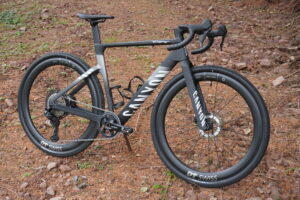
Like Merida, Canyon doesn’t offer a SRAM Force build, but the CF SLX 8 Di2 model comes with the electronic version of Shimano’s gravel groupset GRX and a set of carbon DT Swiss wheels. Like the Checkpoint, it has 50mm of tyre clearance, internal cable routing and shock absorbency, although it uses the seatpost itself rather than any frame-based system. This build will set you back £4,469, although as I always say when it comes to getting a Canyon bike delivered to the UK you’ll need to factor in £50 for carriage and £19 for the Bike Guard box they ship it in.
If you want a suspension fork, then Canyon also sells builds with that option.
I think Trek has done a great job with this latest Gen 3 version of the Checkpoint. It rides brilliantly and I love the characteristics of the frameset and the geometry. It’s a solid, all-round gravel bike for those who want to go far – quickly.
You might also like:
- Scott Addict Gravel 10 gravel bike review
- Gravel bike suspension and dropper posts – do you need them?
- Best gravel wheelsets 2024 – fast and furious off-road wheels
About the bike
Tell us what the bike is for, and who it’s aimed at. What do the manufacturers say about it? How does that compare to your own :
I think it is a great all rounder that has been designed to meet all kinds of gravel riding without compromise.
State the frame material and method of construction. List the components used to build up the bike.:
| Frame | 500 Series OCLV Carbon, IsoSpeed, downtube storage door, hidden mudguard mounts, rack mounts, integrated frame bag mounts, invisible cable routing, T47, flat-mount disc, integrated chainkeeper, removable FD hanger, UDH, 142×12 mm chamfered thru axle |
|---|---|
| Fork | Checkpoint full carbon, tapered carbon steerer, fender mounts, triple rack mounts, flat mount disc, 12x100mm chamfered thru axle |
| *Shifter | |
|---|---|
|
SRAM Force AXS D2, 12 speed |
|
| Rear derailleur | SRAM Force XPLR AXS D2, 44T max cog |
| *Crank | Size: XS, S SRAM Force 1 D2, 40T, DUB, 165 mm length |
| Size: M SRAM Force 1 D2, 40T, DUB, 170 mm length |
|
| Size: ML, L SRAM Force 1 D2, 40T, DUB, 172.5 mm length |
|
| Size: XL SRAM Force 1 D2, 40T, DUB, 175 mm length |
|
| Bottom bracket | SRAM DUB, T47 threaded, internal bearing |
| Cassette | SRAM XG-1271, 10-44, 12-speed |
| Chain | SRAM Force, 12-speed |
| Max. chainring size | 1x:44 2x: 46/30 |
| Wheel front | Bontrager Aeolus Elite 35V, OCLV Carbon, Tubeless Ready, 35mm rim depth, 100x12mm thru axle |
|---|---|
| Wheel rear | Bontrager Aeolus Elite 35V, OCLV Carbon, Tubeless-Ready, 35 mm rim depth, SRAM XD-R driver, 142×12 mm thru axle |
| Skewer front | Bontrager Switch chamfered thru axle, removable lever |
| Skewer rear | Bontrager Switch chamfered thru axle, removable lever |
| Tyre | Bontrager Girona RSL, Tubeless Ready, GR puncture protection, aramid bead, 220 tpi, 700×42 mm |
| Tyre part | Bontrager TLR sealant, 180 ml/6 oz |
| Rim strip | Bontrager TLR |
| Max tyre size | 50 mm without mudguards, 42 mm with mudguards |
| *Saddle | Size: XS, S Verse Short Elite, hollow magnesium rails, 155 mm width |
|---|---|
| Size: M, ML, L, XL Verse Short Elite, hollow magnesium rails, 145 mm width |
|
| Seatpost | Bontrager carbon, 27.2 mm, 8 mm offset, 330 mm length |
| *Handlebar | Size: XS Bontrager Pro Gravel, 40 cm width |
| Size: S, M Bontrager Pro Gravel, 42 cm width |
|
| Size: ML, L Bontrager Pro Gravel, 44 cm width |
|
| Size: XL Bontrager Pro Gravel, 46 cm width |
|
| Handlebar tape | Bontrager Supertack Perf tape |
| *Stem | Size: XS Bontrager Pro, 31.8 mm, Blendr-compatible, 7-degree, 60 mm length |
| Size: S Bontrager Pro, 31.8 mm, Blendr-compatible, 7-degree, 70 mm length |
|
| Size: M, ML Bontrager Pro, 31.8 mm, Blendr-compatible, 7-degree, 80 mm length |
|
| Size: L Bontrager Pro, 31.8 mm, Blendr-compatible, 7-degree, 90 mm length |
|
| Size: XL Bontrager Pro, 31.8 mm, Blendr-compatible, 7-degree, 100 mm length |
|
| Brake | SRAM Force AXS hydraulic disc |
| Brake rotor | SRAM CentreLine X, CentreLock, round edge, 160 mm |
| Rotor size | Max brake rotor sizes: 180mm front and rear |
Frame & Fork
Was the bike comfortable to ride? Tell us how you felt about the ride quality.:
How was the bike in terms of sizing and angles? How did it compare to other bikes of the same stated size and intent?:
Overall rating for frame
Did the bike feel stiff in the right places? Did any part of the bike feel too stiff or too flexible?:
Tell us about the build quality and finish of the frame:
Tell us about the geometry of the frame:
Tell us about the materials used in the frame:
Riding
How did the bike transfer power? Did it feel efficient?:
How would you describe the steering? Was it lively, neutral or unresponsive?:
Tell us some more about the handling. How did the bike feel overall? Did it do particular things well or badly?:
Rate the bike for sprinting:
Rate the bike for high speed descending
Rate the bike for technical descending:
Rate the bike for flat cornering:
Rate the bike for technical climbing:
Rate the bike for climbing efficiency:
Rate the bike for agility:
Drivetrain
Rate the drivetrain for performance:
Rate the drivetrain for durability:
Rate the drivetrain for weight:
Tell us some more about the drivetrain. Anything you particularly did or didn’t like? Any components which didn’t work well to:
Rate the drivetrain for value:
Wheels & tyres
Rate the wheels for performance:
Rate the wheels for durability:
Rate the wheels for weight:
Rate the wheels for comfort:
Rate the wheels for value:
Tell us some more about the wheels.Did they work well in the conditions you encountered? Would you change the wheels? If so, wha:
Rate the tyres for performance:
Rate the tyres for durability:
Rate the tyres for weight:
Rate the tyres for value:
Tell us some more about the tyres. Did they work well in the conditions you encountered? Would you change the tyres? If so, what:
Controls
Rate the controls for performance:
Rate the controls for durability:
Rate the controls for weight:
Rate the controls for comfort:
Tell us some more about the controls. Any particularly good or bad components?:
Summary
Did you enjoy riding the bike?:
Would you consider buying the bike?:
Which components had the most effect (good or bad) on the bike’s performance? would you recommend any changes?:
Would you recommend the bike to a friend?:
Rate the bike overall for performance:
Rate the bike overall for value:
Use this box to explain your score:
All the deals displayed on our review pages are pulled from a constantly updating database feed of the best affiliate deals available. The criteria for deciding on what are the best deals is who is offering the lowest, delivered price. In most cases we will be showing the very best deal available online, but sometimes you may be able to find an item cheaper. If you can please feel free to post a link in the comments box below. To find out more about affiliate links on road.cc click here.