Originally launched in 2017, the Rondo Ruut CF has carved a reputation for its impressive handling and ride quality. Now in its second iteration, the Ruut CF1 aims to build on these fundamentals with a series of radical design and geometry changes that make it even more competitive than before. Like its forebear, it benefits from adjustable geometry but also gets a SRAM UDH interface for compatibility with T-Type drivetrains and the Red XPLR AXS groupset.
- 3T Extrema Italia gravel bike review
- Gravel bike racing – everything you need to know
- Best gravel bikes 2024 – drop-bar bikes for off-road riding

The bike certainly looks intriguing with boxy tubes and outlandish angles that go against the current gravel bike design blueprint – but how does it compare in terms of overall performance and compliance? We spent the past three months getting acquainted with Rondo Ruut CF1 G2 to answer those questions and understand where sits in the gravel bike hierarchy.
Rondo Ruut CF1 G2 gravel bike – Technical details

The Rondo Ruut CF has always stood out among the cookie-cutter facades dominating the gravel bike market. The new model isn’t any different – if anything, it’s even more outlandish than before with geometric shapes and a boxy headtube taking centre stage. Unlike the classic frame triangle designs of its rivals, the Ruut CF preaches the notion of form following function with radically lowered seat stays and a kinked top tube. But the seat tube is probably its most divisive design feature. Unlike a traditional frame, the seat tube eschews the bottom bracket intersection by connecting with the downtube at an angle parallel to the chainstays – the result is claimed to improve comfort and speed. It looks extraordinary and gives the rear end a diamond, leaf-spring-like shape that is unlike anything else on the market.

The geometry has been tweaked over the previous generation but the changes are relatively minor. An extended reach (402mm) and a higher stack value of 565mm have made for a more upright – read comfortable – riding position. The chainstays are relatively short at 420mm while the head angle and fork offset are adjustable via the TwinTip fork with flip-chip design. In the high position, the head angle measures 71.7-degrees with a fork offset of 55mm. The low position is ideal for those who want a gravel suspension fork and relaxes the head angle by 0.7-degrees resulting in a 10mm fork offset and 71-degree head angle.

Tyre clearance has been increased to 45mm with 700c wheels and this can be extended further to 54mm with 650b rims. The latter was chosen as the Polish company believes a smaller wheel is better suited to smaller frames and, considering the smallest frame size is pegged at XS, I tend to agree with this move. There are five frame sizes available with the largest being XL.
While it’s not set up for pure bikepacking adventures, there are myriad mounting options including double bottle cage bosses on the down tube (M, L and XL frames) and a further set of mounts on the top tube and under the downtube. There’s also capacity for bags to be mounted and space for mudguards, too.
Visually, our CF1 test bike’s matte-grey paint is complemented by a black fork. It’s all very refined, very contemporary looking. I especially like the minimalist approach to the graphics and the signage used is meticulously placed and bolsters the overall design. In this instance, a gloss-black Rondo wordmark logo covers the entire right fork leg and is finished with magenta CF lettering, while the left fork has a simpler visual treatment. The magenta theme continues on the frame – a solitary dot on the seat tube and graphics on the strut connecting the downtube and seat tube. Elsewhere, the Rondo logo takes pride of place on the headtube while ‘Ruut’ appears on the headset end of the top tube.
Rondo Ruut CF1 G2 gravel bike – Components

There’s nothing out of this world when it comes to the component list. Despite the UDH functionality, the Rondo Ruut CF1 G2 is built around a SRAM Rival AXS groupset. While this did come as a surprise to me, the new Red XPLR AXS was not available at the time of launch so bikes were outfitted in either Force or Rival AXS – both of which are durable and tried-and-tested for the rigours of off-road riding.

To ensure the Ruut CF1 keeps a clean and uninterrupted facade, it employs an Acros headset system which allows complete integration of the brake hoses and dropper post cables, should you choose to install one.
The Rival DUB crankset comprises a 42T chainring and 172.5mm crankarms and is mated to an XPLR 10-44T cassette. The shifter/brakes are Rival stock as are the calipers and 160mm front/rear rotors. While this particular build is 1x-specific, Rondo can supply a made-to-order front mech for those who’d prefer the extra range afforded by a 2x setup. Other than that, there’s a 27.2mm round seatpost and an asymmetrical, SRAM power meter-compatible T47/77 threaded bottom bracket.

Touchpoints are a mixed affair with a 44cm Spank Wing bar, Velo Comfort bar tape and a Selle Italia Novus Super Boost perch.

A Rondo x Hunt Gravel X-Wide aluminium wheel system wrapped in 40mm Vittoria Terreno tyres round off the build.
Rondo Ruut CF1 G2 gravel bike – Performance
Initial impressions were good but I did need a few rides to dial in my fit and make sure all the bolts were torqued correctly. The Ruut is stiff in all the right places and this translates to an efficient performer on the flats and climbs – the front end is pretty firm and a little lower than other gravel bikes in this category but has little effect on overall compliance. If anything, the lower front end helps the rider place more weight over the front wheel and increases grip without adding any aggression into the riding position.

The work Rondo has carried out to the rear triangle (or is that rhombus?) is immediately evident and helps disperse vibrations and keep both wheels planted on the road surface. It also ensures all pedal inputs translate to forward momentum. Acting like a leaf spring, these rhombus-shaped tubes have shock-absorbing properties that reduce vibrations and smooth out the ride quality. While you don’t necessarily feel this actively working in the background, the Ruut CF1 G2 did feel as quick over corrugated and choppier gravel roads compared to other bikes I had on test at the same time – bikes such as the Specialized Crux with Zipp 303 XPLR S wheels and Cervelo Aspero with Parcours FKT wheels.

There is some vibration power loss owing to the wheels and you can feel this on washboard sections of trails where the rear end starts to bounce around – this can, to a certain extent, be alleviated by lowering the tyre pressure but there’s only so much a 40mm tyre and 25mm internal rim width can do to promote a buttery smooth ride.

I do feel the wheels are the weakness in this build. I would have preferred carbon wheels, perhaps the new Zipp 303 XPLR S wheels – not only to reduce the weight of the bike but to dial in some additional stiffness, tyre compliance and aerodynamics to the wheel system.

This isn’t a defining factor of the CF1, however, as it’s still prodigiously fast and provides loads of feel and feedback through the frame. The geometry is excellent and allows the rider to centre their weight over both axles – owing to this, handling through twisty descents is exceptional and the shooter chainstays improve manoeuvrability even further.
At 9.34kg, it’s not the heaviest gravel bike in the segment and you never really feel its heft, even up steep climbs. The 42T, 10-44T gearing spread is ample and supplies a balance between high and low-speed riding.
Rondo Ruut CF1 G2 gravel bike – Verdict

There’s no such thing as a bad bike these days so it takes a lot for something to stand out amid the bevy of well-rounded gravel options. The Rondo Ruut CF1 G2 stands out for many reasons besides its wild design – it’s beautifully balanced, well-appointed and fast when the going gets rough. It’s also relatively affordable at £4,199 / €4,999.
The Ruut CF1 G2 goes head-to-head against the £4,000 Specialized Diverge Comp Carbon. It’s a little cheaper and has a plusher front end thanks to the Future Shock 2.0, but its groupset is predominantly made up of SRAM Apex AXS (it does get Force levers).
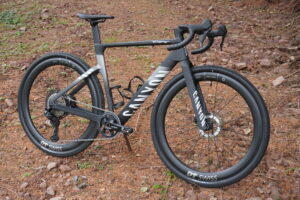
The Canyon Grail CF SL 7 AXS is one of the best value propositions in the best gravel bike space. At £3,299, it’s built around the same SRAM Rival AXS groupset and has similar aluminium Gravel LN wheels by DT Swiss. On paper, it appears the safer bet, but the Rondo has more going for it when it comes to visual drama, and this might be enough to sway your decision – especially if standing out from the crowd is your goal.
In a market dominated by cookie-cutter designs, the Rondo Ruut CF1 G2 stands out in one of the largest growing segments in cycling. While it rides like a dream and features unique adjustable geometry, I’d like to see it fitted with a contemporary aero gravel wheelset and SRAM T-Type drivetrain to fully maximise its potential. Other than that, I feel the Rondo Ruut CF1 G2 gravel bike has a lot to offer the buyer regarding value for money and all-round capability on the trail. Factor in the Polish company’s lifetime warranty and the bike becomes an even more appealing consideration.
You might also like:
- Gravel bike vs mountain bike: what are the differences?
- Best gravel and adventure bikes under £2,000
- Cinelli Zydeco Mud Apex gravel bike review
About the bike
Tell us what the bike is for, and who it’s aimed at. What do the manufacturers say about it? How does that compare to your own :
Frame & Fork
Was the bike comfortable to ride? Tell us how you felt about the ride quality.:
How was the bike in terms of sizing and angles? How did it compare to other bikes of the same stated size and intent?:
Overall rating for frame
Did the bike feel stiff in the right places? Did any part of the bike feel too stiff or too flexible?:
Tell us about the geometry of the frame:
Tell us about the materials used in the frame:
Riding
How did the bike transfer power? Did it feel efficient?:
How would you describe the steering? Was it lively, neutral or unresponsive?:
Tell us some more about the handling. How did the bike feel overall? Did it do particular things well or badly?:
Rate the bike for sprinting:
Rate the bike for high speed descending
Rate the bike for technical descending:
Rate the bike for flat cornering:
Rate the bike for technical climbing:
Rate the bike for climbing efficiency:
Rate the bike for agility:
Drivetrain
Rate the drivetrain for performance:
Rate the drivetrain for durability:
Rate the drivetrain for weight:
Rate the drivetrain for value:
Wheels & tyres
Rate the wheels for performance:
Rate the wheels for durability:
Rate the wheels for weight:
Rate the wheels for comfort:
Rate the wheels for value:
Rate the tyres for performance:
Rate the tyres for durability:
Rate the tyres for weight:
Rate the tyres for value:
Controls
Rate the controls for performance:
Rate the controls for durability:
Rate the controls for weight:
Rate the controls for comfort:
Rate the controls for value:
Summary
Did you enjoy riding the bike?:
Would you consider buying the bike?:
Which components had the most effect (good or bad) on the bike’s performance? would you recommend any changes?:
Would you recommend the bike to a friend?:
Rate the bike overall for performance:
Rate the bike overall for value:
All the deals displayed on our review pages are pulled from a constantly updating database feed of the best affiliate deals available. The criteria for deciding on what are the best deals is who is offering the lowest, delivered price. In most cases we will be showing the very best deal available online, but sometimes you may be able to find an item cheaper. If you can please feel free to post a link in the comments box below. To find out more about affiliate links on road.cc click here.