


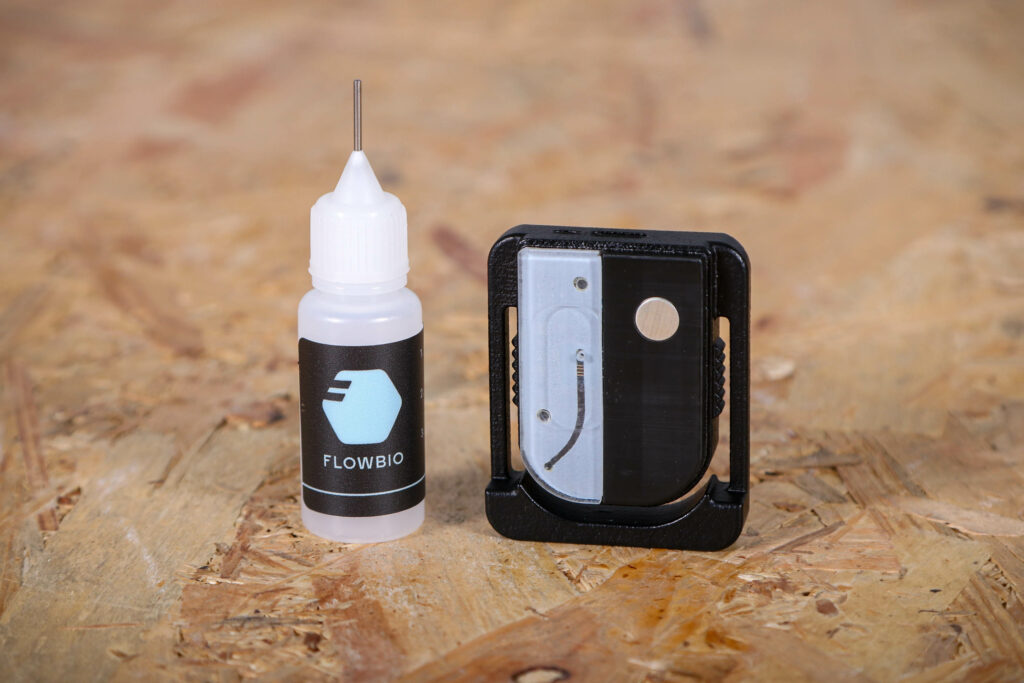

The Flowbio Sensor claims to be ‘the world’s most accurate sweat sensor’, providing post-ride estimates of your water and sodium loss. It’s a wearable device that has improved my awareness of hydration needs, and the user-friendly app offers useful insights. However, it’s currently only available for iOS, though it’s going to be available for Android in April, and the price means it’s not for everyone.
> Buy now: Flowbio Sensor for £379 from Flowbio
These days, you can measure pretty much any metric while riding – heart rate, power, cadence, glycogen levels, core body temperature… Yet, despite the importance of hydration, achieving optimum hydration is often a guessing game for most of us. Unlike other metrics, real-time hydration monitoring has been relatively untapped until now, and the Flowbio is one of the first devices to provide this data.
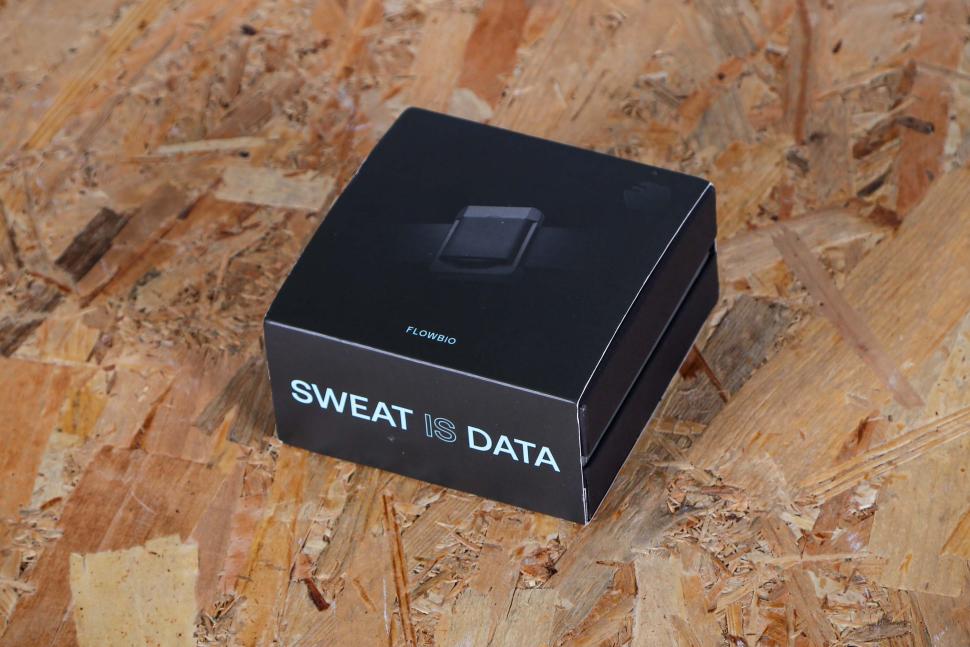
Inside the box, you’ll find the sensor, a simple four-step quick start guide and a small, seemingly mysterious empty bottle with a needle-like attachment.
While it might look like it’s for something else, rest assured, using the Flowbio is a non-invasive process. The bottle is actually for cleaning the sensor with water from time to time to help with the accuracy of the readings.
How does it work?
The sensor collects sweat through a small channel that passes over a conductivity sensor on the underside of the device. It then estimates your overall sweat rate by combining local sweat measurements with skin temperature. The device uses algorithms that factor in environmental conditions and session intensity, taking into account your heart rate or power data.
While I have no way of verifying the accuracy of the data, I recorded consistent data throughout a week-long training camp in Lanzarote, with similar trends observed.
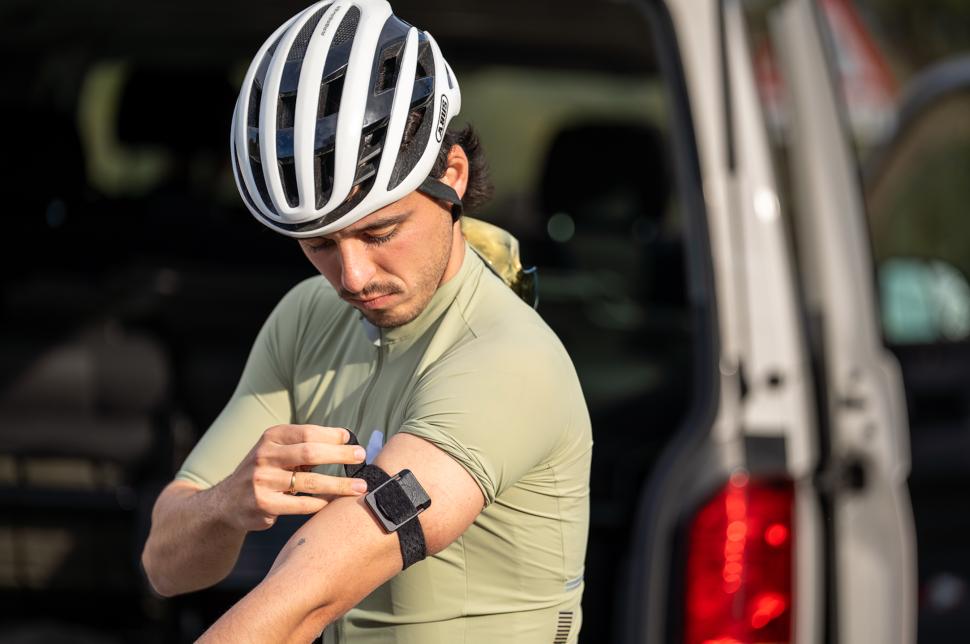
The sensor can either be clipped onto a heart rate chest strap or you can use the arm strap that it’s meant to come with now (ours didn’t); it’s then worn on the back, or the arm. I wore it on a chest strap on my upper back. It stayed in place well, but the sensor lacks a bit of finesse and took some getting used to. Wearing it on the chest strap and with a sports bra meant the placement over my ribs on my back occasionally made it uncomfortable.
I’m hoping to receive an arm strap soon, and will update this review with how well that works and how comfortable it feels.
In use
On the unit itself there is a single button, used for pairing, and there are small LEDs that blink different colours to tell you when it’s on, connected and tracking. You can start and stop sessions using this button or by using the app on your phone, and you then don’t need your phone on you to record while you’re riding.
If you’re wearing it on your back you can’t see these light codes but I tended to stop and start recording through the app on my phone before leaving my house. If you start recording too early, the algorithm crops the activity to the length of the ride, which I found to be effective.
In terms of setting up, it’s pretty straightforward and pairing through the Flowbio App is simple. The app is currently only available for iOS devices, but it’s coming to Android soon. You can then pair with your fitness tracking platform of choice such as Wahoo, Zwift, Coros, Garmin and TrainingPeaks.
Post-ride, you’ll need your phone to sync the data via Bluetooth, where the algorithm then works out the sweat rate and sodium loss. This failed for me a couple of times but the sensor stores the sessions until they have synced.
At the moment, the Flowbio only provides post-ride data, but there are plans to offer real-time guidance. After a ride, you’ll receive an estimate of your total sweat loss, sodium loss and a recommendation of how much fluid and sodium to replenish. Additionally, you’ll get a breakdown of your sweat composition, including total sweat rate and sodium concentration. Feedback of data is simple, with key actionable advice on what you need to replace.
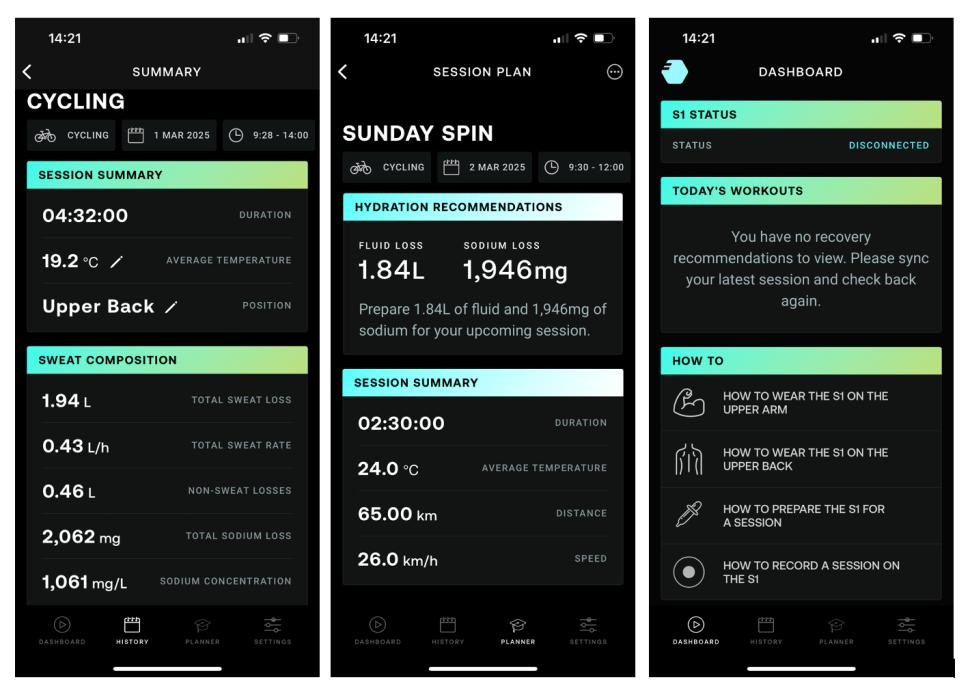
For example, during a 4.5-hour ride in around 20°C, I lost 1.94L of sweat and 2,062mg of sodium, which works out to 1.06g of sodium per litre of sweat, for those who are interested. You’re then given a recommendation for how much you need to replace, but since the sensor doesn’t track what you’ve consumed during the ride, you’ll need to monitor and subtract your intake to figure out what you still need to replenish.
You can also input the details for your next ride, and it will recommend how much fluid and sodium to consume based on the ride’s temperature, distance, speed and time.
While a lot of the time I’m happy to ride on feel, I found this system easy to understand and helpful in adjusting my hydration habits.
Flowbio claims a battery life of 100 hours and I found this to be pretty accurate. It charges via a USB-C cable but this isn’t provided. For the price, I would expect it to come with a charging cable.
The sensor itself is IP55 rated, offering some protection from dust and water.
What are the benefits?
The Flowbio Sensor provides personalised insights that would traditionally require access to a lab or sports scientist. It doesn’t interrupt training, and it’s used in the same environments where athletes train and compete.
It helps fine-tune hydration and rehydration, especially before races or multi-day events, and is useful for planning your race day bottles.
Are the pros using them?
The Flowbio hydration sensor is designed for cyclists, triathletes and runners for both training and racing, and is being used by elite athletes such as WorldTour riders from EF Education-EasyPost and the Brownlee brother triathletes.
Value
At £379, the Flowbio is a significant investment – more expensive than the Core sensor I previously reviewed (and I thought that was expensive!). However, the data may be useful to a wider range of people, and with the potential for real-time hydration tracking during rides, I think the Flowbio could offer better value.
Conclusion
Overall, the Flowbio Sensor performed well and the app is easy to use, providing actionable data to help with rehydration and hydration planning for future rides. Given its price, I think it’s most valuable for those with specific training goals or who are participating in multi-day events where optimal fuelling is essential. For casual riders, the detailed hydration data may not be as useful, as drinking to thirst and following general guidelines, like a bottle an hour, might be sufficient.
> Buy now: Flowbio Sensor for £379 from Flowbio
Verdict
Offers useful hydration insights in a user-friendly app, but it’s pricey and currently iOS only
All the deals displayed on our review pages are pulled from a constantly updating database feed of the best affiliate deals available. The criteria for deciding on what are the best deals is who is offering the lowest, delivered price. In most cases we will be showing the very best deal available online, but sometimes you may be able to find an item cheaper. If you can please feel free to post a link in the comments box below. To find out more about affiliate links on road.cc click here.
road.cc test report
Make and model: Flowbio S1
Size tested: 0
Tell us what the product is for and who it’s aimed at. What do the manufacturers say about it? How does that compare to your own feelings about it?
Flowbio says, “By delivering real-time sweat insights, the FLOWBIO Sensor helps you understand your unique hydration needs – so you can hydrate with precision, perform and recover better.
At the core of FLOWBIO is the world’s most accurate sweat sensor, measuring your water and sodium loss as it happens. Paired with the FLOWBIO App, raw data is transformed into actionable hydration insights, tailored to your physiology and training conditions.”
Tell us some more about the technical aspects of the product?
Flowbio lists:
– BLE/ANT+ connectivity for seamless integration with bike computers, sports watches, and HR monitors.
– Reusable and non-invasive (no needles).
– Measures Sweat Loss (L/HR)
– Measures Sodium Loss (MG/L)
– Skin Temperature Sensor
– 100 Hour Battery Life
– Compatible with IOS & Android (April 2025)
– Can be worn on HR chest strap
– Integrates with Garmin, Zwift, Wahoo & Coros
– USB-C charging
The sensor worked without fault for the review period, providing useful insights.
No issues with the sensor throughout the review period.
It took some getting used to and wasn’t always the most comfortable when worn on my heart rate chest strap under my sports bra. The arm strap might well be more comfortable.
We haven’t reviewed a product like this before, so it’s a bit difficult to compare value. It’s a bit expensive up front, but there’s no ongoing subscription cost.
Tell us how the product performed overall when used for its designed purpose
It performed well. It was easy to set up with a clear and easy-to-use app experience.
Tell us what you particularly liked about the product
Simple operation and user-friendly app as well as the actionable data.
Tell us what you particularly disliked about the product
The unit could be more refined for improved comfort.
Did you enjoy using the product? Yes
Would you consider buying the product? Maybe
Would you recommend the product to a friend? Yes, depending on the person.
Use this box to explain your overall score
The Flowbio Sensor performed well and is easy to use, providing actionable data for rehydration and hydration planning. However, it comes at a premium price, and there’s room for improvement, such as comfort, including a charger in the package, and offering real-time insights during a ride.
About the tester
Age: 25 Height: 175 Weight: 64
I usually ride: specialised tarmac sl6 My best bike is:
I’ve been riding for: 10-20 years I ride: Most days I would class myself as: Expert
I regularly do the following types of riding: road racing, commuting, club rides, general fitness riding, fixed/singlespeed, mtb,



8 thoughts on “Flowbio Sensor”
“At £379, the Flowbio is a
“At £379, the Flowbio is a significant investment…”, that’s something of an understatement. Evolution is smarter than even the slipperiest of Snake Oil salesmen. Can you imagine our ancestors stopping to hydrate while hunting their prey or while being chased by the Sabre toothed Tiger? Of course hydration is important but evolution has equipped each of us with an inbuilt sensor, it’s called ‘thirst’. Ignoring it is dangerous, anticipating it is sensible but paying £379 for a machine to tell you something a million years of evolution has enabled us to manage is bonkers. Spending a tenner on ‘Good to Go’ by Christine Aschwanden may prove a more worthwhile investment.
Given that the smilodon would
Given that the smilodon would have hunted using surprise and brief bursts of high speed, I’m not sure hydration would have been much of a factor for the short time any human unlucky enough to be targetted by one would have had left, even if they’d happened to have had a bicycle to hand.
I’m not sure that aero carbon
I’m not sure that aero carbon fiber bike would have been much use in such circumstances. But a gravel bike, well that’s another story…
Spending a tenner on ‘Good to
Spending a tenner on ‘Good to Go’ by Christine Aschwanden may prove a more worthwhile investment
Another weakness of this very expensive approach is the assumption, apparently unchallenged by anyone around here or in ‘the business’, that sodium losses must be replaced. There’s too much sodium lying around in the average healthy body because of the excessively salty diet. The story, when I last looked it up and which may be true, is that evolution (the non-snakeoil version) has equipped us with a very efficient system for conserving sodium and a less good system for getting rid of it- this is one cause of the worldwide epidemic of hypertension. The great majority of us (this may not apply to elite athletes who are training and sweating most days) have loads of spare sodium and one way of getting rid of it is sweating, so we don’t need to replace it- losing it will do us good. When you’re getting low on sodium, a lot less is excreted in the sweat.
Hyponatremia is a real risk
Hyponatremia is a real risk even for an amateur cyclist or runner in hot weather. I’ve bonked from it before, and I was drinking Gatorade the whole ride to try to keep my electrolytes up, but it was around 38 °C / 100 °F, and Gatorade just doesn’t have enough electrolytes for that. I spent the last half hour of the ride nauseous and barely hanging onto someone’s wheel, regretting not buying that bag of crisps that I was craving at the previous stop.
My blood pressure is great.
Fair enough, personal
Fair enough, personal experience may trump (not that one) theory. However, the bonking I have experienced has been due to lack of carbs. Your point hangs on being able to demonstrate hyponatraemia in a ‘bonking’ athlete. I recall hyponatraemia being demonstrated in people being very ill during marathons etc. due to over-hydration. Clearly, a difficult subject to disentangle, but for decades I have not specifically replaced electrolytes and have relied on cakes, buns, chocolate and the odd sandwich or sausage roll etc. I have certainly never consumed Gatorade, even when I was living in California.
I’d say it is an extremely
I’d say it is an extremely rare condition for most cyclists or runners.
This is tech doing it’s job,
This is tech doing it’s job, extracting money from punters.