



Shimano has said that the global cycling market remains “weak” as the company revealed that sales of bicycle components fell by a quarter during the opening nine months of the year – and detailed figures published by the Japan-based components giant reveal that sales of bicycle components in the key European market are hardest hit, and are forecast to drop by half in the second half of 2023.
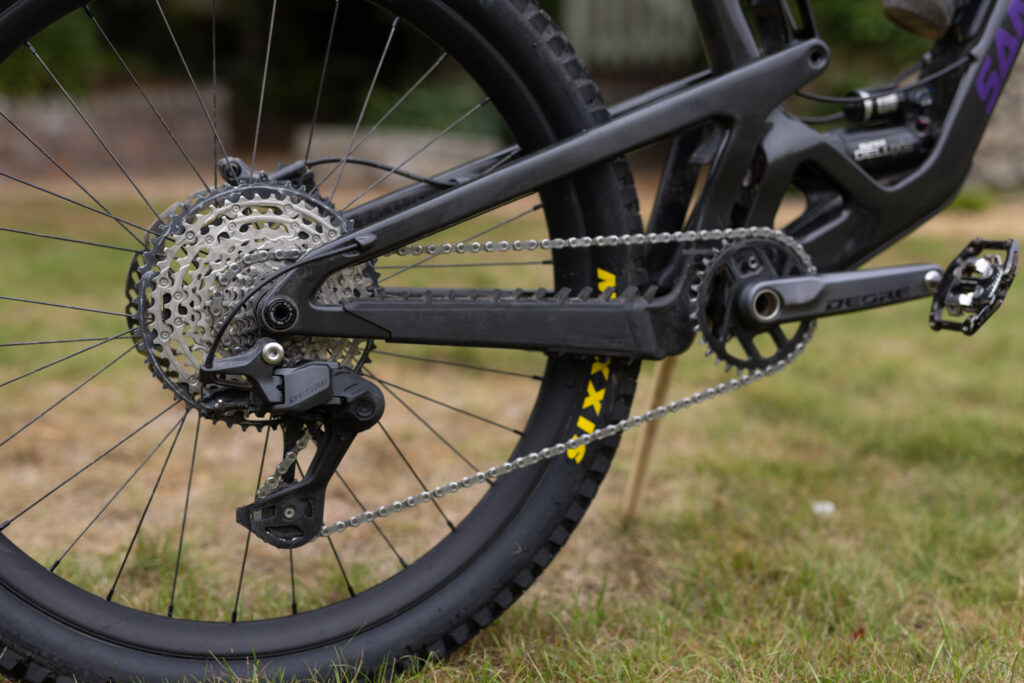
In its third-quarter 2023 financial statement, Shimano – which last month issued a global product recall of 760,000 Dura-Ace and Ultegra cranksets after a reported 4,500 instances of failure – highlighted that new launches this year including the 12-speed 105 and gravel-specific GRX groupsets had met with “a favourable” reception.
> “About time” – Cyclists react to Shimano crank recall after more than 4,500 incidents
However, overall sales within the bicycle components section fell by 24.8 per cent compared to the first nine months of 2022, standing at ¥289,443 million (£1.59 billion). Operating income within the segment fell by nearly half, down 48.8 year on year to ¥55,917 million (£0.31 billion).
The company’s other major product segment, fishing tackle, saw sales edge upwards by 3.4 per cent to reach ¥85,472 million (£0.47 billion), with operating income of ¥16,200 million (£0.09 billion), down 7.3 per cent on the previous year.
Group sales for the period were ¥375,264 million (£2.06 billion), down 19.7 per cent on the first nine months of 2022, generating operating income of ¥72,086 million (£0.4 billion), a decline of 43.8 per cent.
Shimano said that the global economy remains “lacklustre” due to factors including the ongoing conflict in Ukraine, as well as rises in interest rates imposed by central banks to try and curb inflation.
> What the hell is going on in the bike industry?
Due to its strength in componentry, Shimano is something of a bellwether for the cycling industry as a whole, and despite posting record sales last year has previously cautioned that the growth driven by the boom in bicycle sales at the height of the coronavirus pandemic would be unsustainable in the coming years.
One of the effects of that is that that levels of inventory were higher than usual, a situation that still subsists according to Shimano’s third-quarter financial results, released today.
A separate detailed breakdown of its turnover by business segment and geographical market reveals that after a fall of 16.7 per cent in Europe – a market that in 2022 made up 57.1 per cent of total segment sales – during the first six months of 2023, bicycle component sales there are forecast to fall by 50.2 per cent in the second half of the year.
Commenting specifically on the cycling segment which accounts for a little over three quarters of its total revenue, the business said: “Although the strong interest in bicycles [during the pandemic] cooled down, interest in bicycles continued to be high as a long-term trend. On the other hand, market inventories generally remained high, despite ongoing supply and demand adjustments.
“Overseas, in the European market, the strong interest in bicycles continued in our major market, namely, Germany and Benelux countries, and retail sales of completed bicycles were strong. Market inventories, however, remained at high levels.
“In the North American market, retail sales of completed bicycles remained weak and market inventories were at a consistently high level, despite some progress in inventory adjustment.
“In the Asian, Oceanian and Central and South American markets, although interest in bicycles was firm, retail sales of completed bicycles remained somewhat sluggish due to cooling consumer confidence on account of rising inflation and economic uncertainty, and market inventories were at a high level. However, in the Chinese market, sales remained strong, especially for road bikes, owing to the continued popularity of outdoor sports cycling, and market inventories remained at an appropriate level.
“In the Japanese market, retail sales were somewhat sluggish as affected by the soaring price of completed bicycles due to yen depreciation and pullbacks in consumer spending and market inventories remained somewhat high,” the company added.
Despite its financial performance, Shimano’s shares rose 3.95 per cent in trading on the Tokyo Stock Exchange, although they remain 39.3 per cent below the all-time high of ¥35,470 (£195.15) achieved in July 2021 when the benefits of the pandemic-driven boom were at their height.
Commentary by road.cc technical editor, Mat Brett
Shimano, easily the biggest of the major groupset brands, continues to introduce components that have been well-received by both the cycling press and consumers.
The Shimano 105 R7100 Di2 groupset that was introduced in the summer of 2022 has proved to be immensely popular, as has the mechanical version that was launched at the end of August this year. Shimano has also unveiled new cross-compatible CUES groupsets for city, touring and mountain bikes, consolidating Claris, Sora and Tiagra, which could be a game changer for both bike shops and consumers.
> Chapeau, Shimano: CUES looks like a genuine game changer for bike shops, brands and consumers
Over on the gravel side of things, Shimano has recently released mechanical 12-speed GRX components which should consolidate its position in that market.
On the downside, many brands have reported long delays in receiving Shimano products with updated delivery dates only communicated days before anticipated arrival, in many cases.
Then, of course, there has been the Shimano 11-speed crank situation over the past few weeks. A voluntary inspection and replacement recall notice for 760,000 Dura-Ace and Ultegra bonded 11-speed road cranksets was announced in North America at the end of September while a safety inspection and replacement programme is being implemented in other territories.
The monetary cost of this is likely to be immense, as is the damage to Shimano’s reputation for reliability.








28 thoughts on “Bike industry turmoil: Shimano says global cycling market remains “weak” as segment sales fall by a quarter – and worse to come?”
In the UK what do expect,
In the UK what do expect, when the cost of stuff you can not do without, Food – a roof over your head is at just so expensive, people not spending on bikes kit or bits for bike, just making do with and fixing what they have is the only way forward, then it is no wonder that the bike industry is not in profit -when most people in the UK are far from being in profit in there dail lives – real wages are rubish today and when every thing cost to much this is no shock!!!
This news cannot be taking
This news cannot be taking the manufacturers by surprise, at least if they have someone in their organisation with a vague grasp of economics. Prices have been skyrocketing over the past few years, well ahead of inflation, and people are now being squeezed to the extent that they cannot justify spending enormous amounts on over-priced kit and components.
I put together an almost peloton-standard bike in 2016 for around £3,000 which, adjusting for inflation, would be around £4,000 today. However, a quick Google suggests that it would cost upwards of £8,000 to put together today’s equivalent which is bonkers.
Agreed. Seems like only
Agreed. Seems like only yesterday we were being told the market was so hot that it was impossible to buy a bike as everything was out of stock. If it’s now collapsed you have to ask why. Because they’re so focussed on the top end which is ludicrously expensive at massively diminishing returns, while not delivering to normal humans, would be my guess.
As an enthusiast since the
As an enthusiast since the late 80s I took great pleasure in upgrading bikes , frameset one year, groupset a few years later, replacing parts in between. Now bike tech almost demands that you buy a complete brand new bike. Framesets are hard to come by and the price is narly as much as a complete bike. The tech now makes it difficult (not impossible) to build a new bike from scratch, at least not without additional expensive tools, or paying even more for someone to else to do it for you. The industry is slowly strangling the customer base that supported it for soo many years. I certainly won’t be buying a new bike ever again.
This is the trouble with
This is the trouble with chasing the big bucks that come with selling high-tech new geegaws to rich people. Sooner or later, they will move on to the next fad, and you’ll have to go crawling back to your old customers, hoping you haven’t completely alienated them. And the specialist journalists, who symbiotically have to stay close (but not too close) to the industry they cover, will likewise have to change their tune.
I don’t think I’ll help a lot
I don’t think I’ll help a lot in the future. The front derailleur I use has been scrapped, they don’t do ten speed downtube shifters anymore, silver hubs are becoming a rare thing from them…
The problem with cycling is
The problem with cycling is the go faster part is your legs. You can’t get away from the massive gains a training plan will give you over disc brakes and shifting easier or whatever.
You just can’t sell them like motorbikes which will have a better engine, electronics, gadgets etc. I know people who will buy a new motorbike every year but there isn’t the same hold over people in cycling. I have a carbon frame, a Sora groupset and some r501 wheels. It will do.
Yes, absolutely. I’ve got an
Yes, absolutely. I’ve got an Allez Sport with Sora – it’s perfectly fine, and will certainly do until it wears out.
I think one of the biggest
I think one of the biggest reasons for the drop, as highlighted by comments here, is the fact that the companies such as Shimano see their customers as cash rich fools. And in my opinion the single biggest mistake many manufacturers have made is to pursue electronic groupsets and stop making mechanical groupsets. I’ll be honest, I’ve got lots of bikes, three of which cost me £5k, £4.5k and £7.5k. All of them have top end mechanical group sets, GRX, Record 12 speed and Super Record RS 11 speed. If I cannot buy a mechanical groupset in the future I will not buy another bike. My beloved Colnago C60 will never be upgraded, as the current Colnago C frame is electronic groupset only compatible. So Colnago have lost me as a customer if I decide to buy another bike. The industry is all about what the manufacturers want to sell the customer and how much profit they can make out of them, not about what the customer actually wants. Do any manufacturers actually think about how their customers actually feel about the situation? No. Because they just want to continuously shaft them, and, as has been reported here, its beginning to bite them on the backside.
Take the current madness with concealed cables in forks, stems and bars. Yes, it may look sleek but do the manufacturers care that once the bike requires a new cable or headset bearings it entails a job taking bike shops hours, with a bill for fitting a new cable coming in at over £100 including Labour.
Madness, absolute madness.
bit off more than folks are
bit off more than folks are willing to chew (or, something like that). yep; I don’t want, need nor am I willing to purchase cf wheelsets for their disc brake tech. my rim brake wheelsets are still great and swapable; so, no sale shimano….buh bye
For those saying “Its their
For those saying “Its their own fault because they made everything too fancy now I won’t buy it.” You weren’t buying anything anyway. If you refuse to upgrade to the next thing because its too fancy you sure as hell weren’t going to replace a working drivetrain with the same thing again.
They make products for people who are buying products, not people who are complaining on the internet. The people who are spending money want something new to justify spending that money. If Shimano didn’t change their products (sometimes for change’s sake) they would lose all of their sales to the competition who do change things up.
Realistically, whatever your personal bias, bike products are a lot better now than they were 10 years ago because of this constant iterative development, disc brakes stop better than rim brakes, 12 speed shifts better and lasts just as long as 10 speed.
I cannot really feel anxious
I cannot really feel anxious about Shimano because it has an unprecedented advantage, it has an almost monopoly in a global market. It is good that Shimano exists because it gave us components and developed tech that was light, reliable and easy to operate, but now it has become I expensive compared with the equivalent chinese Sensah and L-Twoo and still can make huge profits. Why? Because most bikes have Shimano components.
Bikes will still continue to be sold, with most of them never to exceed 1000 miles ridden. And as more and more former developing countries have managed to improve their finances, billions of people can have the ability to buy a Shimano equiped bicycle.
I know that the latest Dura-Ace seems super expensive. But try imagining living in the 1980s riding with friction tube shifters and suddenly you ride a modern bike with Claris. You would be super-impressed, speaking about a miracle a technology, willing to spent a lot of money to buy this bike. Well now a Claris bike is maybe more expensive but much cheaper compared to a Dura-Ace one.
I believe few people are willing to buy top-end components from brands like Sensah and L-Twoo, as I find it hard for luxury frames like Moots, Colnago, Cervelo, Look etc to accept an “unbranded” part on their bikes, even if was possibly better (like Shimano was when it started). But in lower specs, such brands could make a difference.
The bike industry will burn
The bike industry will burn then return with more thought to the working person rather than the corporate banker with x amount of disposable cash to blow on a 15k road bike with zero technology for the money..I can’t really think of another sport that takes the piss so badly its sad really.. if you are a serious cyclist then you love the feel of a nice light bike but it costs more than the car on the drive !!!@ get real
What the hell is wrong going
What the hell is wrong going on in the bike industry? This statement proves how out of touch the bike industry is with the average person. They push bikes that $8,000 and a lot more, they push $1,000 wheel sets and more, really? They think we’re a bunch of millionaires out paying whatever price they think they can throw at us. Even a simple mini pump costs over $50 if you want one that actually gets up to the pressure you need on a road bike; it’s the same thing with tires, those to cost in excess of $60 each, a pair will cost about the same as car tire, and two bike tires don’t have anywhere near the material used in it as a car tire does, nor does a bike tire have anywhere near the technology in it that a car tire has. Or $80 for a bottle cage made of a tiny amount of carbon fiber that it shouldn’t cost more than $20.
Even a $5,000 bike is nowhere near worth $5,000 in technology and gear, there are a lot of motorcycles you can buy brand new for that price, and there is no way that a bike has more technology than a motorcycle, not even close. Those $5,000 bikes are only worth $2,000 at the most.
People are tired of finding out they have to spend $5,000 bicycles or more on a bicycle. We don’t need electronic shifting, we don’t need disk brakes on a road bike. We don’t need bikes so fragile we have to use a torque wrench to prevent damaging the frame.
The cycling industry has gone insane and then wants us to pay for that insanity.
Change the record FFS.
Change the record FFS.
mark1a wrote:
No, no! I like the frozen one’s song – an early Bob Dylan style compared to your own Perry Como posts. 🙂
Look – I do like a drink
Look – I do like a drink myself, but 10am is a bit early for me, even on a Saturday. Try taking a bit more water with it and see if your posts are just as delusional then.
mark1a wrote:
No drank for moi, old snapper, that’s for bad-tempered little fellows with pub opinions ….. although riding past all the fly agaric fungi out on the verges just now might have an effect on me sensorium and it’s processor ….. .
I often wonder if a dose of the hallucinogenic might do thee a bit o’ good, mind. Or you could just put a drop of oil on that stiff neck. 🙂
Cugel wrote:
It certainly did something for Albert Hofmann. Bike trip indeed.
chrisonatrike wrote:
It certainly did something for Albert Hofmann. Bike trip indeed.— Cugel
Quick! Send this snippet to them as done that survey to show that cyclists are nicer than drivists. You may have discovered the hidden factor in this nice-cyclist phenomenon (assuming it is one and not an artefact of the study-design, as usual with such studies).
froze wrote:
I know, right? It’s the same everywhere, my wife took me out for dinner last week for my birthday and we were charged £30 each a plate for food that was worth £10 of ingredients tops. The resterateur tried to give us some old pony about the cost of running the premises, cooking the food, paying the chef and the waiter etc but we weren’t fooled, it was all just excuses for not letting us have the food for the price he paid for it. Madness.
Rendel Harris wrote:
🙂 But do you go willingly to the fashionable eatery advertised via newspap “reviews” where the chef is “so good” that “a seat” costs hundreds of quids and the plate has hardly anything on it; and nothing worth eating?
It’s no good complaining about capitalists exploiting the bejasus out of everyone and everything they can. This is the nature of the beast. Of course, some would like to corral the beast or even take it to the abbatoir but then there would be moans aplenty about the various lacks of “conveniences” and “my little pleasures”.
Personally I reach a half-arsed compromise via never ever paying full price for anything, shopping around, buying second hand and other consuming practices that do nothing to reign in the capitalist beast but at least ensure that when it kicks me the hoof gives only a glancing blow; a bruise not a break; a manageable purse-pain not a permanent maiming or even murder of the personal finances.
The fundamental question: am I willing to pay what they ask? The fundamental answer: very rarely, so find summick near identical for far less. Often this involves only looking for a different label, whether of bike manufacturer or hierarchy-position of a gubbins. Why pay for Dura Ace on a Cervelo when 105 on a Triban will work as well or even better (doesn’t disintegrate after a bit of use) for 99.99% of cyclist purposes?
********
Those ludicrous prices for so-called top-end stuff – well, just ignore the lot. Only dafties go there: those with too much money and not enough sense as well as those with far from enough money but even less sense.
Of course the frock-promenaders will always pay more for less. It’s part of frock-displaying culture to be so fashionable that nothing else matters but the envy of other frockers. Value for money? “Pah!” says the frocker. Image is everything so substance may be as ephemeral as a pretty morning mist on the dung heap, replaceable by tomorrow’s morning mist on the pig sty when the next new bike frock fashion comes at your eye.
But when someone guffaws at the frocker’s daft, they invent “reasons” such as, “It’s just how it is if you want the best” or, “It’s the R&D costs”. All nonsense but when someone giggles at your expensive bike frock you must fend them away, away, somehow!
froze wrote:
No-one is forcing you to buy a £5,000 bike or £1,000+ carbon wheels. Who told you that? You’re equally not compelled to shell £70k on a fat SUV with all the gizmos and gadgets. Do you not have any freedom of choice?
I’m amazed at how much people are willing to spend on watches and phones, just to know the time of day, their RHR or to waste time on social media.
If people want to buy an SL8, a Lab 71 etc then why shouldn’t they? I have no issue with it. It’s all fine as long as there are also bikes available for the rest of us with fewer pennies to spend. Look at Specialized, Trek, Giant websites. Of course they’re pushing the fancy models (at least to those who follow racing) but there are plenty of alloy and cheaper carbon models available too.
The market being “in turmoil” is not due to the inflated RRP of a small number of high-end models with electronic groupsets, it’s a general downturn in sales across the board. Some dealers are saying that sales of expensive bikes are holding up but it’s the lower priced models, that previously sold in far larger numbers, are sat on showroom floors and in massive warehouses.
Wrong, dear Simon. We want
Wrong, dear Simon. We want SL8 and Lab 71 but NOT priced €14000 because it’s not worth so much because these crazy prices do not correspond to what most people earn. So sales have dropped, as they should, because there’s less demand for that overpriced shite. In 2017 I paid about €8000 for a fully specd SuperSix Evo HiMod Disc, which was already very expensive BUT now costs €12000. Yet I still earn as much as back then. The market is correcting itself, Adam Smith called it the “invisible hand”.
Boss Hogg wrote:
That hand is not so invisible! In fact, it’s many hands, belonging to various bankers, financiers and their pet lawmakers, who construct this market you mention according to a cunning plan rather than any natural law.
In practice, Momma Nature seems to greatly dislike their plot and is currently in the process of sweeping it and them away. Sadly, we will all get caught in her broom.
As to the daft-price bicycles …. surely you have noticed that there are still plenty of dafties happy to pay for them? It’s like them handbags and shoes, see. And the watches. The 1% of 8 billion is still a lot of
dupescustomersI’ve owned 3 road bikes in my
I’ve owned 3 road bikes in my life.
– trek 1000 (circa 2000) second hand with Sora group set. $400usd
– Merida Reacto ultegra (circa 2011) $2000 Australian Dollars
trek Emonda 2023 $7800 AUD
I look at my fancy new trek and love riding it, but realise at the same time how it was the worst decision to spend that kind of money on a bike that. Where does it end? I feel like I was caught up in the craze of chasing the super bike, lured into blowing money on a bike that I could still keep up with, on my 12 year old bike.
Bike companies keep pushing the bs mantra of aero/watt savings and compliance etc to justify this nonsense.
next time I’m going back to basics and I guarantee I’ll still love the ride, heck I’ll probably get a second hand mountain bike too and still come out well under the price of my Emonda.
Bike manufacturers have overreached and people are starting to see the picture. Only wish I had…
I have 2 decent but not
I have 2 decent but not ridiculous bikes plus a single speed commuter. I won’t be buying another,,perhaps ever. Isn’t that part of the problem with new bike sales? Post the boom, everyone’s got one. Or two.
Shimano says demand is weak
Shimano says demand is weak yet I wonder. For instance some of my favorite bike brands are now only offering SRAM. Why?
Is SRAM preceived as better? All the bikes I’ve bought in the last 35 years have been Shimano but now I see the possibility that my next one might be SRAM because it isn’t available with Shimano.
There is some key info missing from this article about the competition and its’ effect on Shimano’s hegemony in the bicycle component market.