



Josh Tarling’s superb time trial victory over Primož Roglič at the Giro d’Italia, the 21-year-old Welshman’s maiden grand tour stage win, wasn’t the only big European triumph for a promising young British rider this weekend. Over in Belgium, hill climb sensation Harry Hudson underlined his climbing credentials with a brilliant win atop the iconic Côte de la Redoute at the junior edition of Liège-Bastogne-Liège.
However, the sprint that secured Hudson’s breakthrough success has been mired in controversy, after a police motorbike rider, taking a deviation just 10 metres before the finish line at the top of the climb, swerved right into the path of Leander De Gendt, obstructing the young Belgian and forcing him to duck inside to avoid a crash.
De Gendt managed to restart his sprint, but narrowly lost to 17-year-old Hudson, prompting his furious Cannibal–Victorious team, the junior squad of WorldTour outfit Bahrain Victorious, to launch an official complaint with the UCI, arguing that both riders should have been awarded the win.
However, the race jury has defended its decision to give the victory solely to Harrogate Nova rider Hudson, guesting for Fensham Howes MAS Design at Liège-Bastogne-Liège, because De Gendt was “seriously hindered” by the motorbike rider, and not his British rival, ensuring the result stands.
17-year-old Hudson, who has placed third overall among the elite riders at the last two editions of the British hill climb championships, formed part of an eight-strong leading group that contested the finale of Saturday’s junior Liège-Bastogne-Liège.
At the top of the fearsomely steep Côte de la Redoute, where the finish of the U19 version of La Doyenne is located, Hudson and De Gendt had surged clear of the rest of the group, as fellow Brits Max Hinds of Fensham Howes and Matthew Peace, racing for Tofauti Everyone Active Majoco, took third and fourth, respectively.
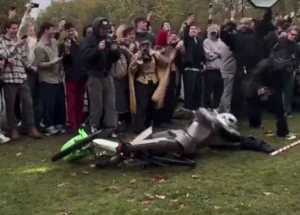
However, footage of the finish shows a police motorbike rider hovering in front of the leading duo just metres before the line. Then, after seemingly being directed by a marshal to take the deviation designated for race cars and motos, the police officer suddenly veers right and cuts across De Gendt’s path, almost causing the young Belgian to crash.
While he managed to remain upright, ultimately losing out to Hudson by a wheel length, De Gendt was understandably upset at the finish.

“I can’t believe it,” he told Het Nieuwsblad. “I really don’t know how this is possible. That police officer should be much more careful, right?
“Now I had to swerve in the middle of the final. My sprint was interrupted. And I still came within a few centimetres of victory. This hurts so much.”
He continued: “This was the day I was hoping for. And I also had the legs to win. It was definitely going to be close, and I’m certainly not going to say that I would have actually won. But the chance of standing on the top step of the podium here was quite big.”
Meanwhile, Hudson, who adds Liège-Bastogne-Liège to his CiCLE Classic win earlier this year, also agreed that the win could have gone either way without the motorcyclist’s bizarre intervention.
“I can’t say which of the two of us would have won,” the teenager said. “It would have been close in any case.
“But just as there was a big chance that Leander could have won, I certainly had a chance of winning without that manoeuvre by the police motorcyclist. Because my final sprint had only just started.”
The motorbike rider’s potentially race-deciding actions have been widely condemned on social media, with one noting that “these kinds of things keep happening”, while another called for the police officer to be “banned from all races”.

After the finish, De Gendt’s Cannibal-Victorious pleaded with the race jury to award the victory to both riders, in what would have been a rare ‘Ex aequo’ decision, but were rebuffed.
“We can’t change the result because the winner didn’t make a mistake,” one of the race jury told the Belgian press.
“Okay, the rider who finished second was seriously hindered. But purely theoretically, the winner didn’t make a mistake. And so, the result stands.”
Posting on social media, Cannibal-Victorious were scathing of the jury’s decision, writing: “The correct way should be two winners, [but the] organisation thinks otherwise. Shame on them.”
The U19 team’s manager Francis Van Mechelen also confirmed that the squad had lodged an official complaint with the UCI, saying “we won’t let this happen”.
“We will continue with this. We will not leave it like this,” he said. “It is a competition for juniors. There is no money to be made with this. But for these guys it is about earning a contract for the following years.
“And then the victory is taken away from him. I had suggested putting both riders in first place. That is apparently not possible. I’m disappointed that Belgian Cycling wasn’t responsive to this request. What difference does it make? So, we have to take further steps.”
That chaotic finale came after the race was also neutralised earlier in the day due to several crashes in the bunch.
Describing that move by the race organisers as a “logical decision”, De Gendt said: “Safety comes first and at that moment there were no more ambulances available. The crashes were mainly the result of the stress among the riders to be in front of every climb beforehand.
“But that attention for safety should have been kept until the last metres. I really wanted to know who would have won. That would have been the most honest thing. Now there will always be a what if.”
Belgian legend Philippe Gilbert, a former winner at the senior Liège-Bastogne-Liège also weighed in, describing the situation as a “shame for Leander and also for the organisation”.
“I have never seen this before. And I think De Gendt would have won. But this also falls under the facts of the race,” Gilbert said.
The senior edition of La Doyenne also wasn’t without controversy this year, after a van driver pulled out onto the course in front of the breakaway during the men’s race and a spectator rode his bike on the route of the women’s race, latching on to the back wheel of race leader Pauliena Rooijakkers before being escorted off the road by a motorbike-riding marshal.









20 thoughts on ““Ban him from all races!” Police motorbike rider swerves and blocks cyclist sprinting for win at chaotic junior Liège-Bastogne-Liège, as furious team slams “shameful” race organisers”
If the Marshall involved
If the Marshall involved surely it’s on them rather than the cop. Or on both at least.
Thiugh I can see an argument saying the Cop should have been nowhere near a sprint.
Sadly, for the guy who was
Sadly, for the guy who was second, the historybooks will only show one winner!
Quote:
I’m not sure whether it’s the jury or road.cc that’s not making any sense here. On the basis of past experience, I’m going with the safest guess of ‘both’.
The winning rider didn’t
The winning rider didn’t hinder his rival, the motorbike is considered “just one of those things”, like an idiot stepping out from the crowd to take a photo.
Chapeau to Erin Boothman for
Chapeau to Erin Boothman for winning the junior women’s race.
Fron the video it looks
From the video it looks almost certain that De Gendt would have won: braking and swerving cost him at least a bike length I would say and he only lost by a wheel. However, I think it’s the right decision by the jury, both within the rules of the race and the rules of common sense, otherwise a whole can of worms could be opened; what about a rider brought down by a stray bidon, a dozy spectator, a loose dog? How far out should the “might have won so call it a draw” doctrine spread? Gutting for De Gent but just have to accept it as a racing incident I’m afraid. The copper should never be allowed within a thousand miles of a bike race again though.
Was the fault with the police
Was the fault with the police outrider, or the marshal directing him off the circuit? I’m assuming the outrider was in radio contact, so what instructions did he receive about his positioning?
rct wrote:
Impossible to say without a longer clip, obviously, but as they are within the barriers and within a few metres off the finish it should have been clear to the motorcycle rider, whether there was a marshall missing or giving wrong directions or not, that they shouldn’t have been there and that having got into that situation they should have just pulled as far as possible to the left and stopped, or alternatively accelerated away across the finish line, not turned across the width of the road in the face of the riders.
From another Belgian sports
From another Belgian sports website (Sporza):
“The officer immediately came to apologize. Because he had a piece of paper that the finish was at the chapel of La Redoute at the top. That’s why he was so close to the riders: he had no idea that the finish was there. Only in the last meters did someone signal that he had to turn.”
Unfortunate circumstances it would seem.
I really think there should
I really think there should be no team cars and no motorbikes in races. They really disrupt the races and, let’s be honest, having a motorbike riding in front of you, even 100m in front is a form of motor pacing and drafting. Maybe the filming could be done with a combination of fixed cameras and a relay of drones. After all, if you actually watch a race from the side of the road, you see a whole day of cows in a field and 10 seconds of cyclists.
Without cars in the race, it’s much more strategic. If your leader punctures, well they can swap wheels (or bike) with a teammate, who won’t be around to help at the finish, so choose wisely. If you need food, then carry it with you. If you want water, then ditto. Suddenly the role of the domestiques becomes critical to success. Flying musette bags at the top of climbs to take on more food and water. It will be a lot more interesting to watch and there will be a lot more thought involved in, for example choosing tyres for speed AND durability, if a puncture means that rider is OUT. Working out exactly how much food and water to carry, where to position soigneurs.
You are Henri Desgrange and I
You are Henri Desgrange and I claim my £5…the logistics of filming a 200 km stage using only fixed cameras and drones would be mind-boggling, you would literally need hundreds. Rationing the food and water available to the riders would inevitably lead to dehydration and probably hypoglycaemia, making them disorientated and unable to concentrate and thus increasing the danger. If you set up races so that a puncture means you’re OUT, firstly do you really want races decided by the lack of the draw as to who rides over a tack or a piece of sharp flint – that has nothing to do with rider skill, after all – and secondly good luck selling that to sponsors, yes we want you to pay Pogacar £6M a year but he might only appear in the first day of the Tour de France because if he rides over a bit of broken glass then he’s out…
Yes, but my point is that it
Yes, but my point is that it would be different. Your saying that it’s not the same as the status quo. Pretty much what I’m saying *could* happen, *does* happen in gravel racing or cross country. It also happens every weekend for lots of casual cyclists who head out on a ride in places where there are sweet F.A. places to get water or food and no car following them with mechanical support. As for dehydration: – Just thinking about several of my own rides over summer, I was able to carry enough food and water for 150km without even resorting to using the pockets of my jersey. I just mountain biked for 9 hours on loose singletrack carrying all my food, water, tent, cooking, camping, tools etc…While not fast, it’s possible without even being much of an athlete. Pros puncture so frequently because the balance of risk of puncture vs speed is in favour of using thin tyres. What’s the point of ‘teams’ when the yellow car swoops in and gets you back on the road without your ‘team-mates’ even having to wait for you?
PS, I approve of the Henri Desgrange comment. You may claim your fiver from Rupert Murdoch.
Rendel Harris wrote:
Gosh, yes, because cyclists are completely unable to carry food, and completely unable to slow or stop to get more food.
And gosh, yes, manufacturers absolutely can not make tyres with better puncture protection, and cyclists are completely unable to adjust their optimisation choice between the trade-offs of puncture resistance, weight, rolling resistance and speed in tyres if the rules move to make puncture resistance much, much more important.
Note that in gravel racing you _already_ have rules requiring riders to be self-supported – other than a select handful of feed+technical zones – in races _much longer_ and more gruelling (on the athlete and equipment) than in road racing. And they manage it!
They’ll be on Tannus. Which
They’ll be on Tannus. Which will slow everything down a bit, but don’t they want that anyway…
Musettes and soigneurs?
Musettes and soigneurs? Nonsense! Make ’em purchase their supplies from whatever establishments they find along the way. And we can do away with these wheel swaps and the like as well – it should be about the equipment you brought with you.
We could even give it a new name to reflect the more autonomous nature of the event – Au…dax maybe?
Local blacksmiths can’t help
Local blacksmiths can’t help with carbon frames, though.
😆
😆
mdavidford wrote:
Snowflakes. At the start of the race, everyone should be issued with a collection of metal tubes, stiff wire and rings *, and a ball of latex. Firewood should be available (on trees). The rest is up to the participants.
* You’re not going to show your idleness by demanding a drivetrain now? You’ve got your feet! And the rubber is just to avoid annoying others with the noise of a metal-tyred wheel.
Fuuuuck me that sounds dull.
Fuuuuck me that sounds dull. I’m off to watch some snooker
I would have hoped that from
I would have hoped that from a professional motorcyclist a glance at the mirrors and a shoulder check should have been automatic.