



UPDATE: A cyclist who was charged with causing bodily harm by wanton or furious driving after colliding with a pedestrian, who died eight days later from a brain injury sustained in the crash, has been found not guilty.
23-year-old property manager Cornelius de Bruin was cycling on Wilmslow Road, south Manchester, on 20 June 2020 when he struck pedestrian Ian Roland Gunn as he crossed the busy road.
Mr Gunn, 56, whose injuries were believed at the time not to be life-threatening, was taken to Manchester Royal Infirmary. His health soon deteriorated, and he died eight days later.
Following a three-day trial at Bolton Crown Court, a jury found Mr De Bruin not guilty after almost two hours of deliberation, the Manchester Evening News reports.
Announcing the not guilty verdict, Judge Timothy Clayson thanked the jury for their assistance in the “short but obviously serious case” and gave his condolences to the Gunn family.
The original story can be read below:
A cyclist has denied riding “aggressively and recklessly” in the moments before he struck a pedestrian, who later died from his injuries, and insists that he was travelling at an “appropriate speed” at the time of the tragic collision.
23-year-old property manager Cornelius de Bruin was cycling on Wilmslow Road, south Manchester, on 20 June 2020 when he struck Ian Roland Gunn, 56, as the pedestrian crossed the road.
Mr Gunn, who drifted in and out of consciousness several times while being treated by paramedics at the scene, was then taken to Manchester Royal Infirmary, where his injuries, mostly to the back of his head and his abdomen, were not initially deemed to be life-threatening.
However, his health soon deteriorated, and he died eight days after the collision due to what prosecutor Simon Blakerough described as a “traumatic brain injury”.
> Cyclist who killed London pedestrian jailed for two years
Mr De Bruin has been charged with causing bodily harm by wanton or furious driving following the pedestrian’s death, which he denies.
He told police at the time of Mr Gunn’s death that he “tried to move out of the way but could not avoid the collision”, and while he accepts that he struck the 56-year-old, he did not mean to harm him, the Manchester Evening News reports.
CCTV footage shown on the opening day of the trial at Bolton Crown Court on Monday depicts De Bruin riding along Barlow Moor Road, where he jumped a red light at the junction with Palatine Road, before turning onto Wilmslow Road. Mr Gunn can later be seen in the footage exiting a Tesco Express before attempting to cross the road, when he was struck by the cyclist.
One witness, Peter Clare, claimed that Mr De Bruin was “going very fast” and “at least 20mph” when he passed his Land Rover shortly before the incident.
Clare told the court that he could remember thinking ‘if anyone steps out’ they would collide with the cyclist, and added: “Before I could even finish my thought, he had already hit the chap.”
Other witnesses described hearing the “screeching sound” of Mr De Bruin’s brakes as he attempted to avoid hitting the pedestrian, but that his “momentum” catapulted him into Mr Gunn.
Carolina Orzsic, who was driving in front of the cyclist shortly before the incident, said she noticed Mr Gunn walking “slowly and unsteady” in the middle of the road and that he was looking “ahead and not left or right” as he crossed. Ms Orzsic told the court that she was forced to slow down and turn to the right to avoid hitting the 56-year-old, and that neither man could be blamed for the incident as they “just saw each other at the last second”.
> Government to crack down on “reckless” riders with causing death by dangerous cycling law
The jury also heard that when questioned by police following the incident, Mr De Bruin – who was unhurt – said that his speed of roughly 23mph was “appropriate” for the conditions.
“If cars can go 30 miles an hour why can’t cyclists go 30 miles an hour? Not that I advise to go 30 miles an hour,” he was recorded as saying to police.
Describing himself as an experienced, “intermediate” cyclist, the Dutch-born property developer also told police that he had been riding bikes “all his life” due to his upbringing in the Netherlands.
While being questioned by his defence barrister in court, the 23-year-old explained that he was “pretty familiar” with the road, and was speeding up to reach the cycle lane after determining that there were “no obstructions” ahead.
The cyclist said that he “doesn’t know” why he hadn’t seen Mr Gunn cross the road and enter the cycle lane, and was in shock after the collision.
He remained at the scene until the pedestrian was taken to hospital and spoke with a paramedic who assured him that Mr Gunn was going to be “alright”.
> Jail for pavement cyclist who rode off after fatally injuring pensioner
During the cross examination with prosecuting barrister Simon Blakerough, the cyclist admitted that he “did not know why” he ran a red light moments before the incident and that it was not something he did regularly.
He also claimed that the volume of music he was listening to through earphones was at a “reasonable level” and that he could still hear “traffic and conversations”.
Mr De Bruin, who was on a post-work leisure ride on a familiar loop at the time of the incident, was then asked if he had been “on a time trial and didn’t care what happened ahead of him?”, to which he replied, “No, I did care”.
The court also heard yesterday how Mr De Bruin got in touch with the police the day after an appeal was launched to find the cyclist following Mr Gunn’s death.
“One of my friends, they saw the news on the BBC News,” he said. “They told me about the tragic accident and I thought it was the right thing to do. To come forward and say that I was involved in the accident.”
> “You’re not going to prison for this,” judge tells teen cyclist who injured pedestrian
During his closing speech, prosecutor Blakerough again suggested that the 23-year-old was “on a time trial” at the time of the incident, and was “racing himself on a powerful racing bike” at 23mph while listening to music on a busy road.
He argued that the cyclist had displayed ‘wanton and furious driving’ by “burying his head in the sand to what was an obvious and serious risk”.
During his closing speech, Mark Fireman pointed to Mr De Bruin’s history of no convictions and argued that the cyclist was “well within the speed limit” and that his use of headphones was no different to motorists listening to the radio while driving. He also stated that the cyclist’s running of a red light “800 metres away” had no bearing on the tragic incident.
He told the jury that what they “are dealing with a good man” who “handed himself in because he knew it was the right thing to do”.



















161 thoughts on “Cyclist found not guilty after collision with pedestrian, who died eight days later”
Seems like a complete waste
Seems like a complete waste of taxpayer’s money bringing this to court.
23mph and listening to music is, according to the anti-cycling bigots, fast and dangerous while in charge of a vehicle that weighs about 10kg.
I really feel for the cyclist who had to endure such an ordeal, it seems this could happen to any of us where an unobservant pedestrian walks out in front of us travelling at a fairly mundane speed.
Kinda desparate prosecution
Kinda desparate prosecution really, making out that this cyclist was “speeding” at a guestimated whole 20mph on a straight, wide 30mph road with a painted cycle lane. And that he was taking part in a “time trial”!
Compare and contrast with the Mick Mason case……
Quote:
I honestly believe that if (for example) Ms Orzsic had hit Mr Gunn with her car at 23 mph then this would not have gone to court.
Totally different
Totally different circumstances, and yes she would have gone to court because she had clear unobstructed view of the pedestrian and enough time to tell her passenger that she was going to have to slow down to avoid him.
If she had been in the position of the cyclist, however – with a vehicle in front of her and obstructing her view, which suddenly swerved out of the way leaving her no time to react, then I agree it would be very doubtful that would have gone to court.
Velo-drone wrote:
She very likely NOT have admitted this – certainly advised against admiting anthing that would undermine her defence if she were up against charges.
I’m glad that the cyclist
I’m glad that the cyclist wasn’t found guilty as it had numerous ramificaitons. Firstly if the cyclist was found guilty of wanton and furious driving for riding below the speed limit and having an accident it could have set a precident that just going above a set speed on a bike is dangerous, even if that is a speed below the posted speed limit on the road.
I still can’t quite understand why the prosecutor thought that an ordinary road bike is a “powerful racing bike”….. unless it had a hidden motor somewhere.
But the pessimist fully exepects the Daily Heil to have a headline story of “Red Light Jumping cyclist escapes jail in fatal collison with pedestrian” in the next few hours.
I dread to think of all the
I dread to think of all the crap that will come out, all of which will no doubt completely overlook any comparisons with the damage a car might cause going at that or most other speeds.
Best none of us click on any link related to the gutter press, it only rewards them.
TriTaxMan wrote:
Not a legal expert but surely that’s part of the point of “wanton and furious”? It allows exactly the kind of subjective “quality” judgement that appears as “below the standard of a careful and competent driver” in dangerous / careless driving? Not that I approve of that either.
Do you object to different (lower) limits in principle though and if so why? We already have different limits for different modes. I think it would not be appropriate for the courts to pluck figures out of the air or set road safety standards. Also as things stand this would likely fail over practicality and would do little for safety in practice. In a future of e-everything (cars, bikes, scooters, hoverboards) however…
Overheard: “That’s a fast bike there!” “But slow legs…”
chrisonatrike wrote:
When you look at any differential speed limits applied in the UK, it is always those with the potential for greater harm that are burdened with the lower speed limits.
i.e. lorries can only do 50mph on single carriageway roads etc. So if it was a differential limit surely it would be reducing the speed limit for motorised traffic before contemplating reducing the speed limit for bicycles.
My point regarding speed is simply one arising from the fact that a large number of people think that a cyclist is both going too fast and too slow at exactly the same time. They are travelling (as was the case here at 23 in a 30 zone) too slow for the motorised traffic but too fast for the pedestrians…..
Not far off.
Not far off.
“Headphones-wearing cyclist, 23, is CLEARED of ‘wanton or furious driving’ after smashing into ‘slow and unsteady’ pedestrian who died eight days later – after he told court ‘if cars can go 30mph why can’t bikes?'”
Speed limits are just that
Speed limits are just that though,maximum limits,theyre not targets to aim for. Your speed should be governed both by not exceeding that max limit, but also maintaining a suitable speed for the conditions,a not suitable speed could be too low or too high for the situation whilst both within the limit.
TriTaxMan wrote:
Well I was a bit off with my prediction….. it was headphones that they went with.
Headphone wearing cyclist
Headphone wearing cyclist SMASHES into pedestrian eh? FFS.
Yet cyclists are always involved in collisions with (presumably innocent driverless) cars.
Clem Fandango wrote:
I can only imagine what a steaming pile of bile and vitriol the comments sections will be like in those articles.
But I get a feeling it will be a suitably large pile on from your average Daily Heil/Express reader who can’t read anything below 40 point typeface and if it has more than 7 letters in any given word that will be too many for them to comprehend.
The level of comprehension is
The level of comprehension is worse than I expected
“A joke of a sentence, how can this be right ?”
“It’s time the judicial system was overhauled and judges held to account. If a car had hit a pedestrian they would be sentenced in some way”
“Yet another unacceptable judicial decision, where will it end.”
Many comments going on about him doing 30.
TriTaxMan wrote:
No, it wouldn’t have set a precident as this was at a Crown Court and precidents are only set at higher courts.
Not sure why the headphones
Not sure why the headphones are relevant to to case.
Cycling infrastructure that
Cycling infrastructure that puts cyclists in a narrow gap between parked cars and moving traffic is also partly to blame.
The cyclist could have been just as badly injured as the pedestrian in this terrible collision. It’s a reminder that you really do have to be prepared for people not following the highway code and putting you at risk, whether they’re walking, cycling or driving.
I’ve had two near misses with pedestrians stepping out unexpectedly without looking. One when I was doing 30mph downhill, only just managed to stop with less than a metre to spare. You really do need to keep your wits about you, but shouldn’t be punished for somebody else’s failings. So, I think the right verdict here.
I agree but as cyclists we
I agree but as cyclists we also have a responsibility to ride according to the conditions.
If you’re in a narrow cycle lane between parked cars and slow moving traffic you should adjust your speed accordingly.
IMHO, based on the witness statements and Streetview, the cyclist was probably going too fast for the conditions.
Its a 30mph road. He was
Its a 30mph road. He was doing 23mph. We don’t know how fast the car was going but:
1. I doubt the car was going less than 23mph so not sure why the cyclist should be held to a higher standard;
2. If it had been a motorist going at 23mph in a 30 and hit the motorist, there’s absolutely no way in hell this would have even seen the inside of a court room – that this was prosecuted is symptomatic of the prejudice faced by cyclists.
sorry, commented before I saw
sorry, commented before I saw this, but agree 100%
There is nothing to suggest
There is nothing to suggest the conditions were unusual, so if 23mph is excessive for those conditions are you suggesting the speed limit needs to be reduced to 20mph?
Just taking the photo
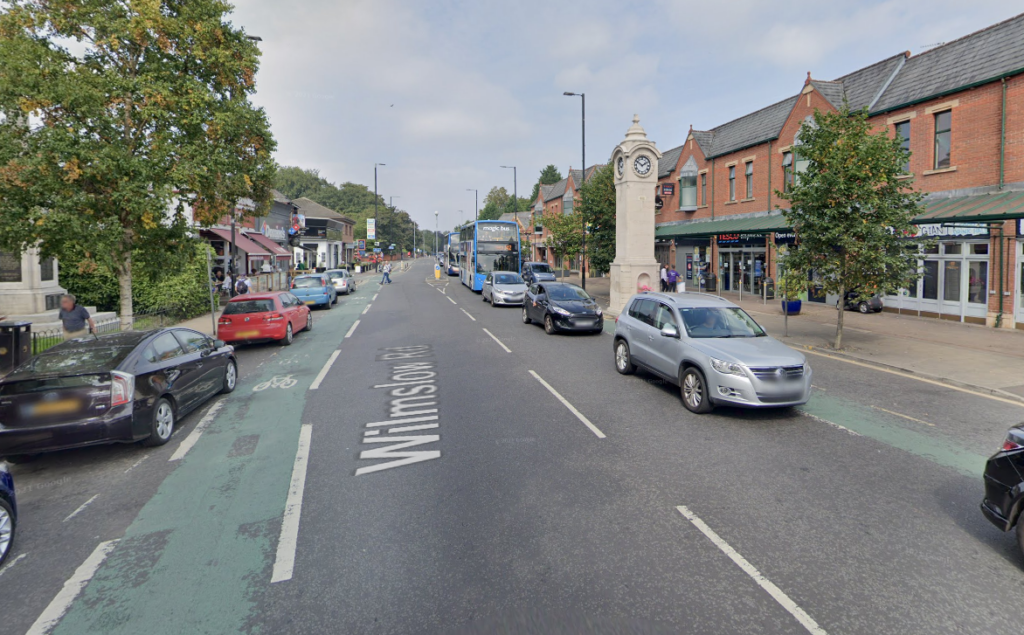
Just taking the photo accompanying the article stand alone from the case for a moment, would you be comfortable riding at 23mph in that green patch of cycling lane with parked cars left hand side and moving traffic say at 30mph right hand side ?
I have to agree, and
I have to agree, and elsewhere I intimate that just because the rider has been found not guilty of the specific charge does not mean they are blameless.
Again looking at the picture, cyclists are put in a worse position than drivers as this is an urban area where we might expect pedestrians to appear anywhere between parked cars. Therefore any cyclist riding in the cycle lane has to ride at a speed where they can stop. If the cyclist is riding at 20+ mph, they can only reasonably do that in the main carriageway. Indeed, given the parking, no cyclist should actually be in the green area which perfectly denotes the door zone. If a cyclist was riding in that lane, potentially filtering through traffic, I’m not sure the safe speed would be anything more than 10mph.
Interestingly, while cars no doubt also cannot safely drive near the speed limit there, the cycle lane gives them a buffer, and it would not surprise me if pedestrians use the cycle lane as an advanced stop line for crossing the road.
There is always some element
There is always some element of culpability and some part of the chain of circumstances that results in a tragedy which could have been broken.
Only from what is reported: Mr De Bruin did ride through a red earlier and although this does not appear to be directly related to the actual collision does it demonstrate reckless attitude or distraction? If he had not been wearing headphones, might he have been a bit more attentive to the road? Was his speed appropriate?
However the suspicion of being a bit distracted is not proof, cycling at under the speed limit is legal and wearing headphones is not an actual crime. These are what a jury has to consider when determining guilt based on a somewhat arbitrary bar or threshold of culpability.
My condolences to all affected.
Mungecrundle wrote:
Obviously the jury decided not. Unless we were to see the video the RLJ is a bit of a red herring (sorry): I personally don’t condone or do it under any circumstances, but obviously if he was shown tearing through a busy junction or slaloming in and out of pedestrians on the crossing that would have relevance, if he was shown coasting through a pelican crossing where the person who had pushed the button had already crossed before it turned red*, not so much. The fact that the jury clearly decided it didn’t demonstrate a (sufficiently) reckless attitude to have a bearing on the case makes one suspect the latter, but without seeing the video we just can’t tell.
* Just as an aside, has anyone ever thought of adding a cancel button to pelican crossings, so if one presses the button but then there is an opportunity to cross before the lights turn right, one could cancel the request on the other side? It does feel a bit daft sometimes sitting at a red light with nobody crossing because they’ve crossed already, and similarly pointless to see a line of traffic stopping to let one across when one has already crossed.
Yes, RLJ does not always mean
Yes, RLJ does not always mean reckless and distracted. Confession here, I went through a red light the other day, but because I was alert and careful.
It was a ped crossing with a cyclist waiting to ride over from the other side. It’s a busy road and I could see a line of vehicles approaching. I just nipped through as it turned red, just before the cyclist got the green light to cross. The red light held back the traffic, meant I had a clear road, no close passes at the pinch point and made the upcoming right-turn a lot safer for me.
It’s the set of lights I’ve often been tempted to stop at and press, just to hold up the traffic so I can make that right turn safely!
The more modern ped crossings
The more modern ped crossings have body detectors, partly to give slower Peds more time to cross, but if the crossing believes there is no-one there it will cancel the beg.
There is one on the tgi Friday roundabout (toucan) that I will occasionally use if the traffic is busy and I’m not feeling it, that ignores me a fair bit, and cancels the beg.
Oh, is that what they’re
Oh, is that what they’re doing? There are a couple of toucans I use where I have to keep pressing the button because the red light around the button keeps going off. I’ll have to try moving around more and see if it makes any difference.
brooksby wrote:
If the infrastructure is not fit for purpose and could have been a contributory factor then perhaps the family would have been better served by a coroner’s inquest.
I would not like to consider
I would not like to consider what was going on with the cyclist, really I am making a general observation that though Awavey rightly points out the unsuitability of that cycling lane for travelling at high speed, actually it is unsafe at any speed.
However, if the circumstances are that a cyclist is depending on that lane to ride amongst traffic, disregarding all other factors, simply riding at a supposedly agreed 23mph in that lane rather than in the road is unwise if only for self-preservation.
It’s a very narrow strip of
It’s a very narrow strip of tarmac with cars either side limiting your view.
I’d say 20mph+ is too fast in that circumstance.
The limit question is tricky because the cycle path is the dangerous bit and speed limits don’t apply to bicycles so what would be achieved by lowering the limit?
Pedantic but important – not
Pedantic but important – not a cycle path, a cycle lane. And not a great one at that. At least, that’s what appears at the location below (yes – a year back, and yes this might not be *the* Tesco Express mentioned).
I’d also agree that cycling slower rather than faster would be appropriate if there was much traffic e.g. if it was blocking your view (buses etc). However if this was a cycle lane (and unprotected to boot) with a little less traffic cars may have been going past you at speed and very closely. That’s unpleasant and tends to make cyclists speed up.
I’ve no idea if this had any bearing on what actually happened here. This guy could have been riding carelessly also.
https://www.google.com/maps/@53.4183816,-2.2317544,3a,75y,87.97h,70.72t/data=!3m6!1e1!3m4!1sl8Nipd83Y9yyI08zc8SADQ!2e0!7i16384!8i8192
Looking at this location I
Looking at this location I hope it’s one where they’ve applied for help as part of the Bee Network – having e.g. a proper separated cycle path on what looks like a busy artery which also has destinations (very common mixing of functionality in UK streetscapes…) might help everyone avoid collisions.
Rich_cb wrote:
Rich_cb to take your argument to it’s logical conclusion…. I presume you agree that any road where pedestrians are likely to be crossing should have a speed limit of below 30.
The facts of the case show that the cyclist was riding NW on the road, the pedestrian crossed the road from the cyclists right, so across a cycle lane and two live lanes of traffic before the collision.
If this had been the motorist in front of the cyclist (remember they had to take evasive action to avoid the collsion) who collided with the pedestrian as opposed to the cyclist. Would this have even went to court?
And if a motorist collided with a pedestrian in exactly the same circumstances, and the motorist was keeping up with the other traffic…. would you have a witness saying “the car in front was going very fast, and was going at least 20 mph”?
I do actually support blanket
I do actually support blanket 20mph limits in areas where pedestrians are at risk.
Wales is introducing such a measure this year.
The cyclist in this case was travelling faster than the cars.
Had he been travelling more slowly a collision would have been less likely and there would have been less chance of serious injury even if the collision had still occurred.
I think the cyclist’s speed was excessive given the circumstances.
Rich_cb wrote:
I saw this trailed – good for Wales! We muffed our recent chance to do that in Scotland. Hopefully the conversation won’t stop there. I’d suggest rather than just “in areas where pedestrians are at risk” noting that lower speeds reduce risk to everyone including drivers and makes areas more pleasant too e.g. less noise.
As is generally understood simply “sign it better” alone has a limited effect. Enforcement is also needed and even better is to provide driver cues via infra. However changing the limit has been shown to have an effect [1], [2], [3].
Rich_cb wrote:
Most of your opinion is based on speculation of what you think happened based on the reporting in the paper……..
To ask you a question….. if you are riding in a cycle lane, with a row of vehicular traffic to your right. The vehicular traffic in the lane to your right is moving (which we know happened in this case due to the eye witness testimony of Ms Orzsic)…. are you focusing your attention on the the lane in front of you and the pavement to your left…. or are you focusing on the incredibly slim chance that a pedestrian may emerge from the line of moving traffic?
And it was an estimate that they were going 23mph at the time. Any estimate will have a margin of error which has not been disclosed. The more important factor is the speed differential between the cyclist and the motor traffic given that the pedestrian emerged from the live traffic lane.
Incredibly slim?
Incredibly slim?
Have you ever actually ridden a bike through an area with lots of pedestrians?
I’d say a pedestrian steps into my path at least every other time I ride through such an area often emerging completely unexpectedly. With that in mind I modify my speed accordingly.
The speed was an estimate but it wasn’t contested by the defence as far as I can tell from the reporting.
Rich_cb wrote:
Yes I have ridden through areas with high volumes of pedestrians.
So of your pedestrians that step in front of you what kind of percentage come from the pavement….. and what percentage come through a live lane of traffic which is moving?
Remember this is about a pedestrian stepping in front of a moving car causing the car to swerve, then continuing across the live lane of traffic and the cycle lane to get to the pavement. Not about a pedestrian stepping from the pavement to the cyclists left onto the road.
All of my assertions are based on the reported facts.
As I said the relevant speed is the differential between the cyclist and the moving vehicles…. which was never ascertained.
The majority do come from the
The majority do come from the pavement but, as I said, a decent number just appear unexpectedly stepping out of places I wasn’t expecting pedestrians to be.
For that reason I mitigate my speed in any area where there are pedestrians.
Realistically if a pedestrian had stepped out from behind a parked van he’d have been no more likely to spot him than had he come from the traffic side.
The most effective way to reduce your risk of an accident in such a situation is to reduce your speed.
Rich_cb wrote:
So if you are cycling at 15mph and a pedestrian emerges from behind a parked van in such a way that you cannot avoid a collision….. I trust you would agree that you are still going too fast?
What about 10mph? Or 5mph?
In that particular cycle lane
In that particular cycle lane I’d argue that under 15 mph would be a reasonable speed.
Not all collisions are avoidable but, as cyclists, we should try to reduce the risk we pose to more vulnerable road users. In areas with a high number of pedestrians we should reduce our speed and pay close attention to our surroundings.
Rich_cb wrote:
So if the cyclist had been doing 15mph in this case, in exactly the same circumstances, and it had exactly the same outcome……would your opinion have been any different?
Or if a motorist is passing a row of parked cars at the edge of a road, regardless of the speed limit you think they should be doing only 15mph just in case someone runs out of between a parked car….. regardless of the posted speed limit.
Given the fact that jury decided on the basis of ALL of the evidence that the collsion was not due to careless cycling/wanton furious cycling is it not reasonable to infer that a) they had access to evidence which we have not seen and that b) based on ALL the evidence they did not think that the riders speed was inappropriate for the conditions.
Bearing in mind that the bar for careless cycling (s.29 RTA) would be based on the same definition used for careless driving being “Careless driving falls below the minimum standard expected of a careful driver and includes driving without reasonable consideration for other road users.”
Speed limits aren’t targets.
Speed limits aren’t targets.
You cycle or drive to the conditions as you find them.
If the cyclist had been doing 15 mph when this collision occurred I’d be inclined to say the fault lay almost entirely with the pedestrian.
The jury made no decision on careless cycling.
They decided that ‘wanton and furious’ cycling could not be proven beyond reasonable doubt.
I believe ‘wilful neglect’ and ‘wilful misconduct’ are the other two phrases included in the statute. There is no mention of carelessness.
The charge of ‘causing death by careless cycling’ does not exist.
If it did, and it has been proposed, then I believe the cyclist in question would have been charged with it and, IMO, found guilty.
RLJ on the same journey would undoubtedly be used to show the cyclist was not ‘being considerate’ earlier in his journey. The speed would also not be ‘considerate’ in the circumstances IMO. Lastly the use of headphones could easily be painted as somebody not paying full attention to the road much in the way a hands free conversation (also legal) might for a driver.
To precis: I believe that,
To precis: I believe that, based on a scant amount of evidence supplied by the newspapers, the cyclist is guilty of breaking a law which doesn’t exist because he might or might not have been riding too fast in my opinion even though the fastest guess is 7mph below the speed limit, he jumped a red light nearly a kilometre beforehand and he was wearing headphones which is perfectly legal.
Desperate, truly desperate.
Rich_cb wrote:
So basically you have decided that the cyclist is guilty based on the selective evidence published by the newspapers in the Reach Group, who have a long standing tradition of anti-cycling rhetoric…… and if you think the reported evidence is anything other than selective you are even more gullible than I thought.
As for your comment about headphones….. it’s not like having a hands free phone conversation in a car, it’s like a driver listening to the radio. Now please provide reference to a single case where it has EVER been mentioned that the driver was listening to the radio
The RLJ and the speed were
The RLJ and the speed were both presented in court and neither were disputed by the defence.
The objectivity, or otherwise, of the reporting media has no effect on that whatsoever.
Personally I think headphones are a significant impairment to safe cycling, on a par with a hands free conversation for a driver. Hands free conversations have certainly been mentioned in court.
Maybe you’ve got a different opinion. C’est la vie.
My opinion is that a combination of the RLJ, the excessive speed for the conditions and the use of headphones amounts to carelessness but not ‘wilful neglect’.
Maybe you’ve got a different opinion on that too. C’est la vie.
I find myself agreeing with
I find myself agreeing with you here * although I’m done with second-guessing of details of this one. It sounds like this cyclist could have been a bit carefree and could have paid more attention / driven to conditions. In general if you can’t see to your right or left then filtering / overtaking have the (usually small) risk that vehicles in another lane brake before you and then you can collide with crossing traffic which one or more party has not observed – as here.
Would things have been different here? I have no idea.
However: are there concerns around people not expecting others at certain points (e.g. cylists to the inside of cars)? Yes. Is this in part to do with how we slap in cycle “facilities” and could that be improved even at our current level of spending? Very probably **. Would changing the environment to something more in line with best practice help (like below) so “safe areas” and conflict points are clearer? Undoubtedly.
* With a slight difference on the headphones. I never wear these when out but that’s just me. I think a phone conversation is an entirely different thing – that has been proven to be a significant distraction when driving. Obviously the same would apply for cycling on the phone if anyone does that. For music though I doubt this is any more distracting than music in a car. Even using the most noise-cancelling of earphones you are probably no worse than driving with your windows up and music on. Consider – windows are *designed* to block sound. If there were openings you’d have similar wind noise to a cyclist but additionally cars have more noise from the wheels and then there’s the power plant…
** Allowing for a lag time while people adapt / learn.
I was wondering though if
I was wondering though if thats related to localised adoption of cycle lanes, volume of cyclists using them.
Like if you see lots of cyclists all the time you naturally expect them to be there so stepping into a cycle lane unsighted is the exception, and cyclists are able to ride quicker as a result.
Whereas areas where there might be cycle lanes but low numbers of cyclists it becomes just abit of path or road to pedestrians and they dont expect cyclists in them and that’s why it becomes near impossible to ride them anything but slowly because you basically cant do anything else but do that because youd constantly be colliding with people
Simply saying you need to ride at a slower speed to deal with potential hazards doesnt seem remotely as controversial a position to state as this debate has made it out to be, imo.
I didn’t think it was
I didn’t think it was particularly controversial either!
I think that’s the issue with the cycle lanes in Cardiff. There’s, unfortunately, not a huge volume of cyclists using them yet so many pedestrians seemed shocked to see one.
Had a headphone wearing phone zombie cheerfully stroll into my path on my way home today. He actually had to step over the raised kerb onto the bright blue lane and still didn’t look up for a second.
Thankfully a relatively low speed meant no collision occurred and neither he nor, more importantly, I were injured.
Reckless headphone wearing
Reckless headphone wearing pedestrian?
Careless definitely.
Careless definitely.
I don’t know whether he was
I don’t know whether he was or wasn’t, but if a car driver at 23mph hits a pedestrian in a 30mph zone, do you think the prosecution would have been quite so zealous? Leaving aside mass / momentum / kinetic energy difference of course.
It’s impossible to say
It’s impossible to say obviously but I imagine that if a car driver had hit someone shortly after running a red light and whilst having a conversation on a hands free phone (legal but generally frowned upon) the chances of ending up in court would be higher.
We all know that there would
We all know that there would have been no prosecution at all in that case.
The fact that another vehicle
The fact that another vehicle had to take evasive action to avoid this pedestrian seems to indicate this was an unusual circumstance.
A court has considered the evidence and found them not guilty of being reckless.
Whilst you do have a responsibility to ride to the conditions, there are limits. Certainly I would have considered the pedestrian I nearly hit when doing 30mph 100% to blame had I not been able to stop in time. I was doing 30mph in a 30 limit, they are lucky I had good brakes and quick reactions. I felt very annoyed with them afterwards, as their inattention had put me at risk.
We haven’t seen what advice
We haven’t seen what advice is offered by a typical judge for such a charge to succeed.
I suspect that the charge is akin to dangerous vs careless driving, only with a few less precedents to muddy the water. So I would guess, but don’t know, that it is not sufficient to argue that the cyclist was careless or inattentive but there must be an extra level of deliberateness or foolishness to meet the criteria – and of course, again we don’t know, but there is clearly the suggestion that the pedestrian was impaired in some way. In other words, the verdict does not mean they are blameless, but that they were not reckless (which is some unknown order of magnitude worse than careless) or (deliberately or excessively) furious in their riding.
My other observation, not based on anything particular to this case, is that the brain is a con-merchant and is inclined to show you what you want to see. I’ve said enough times that when drivers say “I didn’t see you, mate” they are usually not lying, even when their eyes have been pointing in the right direction, so it would not be surprising if the cyclist didn’t see the pedestrain because his brain didn’t bother to tell him about something that shouldn’t be there.
IanMSpencer wrote:
According to this:
1. There must be a degree of lack of care that would ordinarily amount to dangerous driving. This can involve driving recklessly. ‘Reckless’ was defined in the case of R v Okosi (1997) RTR 450 as follows:
“Driving a vehicle in such a manner as to create an obvious and serious risk of causing physical injury to some other person.”
2. It must be reasonably foreseeable that there is a risk of causing harm or injury to another. This can be where the defendant was aware there was a risk but went on and took that risk regardless. This is known as subjective recklessness. Or there can be objective recklessness which means the defendant gave no thought to the risk but the reasonable man would have seen the risk given how obvious it was.
I don’t think the cycling in this case was reckless, possibly it might have amounted to careless cycling. Difficult to say if you weren’t in court.
IanMSpencer wrote:
We don’t need to. The CPS charging guidelines (which are based on the likelihood of achieving a successful prosecution) give exactly that perspective:
“Prosecutors should only prosecute this offence when it is not possible to prosecute for an offence under the RTA 1988
The offence can only be committed if the driver has a degree of subjective recklessness so far as the foreseeability of causing injury is concerned. In other words, he or she must appreciate that harm was possible or probable because of the manner of driving: see R v Okosi [1996] CLR 666.”
Remember that those
Remember that those guidelines are written from the perspective of drivers, not cyclists.
However, I’m not talking about alternative charges, I am talking about the guidance the judge will have given to ensure the jury understand the law and the decisions they are allowed to make. We don’t know what the judge said about things like the definitions of reckless and dangerous, and what reference they made to precedents. For example, the judge might have said “You must find that there was a deliberateness in their actions or it was obvious that he was riding in such a way that it was inevitable he would crash.”
Without knowing what constraints the judge put on the jury with their deliberations, we cannot really understand the way the jury came to their conclusion.
The fact that another vehicle
The fact that another vehicle was able to safely respond to the pedestrian but the cyclist was not indicates that the cyclist was going too fast for the conditions IMO.
I’m happy to do 20 or even 30 (downhill obviously)on a road where you’ve got room to manoeuvre should a pedestrian step out but on a narrow track like the one in question it seems like a recipe for disaster.
I wasn’t clear which way they
I wasn’t clear which way they were coming sounds more like right to left as I read it in which case the width of road can be added in.
Still not sure how long he was wandering in the middle of the road.
From Streetview it appears
From Streetview it appears there is a little green strip on either side.
From the reports I took it that he was cycling in that green cycle lane (h/t CoaT) travelling faster than the cars in the rest of the road with parked cars to his left.
That seems reasonable but
That seems reasonable but what I find unclear is the ped – was he travelling left to right or right to left. Then there is the bit about being in the middle. Did he walk along the road a bit then decide to head for the pavement? In which case it may be as Hoarseman suggests ‘I’m not so sure of that, they swerved around the pedestrian, possibly obscuring them from following traffic in the process.’
As to speed, seems to be travelling too fast that you would be liable for a collision or too fast that you can’t react to a hazard but it is the other parties fault. I’m thinking of those ones where a cyclist in the lane gets struck by a driver coming the other way and turning across them.
I’m guessing the jury went with the second one based on the actual charge. OR rejected the first based on the charge.
I was impressed with this driver from Sunday’s dash cam
This one is a bit more 50/50
I took it that the pedestrian
I took it that the pedestrian was crossing the road, through the traffic lanes and then walked into the cycle path.where the collision occurred. I suspect the cars were moving pretty slowly.
I think it’s the charge itself which has helped him get acquitted.
If he’d been charged with ‘causing death through careless cycling’ he’d likely have been convicted in my opinion.
RLJ. Headphones. Excessive speed for the circumstances.
All point to carelessness in this case but not IMO recklessness.
Rich_cb wrote:
RLJ 800 metres previously. Well below the posted speed limit. Headphones perfectly legal and would make no difference anyway unless you believe that a cyclist can hear a pedestrian’s footsteps. Why are you so desperate to try and find the cyclist in the wrong when the evidence – and the verdict of the jury – clearly point to a tragic accident caused by pedestrian error?
I think the rlj, headphones
I think the rlj, headphones are not relevant but I think it is reasonable to consider the speed. Proving the charge was not going to be met due to the high threshold but it does raise the question of what would have happened in a lower charge.
See also IanMSpencer’s post
I would not have been taking that much speed into that road given the layout and voume of traffic – but really for self preservation.
Rich, I think it quite a leap
Rich, I think it quite a leap from the facts in the public domain to reach the conclusion of a ‘careless’ conviction being a likely outcome.
I disagree.
I disagree.
As a general rule the CPS only proceed if they think a prosecution has a good chance of success.
60% is the rule of thumb according to a detective friend of mine so we can assume the CPS felt this prosecution had at least a 60% chance of success.
Given that carelessness should be far easier to prove than “wanton and furious driving” you’d have to assume the CPS would deem the likelihood of success to be higher.
Obviously the point at which we say a conviction is likely is quite subjective but once you get over 70% I’d say that’s a very reasonable description.
I don’t think there is enough
I don’t think there is enough clear evidence in the public domain that allows us to assess if the CPS’s decision was a good one.
It is also why I have not joined in the speculation about the case.
Rich_cb wrote:
I’m not so sure of that, they swerved around the pedestrian, possibly obscuring them from following traffic in the process. Perhaps if they had stopped and used their horn, there might have been a different outcome.
Yes, I think Panda above
Yes, I think [b]panda[/b] above describes it well:
The driver in question said, “They just saw each other at the last second.”
If I saw a car swerving in
If I saw a car swerving in front of me I’d be slowing down rapidly regardless of what I could see.
Rich_cb wrote:
By all accounts that’s what the cyclist did, witnesses said they heard the bike’s brakes squealing.
Pedestrian was coming from
Pedestrian was coming from the opposite side of the road as the parked cars /cycle lane apparently which meant she could swerve right to avoid him. And cyclist also tried to do a similar avoiding manouve around Mr Gunn but he stopped and stepped back apparently.
I suspect cyclist was monitoring left hand side for danger and not right as much if car just ahead was moving at a pace where she couldn’t actually stop in time to avoid Mr Gunn but had to swerve. Coming from that side could also mean that her moving car hid Mr Gunn.
The cyclist was riding in a
The cyclist was riding in a very narrow lane with obstacles on both sides limiting visibility.
In those circumstances his speed was, IMO, excessive.
Rich_cb wrote:
It’s amazing that you have such clear knowledge of the cyclist’s speed, where he was positioned in the road, and what obstacles were there at the time and how the tragedy could have been avoided when there is no video of it available. It’s quite distasteful how the usual suspects (apart from Martin73, who has been conspicuous by his absence in the last 24 hours, having revelled in what he supposed was a guaranteed guilty verdict beforehand) are determined to make this the cyclist’s fault despite the verdict of the court, exactly the same people who, if he had been found guilty, would have been ridiculing any mitigation put forward by anyone else and any suggestion that the court had made anything but the right decision.
I don’t agree that the other
I don’t agree that the other vehicles ability to react automatically means the cyclist was travelling too fast.
I do agree however that a degree of culpability does naturally remain with the cyclist no matter the verdict.
IMO the most dangerous roads for vulnerable road users is heavy, flowing, but slow moving traffic on urban roads. its all too easy to follow the vehicle in front too closely, relying on their reactions to dictate your own driving. Large chains of vehicles form where no one is taking any notice of wider potential hazards.
All is good until the car infront misses something. The following vehicle is then suddlenly left with minimal time to react to a hazard.
My gut feeling is that the cyclist here was not paying full attention to the road, relying on the vehicle infront to react to potential hazards and was merely looking at the cycle lane infront. The car drivers last minute swerve left the cyclist with insufficent time to react.
Lots of other questions here too mind… was the car drivers swerve indicative of lack of care / consideration and contributed to the accident? do cycle lanes offer insuffiient visability for cyclists in heavy traffic? Do these cycles lanes faciliate situations where spacing between cycles and other vehicles are insufficient for urban areas?
Yep, a few parties actions and infrastructure could be improved, but I don’t think you could possible hold the cyclist to accunt in isolation on this one.
I think you’ve got to lok at
I think you’ve got to lok at his speed in the context of the lane he was travelling in.
It was narrow giving limited opportunity for evasive manoeuvres so he was essentially relying on his brakes.
The faster you’re going the longer it’s going to take to stop.
I actually agree with the verdict in this case but had there been more options on the statute book I suspect he’d have been tried for ‘Causing Death through Careless Cycling’ and IMO probably convicted.
Rich_cb wrote:
I would argue that the driver was also going too fast if the cyclist was.
The response to a pedestrian in the road should be stopping not swerving. This incident shows one of the reasons why – a vehicle behind you can’t necessarily see past you. You can swerve much later than you would need to brake to avoid a collision which leaves the vehicle behind with far, far less warning (n.b. a pedestrian crossing the road from the far side will usually take long enough to cross a lane that you could be expected to get fairly close to stopping from 30mph – typical walking pace of 4mph = 1.8m/s, so 2s to cross a standard lane))
Unless we are arguing safe following distances should be full braking distance (so significantly longer than they are now…)
While I will argue we go too fast in urban areas and accept an argument that the riding was sub standard from what we know, under current law/interpretation, a driver in similar circumstances quite plausibly wouldn’t have been charged, let alone convicted.
From the reports the driver
From the reports the driver had time to warn their passenger that they were about to slow down.
“Ms Orzsic told her daughter, who was in the passenger seat, that she would have to ‘slow down’ and the court heard how she steered her car to the right so she didn’t hit him”
It doesn’t sound like an emergency manoeuvre and the driver clearly had plenty of time to react to an unexpected hazard. Given that, I’d say her speed was appropriate.
It’s very hard to know what would have been the CPS decision for a driver driving through red lights whilst listening to loud music and then shortly after hitting a pedestrian. I’d hope that prosecution would be considered as it was in this case.
“shortly after” – half a mile
“shortly after” – half a mile later. In an urban area.
Whenever there is a collision
At 23 miles an hour he would have covered that half a mile in under 90 seconds. I think that meets the criteria for ‘shortly after’.
Whenever there is a collision investigation the police will often ask for dash cam footage of the vehicles involved prior to the collision even if the footage does not include the collision itself.
It’s pertinent evidence. If you have footage of one car being driven aggressively and recklessly and the other car being driven sensibly and legally it’s helpful when building a case one way or the other.
The cyclist chose to run a red light during that journey.
That is evidence as to the manner of their cycling prior to the collision. It’s admissible in court as evidence against the cyclist.
Rich_cb wrote:
Of course you are right, and evidence of reckless, aggressive cycling with a cavalier attitude towards the safety of others only minutes before the collision should count against the accused. I think the mistake is to then necessarily equate RLJ with those aggressive, cavalier attitudes.
Certainly jumping a red light can be the outcome of an aggressive, dangerous, selfish disregard for safety. It could also be that the junction was deserted, the lights were about to change, a tipper truck was approaching from behind and the cyclist prioritised pragmatism over punctiliousness. Or something in between, or altogether different (he failed to see the lights?).
None of that excuses the RLJ, and if he were on trial for that then he’s guilty. But used as a proxy for the character of his riding, I think only the jury are in any position to judge
There are, of course,
There are, of course, situations in which RLJing is not dangerous or in which RLJing is the safest option available. In the majority of cases though it is a dangerous manoeuvre carried out for expediency’s sake.
I believe he was given the opportunity to explain the RLJ and did not offer any explanation or mitigation.
“During the cross examination with prosecuting barrister, Simon Blakerough, Mr De Bruin said he ‘did not know why’ he ran a red light”
That leads me to believe it wasn’t a justifiable RLJ.
https://www.manchestereveningnews.co.uk/news/greater-manchester-news/cyclist-riding-23mph-crashed-pedestrian-24947992
Rich_cb wrote:
I wouldn’t read that into his silence on the matter. I suspect he may have taken advice, or have been canny enough himself, to know that no good would come of telling a jury that it was in any sense “ok” or even “not dangerous” or (heaven forbid) “justifiable on grounds of safety” for a cyclist to RLJ. A slightly deferential “I don’t know why I did that” may have been his best option. Just my speculation.
I did consider that.
I did consider that.
Explaining the thought process of a cyclist to a jury of non cyclists may be more trouble than it’s worth.
It’s a shame the video is not publicly available. Without it we can do no more than speculate.
Rich_cb wrote:
So again I will ask the question that you repeatedly dodge.
What was the speed differential between the cyclist and Ms Orzsic?
Now bearing in mind the fact that Ms Orzsic said she would have to slow down….. what speed was she doing when she thought she had to slow down? If she was travelling along the road at 25mph was she driving recklessly?
Would you consider a driver (driver 1) who was travelling marginally faster than a driver (driver 2) in an adjacent lane to be reckless/careless/dangerous or participating in wanton or furious driving in the event that a pedestrian stepped in front of driver 1 emerging from in front of driver 2 resulting in a collision?
I think in the thread Rich_cb
I think in the thread Rich_cb has over-egged a couple of arguments but I’m generally in agreement with his fundamental premise: I don’t think you can boil down appropriate speed to an assessment of simply the speed differential – obviously you are trying to assert that if the car is going at a speed then the cyclist is equally safe.
If a cyclist was occupying the road lane and cycling at a similar speed to traffic, then I would agree that a cyclist is at least as safe as a car, and generally the only problem cyclists have is that pressure to ride perhaps a little too close to the car in front in response to perceived threats from following motorists – to demonstrate, in part, that we are keeping up (a response that many motorists themselved seem to show where they follow the speed of the traffic flow rather than independently deciding to limit themselves to the speed limit).
In this case, the cyclist appears to have been in the cycle lane, so in the general case there are two problems that the car does not have – dooring and a pedestrian stepping forward into the lane to take a look (that’s disregarding the aimless wander). The latter is something pedestrians do, for example when walking out from behind a van, they don’t expect a vehicle to be passing close to parked cars so may step forward of the parked vehicles. so there are two factors that dictate that the safe pace in the cycle lane is likely to be lower. As the cycle lane is running next to the parked vehicles, the cyclist is in direct conflict with any pedestrian who does not look properly, whereas a car has the buffer zone.
There is another factor – the invisible cyclist factor – people don’t see what they don’t look for. Motorists tend to depend on their simple presence detering any pedestrians stepping out – regardless of the HWC, it is clear that there is an expectation for pedestrians to know their place. That does not apply to cyclists, and I think two things can happen, a pedestrian simply does not bother to look for cyclists – or their brain fails to alert them of their presence – and pedestrians may be more beligerent to a cyclist and less inclined to clear the way if they have stepped forward, or possibly even deliberately seek to block a cyclist that they perceive as a nuisance in their difficult task of trying to cross traffic (which they perceve as vehicles, not bikes).
The fact that using a cycle lane dictates a slower speed goes against up to date design guidance, but it is a brave cyclist who deliberately occupies the main lane when there is a clear lane beside them, even when, as in this case, the design is clearly significantly sub-standard.
Note, my take is purely based on the road layout as can be seen in pictures on the thread, not based on any judgements as to this particular case.
You can ask it as many times
You can ask it as many times as you like.
That information isn’t available. You know that so why you persist in asking a question that you know there is no answer to is beyond me.
Ms Orzsic was driving when an unexpected hazard occurred. She had the time to warn her passenger and then safely avoid the hazard.
Given that, it would seem her speed was appropriate for the conditions.
Mr De Bruin, in a separate, narrower, lane encountered an unexpected hazard. He was unable to stop in time and ended up hitting and ultimately killing a pedestrian.
Given that it would seem his speed was inappropriate.
Looking at the dimensions and location of that cycle lane I would never consider 23 mph to be an appropriate speed. Hence why I consider the cyclist’s behaviour to have been careless.
Would you consider 23 mph to be appropriate in the green cycle lane pictured?
Rich_cb wrote:
And therein lies my point…… you are speculating on everything from the limited facts provided by a newspaper.
But in the absence of the full facts you have stated repeatedly that the cyclist is guilty.
The relative speed is
The relative speed is irrelevant.
23 mph is an unsafe speed in that cycle lane IMO.
It doesn’t matter if the traffic is at a standstill or going at 100mph or any speed in between.
I’ve said repeatedly that the cyclist was careless. I’ve not said that they should have been found guilty of ‘wanton and furious’ cycling.
A ‘not guilty’ verdict for ‘wanton and furious’ cycling does not mean the cyclist was entirely blameless however. It means the jury didn’t feel the evidentiary threshold was met for the specific offence being prosecuted.
This case demonstrates the need for a broader spectrum of cycling offences to enable more appropriate prosecutions in future.
Rich_cb wrote:
Unless I’m reading that wrong you lost me again. If you’re really saying “it doesn’t matter what the other traffic is doing” (100mph) it would appear you’re saying 23mph on a bicycle in that lane is unsafe full stop. Given the lane is just some paint on a road that would appear to be you saying “23mph on a bicycle is unsafe”. I’m pretty sure you don’t mean that given you’ve been over that on a cargo bike!
Does it? Why? This sounds a bit like “I’m unhappy with the outcome, so I want another charge which might succeed”. I know this is very similar to the complaints (mine included) around driving offenses but in most of those cases there is a very clear legal standard (the driving test) and apparently requirements to abide by it (e.g. you’re licenced). Even though (for reasons I still don’t understand) this is not formally referenced in the dangerous / careless driving charges.
I think we should certainly investigate every collision which leads to a fatality – let’s see what the Road Safety Investigation Branch start to do.
I’m not opposed to more clarity / a revamp of the cycling offenses (and including scootering etc. if not there already) Currently I’d suggest this is of very low priority. I’d be more than happy if this would be addressed sooner if it was a part of a comprehensive review of road law. Or even better a look at road safety in general including design “standards” which aren’t and far too much “guidance” and “advice”. (If it’s important make it a rule, if not publish it in a guidebook!)
23 mph in a lane that narrow
23 mph in a lane that narrow with no room to manoeuvre is unsafe.
If you’re on the main carriageway the safe maximum speed is obviously much higher.
The problem we have with cycling offences is that any KSI caused by a cyclist has to be prosecuted as ‘wanton and furious’. The terminology is archaic and doesn’t cover the broad spectrum of potential offences.
There is no equivalent to ‘careless driving’ for example. If you cause death through Careless Cycling then the CPS have to either try and get ‘wanton and furious’ to stick or not prosecute. Neither option is ideal.
I’m not a lawyer so don’t
I’m not a lawyer so don’t understand the relation between the bits marked “offence” in the law and charges. I also wasn’t aware that this appeared to be covered by the road traffic act 1988. There careless and inconsiderate cycling is an offence.
https://www.legislation.gov.uk/ukpga/1988/52/part/I/crossheading/cycling-offences-and-cycle-racing
However that was repealed in the RTA 1991 for some reason.
https://www.legislation.gov.uk/ukpga/1991/40/section/7
That leaves:
Dangerous cycling.
(1)A person who rides a cycle on a road dangerously is guilty of an offence.
(2)For the purposes of subsection (1) above a person is to be regarded as riding dangerously if (and only if)—
(a)the way he rides falls far below what would be expected of a competent and careful cyclist, and(b)it would be obvious to a competent and careful cyclist that riding in that way would be dangerous.
(3)In subsection (2) above “dangerous” refers to danger either of injury to any person or of serious damage to property; and in determining for the purposes of that subsection what would be obvious to a competent and careful cyclist in a particular case, regard shall be had not only to the circumstances of which he could be expected to be aware but also to any circumstances shown to have been within the knowledge of the accused.”
Again I’m not a sophisticated type but frankly I’d think that would have it covered. I do object to the wooliness of “far below”. Possibly I missed mention of cycling experts / trainers in as witnesses being brought in? Otherwise how do you judge? The same applies but more so I’d say for motorists and they’re licenced given a standard – I think it should just mention that and there would be a “fail a driving test” as part of the evidence. (That evidence can always be tested, you can bring in other evidence etc.) I’d also suggest the issue is “dangerous” (as opposed to “careless”) in the case of driving seems to end up being interpreted (by the outcome of cases) in a way at odds with my layman’s understanding of the word…
There isn’t an offence of
There isn’t an offence of ‘causing death/serious by careless/dangerous cycling’ afaik so ‘Wanton and furious’ is the only recourse when a serious injury/death occurs.
It does need reform IMO.
chrisonatrike wrote:
I think you’ve got a bit mixed up, careless cycling is still an offence. In the RTA 1988 it included the line “In this section “road” includes a bridleway”, which was subsequently removed. It was just that line that was repealed, not the whole section.
Thanks – so would that answer
Thanks – so would that answer rich_cb’s concerns that there is no provision for prosecuting “careless cycling” because there is no such chargeable offense, or is this just semantics? So could someone who was suspected of committing an offence by careless cycling (per RTA 1988 if that is still in force through the RTA 1991 and onward) be prosecuted? If so presumably that would be charged as “wanton and furious driving” (so therefore that charge does cover the offenses rich_cb felt were missing)?
EDIT: I think it’s “wanton and furious driving”, not “cycling” as I wrote.
Apologies if I’ve misunderstood this – not a lawyer…
Rich_cb wrote:
I think you will find the relative speed is most likely one of the most relevant factors in deciding this case.
If the cars were travelling at 20 mph with the cyclist 23mph then it would be unlikley that this would even meet the bar for careless cycling….
Compare that to stationary cars and cyclist at 23mph, then in all likelihood that would have met the bar for wanton and furious cycling….. resulting in a conviction for the cyclist.
So please do explain why you think IN THIS CASE why the relative speed of the cyclist and motor car is irrelevant, given the fact that the pedestrian stepped in front of the cyclist from the live lane of traffic….. not from the pavement.
I do find it interesting how you seem to think that 23mph in that cycle lane is unsafe under all circumstances….. despite the fact that motorist just a mere metre further from the pavement can travel at 30mph…….
Look at the width of the
Look at the width of the cycle lane.
It’s incredibly narrow with little or no room to manoeuvre either way.
With parked cars on one side and a traffic lane on the other you have very limited visibility and multiple points at which a pedestrian could step directly into the lane whilst you have no easy way to avoid them if they did step into your path.
Given that, you need to be able to stop quickly. 23 mph is too fast IMO to be able to do so.
The space available to the cyclist is the same regardless of the speed of the vehicles in the main carriageway. The relative speed of the cars is therefore irrelevant.
10mph cycling with stationary cars would be safer than 20mph cycling with 20mph cars. The relative speed is irrelevant.
Would you honestly ride at 23 mph in the green strip of paint pictured in the article?
Rich_cb wrote:
Honestly I’d try not to cycle in that cycle lane at all, as the risk of dooring is too high.
That particular cycle lane
That particular cycle lane appears to be an accident waiting to happen for all involved.
Given that, if I had to ride in it, I’d be going plenty slow.
wycombewheeler wrote:
Same here, but it’s not clear whether there were any parked cars when the incident occurred.
I agree that 23 is too fast
I agree that 23 is too fast and I would not be doing anywhere near that (even if I could !)
I just think using the limited reporting it’s a bit of a stretch to say he would be guilty of a lesser charge. We still don’t really know how the ped was moving or in what direction or if anyone had been cycling at a reasonable speed the collision would have been avoided.
Since the driver had to swerve rather than brake, then they were either going too fast or the ped was indifferent to their own safety and it was fortuitous that the driver avoided them.
TriTaxMan wrote:
You must understand that when you’re walking in RichWorld (TM) – I’ve been there many times myself – his opinions have the status of fact and actual facts are only opinions, he has decided that this cyclist is guilty and that’s all that matters.
He won’t respond to you
He won’t respond to you rendel as he said he would not and he is not at all like the 2 PBUs.
You may not agree with his conclusions but he is polite, clear, presents a good case and has many valid points.
I know, and that’s fine, it’s
I know, and that’s fine, it’s up to him; just as it’s up to me to decide whether or not I will still challenge what he says when I disagree with it, no?
Sure
Sure
I think you are over egging
I think you are over egging it a bit for “Ms Orzsic was driving when an unexpected hazard occurred. She had the time to warn her passenger and then safely avoid the hazard.”
She avoided the hazard but whether she did it safely is not known without a video. For all we know her swerve took her into the opposing lane and it was fortuitous that there was no oncoming traffic at that point.
Fair enough but if you’ve got
Fair enough but if you’ve got time to warn your passenger that you need to slow down I’d hope you’d have time to avoid any excessive manoeuvres.
Quite possibly going too fast
Quite possibly going too fast although not sure what the 23 comes from unless the cyclist themselves. Given that Ms Orzsic had to swerve to avoid Gunn and her description of his gait makes me wonder what speed would have safe.
Always a chance of a ped collision unless you are at walking pace.
One thing I find particularly
One thing I find particularly disturbing is the matter of his wearing “cycling gear” being brought up. Most of the other bits of diatribe I can understand – it’s the prosecution’s job to cast the accused as being reckless. The fact that wearing cycling gear plays into that perception is my concern. I wonder whether it was brought in to distance the popular perception of a Dutch person riding a bicycle.
It’s not entirely clear who
It’s not entirely clear who brought it up but if it was the prosecution it was presumably to attempt to bolster their assertion that the defendant was out on a personal TT with no regard for others. Doubtless in future cyclists can look forward to being accused of being reckless for such offences as wearing an aero helmet, having internally routed cables, and having shaved legs, all signs of people desperate to go as fast as possible without regard for others.
I got twatted by a car in May
I got twatted by a car in May 2020.
I went after the driver’s insurance as soon as I was out of the hospital. Their original take was I was going too fast as I was obviously on a personal TT.
I destroyed their argument using my Garmin data overlaid onto streetview and using simple physics equations.
They changed their mind sharpish and paid out.
Don’t fuck with a nerd.
S13SFC wrote:
That’s good to hear – I have mounts for my Garmin on all four bikes for precisely that reason (to prove my speed in any incident) knowing I can overlay it on the GoPro footage with VIRB.
Down under sadly an elderly
Down under sadly an elderly pedestrian died after being struck by a cyclist and despite some misreporting by the press the roads authority used garmin data and the data from the ped lights to show the pedestrian was crossing on red…the cyclist was in a cycle lane travelling at 40km/hr past stationary traffic…ended up with injuries requiring hospital treatment…both cases show need to be aware in situations where peds may be crossing
https://www.theage.com.au/national/victoria/traffic-light-timing-crucial-in-death-of-pedestrian-hit-by-cyclist-20190524-p51qxo.html. possibly pay walled
I’m more interested in where
I’m more interested in where I can get one of these “powerful racing bikes” as all my bikes are the standard zero horsepower ones! </sarcasm>
Has anyone else managed to
Has anyone else managed to piece together what actually happened? It reads as though a car had overtaken the cyclist, and the driver steered right to avoid the – apparently confused – pedestrian who was finishing crossing from the driver’s right, leaving the cyclist nowhere to go when the pedestrian suddenly appeared in view? That must have been horrible.
I hit a pedestrian in Otley once who just walked out into the road. I shouted, which was my only mistake. Had I kept quiet and allowed him to carry on walking I could have avoided him, but in his alarm he did the “am-I-going-left-or-right?” dance and I couldn’t stop in time. Luckily nobody hurt on that occasion but cranium doesn’t need to hit tarmac that hard to do serious damage so it could have been catastrophic.
I don’t understand the headphones thing? Is there a suggestion that the cyclist ignored a warning?
I also don’t understand from the report why the prosecution was brought at all? If you’re driving a car inside the speed limit and someone walks onto your bonnet, I imagine her majesty’s finest offer you counselling rather than a spell at her pleasure?
panda wrote:
That’s my understanding too, although it is hard to piece it together from the snippets we have been given.
Yep, the incident picture
Yep, the incident picture from the written statements does have some missing points. He supposedly undertook a car stuck in traffic (witness who stated he was going to hit someone) when in the cycling lane. But another driver a few metres further on had to swerve around the unfortunate Mr Gunn as he very slowly walked in front of her. So what speed was she doing? (not stating speeding but fast enough she had to swerve.)
Also appears that the cyclist and Mr Gunn also did the same “dance” you had which also then lead to the collision.
I neither applaud nor decry
I neither applaud nor decry the result, without seeing the detail all we have are cherry-picked sound-bytes and what appears to be at least one witness with an agenda, giving coloured opinion rather than fact. Add in the adversarial nature of the courtroom with barristers essentially making stuff up, court reports rarely give us the facts to make proper judgement.
Still, I might have a happy dance that our PBU’s latest trolling attempt has backfired.
A sad incident indeed but
A sad incident indeed but very much sounds like the right result. The tone of the accusations from the defence barrister brought back some old memories for me. In the late 80s (yes, that long ago) I was cycling with my brother one day when he was knocked off his bike and hurt by a driver making a stupidly reckless overtake. My brother brought a civil case against the guy, lost earnings etc, and it went to court. The bloke had hired a barrister and she cross-examined me. I remember being very irritated by (a) how accusing she was of me and my brother, and (b) how completely ignorant of cycling she was. “I put it to you that you were speed cycling!” she said triumphantly. FFS, where to start with that. Anyway they lost and he had to pay compensation. So much for barristers.
A jury heard all the evidence
A jury heard all the evidence and found him not guilty so fair enough.
That the poor bloke died is the tragedy.
And no-one reported this
And no-one reported this immediately to the police. Unfortunately this is too common – and frequently reported in the case of motor vehicles on this site also. I understand that this may have not seemed a big drama at the time but sadly it’s turned out to be.
I’m not sure how much
I’m not sure how much difference that made – it wasn’t a “hit and run” in that the cyclist stayed with the pedestrian until medical help arrived, and indeed turned himself in once the police did start their inquiries. There’s no suggestion that anything the cyclist did (or did not do) after the event contributed to the unfortunate death of the victim. There’s also no suggestion it affected the course of justice – it seems the police were in time to gather CCTV evidence and, unlike certain motoring offences that require a NIP to be served within 14 days, the delay did not prevent the police eventually bringing charges.
This is my manor. I cycle
This is my manor. I cycle that road once a week on the way home from Fletcher Moss parkrun (hush now…) via the Aldi on Wilmslow Road.
23mph. From the accounts given, the collision occurred approximately 60-70 metres north of the Barlow Moor Road/Wilmslow Road junction on or around the northbound murder strip before the left hand turn into Aldi. Someone do the maths on this, but accelerating to 23mph from a slow or standing start in 60-70 metres seems very quick (the left hand turn from Barlow Moor Road is quite sharp and has traffic lights).
The pedestrian would have been approaching from the right, as he had been shopping in the Tesco Express on the east hand side of the road. The Nissan Micra in front of De Bruin driven by Ms Orzsic had had to swerve to avoid Mr Gunn, and it would seem that Mr De Bruin’s view of Mr Gunn was obscured and only visible at the last moment.
My sympathies for Mr Gunn’s family, but if he’s going to walk “‘slowly and unsteady’ in the middle of the road and that he was looking ‘ahead and not left or right’ when he was crossing the road”, it would seem unjust to paint someone else as the author of his demise when he was only been visible to the cyclist immediately prior to the collision.
Fortunately, the jury for saw through the prosecutor’s attempts to appeal to anti-cycling prejudice (headphones, powerful racing bike, on a time trial), and justice was done.
Let’s be clear – the 23mph
Let’s be clear – the 23mph thing is conjecture on the part of a witness. Given that drivers/witnesses routinely over-estimate the speed of ‘speeding’ cyclists, we shouldn’t take it seriously.
I’m regularly told that cyclists exceed 30mph on the canal towpath near us….!
the little onion wrote:
I’m regularly told that cyclists exceed 30mph on the canal towpath near us….!
— the little onionReminds me of the meeting SGlos council had to discuss the chicanes they had put on the Bristol/Bath path, where one guy stood up and said cyclists were doing 60mph along it.
eburtthebike wrote:
Taxi driver this summer told me I was doing “at least 40” on a flat 30mph TfL road. Kilometres per hour? “Nah MPH.” Asked him if he could give me a written statement to that effect that I could send to pro tour teams.
(For the record I checked the Garmin afterwards, I was doing 26 average, max 28 (good tailwind!))
I think it’s more than that
I think it’s more than that from reading various reports.
A video was played in court of the cyclists riding prior to the collision and it was estimated from that video that his speed was approximately 23mph.
As far as I can tell that wasn’t disputed by the defence
The cyclist accepted the
The cyclist accepted the speed though or possibly volunteered it. It’s a specific number as opposed to the more than 20 said by another driver.
Looking at streetview, there
Looking at streetview, there does seem to be a curved entrance into Wilmslow Road at that junction so cyclist could easily carry upto 15mph into it if it was reasonably traffic free and he could take more of the road for the manouvre.
Why assume that the cyclist
Why assume that the cyclist was stopped at the traffic lights on the corner? You do know that all traffic lights have a green phase, and that it is perfectly feasible to make a left turn on such lights in a green phase without coming to complete halt, right? In fact I would go so far as to say it would be dangerous to slow to a near stop at such a junction …
What the heck is a “powerful
What the heck is a “powerful racing bike”?
It’s like ebikes – they’re
It’s like ebikes – they’re all restricted to 250W, but each year they are more powerful than before, apparently.
Richard D wrote:
One with WVA or MVdP sitting atop it.
an e-bike has the awesome
an e-bike has the awesome power of a couple of lightbulbs or 10% of a domestic kettle, other bikes are powerless completely.
There’s a power limit but no
There’s a power limit but no torque limit.
jeez, glad you cleared that
jeez, glad you cleared that up for all of us
ooldbaker wrote:
I think you need to replace your lightbulbs, 120w bulbs are so last century.
Might save you some money too.
My thoughts too
My thoughts too
I find it a bit inappropriate
I find it a bit inappropriate to compare car speed limits with bicycle speeds. Urban car speed limits are set not just bearing in mind that drivers will manage to brake, but mostly that with 20 or 30mph, pedestrian injuries will be somehow controlled.
A pedestrian killed by a cyclist is a very sad incident, yet very rare and bicycles are not required to have speedometers, so any conversation about speeding bicycles is I think a little of the mark.
The only problem somehow connected to speeds, that is not easily solved, is that bicycles can have huge disparities in braking distances. Just try braking with an old 10speed road bicycle with dented steel rims and super long reach caliper brakes (I don’t consider brakeless fixies as controlled vehicles) and hop on a hydraulic braked mountain bicycle, whereas a modern Porsche will not brake that much better than a rusty Beetle. Just try to respect yourself and others and treat you with decent brakes!
cyclisto wrote:
But someone driving an old car will drive it very differently from someone driving a modern performance car – they know that their brakes are not as good, and will drive accordingly.
The same rules apply for bikes – someone will ride their whizz-bang modern hydraulic-disc-braked steed very differently from someone on steel rims with rod brakes, for example.
At least – one would hope that they would
brooksby wrote:
And I give good odds there are a fair few older motorbikes whose brakes make old bicycles stopping power look impressive (let alone a modern hydralic disc setup)…
Fairly sure there are a bunch that used drum brakes because they are less susceptible to overheating when trying to stop a motorbike that weighs significantly more than rider + bicycle; Yet speed limits were set at least partially based on braking distances when these were a lot more common than they are now…
cyclisto wrote:
Right – no way an old, unservoed, narrow tyred beetle will brake much worse than a modern, servoed, wide tyred, ABS managed Porsche.
I’ve driven both – you have no idea what you’re talking about.
STiG911 wrote:
You know, I completely misread cyclisto’s post! I thought they’d said that a Porsche will brake much better than a Beetle (rusty or not).
Unservoed cars are a distant
Unservoed cars are a distant memory now, I doubt if I have ever driven one and they are a tiny percentage on roads now. But I have driven cars with bad brakes and managed so survive even having fun.
Having riden though old road bikes on 23c tires the experience was kind of terrifying combined with the fact that I started them both at the top of a 10%+ grade descent. But even with modern well serviced road bicycles with 23c tires and caliper brakes, there is a huge difference from a MTB with hydraulics. And having been rear-ended on a group ride (fortunately only material damage) from a road bike while I was riding with V-brakes and 32c, I don’t trust much this caliper brakes/23c tires combination for daily commute.
The problem with bicycles is that they have very different tire widths for the same weight according to their type.
Was Mr de Bruin actually
Was Mr de Bruin actually cycling in the narrow green cycle lane anyway? It just says he was riding on the road.
https://www
https://www.manchestereveningnews.co.uk/news/greater-manchester-news/cyclist-found-not-guilty-after-24954444
I have just read this link and I think it gives a clearer picture of what happened. Sadly, if I have understood what happened correctly, I have to conclude that the cyclist was going too fast for the conditions. Not wanton and reckless though. The jury took 2 hours to decide.
Same story as already
Same story as already reported in the road.cc though.
Pretty close but the link
Pretty close but the link says he undertook the landrover rather than passed it which I had read as overtaken, my bad. The other difference is that Mrs Orzsic had time to tell her daughter that she would have to slow down after she had seen Mr Gunn which implies to me she thought she had more time to do so than I had imagined from other accounts, so she must have seen Mr Gunn a lot earlier than I had imagined.
I assume the cyclist was undertaking Mrs Orzsic as she slowed down and as Mr Gunn appeared from in front of her car. I may have got this wrong but if that were the case then the cyclist should have seen Mr Gunn unless Mrs Orzsic was driving some huge vehicle. I’m pretty sure I wouldn’t have been going fast in that narrow cycle lane between parked cars and slowly moving traffic especially if the car on my right was slowing down for no reason that I could see.
Any way, that’s my take on what is a very sad case. All conjecture on my part I acknowledge. Also, fair play to the cyclist for stopping at the scene until he had been assured that Mr Gunn would be OK. More road users like that would be very welcome
Bungle_52 wrote:
Unless they ended up travelling at the same speed, so that the cyclist and the motorist ended up travelling next to each other, hence obscuring the pedestrian from view. ‘Constant speed; constant bearing’ – isn’t that a thing?
Ultimately, we don’t know what happened. The only points uncontested are that the pedestrian was (allegedly) crossing the road without looking, and that the cyclist (who had RLJ half a mile earlier) was travelling at below the much vaunted legal speed limit.
Bungle_52 wrote:
An interesting choice, considering he was doing 23mph, more likely is the landrover had just/was passing him, and then hit the brakes. If the vehicle to my right suddenly hits the brakes, now I am at fault for undertaking?
Alternatively, the traffic
Alternatively, the traffic was moving slowly and the cyclist was travelling faster than the traffic in the cycle lane.
That was my take.
“himself on a powerful racing
“himself on a powerful racing bike”
Unless assisted with an electric motor, one cycle is no more powerful than a kids trike. It’s the rider that makes a bike go faster
A very sad case, but it feels
A very sad case, but it feels incredible this went to court as the riding was not really reckless (or wanton and furious).
Pretty unlikely that a coviction would be the outcome, and bearing in mind the court backlog at the moment a strange priority for the CPS.
My thoughts and sympathies
My thoughts and sympathies are with the family and friends of Ian Roland Gunn.
What is a powerful racing
What is a powerful racing bike if it does not have electric assistance? A cyclist can be considered reckless and dangerous if they are travelling at 23mph but a driver going that speed in a 30mph might be accused of likely to cause an accident because they are going too slow. The genuine road traffic offence commited by the cyclist was jumping a red light, everything else is a ‘we must throw the book at them because they are a cyclist’. Didn’t the hospital do an MRI on the victim when they were brought in, seems odd they only discovered a traumatic brain injury after he died 8 days later. It would be an interesting to know if every driver involved in the death of pedestrian has been prosecuted versus every cyclist involved. I’m sure I’ve heard ‘tragic accident’ a lot to describe when a vehicle hits and kills a pedestrian, move along nothing to see here.
A “traumatic brain injury”
A “traumatic brain injury” covers a very wide range of severities. And the brain is an extremely complex organ, meaning it is not always apparent what the consequences of a traumatic brain injury will ultimately be.
Some people suffer extremely severe TBIs and make a full recovery. Some people suffer, as in this case, what appears to be a relatively minor TBI and it turns out to have tragic consequences.
To cast aspersions on the hospital, without any knowledge of the particular medical circumstances – or indeed of what actions the hospital did or didn’t take – is distasteful and inappropriate.
The NHS missed my TBI and 3
The NHS missed my TBI and 3 fractured vertebrae after I was hit by a car driven by an 80 year old.
Admittedly, they where dealing with a host of other complex injuries as well, and I wish them no ill.