


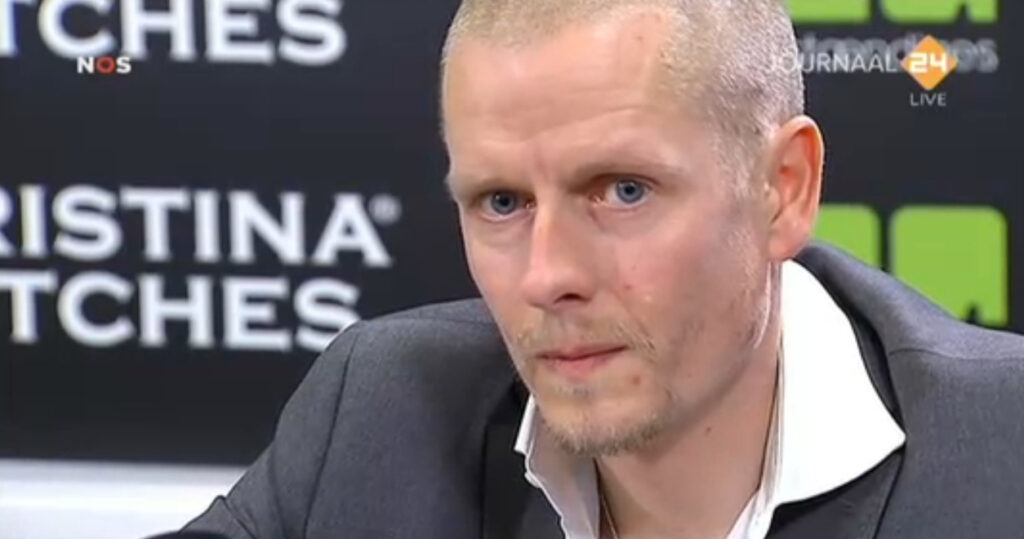

Former Danish pro cyclist Michael Rasmussen, who last week triggered Ryder Hesjedal’s admission to doping in 2003, has admitted he persuaded his dad to donate blood as part of his doping activities, and used a synthetic blood intended for dogs.
With a test for EPO intriduced at the 2000 Olympics forcing them to limit their use of that blood-boosting drug, riders looked to other techniques to increase performance in the earky years of this century.
There was no test at the time that could detect another person’s red blood cells in an athlete’s sample.
“In the Tour of Spain in 2003, I discovered that there was someone who was blood doping,” Rasmussen told Danish TV station DK’s 21Søndag in an interview shown last night. “I had never done it before, so I spoke with the team doctor at Rabobank about it.”
Rabobank’s team doctor at the time was Geert Leinders, who later worked with Team Sky before being sacked because of his association with doping.
Rasmussen said: “He had done it earlier with two brothers who were compatible. And if the blood was compatible, it was like mixing water with water, so there was no risk to health.
“He told me that I should see if I could get someone to agree to it, so I took courage and asked my dad.”
Rasmussen’s confessions have painted a picture of a world in which doping was standard practice for professional cyclists, but asking his dad to donate blood made even him pause.
"It felt like stepping over the line," he said. “It was not easy, but my parents were aware that I used drugs to ride faster. I used the same methods as my rivals to compete with them.
However, the father-to-son blood transfer never happened. After the Flèche Wallone race in 2004, Rasmussen’s father, Finn, went to Belgium where his blood was tested and turned out not to be compatible.
"It [the blood doping] never took place,” said Rasmussen.
Rasmussen’s parents now say that they hope his reveleaitons will help cycling clean itself up.
"It is wrong that he is the only person to be branded a cheat," Finn Rasmussen said. "Our impression was that there was a culture (of doping)."
Artificial blood for dogs
Doping using his father’s blood wasn’t possible for Rasmussen, but he had previously tried an even more alarming technique: injecting a synthetic blood substitute intended for dogs.
"I waited for thirty seconds to see if I would go into shock."
Rasmussen said that he got the idea after riders from the Telekom team took all three podium places in the 2000 Olympic road race.
In his book, Yellow Fever, out today, Rasmussen writes: "It required no great analytical skills to figure out that there was something going on. I also heard rumours that Telekom riders had used synthetic hemoglobin. I never found out if that was true, but this supposed wonder drug was worth looking into.”
"I found out that there was a synthetic hemoglobin for dogs whose composition was exactly the same as that given to humans.”
That product is Oxyglobin, used in cases where dogs become transfusion-sensitive even to matching blood. Its human equivalent, Hemopure, is only approved for human use in South Africa, but Oxyglobin is more widely available. Rasmussen obtained his initially from Puerto Rico.
“Synthetic hemoglobin comes in prepackaged blood bags, and I must admit I was pretty nervous before I took it for the first time,” writes Rasmussen. “It was, after all, artificial blood I had to shoot into my veins. "
"I was sitting in a hotel room in Italy, when I did it the first time. I took a painting off the wall and hung the bag there. It was prior to my first road race in 2001."
Rasmussen first had to administer just a few drops of the synthetic blood to see if he was allergic to it.
“I let five drops run into my veins. Then I waited for thirty seconds to see if I would go into shock.”
He didn’t, but nor did he derive any benefit from what he describes as “a foolish experiment. The artificial blood did not work.”
In 2007, former mountain bike racer Whitney Richards claimed Rasmussen had attempted to trick him into smuggling artificial blood into Italy in a shoebox.
Richards opened the box while trying to fit everything into his suitcase and discovered the real contents, which he subsequently threw away.
“There was no way that I would carry that on to an airplane or carry that through customs for anyone,” Richards told Velonews in 2007.
The story came out after Rasmussen took the Tour yellow jersey that year and in a press conference claimed to be clean. Richards had told his story to journalists before, but had insisted Rasmussen not be identified. But after that press conference, he snapped.
“Look at what the Tour has gone through this past year,” Richards said. “Riders are putting their salaries and their careers on the line to help convince people cycling is clean and this guy gets up and tells people, ‘You can trust me,’ something I know for a fact is not true. The stupidity, the arrogance, the hubris… it’s incomprehensible.”
Rasmussen was withdrawn from the Tour de France by the Rabobank team shortlly afterwards amid accusations that he had misled anto-doping authorities about his whereabouts before the Tour.














18 thoughts on “Michael Rasmussen asked dad to donate blood, used canine blood substitute”
Cock!
Cock!
I was out at the Tour of
I was out at the Tour of Malta a couple of years ago – it seems quite a popular race with British riders looking for some early season sun.
Anyway, the organisation had managed to get Michael Rasmussen to race (in the colours of event sponsor, Festina Watches). They were trying to big him up as they introduced him, clearly overwhelmed by the presence of such a personality gracing the little island of Malta.
Everyone booed him.
🙂
(No subject)
#o
good god, how low can you
good god, how low can you get?
Rabobank and Rasmussen must
Rabobank and Rasmussen must not have got the memo that doping stopped in 2006…………..according to all those ex USPS dopers……….. 8}
Decster wrote:Rabobank and
You know the score!
When you lay the facts of the sport bare and what people have done and continue to do it is hard to see what they wouldn’t do to win.
Perhaps someone ought to propagate the lie that donkey piss gives you a boost and wait and see who goes shopping for it.
The lengths riders would go
The lengths riders would go to are just staggering! Administering something only approved for use in animals into your own veins
jarredscycling wrote:The
It’s not that staggering when you look at what passes for human consumption in the freezer shelves of Tescos, Iceland etc
It wouldn’t surprise me if any of the current tour riders would inject their own piss if it gave them ‘marginal gains’.
OK, I’ll do the honours and
OK, I’ll do the honours and be the first to say:
I bet he was feeling Ruff after that synthetic transfusion.
I’ll get my gillet.
Another bash for cycling.
The
Another bash for cycling.
The way forward is for the teams associated with doping to pull out of the cycling scene incrementally say over 3 or 4 years and allow new sponsor names to move in. Cheerio Cofidis, Rabobank etc. That way the new younger fans to cycling probably won’t associate the dodgy past with a clean sport.
Guyz2010 wrote:Another bash
Roadies = Dopers it will be years before that association is lost no matter which particular ex-tour winner is carrying the cross for the entire sport.
In my own eyes, the only genuine (according to the strictest sense of the holier than thou brailsford doping policy) dope free cyclists are the ones who are going to be riding the 2014 Under 12’s
& will the next EX-PRO please
:W & will the next EX-PRO please step up to the guilty conscience platform? (in the voice off of the post office que) :W
My wife has just said he only
My wife has just said he only did because he was dog tired.
I find all of this so sad,
I find all of this so sad, this is on a different level to other doping confessions, the lengths that this guy would go to is astonishing, this just hi-lights the pressure that they are under and the lengths they will go to, very sad
It’s not an admission of
It’s not an admission of anything though. It’s more “I wanted to do this but it wasn’t a match, so didn’t” followed by “I thought about doing something else but couldn’t go through with it”.
Tell us – what did you ACTUALLY do, where and when, who knew about it and turned a blind eye, and who facilitated it. Anything else is somewhat irrelevant.
Not even real dog’s blood!
Not even real dog’s blood!
Rasmussen denied that he’d
Rasmussen denied that he’d suffered any lasting side-effects, as he sniffed his interviewers arse…..
Relax Cyclists. Not that bad.
Relax Cyclists. Not that bad.