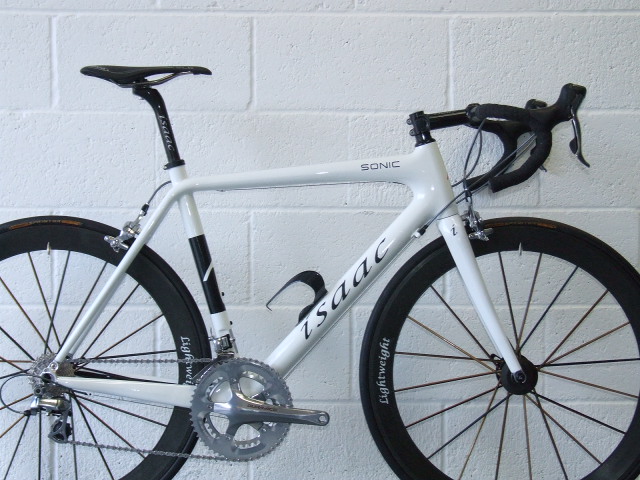

We were lucky enough to have a new 2009 Isaac Sonic on our stand at Cycle ’08 and it certainly created quite a stir. We haven’t ridden it yet – they don’t allow that sort of thing at the Cycle show – but here’s the technical lowdown. What Isaac are aiming for is a race bike that you can ride all day, that’s extremely light, efficient, robust, comfortable, oh and it’s got to have killer looks as well. The They’ve certainly succeeded on the lightness bit anyway our bike weighed 14.8lb (6.7kg) on the road.cc scales and no arguing it’s a looker too. As for the ride we’ll let you know asap. 
It’s tough too – surviving trial by tourer on the road.cc stand when one over-excited visitor managed to drop a bike on it not once, but twice in quick succession (a memorable show moment for all who were there…). Isaac’s design philosophy places great emphasis on the strength of natural forms, all their bikes have flowing curves rather than lots of straight lines – they are all also true monocoques meaning that the front triangle is one continuous structure without joints or sockets. Isaac maintain that a curved one-piece structure allows stresses to be dissipated more effectively allowing you to build a frame that is both light and strong. All those curves look pretty good too. 
So what’s different for 2009? The big difference is something that you can’t see and will hopefully never get to experience, improved impact resistance. We reported on this from Eurobike but all new models have what Isaac are calling Synthetic Sphere resin added to the pre-preg carbon fibre this was developed by Isaac in collaboration with a Japanese university. This resins is used in conjunction with various grades of high and ultra-high modulus carbon filament, supplied by Japanese producers Torayca and Mitsubishi Rayon, are used, with an attractive 3K weave in the visible layer. The lamination is made up of between five and fifteen layers of uni-directional pre-preg carbon. All Isaac frames feature a continuous, woven, visible layer. The Sonic employs a 3K weave. This has an important structural function in that it increases resistance to de-lamination and bursting in the event of an accident. It also protects the underlying structure from knocks and abrasions. More Sonic pics
The latest Sonic also boasts a new monocoque fork, shaped specifically to complement the Sonic frame, which incorporates a dual diameter steerer. The reasoning behind this, say Isaac, is that having a larger diameter to the steerer at its base gives increased stiffness and safety without a weight penalty. It also allows an oversize lower head set bearing to better deal with the impacts and stresses. Dual diameter steerers are becoming more common and are an innovation we’ve noticed cropping up more and more particularly on top-end time trial machines. An FSA Orbit Carbon asymmetrical head set is also included to complete the frameset package. This has high-grade stainless bearings and a carbon fibre top cap. COMPLETE BIKE SUPPLIED TO ROAD.CC Our Sonic was a 54cm sized frameset (48, 51, 55.5, 57 and 60 are also available) built up with Isaac ‘bars, stem and seatpost, Shimano Dura Ace 7800 drivetrain and a set of Lightweight wheels. You can buy any Isaac either as a frameset or a complete bike. UK distributor RBS offer a custom build up option or they can supply it to your local Isaac dealer to do the same. Our bike weighed in at 14.8lb (6.7kg) as shown. Two colourways are available. White with carbon detailing or carbon/black with silver detailing. Sonic complete bike prices range from around £2,500 to £6,000. The Isaac Sonic 2009 is available from November 2008 at Isaac stockists across the UK. Isaac Sonic 2009 frameset UK srp £1,599.00 Bike as featured – approximate UK srp £5,250.00 For more Isaac information visit www.isaac-carbon.co.uk Product info line: 01329 820890