


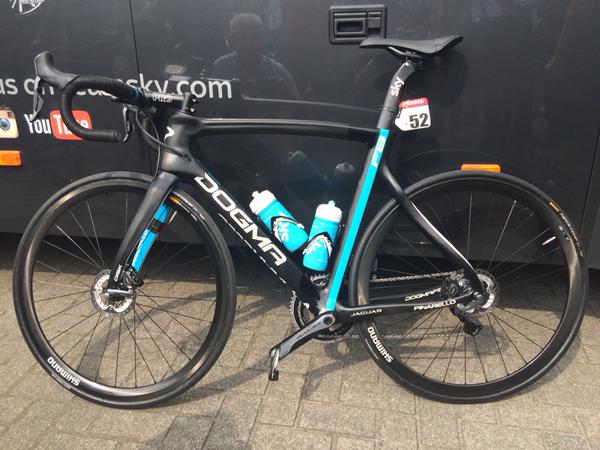

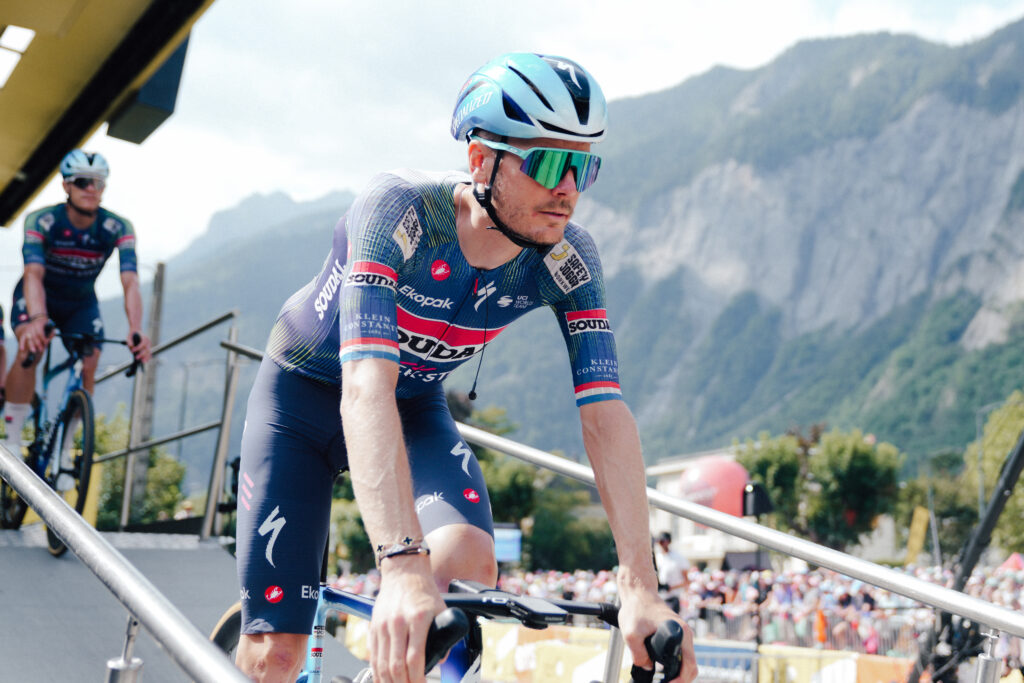
Team Sky’s Bernie Eisel is using a Pinarello Dogma F8 Disk equipped with Shimano disc brakes in the Eneco Tour in Belgium.
It now looks like Sky has become the first top-level WorldTeam to follow suit.
Teams could nominate two races in which they’d use disc brakes in August and September of this year.
Pinarello unveiled the Dogma F8 Disk back in May.
The bike is based on the standard Dogma F8 that Team Sky riders use regularly. The new Dogma F8 Disk is said to retain the “main characteristics” of the regular Dogma F8 in terms of the geometry, frame material, stiffness and aerodynamics.
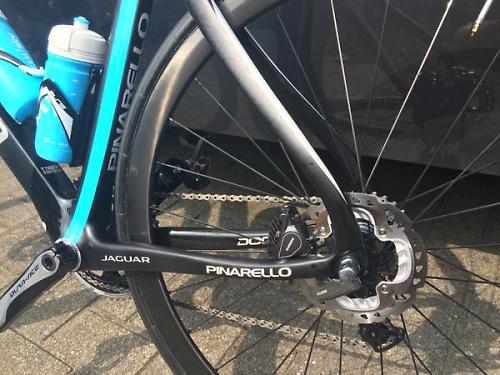
The frame uses Shimano’s new Flat Mount brake calliper system (you can use adapters to make it compatible with other brake systems).
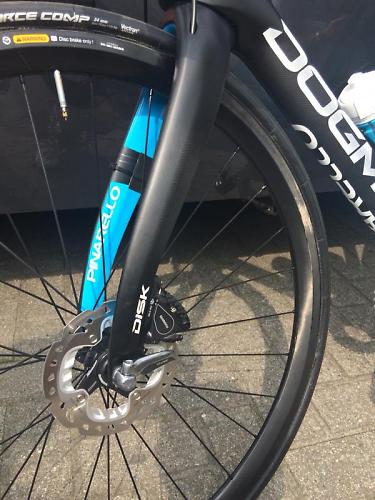
Pinarello has stuck with conventional quick release axles rather than adopting the thru-axles like a handful of other bike brands.
Good news? Bad news? Let us know what you think.









54 thoughts on “Team Sky races with disc brakes for the first time”
I want to know what rotors he
I want to know what rotors he is running there, nothing I’ve seen before.
Gkam84 wrote:I want to know
Brailsford says that they are especially round ones made in France.
oozaveared wrote:Gkam84
Froome of course will be using oval rotors.
Gkam84 wrote:I want to know
Standard Shimano Icetech freeza rotors,
http://www.chainreactioncycles.com/shimano-rt99-ice-tech-freeza-cl-disc-rotor/rp-prod82466
Gkam84 wrote:I want to know
Ice tech rotors from Shimano. I have them on my new Hunt wheels.
Gkam84 wrote:I want to know
Aren’t you a mechanic? The Icetech’s have been out for at least 3 years in MTB versions and on road bikes for over a year
Aren’t they Shimano?
Aren’t they Shimano?
God that looks awesome.
God that looks awesome. Beautiful bike.
Nice! Odd seeing so many
Nice! Odd seeing so many spokes on a modern looking frame though, even knowing it’s necessary
well spotted – what’s with
well spotted – what’s with all the spokes?
I think it’s due to the
I think it’s due to the greater stresses cause by braking forces from the discs.
graybags wrote:I think it’s
Can someone explain to me what these extra stresses I keep reading about actually are? My understanding of brakes is that you try to stop one part of the wheel from turning (or reduce its rotational speed) which is the rim in the case of rim brakes and the hub in the case of disc brakes. Because the spokes tie everything together, as you stop/slow one part of the bike the rest has to do the same. If I lock a wheel up with either a disc or rim brake, the spokes have to carry the stress which ties the whole bike together as a single unit, if they didn’t then the spokes would bend or pull out of the rim or hub, everything would fall apart and different bits of bike would end up travelling at different speeds. Surely if I stop a bike from a given speed in a given distance, the stress on the spokes is the same. I know a disc can produce more stopping power but once maximum deceleration is achieved (just before a wheel locks up which is a function of tyre grip and road surface) no further loading is being applied to the spokes. Because I can lock a wheel with either type of brake, where does this extra stress come from?
extra dresses because on a
=D> extra dresses because on a rim brake system the rim is being held and the ground is trying to turn the rim. On a disc brake the hub is being held and the ground exerts a force on the rim so the spokes must resist the turning moment.
Welsh boy wrote:graybags
Been a while since GCSE Physics, but I would hazard a guess at effective lever lengths between the bit doing the stopping and the contact at the road.
Welsh boy wrote:graybags
With rim brakes, the brakes stop the rim and all the spokes have to do is stop the hub spinning. As the hub is light and also because its near the centre it doesn’t have much angular momentum so its easy to stop. They also have to stop the hub shifting forward inside the wheel, but that’s tension in the spokes at the back and spokes are very good at holding tension directed out from the hub.
On a disc brake wheel, the brakes stop the hub, and the spokes have to stop the entire bike and rider, by stopping the rim turning. (or as wycombewheeler says they have to stop the rim spinning while the ground is pushing it backwards, which is the same thing)
Welsh boy wrote:graybags
There aren’t any greater or extra stresses.
You still have to stop the same bike, there are simply different stresses on different components and/or different areas.
You have to beef up the left-hand fork but you can correspondingly reduce the mass up by where the rim brake was as you no longer need a mounting point up there. Same on the chainstay – beef up the left hand stay but you can then completely redesign the seat-stays for more compliance/lighter weight etc.
Welsh boy wrote:Can someone
It’s to do with the differential torque on each side of the bike interacting with the coriolis forces as the spokes pass through the Earth’s magnetic field. For small riders on light bikes – essentially, anyone in the pro-peleton – that interaction can cause them to be thrown violently from their bikes and will turn their wheels into red-hot discs of terror. If the entire peleton were to adopt discs and were to all brake at the same time, the feedback could potentially cause the Earth to slightly increase its natural precession, causing an ice age. In the Southern Hemisphere this problem will be exacerbated unless manufacturers produce frames and hubs with the rotor and caliper on the other side of the wheel, or unless everyone rides backwards. There is no problem using discs in equatorial regions.
adamthekiwi wrote:Welsh boy
Quite right Welsh Boy but I think you’re a little ill informed concerning equatorial braking. Disc brakes are so good that if all those tedious heroes circumnavigating the globe for charity all braked at the same time the extra traction achieved could slow the earth’s spin to drop all geo-stationary satellites off by as much as 5 degrees – consequently rendering Strava next to useless as a way of trumpeting your sad pbs to those that don’t give a toss.
Native types living on the equator would have no effect on thexearth’s spin rate. They can’t afford bikes let alone ‘essentials’ like disc brakes.
graybags wrote:I think it’s
Someone should tell Crank Brothers: https://www.crankbrothers.com/category/wheelsets
What kind of wheels are
What kind of wheels are those?
cdamian wrote:What kind of
They look very odd, if you look at the front rim, despite the sticker saying no rim brakes, it looks like a rim brake rim, the back appears much rounder.
The sheen suggests carbon, with the shimano stickers, and the UCI regs I would guess these are what will become the new Dura Ace wheels, why 28? spokes again not sure when you can get perfectly serviceable mtb wheels with less.
how to ruin a good looking
how to ruin a good looking bike quickly…
spasypaddy wrote:how to ruin
Quite surprised we actually got 11 comments in before the obligatory “I don’t like the look of discs, and and I want you to know that too” one… 😉
spasypaddy wrote:how to ruin
Said previously about:
– derailleur gears
– hub gears
– triple chainsets
– STI shifters
– clincher tyres
– mudguards
– rear racks
– lights
– seat packs
– non-leather saddles
– every new frame material introduced
and just about every part of a bicycle ever created.
spasypaddy wrote:how to ruin
By removing the rim brakes?
Yeah, dem tings is so priddy
I want
I want =P~
MY EYES! I know I’m swimming
MY EYES! I know I’m swimming against the crowd, but discs look stupid on road bikes.
That said it is still it’s a 1000% better looking than that Spesh VIAS venge and the new crop of #aeroisugly machines…
Beast.
Beast.
Bike with no name – I’ve got
Bike with no name – I’ve got the Spesh Diverge as my commuter/winter bike and the discs make perfect sense. Bike gets a lot of comments too about how ‘cool’ / ‘mean’ it looks.
I’m so hipster it hurts, unfortunately my beard growing prowess is poor!
Another fun part of disc brakes is watching my clubmates faces as I pile past them downhill and brake so much later than them…
alansmurphy wrote:Another fun
Don’t think turning around to look at your club mates faces is a good idea in those circumstances. 🙂
What spacing are the drop
What spacing are the drop outs, 130, 135 or 140mm?
And presumably STIs as good as their cable ancestors?
Where are the brake fluid reservoirs?
What’s the WEIGHT of the
What’s the WEIGHT of the bike? We all want to know… 😕
Regardless of the disc/no
Regardless of the disc/no disc issue, I can’t think of anyone other than Stevie Wonder who would consider Pinarellos to be aesthetically pleasing.
Helen Keller’s favourite bike…
crikey wrote:Regardless of
Quite. Pinarello just don’t do it for me.
As to disc brakes, I have them on my CX. I am happy enough with them, but I think the benefit is marginal, even in the wet, perhaps slightly stronger braking power, but mine aren’t hydraulic. The biggest benefit is that by keeping the brake off the rim it’s lower maintenance, with less adjustment (popping a wheel in an out is actually easier).
The interesting part is the issue over the service vehicles carrying both rim and disc brake wheels – I don’t really care which way the door swings on this innovation.
It’s because the disc is on
It’s because the disc is on one side of the wheel; trying to stop it produces a twisting force. That stresses both the wheel and the fork as well as, potentially, the axle and QR (hence the fashion for thru-axles instead).
The same twisting force – and resulting stress – doesn’t apply to rim-braking, as the callipers press (more-or-less) evenly on both sides.
Toro Toro wrote:It’s because
I think the trend for thru-axles is due to the torque on the axle not any twisting, the disc is stopping the axle, which the spokes come off, so there shouldn’t be any twisting at the rim.
Come again? The torque is
Come again? The torque is applied on one side of the axle, which produces a twisting force.
Twisting at the rim isn’t the problem, only a symptom.
Toro Toro wrote:Come again?
Erm, no! The force is being applied to the disc, which although on one side of the hub, is still on the hub, so there is no twist in the wheel as the whole hub is slowed by the braking forces. It is in the fork that the forces are uneven one side to the other. Bolt though spindles help stiffen the fork.
However, bikes survived without bolt thru spindles for ages, and the problem that was found was more to do with the position of the disc caliper resulting in a downward force on the spindle when braking, thus potentially pulling the wheel out of the fork when braking. Bolt thru spindles solve this, but so does turning the dropout forward 45 degrees.
Through axles are rather more
Through axles are rather more to do with the way suspension forks tend to be affected by the one sided effect of disc brakes. They also stiffen up the whole front end which may or not be a help on a road bike with, hopefully, stiff enough forks.
crikey wrote:Through axles
Thru-axles are rather more to do with the way suspension forks (and hubs) tend to be affected by the tyres hitting stuff hard. Their primary raison d’etre vis-a-vis road bikes seems to be derived from the almost accidental finding that they tend to reduce brake rub on mountain bikes.
I’d like to know what Bernie
I’d like to know what Bernie Eisel thinks now he’s raced with discs.
nortonpdj wrote:I’d like to
Indeed! And I won’t believe a word of what he says about it until he’s retired and no longer in the direct or indirect pay of a bike company 😉
Have a look on the Cycling
Have a look on the Cycling Weekly site then…
and through-axles are meant
and through-axles are meant to make it less likely that the braking forces will pop the front axle downwards out of the drop outs. Whether that’s a consideration on road bikes (which presumably will have their front wheels on the ground all the time when braking) I have no idea.
Morat wrote:and through-axles
Tell that to Peter Sagan.
I’ve ridden with hydra disc
I’ve ridden with hydra disc all summer. They come into their own on long descents and in wet weather. The improvement is an evolution for the road performance – regardless of looks.
When hitting a hole or stone I’ve had to stop to adjust my wheel with the disc rubbing several times so do think bolt thru axel is the way forward. Not sure how you get a quick wheel change thou in the pro peloton. Don’t know how the mavic neutral service car is going to cope with Giants thru axel, Sky on quick release, Merida developing a larger diameter thru axel. The Uci should have made a ruling to push for some standard…… But no money In that
My experience with hydraulic
My experience with hydraulic disc roadbikes with QR echo others here; they are fantastic in the rain (I didn’t realise how good until I went out on a very wet and windy day with our club recently), but they rub slightly when they are knocked and occasionally when replacing the wheel. Also, if you are unfortunate enough to have a fall expect to spend a couple of minutes tweaking them by sub-millimeter increments. They also add a LOT of weight which isn’t ideal.
Overall, a mixed blessing but I think I slightly prefer them to normal callipers. In an ideal world I’d have disc brakes on a winter bike and normal callipers in summer.
@part_robot
I’ve been riding
@part_robot
I’ve been riding a hydraulic disc brake road bike since October last year – my only road bike
I agree somewhat with comments about Q/R and disc brakes.
I’ve had situations where I’ve done a lot of heavy braking and I believe the wheels have shifted slightly in the dropouts as I then get small amounts of rotor noise, which vanishes if I stop, loosen the Q/R, shimmy the wheel in the frame / fork and re tighten the Q/R. I’ve tried different Q/R skewers but it makes little to no difference.
I also get small amount of rotor noise (tinkling) on the front if I sprint really aggressively and honk the bars from side to side.
Otherwise I have been extremely happy with disc brakes on my road bike, for my riding (not a racer) they are a progressive move forward. I would like to see thru-axles front and rear as the next step.
But I come from 20+ years of mountain biking and we’ve had hydraulic disc brakes for along time (my first hydro discs were in 1995). Other riders who have a road background may have a different opinion on disc brakes.
Regarding weight? My current road bike is exactly 8kg with pedals, exactly the same weight as my previous caliper brake road bike. Both were mid priced (£2,500) bikes.
I’d like to see thru-axles if
I’d like to see thru-axles if they were one of the newer, part-turn devices like the RAT as you’d get something quicker and easier than a QR on the front with the benefits of alignment – and (purely personally) I think they’re a nice bit of engineering.
In the racing situation the initial line up of the rotor will take a bit longer, part of which will be technique (e.g. lift the front by the caliper and using your fingers to guide it in) so it’s swings and roundabouts I guess. I imagine we’ll find out what the teams think in due course, even if potentially diluted by sponsor commitments by some of them. In one way it would perhaps be nice if they did get the OK in racing insofar as allowing manufacturers more resource and incentive to improve with the knock-on benefits for the rest of us – not to mention the outside chance of actually standardising things (although i’ll not hold my breath on that). My tuppence worth anyway.
fukawitribe wrote:I’d like to
I totally agree it gives the through axle that seems to be favourite and the ease of quick release I think it should be the standard as it is a beautiful simple solution to a quick wheel change problem. focus have really thought out the solution. the wait now is for campagnolo to see what solution their partners come up with.
“Good news? Bad news? Let us
“Good news? Bad news? Let us know what you think.”
Well, you did ask!
Don’t understand the rush for
Don’t understand the rush for thro axles on road bikes. Surely a better way would to increase the clamping area of the QR and hub on the left side. It works on older mtbs.
Yorkshie Whippet wrote:Don’t
Which didn’t have disc brakes, not to mention I’ve had rear wheels pop out under load because the QRs were simply not up to scratch. IIRC there was a recall on those Cannondales/Shimano QR interface
Anyway quick releases are not in fact quick because of lawyer tabs or more importantly not very accurate, so being replaced by a better idea is a good thing.
Disc brakes? Electronic
Disc brakes? Electronic gears? Carbon bars? All I know is the price of traditional cable and brake Campag Super Record is dropping all the time so keep on buying the latest ‘evolutions’ and I’ll be quids in. 😀