


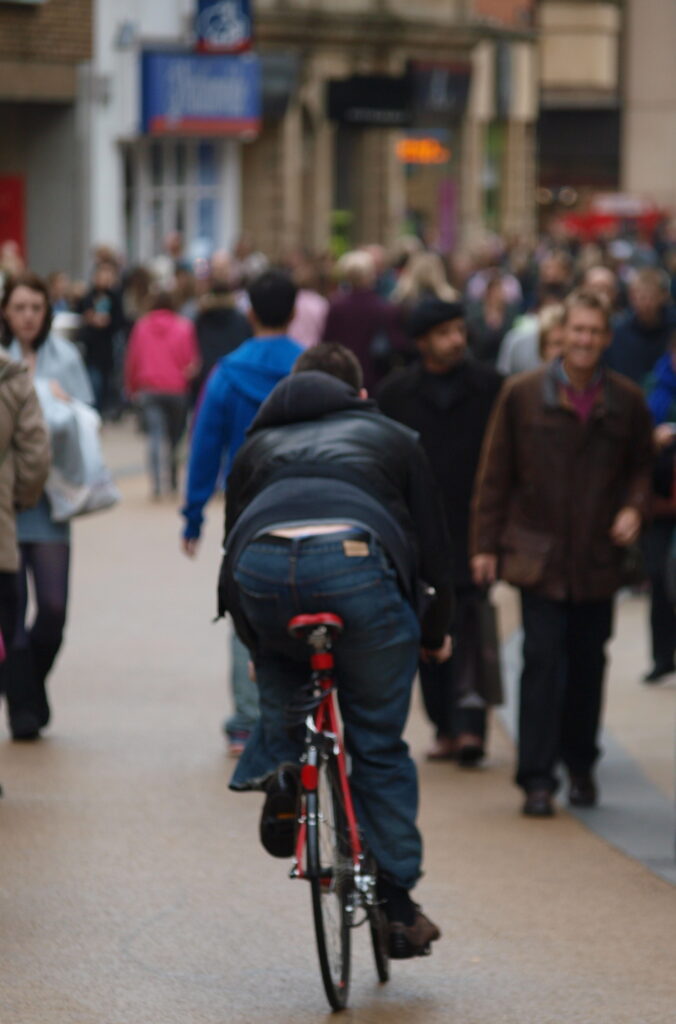

A Conservative MP says that anti-social cyclists who ride on the pavement should be subject to a “three strikes and you’re out” regime after which they are fined the value of their bike – and have it impounded if they don’t cough up. As one of the people who helps decide the country’s laws, though, he perhaps should have boned up on the legal situation first.
Stewart Jackson, who has represented Peterborough since 2005, acknowledges in his Westminster Life column for local newspaper Peterbrough Today that it's “a pretty cycle friendly city, with its many miles of cycle routes, commitment to sustainable transport, as recognised by Central Government and aspirations to be the Environment Capital of the UK. So far, so good. What’s not to like?”
Quite a lot, it turns out.
“Well,” he continues, “the slightly superior and arrogant attitude of some hard core cyclists, who really don’t believe that basic roadcraft rules and conventions and the Highway Code really applies to them.”
Mr Jackson says his eyes were opened to the strength of feeling about people who ride on the pavement at a local Police and Community Neighbourhood Panel where he found people “were seriously irritated, annoyed, crazy, mad” about them.
He goes on: “People say, ‘it’s Eastern Europeans who don’t understand the rules of the road….’ but it isn’t. Young men and women, older men and women, students, council workers, parents with kids….yes, they all ride on the pavement at speed and really couldn’t give a monkey’s what you think about it or about your safety and security as a pedestrian and the fact that you might have babies and toddlers with you.”
The MP adds that the police “don’t seem that bothered either, despite the fact that a criminal offence is being committed and the law is seemingly being flouted with immunity.”
While cycling on the footway is illegal under Section 72 of the Highway Act 1835, amended by Section 85(1) of the Local Government Act 1888, the situation of enforcement is less cut and dried than the politician seems to believe, as a look at Bike Hub’s excellent Cycling and the Law article reveals.
Earlier this year, transport minister Robert Goodwill said in a letter to Donnachadh McCarthy of the campaign group Stop Killing Cyclist that Home Office guidance first issued in 1999 by former Home Office minister Paul Boateng which told police to use their discretion was still valid.
The latter had written to senior police officers to say: “The introduction of the fixed penalty is not aimed at responsible cyclists who sometimes feel obliged to use the pavement out of fear of traffic and who show consideration to other pavement users when doing so.
“Chief police officers, who are responsible for enforcement, acknowledge that many cyclists, particularly children and young people, are afraid to cycle on the road, sensitivity and careful use of police discretion is required.”
Following Mr Goodwill’s reiteration of that guidance this year, the Association of Chief Police Officers (ACPO) repeated its support of the Mr Boateng’s 1999 letter, saying: “We welcome the re-issued guidance from the Minister for Cycling in respect of cycling on the pavement and have re-circulated this to all local forces.”
Back in Peterborough, Mr Jackson acknowledges that “of course there are some diligent, law abiding and respectful cyclists and I absolve them of my ire and collective opprobrium.
“But what about the “couldn’t give a damn” crew, who whizz round the corner on your street risking life and limb (yours, not their’s),” he asks.
Here’s his novel solution:“Well, how about three strikes and you’re out? Caught three times cycling on the pavement, they would have their cycles confiscated and unless they paid the full value of the cycle, it would be either destroyed or given to a charity. We’d soon have pavements for pedestrians and a little more mutual respect.”
He concludes: “Over to you Peterborough City Council. A bye law needs updating…”
Except it doesn’t. The fixed penalty notice for riding on the pavement, currently £30, is set out in Section 51 and Schedule 3 of the Road Traffic Offenders Act 1988 – and since that comes down to the Secretary of State; perhaps Mr Jackson needs to have a word with one of his Parliamentary colleagues instead?

















52 thoughts on “MP calls for “three strikes and you’re out” rule for pavement cyclists”
Are we going to start doing
Are we going to start doing the same for motorists? Break the law 3 times and your car is confiscated until you pay the full value of it? I must admit this idea is growing on me.
portec wrote:Are we going to
Yep, I can really see the appeal now you put it like that. Let’s throw in pedestrians as well, step out into the road three times whilst staring at a mobile phone, it gets confiscated.
portec wrote:Are we going to
Harsh. Let’s be fair and make it four, or, if you like, 12 points. 😀
Given the actual title of the
Given the actual title of the article … ” Westminster Life: Plague of ‘couldn’t give a damn crew’ ” … you’d be forgiven for thinking he was talking about his fellow MPs.
And for an article published yesterday but which would hit most people’s doormats or in-boxes today – you’d have thought an MP could have found something more important to discuss.
So isn’t there something like
So isn’t there something like 20,000 motorists out there with more than 12 points on their license? With some having in excess of 50 points?
Maybe we could start with those first?
Or even with everyone who’s actually caused a death or serious injury on the roads due to dangerous or careless driving? Some multiple times?
Or is that too sensible?
“[T]he slightly superior and
“[T]he slightly superior and arrogant attitude of some hard core cyclists, who really don’t believe that basic roadcraft rules and conventions and the Highway Code really applies to them.”
That bit at least makes sense.
harman_mogul wrote:“[T]he
Not really. Every ‘hardcore cyclist’ I know (I imagine I’m included in this category) abides by the Highway Code far better than the ‘guy on a bike’ and have a far greater understanding of ‘roadcraft’.
harman_mogul wrote:“[T]he
Substitute cyclist for any other road user and it still makes sense. There are idiots everyhwere.,…
Not saying this isn’t an
Not saying this isn’t an issue, but is this really such a pressing problem? The statistics for pedestrian injuries would indicate motor vehicles are a much, much larger problem – even accounting for various factors (# of cycles, miles travelled in urban areas, etc.)
I would also paraphrase “he found people were seriously irritated, annoyed, crazy, mad about them” to “he found the type of people who pitch up at local Police and Community Neighbourhood Panels “were seriously irritated, annoyed, crazy, mad” about them.” That – and hedges – and young people – especially young people, all “slightly superior and arrogant”.
CanAmSteve wrote:I would also
Like all those self-selecting surveys (Guide Dogs – I’m looking at you X( ) – very few people know about local Panels, and far too many of the ones who look them up, turn up, and speak at them are the ones who clearly have a bit of a axe to grind (in my limited experience).
And pavement parking!! Get
And pavement parking!! Get caught three times within,say, a week, and your car is put in stocks in the village square (I think Conservative MPs like the idea of a stocks in the village square 😕 )
yep – looking out of the
yep – looking out of the window I can see about a dozen cars parked on the pavement right now. “Tow ’em” I say!
I don’t approve of pavement
I don’t approve of pavement cyclists, but I do wish there was a zero-tolerance approach to _driving_ on the pavement.
There’s a spot near a local school where not only do parents on the school-run always park in the bike-lane (as happens outside every school I know of), but when approaching the school they tend to use a combination of the bike-lane and the pavement as a special high-speed ‘undertaking lane’ (two wheels in the bike lane, two on the pavement). Sometimes other drivers do the same, to skip the queue of traffic and get to the junction faster.
Consequently the paving there is all smashed to fragments.
FluffyKittenofTindalos
I had a stint as a lollipop man after I retired and had people driving on the pavement around traffic that had stopped at my sign. No action from GM police despite my reports and witness statements. I finally resigned after a child was brushed by a car which failed to stop. The police took no action on this incident either.
Must admit I had the same
Must admit I had the same immediate thought: apply it to driving as well as cycling and, yeah, let’s do it. An FPN for speeding, one for parking on double yellows and another for having a worn tyre, and your company Beemer’s gone and it’s fifteen grand to get the thing back.
Or is this just a slight case of double standards?
Oh, yes, it is. That’s novel, then.
Can we have a “three strikes and you’re sacked” policy for highway engineers and local authority members who design and approve cycle paths that are just lines on pavements? Or is that too much like a potential solution?
“Mr Jackson says his eyes
“Mr Jackson says his eyes were opened to the strength of feeling about people who ride on the pavement at a local Police and Community Neighbourhood Panel where he found people “were seriously irritated, annoyed, crazy, mad” about them.”
That’s because, in general, the people who attend these Panels *are* ‘crazy, mad’.
I went to one of these meetings once, everyone was over the age of fifty, paranoid types, the leader said she kept a baseball bat under her bed to battle invading burglars.
They aren’t representative of anyone.
Where I live, they closed the cycle path for months, and then the police put out a warning to cyclists (based on one of these panels) to stay off the pavement. The very next day a cyclist was hit by car on the adjacent road (30mph limit, but plagued with speeding) and airlifted to hospital. The police quickly deleted their warning.
People on community panels WILL spend their time ranting about youths ‘hanging around’ in parks, people riding bikes, because that’s the kind of world view they have. If the police take their priorities from these panels, we are f***ed.
thelawnet wrote:Where I live,
Other than the retraction of the warning, that’s not unusual, sadly:
Whats the point of impounding
Whats the point of impounding a BSO that can be replaced in less than 5 mins!?. Will they have a minimum and maximum age for who they nick? will they choose to target one race of people over the other?
Police are pretty poor at crime as it is, i can’t see them stepping out of the Greggs Bakery line to chase a pavement cyclist
Yes, some more details on
Yes, some more details on this here:
http://forum.ctc.org.uk/viewtopic.php?f=6&t=51527
You know a politician is just
You know a politician is just phoning it in when the most damning thing he can say is that cyclists make people “seriously irritated”.
Is that really the best you can do Stewart Jackson? If you really want to pander to your public then perhaps you should trot out the old canard about how all cyclists are guilty of red light jumping. Or maybe the old favourite that cyclists don’t pay road tax. Or that they’re not insured.
But to say that they make people crazy mad just shows a total lack of effort on your part. If you really want to be perceived as a man of the people then you must try harder.
*Warning: This post may contain sarcasm.
Stewart Jackson for
Stewart Jackson for chancellor,prime minister and new SNP leader.
It’s those pesky cyclists
It’s those pesky cyclists again …………. ~X(
“Well,” he continues, “the
“Well,” he continues, “the slightly superior and arrogant attitude of some hard core car drivers, who really don’t believe that basic roadcraft rules and conventions and the Highway Code really applies to them.”
Just amended what he meant to say 😉
To be fair I think Motorists
To be fair I think Motorists are being held to a similar rule, i.e. injure or kill 3 cyclists and you’re out.
Meh, same old shit.
MP hasn’t
Meh, same old shit.
MP hasn’t had his name in the paper for a while.
MP wants to look “pro-active” and “caring for the constituency”
MP comes up with easy soundbite to generate a few column inches and some free publicity.
Usual thing – pick on an easy target so you just pick the most relevant one out of things like:
littering, public transport, local health service, local amenities, cycling
Mould your pro-active “be seen to be doing something” approach accordingly to tell your constituents that you’re representing them at the highest level and please can they all vote for you again.
Minor things like facts and legal frameworks don’t really come into it although it helps if you can trot out some “focus group” that you’ve attended as that shows that you’ve listened to your valued constituents and their bigoted nimby-ism.
Perhaps we can adopt a three
Perhaps we can adopt a three strikes and your out approach for ridiculous MP’s.
Only problem as I see it … There will be very few left!
Maybe not such a problem after all..
I think his morals are a
I think his morals are a little lacking –
The Independent Parliamentary Standards Authority had launched legal action to recover £54,000 from Stewart Jackson, who claimed taxpayer cash to pay mortgage interest on a property in his constituency.
http://www.huffingtonpost.co.uk/2014/03/01/expenses-mp_n_4881417.html
I feel this would be
I feel this would be draconian and unfair. I also feel that if an MP has fiddled their expenses over three consecutive years, then they should be sacked. Three strikes and all that.
Section 72 of the Highway Act
Section 72 of the Highway Act 1835, amended by Section 85(1) of the Local Government Act 1888.
This applies to the fact that there are road restrictions yellow lines etc. If there are no road markings then you can ride on the pavement. In fact you can even drive a car on the pavement as long as you don’t put at risk other road users.
Source Metropolitan Bike squad and Local police once they had gened up on it all. They didn’t like me cycling my 5 year old son home on the pavement by bike.
The bottom line is that all road users need to feel comfortable and if cyclist on pavement causes anxiety or problems then they should move to the road. I personally I don’t like cycling on the pavement as it too complicated but you do get people riding skateboards, roller skate’s and the like on pavements. Are these people meant to ride on the road as well. Technically there is no difference between a longboard and bike Both are man made vehicles propelled by human leg power. Just a thought.
In my S. Cambridgeshire
In my S. Cambridgeshire village the only cyclists regularly using the roads are lycra-clad roadies like myself. Just about everyone else, from kids on their way to school to pensioners out shopping, rides on the pavement. Why? Because they’re too scared of the cars, vans and lorries racing around to use the roads.
If they want to fine cyclists for riding on the pavement, they should do the same for cars that park on pavements, because you have to drive on them to park on them.
You know on Drunkcyclist when
You know on Drunkcyclist when they post a picture of a cyclist’s arse it’s always prettier than that.
At the risk of incurring your
At the risk of incurring your wrath. I believe he is speaking specifically about Bridge Street in Peterborough. If is he I 100% agree with him.
This is a pedestrianised shopping street which is very busy. Some people who aren’t cyclists as we would define the word, whizz down there at high speed on a Saturday afternoon tutting at the likes of me with a push chair trying to get in the shops.
Peterborough has some splendid roads and cycle ways. This link into the city centre is a gap in that quality routing.
While I too dislike cars
While I too dislike cars parking on the pavement it isn’t illegal, except in London. Locally our police will only take action if a car on the pavement is causing an obstruction, i.e. Pedestrians or mobility scooter cannot pass it safely, but in reality they don’t even take action then.
I do like the three strikes idea for road users though, it sounds like a good idea for a new campaign! The brain dead Tory might not have realised it but he has started a movement that will radically improve road safety.
stevengoodfellow wrote:While
That depends on the road markings. You can’t for example drive over double yellow lines and park on the pavement. Unless of course you switch on you hazard lights which makes it fine to park anywhere it seems.
no you’re right its not
no you’re right its not illegal to park on the pavement, but it is illegal to drive onto the pavement, to have got there, so unless youve used some kind of tow truck/drone to drop you in place, youve driven on the pavement.
but as people say we already have a 4 strike rule for road users, it doesnt seem to make a heckuva lot of difference if we cant even ban road users above 12pts.
Swivel-eyed – strike
Swivel-eyed – strike one!
Brain-dead – strike two!
Fuck-wit – you’rrre out!!
MP Jackson wants this 3
MP Jackson wants this 3 strikes for cyclist, I’m happy for that only when he gets it through to ALL forms of transport no matter what its used for! bus driver flouts the law 3x, bus confiscated til firm pays for it to get back. same for ALL car drivers whether its parking on pavement, in ASL, RLJ or speeding . 3x & you loose your car, doesnt matter you need it or not.
So Mr high & mighty MP Jackson, are you happy to loose your car when you flout the law 3x no matter how insignificant you think it is?
Dark_Wolf wrote:MP Jackson
This would be more acceptable… IF the roads were safe and reasonable places to ride a bicycle. For many people they most certainly are not!
Even experienced cyclists avoid routes based on perceived risk or previous incidents; many people would like to ride but are too scared to ride in traffic:
“Half of Britons say local roads too dangerous for cycling in BBC poll”
http://road.cc/content/news/122068-half-britons-say-local-roads-too-dangerous-cycling-bbc-poll
I don’t know even one driver who would say this about driving to work, school or the shops. It is a crime that this is perpetuated (and reinforced by dreadful driver behaviour) every day all over the country.
Don’t quite see what all the
Don’t quite see what all the fuss is about – three strikes is a brilliant idea when applied to MPs and their expenses.
You get an indication of the calibre of Jackson MP from http://www.independent.co.uk/news/uk/politics/expenses-watchdog-takes-action-against-tory-mp-stewart-jackson-in-54000-dispute-over-taxpayerfunded-homes-8608508.html
So why do many cyclists ride
So why do many cyclists ride on pavements?
1) they simply ride how and where they like, at times this attitude may not be in line with good social harmony.
2) they’ve been scared off the roads by poor traffic planning and the attitude of British drivers and ride where they feel safe.
3) they’re kids, let them.
And, ‘MP in daft attention-grabbing idea shocker’ ..
The pavement is a good place
The pavement is a good place to start cycling, whether you’re a child or an adult.
If you’re against cycling on the pavement then you’re effectively against cycling.
I cycle on the roads now, I spent years cycling considerately on the pavement, if that option wasn’t available then I wouldn’t be a cyclist.
Did he really say: “Over to
Did he really say: “Over to you Peterborough City Council. A bye law needs updating…”
Because the word is “by-law”, with or without the hyphen.
I can forgive that in the average punter or sign-writer but an MP who deals with this sort of thing a little more frequently really should know better.
When perambulating as a
When perambulating as a pedestrian I always carry a cheap umbrella; legislation and the pursuit of enforcement can never be as effective a deterrent as the salutary and immediately humbling result provided by the judicious and timely conjunction of spokes and gamp. I do, however, accept that the resultant collateral damage to innocent bystanders may not be entirely congruent with the public-spirited nature of the intervention.
Disclaimer: Although prepared, I have never implemented this course of action nor, indeed, found occasion to do so. 8}
I NEVER cycle on the pavement
I NEVER cycle on the pavement – the bleddy cars get in the bleddy way!!!!!
I sent an e-mail to this mp
I sent an e-mail to this mp regarding his idea and got a brilliant reply last night. Now, I admit my views on his theft of public money might have been strong, but I still think his reply was great, give it was from his official e-mail account.
:H
Sent from my iPhone
Begin forwarded message:
From: “JACKSON, Stewart”
Date: 20 September 2014 23:31:08 BST
To:
Subject: Re: Cycling
Unless you’re a constituent, I really couldn’t give a toss about your tedious views on any subject.
Yours
Stewart Jackson
MP for Peterborough
Telephone: 0207 219 5046
Email: stewart.jackson.mp@parliament.uk
Write: House of Commons, London SW1A 0AA
Website: http://www.stewartjackson.org.uk
Twitter: @SJacksonMP
A strong and independent voice for Peterborough
On 20 Sep 2014, at 16:42, wrote:
Hello Mr Jackson.
Your recent comments regarding cycling have been widely reported in the cycling media, I’m sure that was part of your aim. I would like to say as a keen cyclist that I would totally support your idea of “3 strikes” and your out, if you were to extend this to motor vehicles who in brake the rules also. Motor vehicles as I’m sure you know kill and seriously injury in excess of 2500 people year, cyclist don’t cause anywhere near those kind of problems. This would go a long to improving people’s safety on the roads and make it more likely that cyclist would feel safe there too and less likely to be on the pavement.
But, I’m sure you would never suggest the same for motorist as that would hit the core Tory voter.
All that being said, I had a brief google of your name before sending you this e-mail, and I was shock and disgusted to see the article below. You appear to be just another nasty Tory on the take from the hard working tax payers of this country. You are a far bigger problem to this country than any pavement cyclist will ever be.
http://www.independent.co.uk/news/uk/politics/expenses-watchdog-takes-action-against-tory-mp-stewart-jackson-in-54000-dispute-over-taxpayerfunded-homes-8608508.html
Shame on you.
“Unless you’re a constituent,
“Unless you’re a constituent, I really couldn’t give a toss about your tedious views on any subject.”
That nicely sums up the average MPs attitude to all voters 🙁
Housecathst wrote:I sent an
Speechless, at the rudeness and arrogance of even a conservative MP.
I would for the hell of it lodge an official complaint to the party about the reply.
I’ve sent it on to my local
I’ve sent it on to my local MP, also a conservative to see what he thinks. I was thinking about sending on to the PM office and suggest that it’s used for the next conservative poster campaign.
“Vote Conservative, we really couldn’t give a toss about your tedious views on any subject.”
It’s what I’d always suspected but it’s nice to have it confirmed.
Whilst I don’t see pavement
Whilst I don’t see pavement cycling as a big issue I would like to see greater clarity on the rules.
As it stands we’re told that we shouldn’t be on the pavement as a rule, but it might be OK if the roads are too scary and that the police should exercise discression. This approach is based totally on subjectivity, let’s have some simple and transparent rules that we can all follow.
I’ve said it before but I maintain that the increased prevelance of shared use ‘pavements’ and pavement cycle lanes has confused this issue by reinforcing the idea that bikes should not be on the road.
must be missing something,
must be missing something, this looks fine to me. unless you want a good whinge about ’why just us’?
andyp wrote:must be missing
I see where you’re coming from but the idea of having to pay the value of your bike as a fine is ridiculous. If there’s going to be a fine it should be the same for everyone.
I’m all for better enforcement of the rules, but on the other hand it’s not even clear what the rules are.
Matt eaton wrote:andyp
Exactly, they’d never go as far as proposing the same for a driver of a car/van/lorry/bus.
It’s a minor infringement and should be on a level of fine with minor motoring offences.