


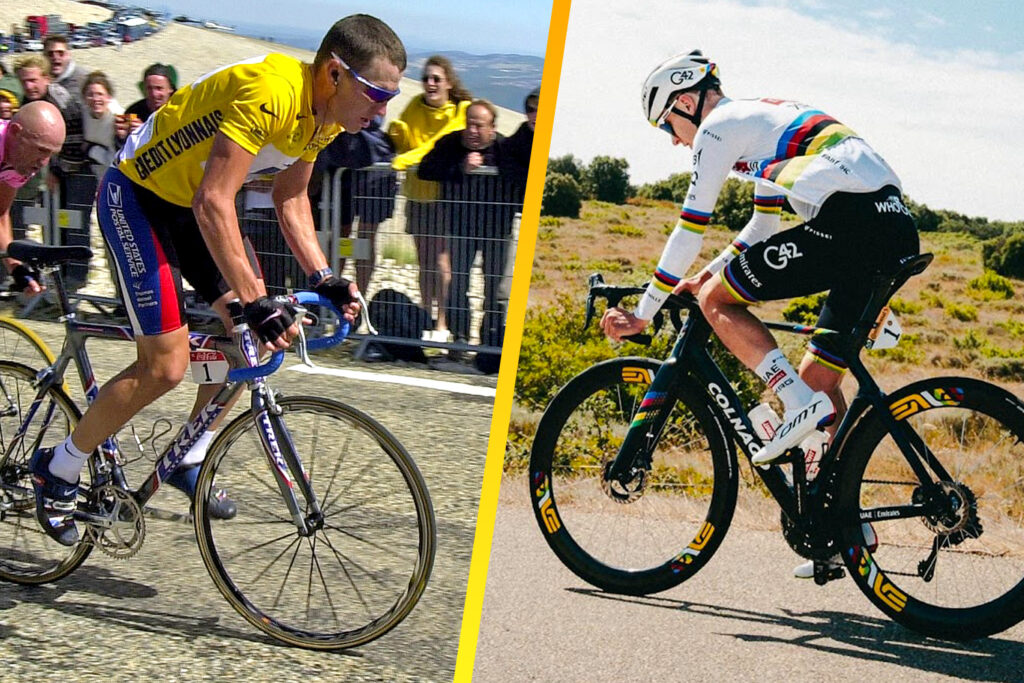

Tadej Pogacar could all but cement his fourth Tour de France title on Stage 16 of this year’s race from Montpellier to Mont Ventoux, and we thought it would be a great opportunity to compare the Slovenian superstar’s modern-day Colnago bikes with the Trek 5900 that Lance Armstrong rode up Ventoux back in 2000. Things have really, really changed.
Granted, there are five more stages after today in this year’s Tour de France, including two more days in the mountains, so anything could still happen, but few would bet against Tadej Pogacar sealing another win.
Lance Armstrong dominated the Tour de France between 1999 and 2005. That’s when he “won” seven times on the bounce. “Won” in inverted commas, obviously, long before it all came tumbling down. You might have heard.
After years of allegations, a United States Anti-Doping Agency (USADA) investigation concluded in 2012 that Armstrong had used performance-enhancing drugs during his career and named him at the centre of a sophisticated doping programme… but you’re familiar with all that. You’ll remember the infamous Oprah Winfrey interview where he confessed to doping.
You’ll also know that, despite being stripped of those titles and banned for life by USADA and the UCI, Armstrong believes his Tour de France titles will be reinstated eventually as “history always tells the truth”.
He’s deluded, of course, but he appears to believe it, so let’s leave him in his happy place. We’re here to talk about bike tech.
Okay, so back in 2000, Stage 12 was 149km (93 miles) from Carpentras to Mont Ventoux. Armstrong had taken the race lead on the mountainous Stage 10 and would hold it all the way to Paris, finishing over six minutes ahead of Jan Ullrich.
He didn’t win on Ventoux, though. That stage went to Marco Pantani after a memorable dual up the mountain, with Armstrong finishing on the same time.
Even that is interesting, though. Pantani had a decent lead on the climb before Armstrong chased him down. It looked like Armstrong would take the victory, but he didn’t contest it on the line, Pantani crossing first.
“It almost looks as though Lance Armstrong was not interested in winning the stage,” said Phil Liggett in the television commentary.
Armstrong later said that he felt Pantani wasn’t the strongest rider on that stage and that he shouldn’t have conceded the win, calling it a “gift” that he regretted.
The point is that Pantani got the stage win while Armstrong gained time over his GC rivals… But we’re here to talk about the bike.
Armstrong’s Trek 5000 Series bikes
Armstrong was riding Trek 5000 Series bikes in 2000, three years before the Madone was introduced to the range. Made with the US brand’s OCLV 120 carbon, the 5500 had a claimed weight of 2.4lb (1,106g) in 2000, while the 5900, made with lighter OCLV 110 carbon and available to the public in 2001, was a claimed 2.27lb (1,029g). That’s not especially light by today’s standards, but it was impressive for its era.
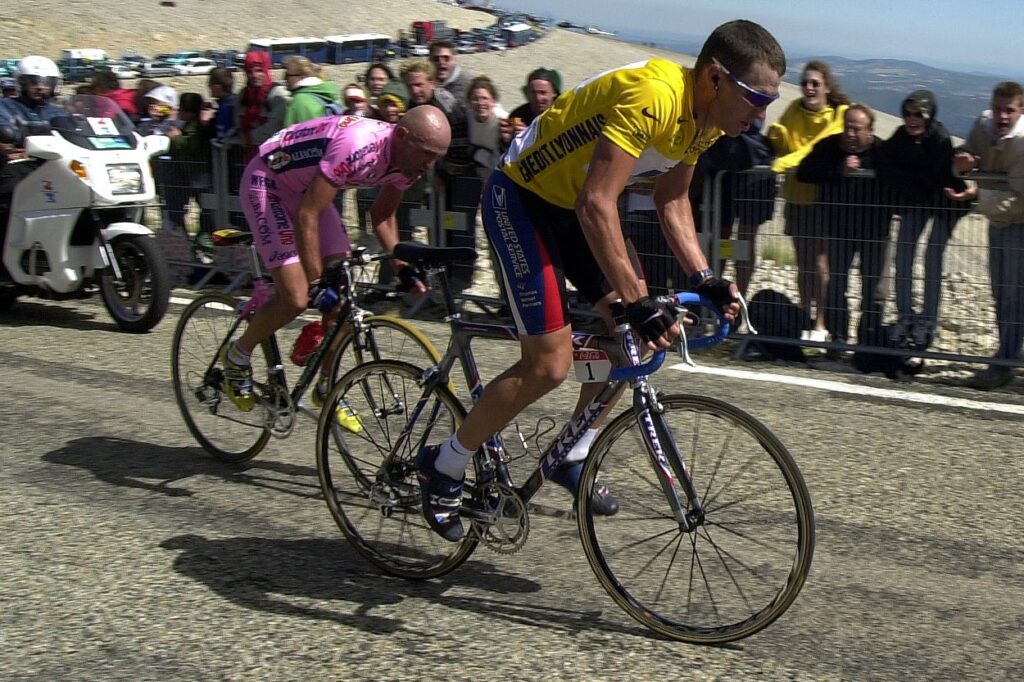
Carbon-fibre certainly wasn’t new on the scene – Trek had unveiled its first moulded carbon fibre frame in 1989 and Greg LeMond had won the Tour on a carbon Look KG 86 as far back as 1986 – but the Trek 5500 OCLV, ridden by Armstrong in the 1999 Tour de France, was a real breakthrough for the material.
In 2000, Trek changed the fork steerer tube from threaded to threadless, from chromoly steel to aluminium, and increased its diameter from 1in to 1-1/8in. The fork blades were again OCLV carbon.
It won’t surprise you one bit to hear that back in its 2001 catalogue, Trek described the 5900 as “the lightest, fastest production frame ever made”. Road bike marketing hasn’t changed much in the last quarter of a century, then
Armstrong was using a top-level Shimano Dura-Ace groupset. Dura-Ace still dominates the pro peloton, but it has changed a whole lot since then. We’re talking about a 9-speed setup back in 2001, and mechanical shifting. Di2 electronic shifting was still several years away, introduced by Shimano in 2009.
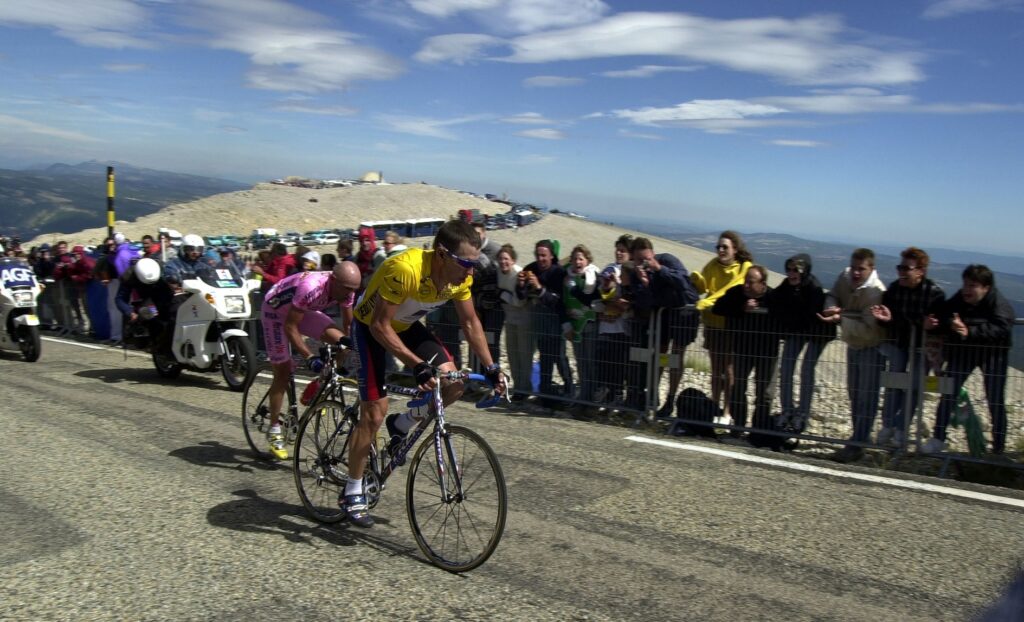
Although STI (Shimano Total Integration) was very much in existence back in 2000, Armstrong preferred to have an old-style front derailleur friction shifter mounted at the top of the down tube on mountain stages to save weight and allow for more precise adjustments. This also meant that his handlebar-mounted levers were slightly different shapes from one another.
Braking? We’re talking about cable-operated rim brakes, of course, and cables that were routed under the handlebar tape and then externally. It wasn’t until 2015 that the UCI trialled the use of disc brakes in professional road racing, before authorising them fully in 2018.
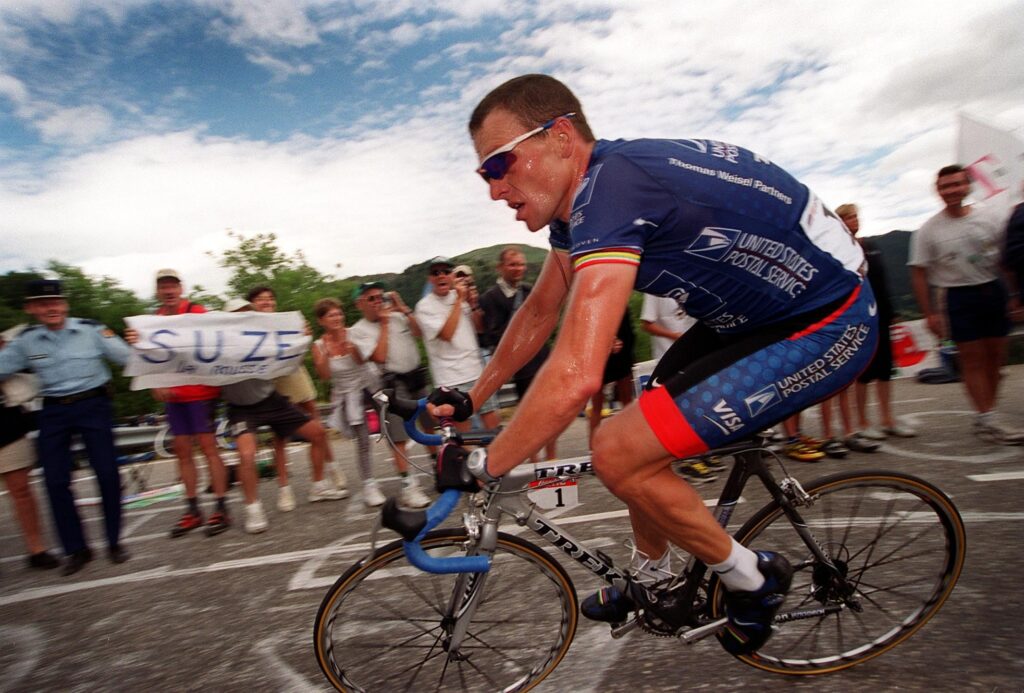
This (above) is Armstrong on a very similar bike riding Alpe d’Huez in 2001.
What about those wheels? Armstrong’s US Postal team had previously been on Trek-branded Rolf wheelsets but had just moved onto Mavic’s Ksyriums and those look like 23mm tyres. No one rides 23mm in the WorldTour anymore.
The handlebar and threadless stem came from Deda, and Armstrong was riding without a power meter.
Pogacars Colnago Y1Rs
On to 2025 and Tadej Pogacar is dominating the Tour de France in a similar fashion, but the Colnago bikes he’s riding are vastly different from Armstrong’s Treks.
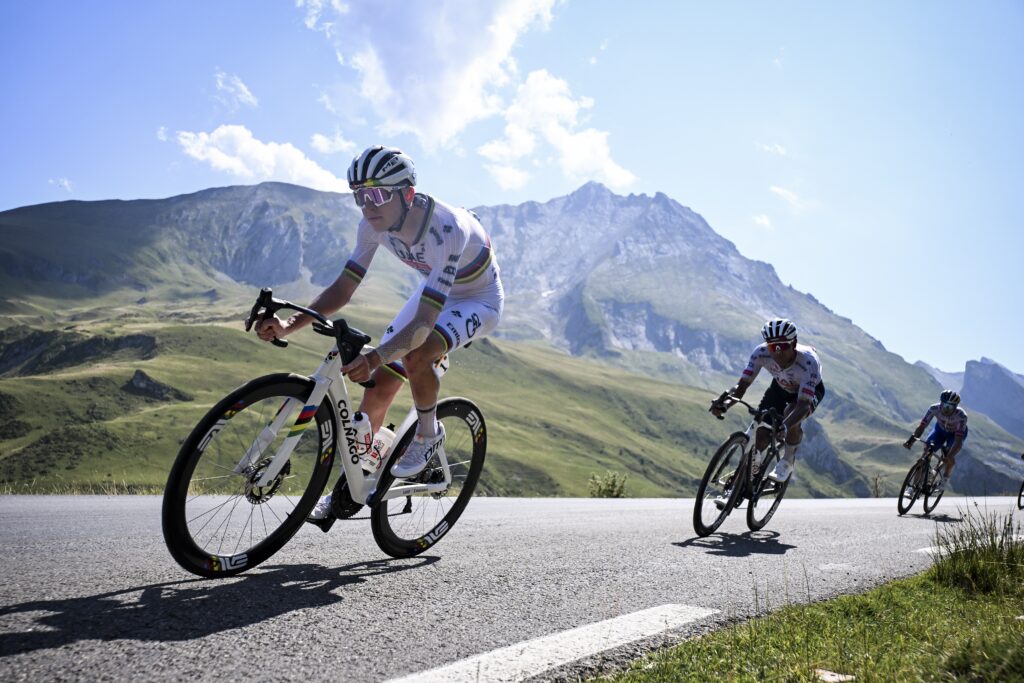
Pogacar has the option of riding the Colnago V5Rs, but he has been favouring the V1Rs so far in this race, and will continue to ride it for the Mont Ventoux summit finish, albeit in a slightly modified form – which we’ll come to in a minute.
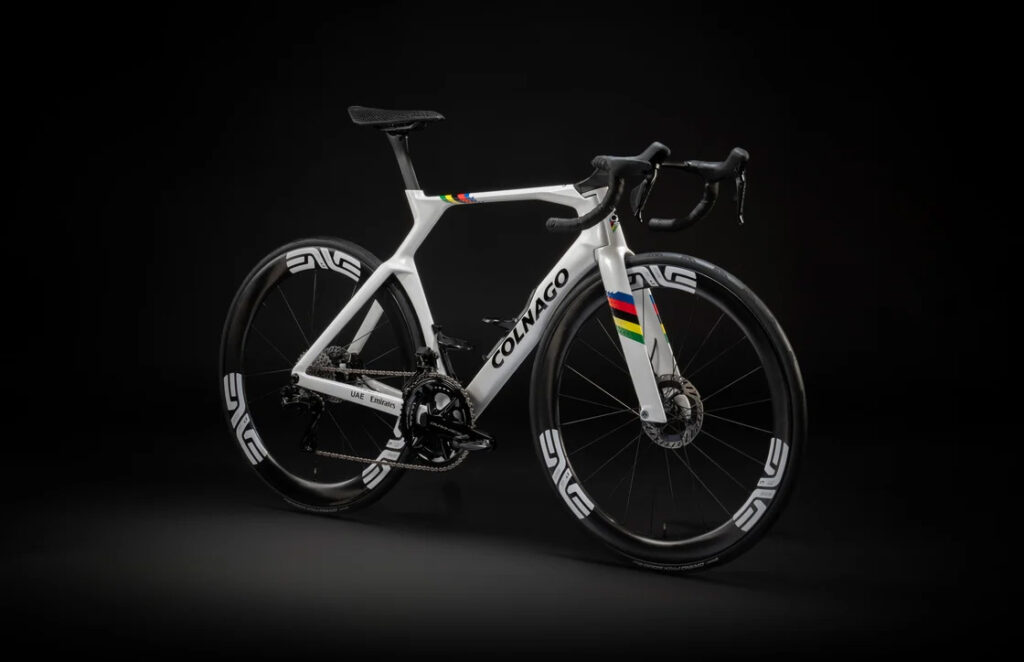
Colnago launched the Y1Rs towards the end of last year, and it’s all about aerodynamics. The UCI introduced the 6.8kg minimum bike weight limit in 2000, so there’s not a whole lot of point chasing weight improvements beyond that; it’s far more worthwhile going for an aerodynamic advantage.
The Y1Rs frameset is 242g heavier than Colnago’s V4Rs, but the Italian brand says it saves 20 watts on its stablemate at 50km/h.
The most noticeable feature is the back end of the frame, where the shortened seat tube meets the extended seatstays.
Colnago says that what it calls its Defy shape, enabled by new UCI standards, means the seat tube can “follow the shape of the rear wheel and thus be aerodynamically more effective in an area where the cyclist’s turbulent pedalling flows arrive”.
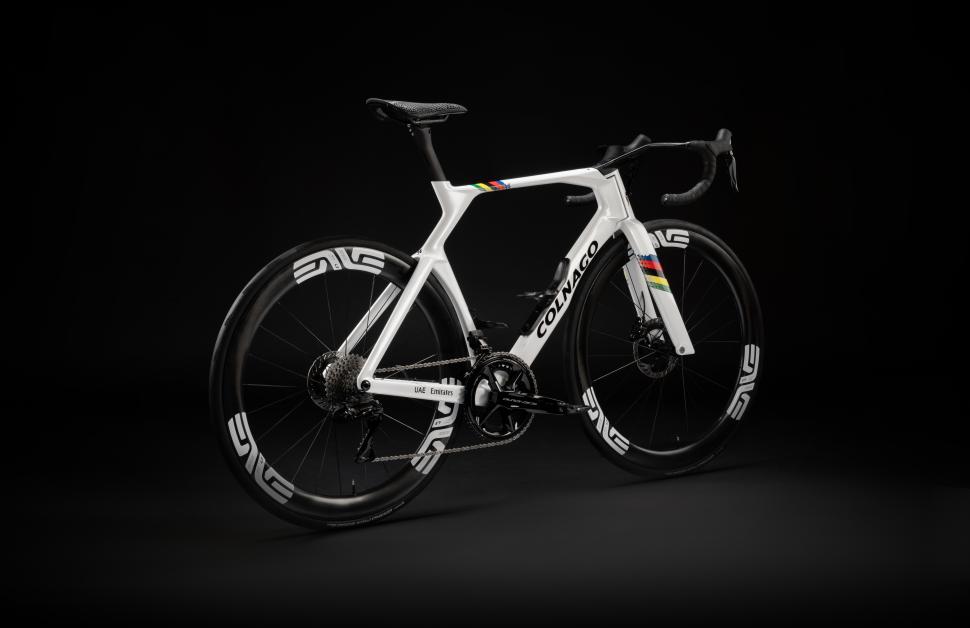 The seatpost has to be cut before being positioned. Once inserted, there is space for further adjustment of about 1.5cm.
The cockpit is a new design too, the CC.Y1 WYND shape integrated handlebar being designed to offer the most aerodynamically efficient setup. Of course, unlike Armstrong’s Deda handlebar/stem from 2001, it’s carbon fibre.
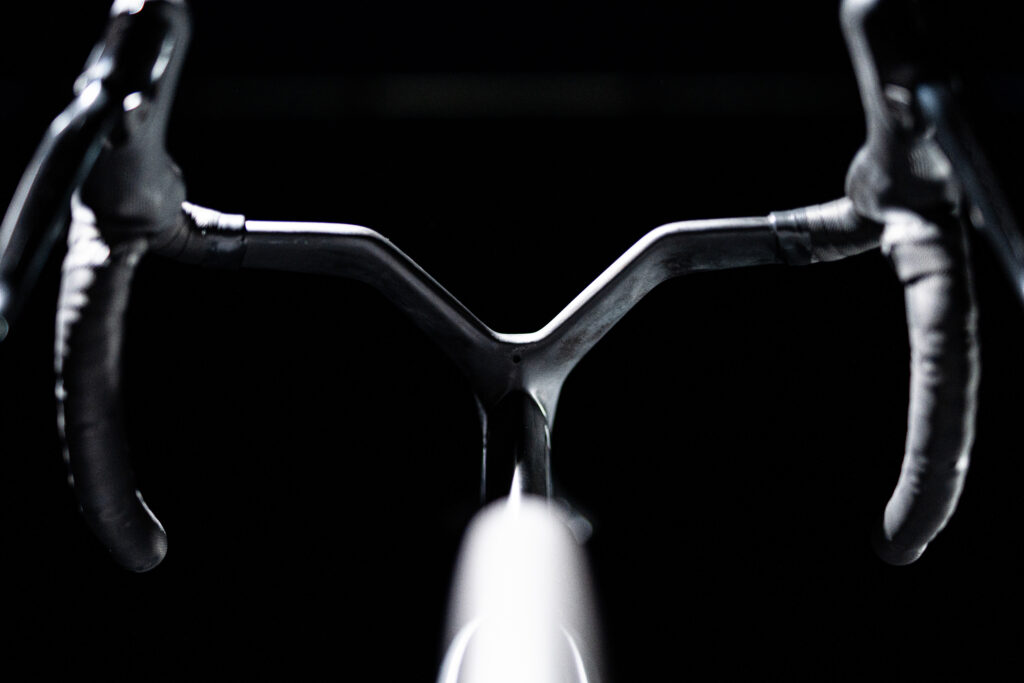
The aim of the ‘gull wing’ Y-shaped structure is to reduce the frontal area and allow for cleaner airflow over the main body of the bike.
With the Y1Rs, Colnago has taken advantage of changes to UCI rules governing frame design. When it started developing its Y1Rs aero road bike in 2021, the UCI had just communicated upcoming revisions to its regulations. For a long time, the UCI had a 3:1 rule governing bike design. The rule limited the ratio of a bike tube’s height (or depth) to its width at a maximum of 3:1. That rule was scrapped and bike designers can now go with an 8:1 profile.
Filippo Galli, lead engineer on Colnago’s Y1Rs told us, “None of the tubes of Y1Rs is 80mm long and 10mm wide since using such extreme profiles would mean increasing the final weight to guarantee the proper lateral stiffness, but almost all of them exceed the former 3:1 rule.
“In particular, it wouldn’t have been possible to realise such a thin frontal area, which significantly affects the aerodynamics of the whole bike, without penalising the stiffness of the whole front end (which is crucial in sprinting).”
The position of the seatpost on the Y1Rs is unusual, too. It is fixed in place at the point where the top tube and extended seatstays meet. Again, this is now permissible thanks to changes to changes to UCI regulations.
“Such a design wouldn’t have been possible before since the seatpost had to be aligned with the seat tube, or at least a straight line should have been drawn along these two elements,” Filippo Galli told us.
> Why the aero road bike is making a comeback
The tube profiles, the bayonet-style fork with deep legs, bottle cages integrated into the down tube… in fact, most design decisions made in the development of the Y1Rs were aimed at aerodynamic efficiency.
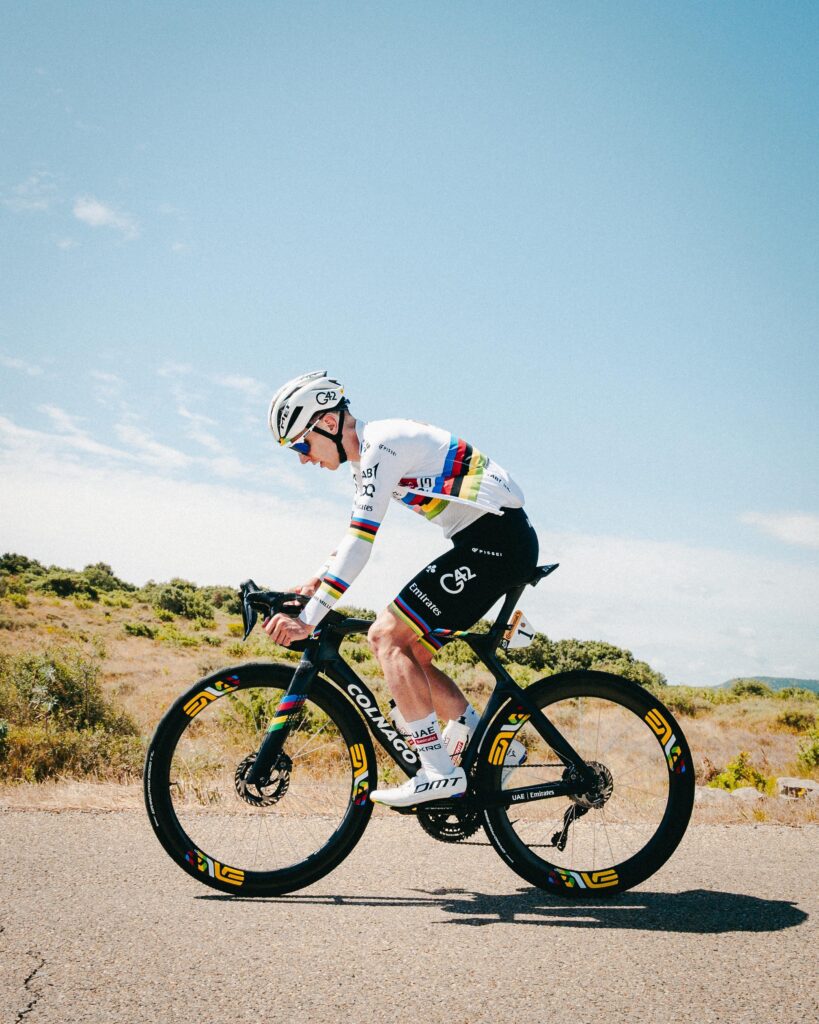
Tadej Pogacar won Friday’s Tour de France mountain time trial on a stripped-back Colnago Y1Rs and he’s racing Stage 16, which includes a summit finish on the legendary Mont Ventoux, on a slightly modified version of that bike.
Unlike the white Y1Rs bikes decorated in a world champion finish that Pogacar rode earlier in the Tour de France, this version is in raw carbon with what Colnago calls “a paper-thin clearcoat” to save a little weight.
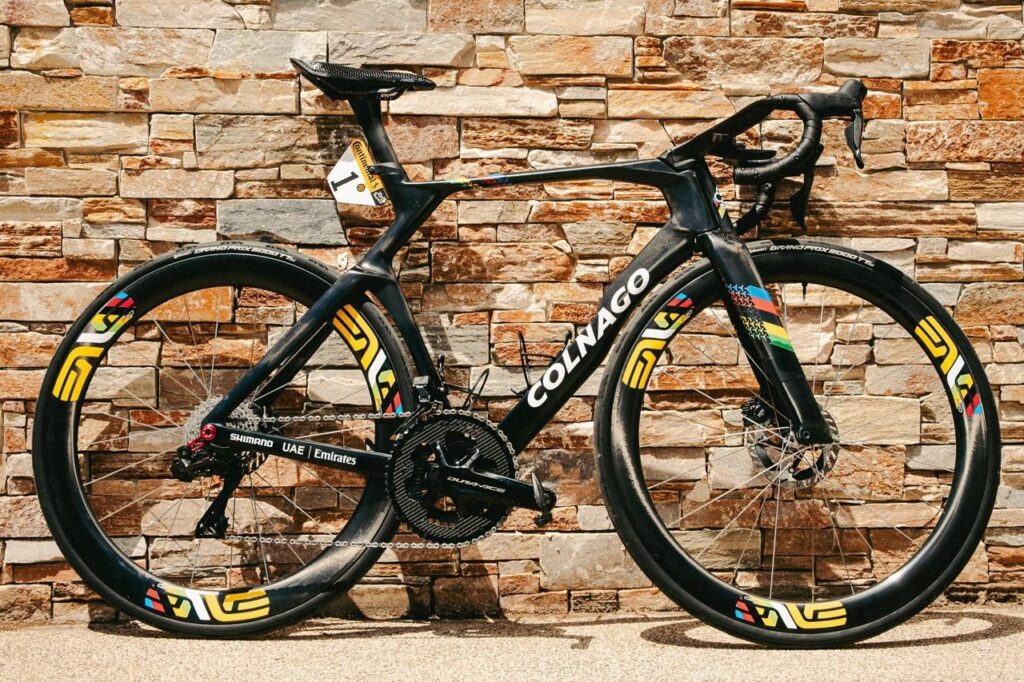
Unlike the stripped-down TT build used for the time trial, this version comes in a full road race configuration with bottle cages, handlebar tape, and 28mm tyres. It also has a 160mm front brake disc, whereas Pogačar used a 140mm rotor during Stage 13’s time trial to shave grams.
Pogacar uses a Shimano Dura-Ace R9200 groupset with 165mm cranks and additional sprinter buttons on the drops. He is using the Dura-Ace power meter for Stage 16. It’s something he moves from frame to frame to make sure the data is consistent.
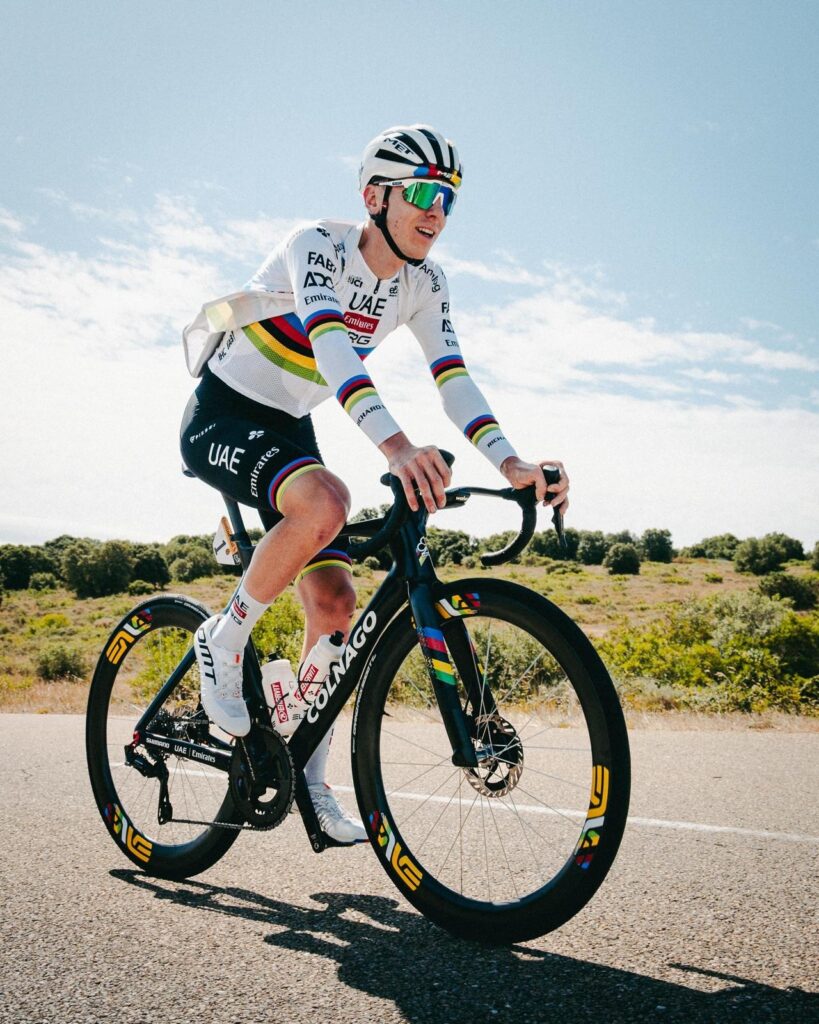
The 55/38T chainrings are from Carbon-Ti, while the wheels are Enve 4.5 Pro fitted with Continental GP5000 TT 28mm tyres.
The bottle cages are Elite Leggero Carbon and the saddle is a Fizik Argo R1 Adaptive with 3D-printed variable density.
The bottom bracket is from Bikone, and titanium bolts replace steel wherever possible.
Colnago says that a Y1Rs in a typical UAE race build is around 7.2–7.5 kg, compared with a typical V5Rs build that’s around the UCI’s 6.8kg minimum weight. The Y1Rs that Pogacar used in the mountain time trial was a claimed 6.9 kg. The Y1Rs he’ll ride up Mont Ventoux will be heavier than that, but not by much.
Pogacar’s Colnago V5Rs
For a hilly/mountainous stage, Tadej Pogacar has the option of the Colnago V5Rs, which was launched earlier this year, although we know he’ll be on the Y1Rs for Ventoux.
“In stages where a key moment calls for better aero efficiency, like a flat section after an attack or a climb with an average gradient of less than 8%, the team will favour the Y1rs, even if the rest of the stage suits the V5rs better,” says Davide Fumagalli, head of product at Colnago.
“The team has done its calculations, and the tipping point is around that 8% gradient. Not many climbs are significantly steeper than that on average. Take the uphill time trial: although it was a climbing stage, the average speed was relatively high. In that context, the aero bike, especially as it was set up relatively light, proved worth the extra weight.”
“Another consideration is how much energy can be saved with the aero bike versus the V5rs in the lead-up to the climbs. Over longer stages, this can make a meaningful difference in overall freshness at the decisive moments.”
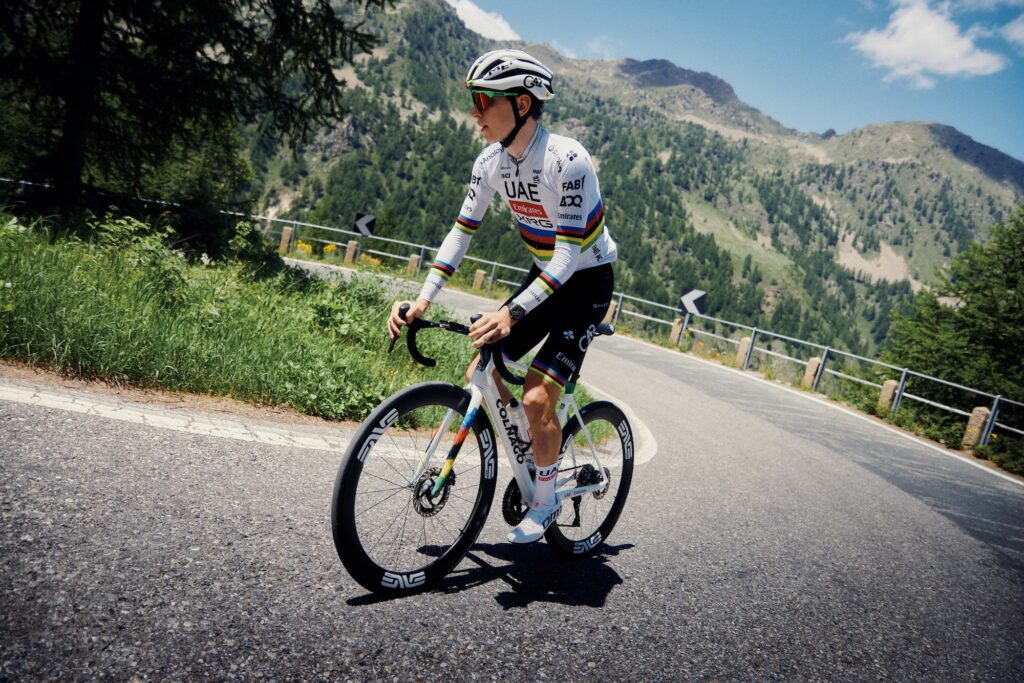
The whole idea of the V5Rs is that it’s more aerodynamically efficient and lighter than its V4RS predecessor while matching it for stiffness.
While the Y1Rs (above) is the all-out aero bike at the top of the range, Colnago says the V5Rs is the lightest frame it has ever produced, weighing just 685g (unpainted), while the fork that slots in up front is a claimed 342g.
In terms of aerodynamic efficiency, Colnago says it was able to transfer knowledge from the development of the Y1Rs over to the V5Rs. The head tube is slimmer than on the V4Rs, for example, and the seatpost and seat tube profiles are significantly thinner and deeper.
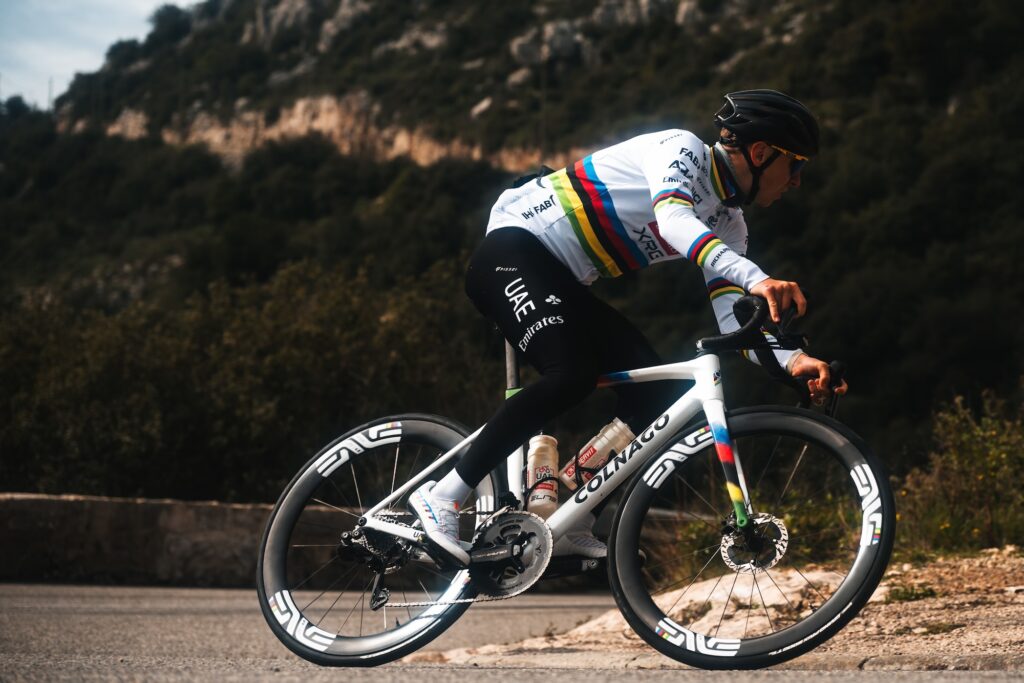
Colnago boasts that the V5Rs requires less power than the V4Rs – by 9 watts – to maintain a speed of 50km/h (31.1mph) “in real-world racing setups”, although the drag is higher than that of the aero Y1Rs at all angles.
“V5Rs is the perfect all-rounder,” says Colnago. “It achieves the lower UCI weight limit [of 6.8kg] with standard and even aerodynamic components. Furthermore, the improved aerodynamic performance and the balanced stiffness mean that the V5Rs performs better than its predecessor, already proved as a winning machine in all conditions, from cobblestones and sprints to mountain stages.
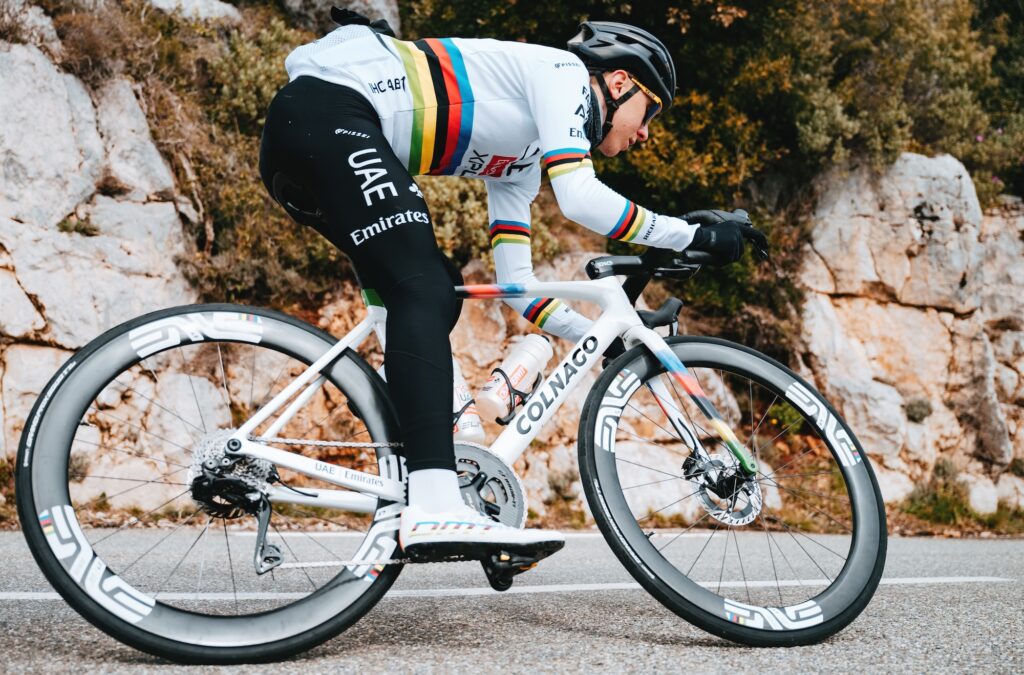
It’s not just today’s framesets that are designed with aerodynamics in mind; pro riders race on wheels with deep-section carbon rims. Even in the mountains, Pogacar has used Enve SES 4.5s for ages, and he’s now on a lighter Enve SES 4.5 Pro wheelset with a 49mm front rim and 55mm at the rear, ceramic bearings, and an all-up claimed weight of just 1,295g.
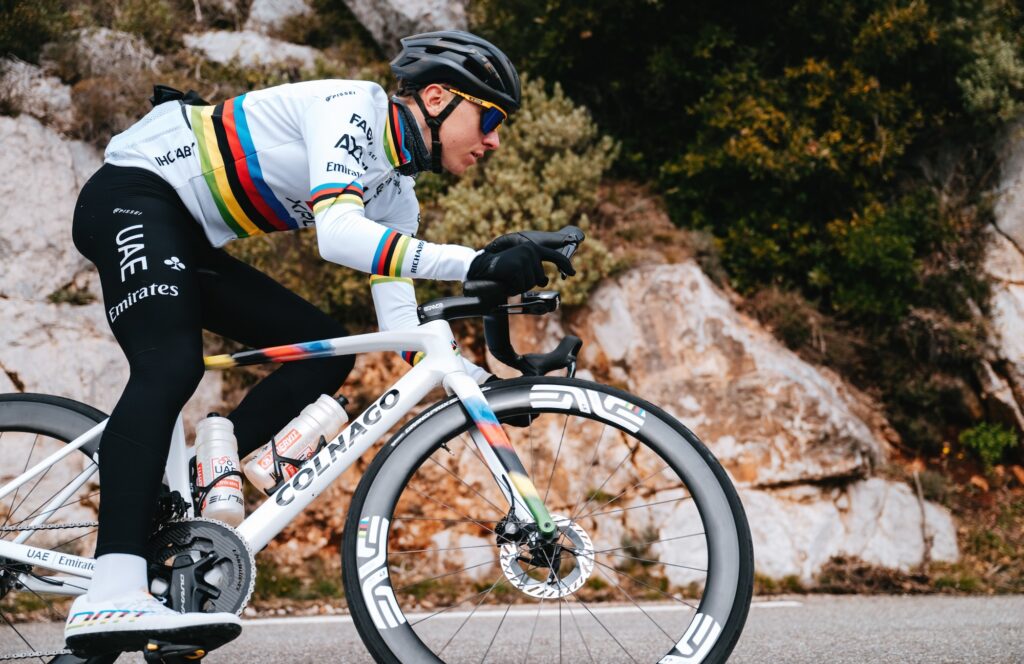
As far as groupsets go, the most obvious changes from Armstrong’s day are to hydraulic disc brakes and electronic shifting. Dura-Ace has crept up to 12-speed and, as mentioned earlier, Tadej Pogačar uses the groupset’s power meter, which is integrated into the chainset.
There have even been big changes to saddle technology. Lance Armstrong used a Selle San Marco Concor Light saddle for most of his racing career, which looks decidedly bulky and retro today.
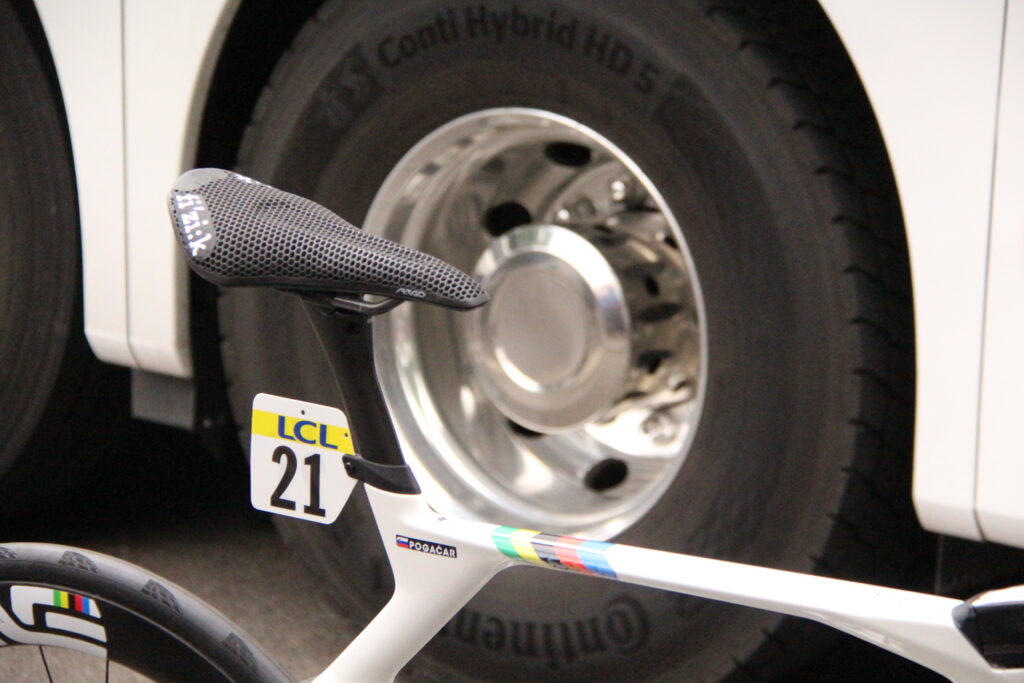
Pogacar uses a Fizik Vento Argo 00 Adaptive saddle on his road bike (pictured above on his Y1Rs), with a short nose, lightweight carbon rails and 3D-printed padding – tech which has only been available since 2019.







8 thoughts on “Two eras, one climb: Pogacar’s Colnago vs Armstrong’s Trek on Mont Ventoux”
Why are you comparing Pog
Why are you comparing Pog today to someone who didn’t officially contest that stage?
They’re both equally dominant
They’re both equally dominant in their era?
Let’s hope it’s not for similar reasons eh..
I was ready to say something about how much nicer bikes looked back then, but the Trek wasn’t the nicest of that period and Pogacar’s Colnago looks weirdly great, it’s really growing on me (edit to add, the new Madone looks unconventionally good too).
Technically comparing their
Technically comparing their bikes, but I agree I’d rather not give him the oxygen.
quiff wrote:
Or any oxygen.
Armstrong’s bike looks like
Armstrong’s bike looks like one you’d see someone just riding around on. You’d very rarely see a civilian (not a very serious roadie, I mean) riding something like Pogacar’s bike.
The doping shadow that
The doping shadow that continues to dog cycling is in large part down to Armstrong’s legacy. P#@$ off road.cc by giving any air to this cheat.
I love the new Y1rs. My
I love the new Y1rs. My favorite bike is the C40 from back in the day. I really think the Y1rs is like the modern day C40.
Stop giving the drug cheat
Stop giving the drug cheat airtime