



Tadej Pogacar and Jonas Vingegaard, two of the best athletes in the world, are going head-to-head in cycling’s biggest race, the Tour de France.
The rivalry is spicier than ever this year and both riders have some super hot bikes at their disposal. We’re going to take a close look at those bikes, because as you’d expect, both Cervelo and Colnago claim that their bikes are the fastest in the world.
Cervélo R5 vs Colnago V5Rs
Let’s begin with the climbing bikes – the ones you might see on those pivotal mountain stages where serious gaps can open up between contenders.
First, the obvious: weight. In the high mountains, every gram counts. The previous Cervélo R5 was among the lightest race bikes ever produced, and this latest version is lighter still. Or that’s what Cervelo told us when we visited the Visma–Lease-a-Bike team and got a close look at Matteo Jorgensen’s bike.
Colnago’s V5Rs is no heavyweight either. At 685g for the frame, it’s the lightest production bike the Italian brand has made. Add in the fork and you’re just over a kilo. Still, that’s around 150g heavier overall than the R5 – so if you’re shaving every last gram for the climbs, Cervélo holds the advantage.
It’s not quite as simple as that, though, because both teams told me they’ll be adding ballast to meet the UCI’s 6.8kg minimum weight limit. That task falls to the mechanics, who typically hide lead weights inside the crank axles.
Vingegaard’s R5 will need roughly 300g added, which raises the question of whether the UCI’s 25-year-old weight rule is due for a rethink. I’d say it is.
The R5 has traditionally prioritised light weight and stiffness over aerodynamics. However, Cervélo confirmed at the Tour that the latest model sees a subtle shift in that philosophy, though they haven’t released specific aero data just yet.
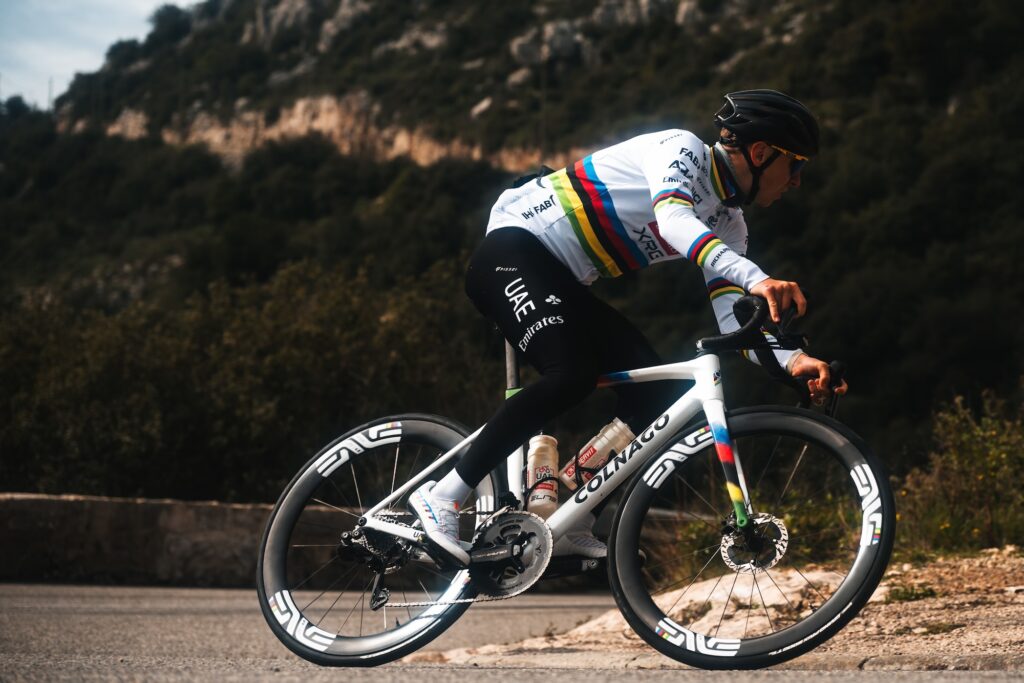
Colnago is more forthcoming. The V5Rs reportedly saves 9 watts at 50km/h compared to its predecessor, the V4Rs, thanks to a 13% reduction in frontal area and improved stiffness-to-weight balance.
Now, 50km/h is a speed only pros sustain for long periods, but for punchy headwind finishes or those wanting a one-bike-for-every-race solution, it’s significant.
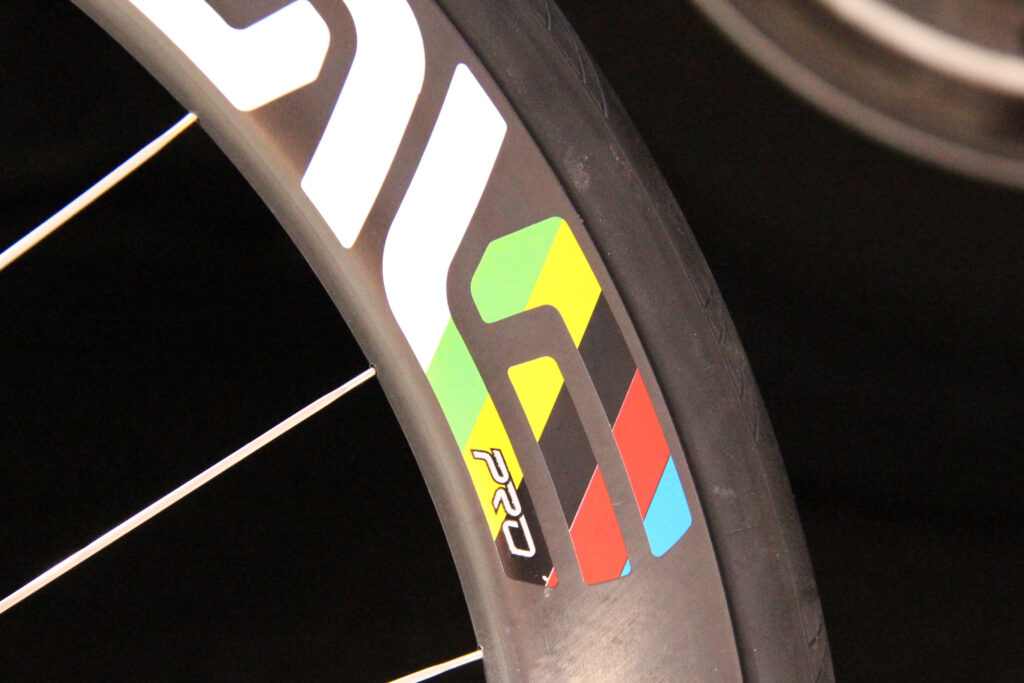
Pogačar’s V5Rs also gets new wheels: custom Enve 4.5s with narrower internal widths. These allow him to run his favoured Continental TT tyres – and they come with polished silver hubs and spokes, which look utterly fantastic.
Vingegaard, meanwhile, sticks with Reserve wheels from the Cervélo stable, likely opting for the ultralight 34|37 combination. Tyres are the wide version of Vittoria’s Corsa Pro.
As for pricing: Cervélo has yet to confirm the R5’s updated price tag, though the previous Tour-spec version came in at around £11,500. The Colnago V5Rs frameset is £5,499, with a Shimano Dura-Ace build about £10,000 (Colnago allows you to configure the exact build you’d like).
Cervélo S5 vs Colnago Y1Rs
Aero bikes promise big speed gains – and even bigger claims – and these two don’t disappoint.
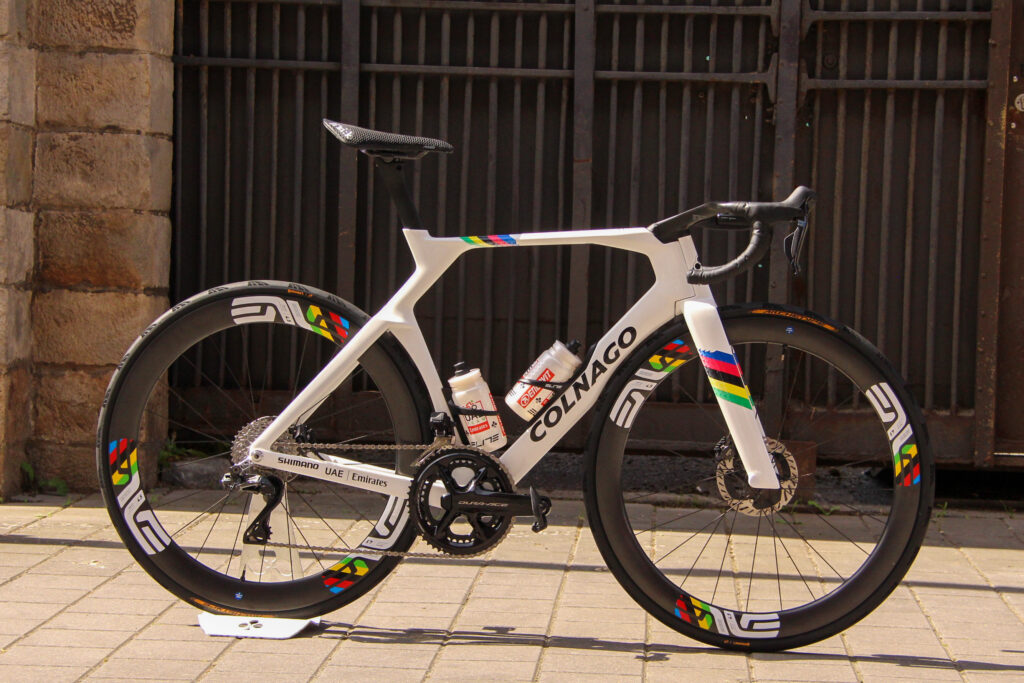
Let’s begin with the Y1Rs, Colnago’s most aerodynamically efficient road bike to date. Compared to the outgoing V4Rs, it reportedly saves 20 watts at 50km/h, reduces frontal area by nearly 20%, and improves drag across all yaw angles. Bold numbers, and a bold redesign to match.
Cervélo’s S5 is being touted as the fastest aero bike currently in the WorldTour. The latest iteration is claimed to be 6.3 watts quicker than its predecessor, which was already among the fastest. Cervélo has reworked the front end with a deeper head tube, neater cable routing, and an all-new one-piece cockpit. Impressively, it still manages to shed 124g from the complete system weight.
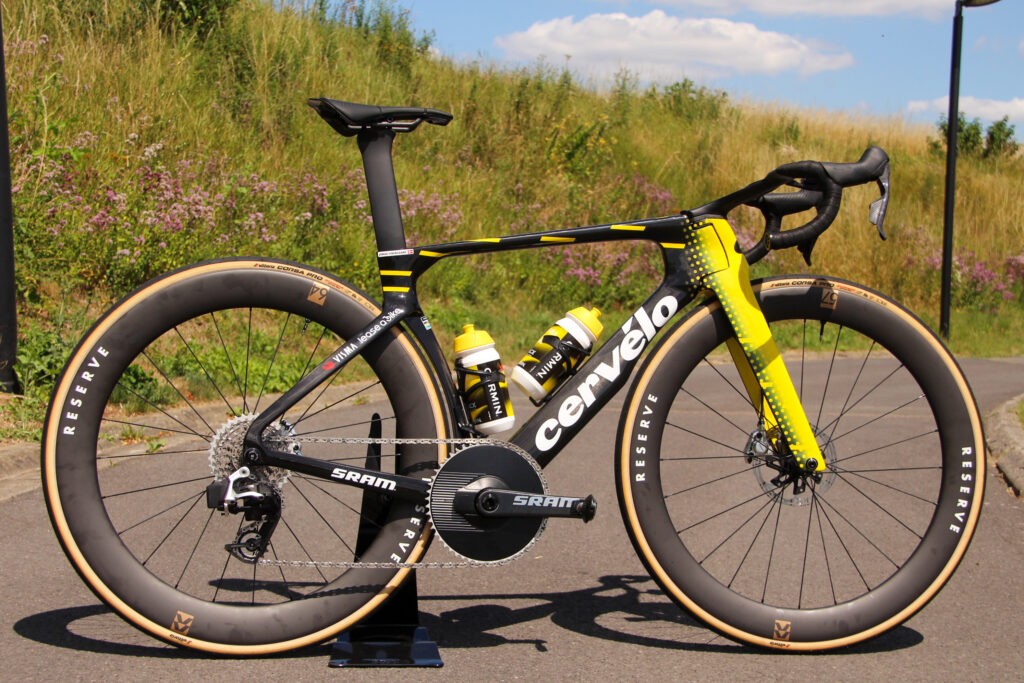
Vingegaard runs his S5 with a 1x SRAM drivetrain, while Pogačar sticks with a traditional Shimano Dura-Ace double.

Both bikes roll on wide tyres (by road bike standards). Pogačar is riding new 30mm Continental Archetypes – a middle ground between the GP5000 S TR and his favoured TT tyres. With his 25mm wide Enve rims, the original TT tyres (which max out at 28mm) no longer comply with ETRTO guidelines – hence the switch.
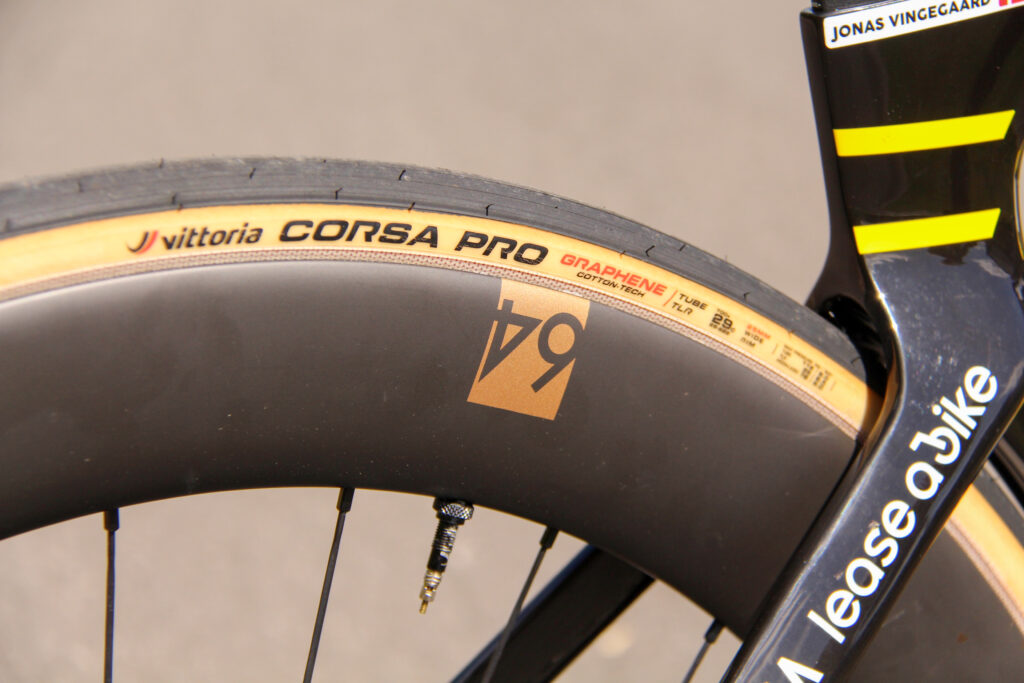
Vingegaard again opts for Vittoria Corsa Pro tyres, using the wider casing designed for modern rims.
A noteworthy trend here: both riders use ultra-short 165mm cranks – something that’s become increasingly common in recent seasons. Claimed benefits include improved aerodynamics and hip angles, and smoother cadence on climbs. According to Vingegaard’s team, it’s the latter they value most.
> How much does a Tour de France bike cost?
In terms of price, the Colnago Y1Rs starts at £6,299 for the frameset, with Pogačar’s full build reportedly costing over £15,000 or more. Cervélo’s S5 frameset starts at £5,400, and a team-spec version hits around £12,500.
We have both the S5 and Y1RS coming in for review very soon.


















4 thoughts on “Pogacar vs Vingegaard — 2025 Tour de France Bikes Head 2 Head”
This is stupid, bikes don’t
This is stupid, bikes don’t do battle, people do, this is all about marketing to get people to buy a particular bike. There was an old saying in NASCAR back when cars were true stock cars, which ever car wins on Sunday was sold on Monday, but the car didn’t win the race, the driver did, but people didn’t notice that little tid bit.
“Let’s begin with the
“Let’s begin with the climbing bikes”
Why? Neither, at any point, used a ‘climbing’ bike’. Pogacar & Vingegaard rode their S5 or Y1RS respectively, on every stage except time trials. Which means the age of the dedicated climbing bike is dead (again). Aero is everything even if your bike weighs 1/2kg more
Smoggysteve wrote:
Worth noting that some of the other UAE riders were using the V5RS though, Tadej’s in a privileged position of having the special custom model with 500 g shaved off in various areas including having no paint, which brings it within about 100 g of the climbing model. If he had to choose between the two standard models he might have taken the climbing bike on the very steepest stages.
If the main guy in both teams
If the main guy in both teams are on the heavier aero bike throughout I don’t tbink it really matters what domestiques ride. They probably get told what they are riding and it’s not in their hands. And if they can make the Y1RS as light (or as near to as possible) what is the point the V5RS? Also Visma we’re all on S5s I don’t think I’ve seen an R5 all race. Their flagship is brand new and lighter than the last version which again makes you wonder what’s the point of the R5? I dint think Cervelo would discontinue it like Trek did with the Emonda but it certainly becoming a rare sight in world tour racing