



Deep-section carbon wheels are often seen as the ultimate upgrade, so how much of a difference do they really make to your speed? Are they always the smartest choice for your bike? With input from Hunt, we put deep wheels to the test to see what gains they actually deliver, before exploring which rim depth might be the best fit for your riding.
So… are deep wheels faster?
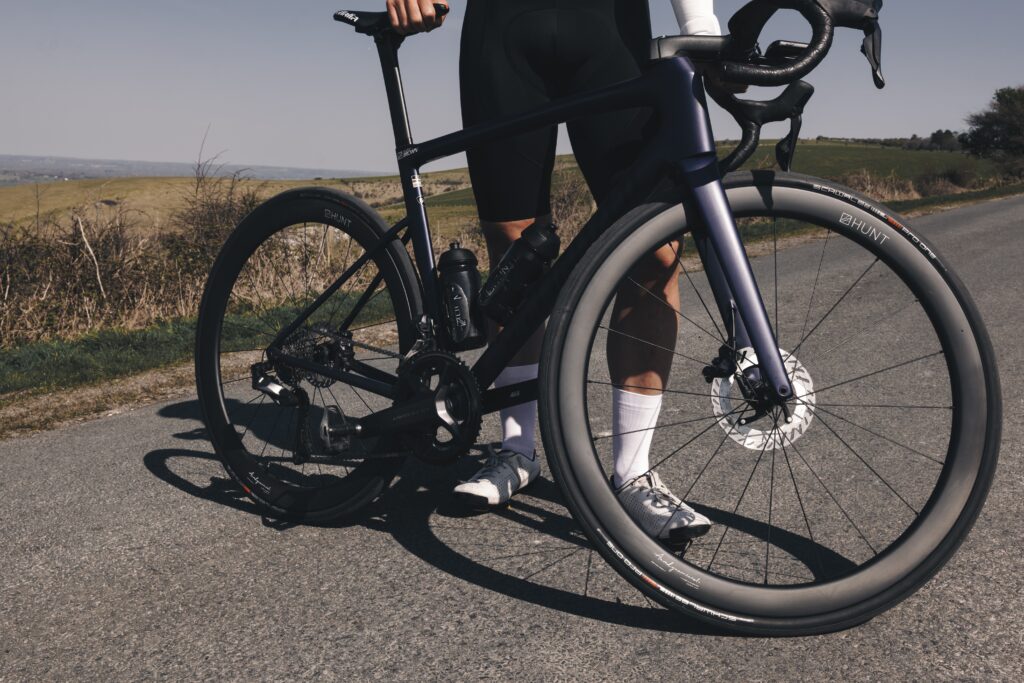
Hunt compared its shallowest 34mm carbon wheels with its deepest 54/58mm Aerodynamicist model, and found an average saving of 5.9 watts across a spread of yaw angles at 45kph. That might not sound like much, but it equates to a 7.3% gain, and 34mm carbon rims are already considered quick by modern standards.
The difference grows when Hunt’s deep-section wheels are compared with a standard alloy option, such as the brand’s 4 Season Pro Disc – the kind of stock wheelset many riders are likely to have. Here, the claimed saving jumps to more than 13 watts, or around 18%.
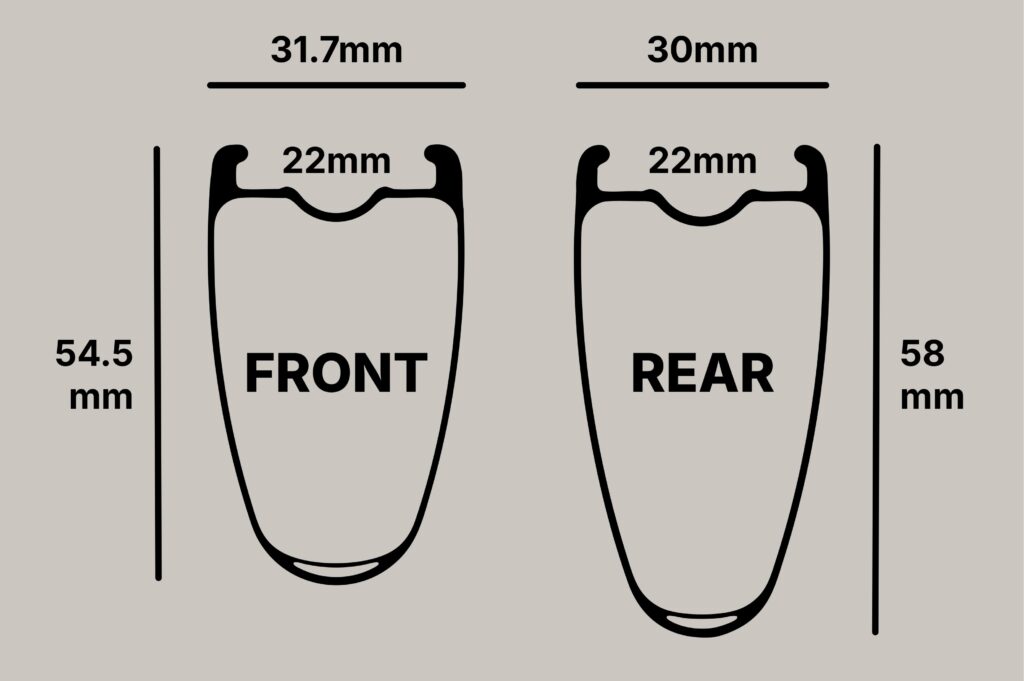
Much of that advantage comes down to rim shape. The 54mm deep front wheel features a 31.7mm external width and 22mm internal profile optimised for 28-30mm tyres. The rear is deeper but slightly narrower, a configuration Hunt says its CFD modelling and wind tunnel testing identified as the fastest balance.
But what does this mean in the real world? To get a feel for what those watt savings look like out on the road, Liam took the wheels to Odd Down Cycle Track, a purpose- built 1.5km road circuit, and completed two runs on each wheelset depth to calculate an average. Keep reading to see how the different wheel depths performed.
How fast do you need to ride to reap the benefits of deep-rim wheels?
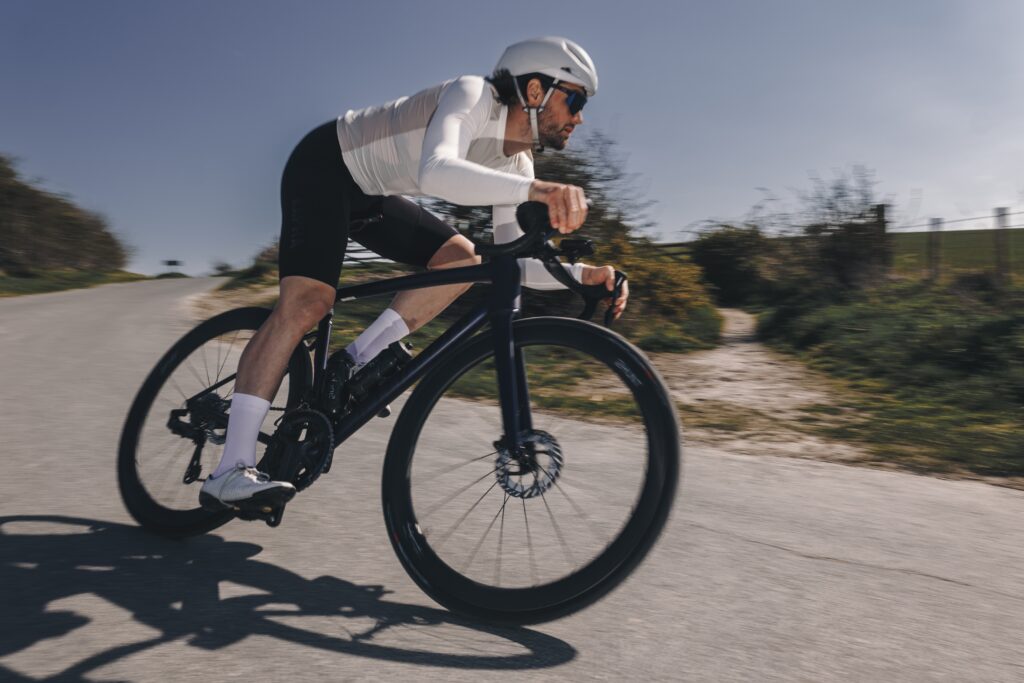
Hunt’s wind tunnel testing was carried out at 45kph, which might sound a touch ambitious for most of us. So the obvious question is, how fast do you really need to go before aerodynamics starts to matter?
It might surprise you, but you don’t need to be doing Tour de France speeds. Brands often present test data at more realistic speeds to demonstrate that aero modifications still deliver worthwhile gains, and wheels are no different. Hunt says that while the exact point depends on factors like terrain and surface, aerodynamic drag typically becomes the main force you’re working against from around 22kph onwards.
That means you’ll benefit from deep-section wheels even at lower speeds, though the advantages scale up the faster you go. Above 40kph, aerodynamics dominates almost entirely.
So, even if you’re not chasing Tour de France pace, there are still clear gains to be had. But speed isn’t the only consideration – how do you decide which wheel depth is right for your riding?
Which wheel depth is right for you?
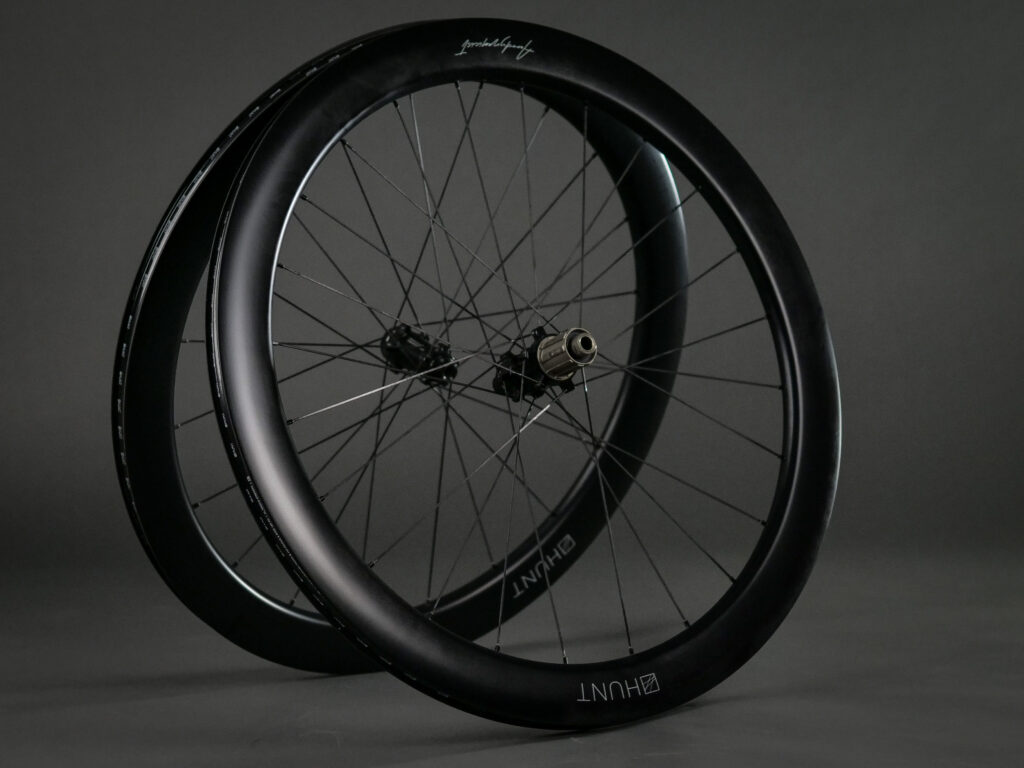
When it comes to choosing the right wheel depth, there’s no one-size-fits-all answer. Hunt’s Aerodynamicist range makes that clear, with options spanning from relatively shallow 34mm rims to mid-depth 44/46mm all-rounders, and finally the deepest 54/58mm wheels.
The most obvious difference between these wheelsets is weight. Unsurprisingly, the shallowest 34/34 option is lighter than the 54/58 deep set – by around 124 grams. That doesn’t sound like much, but on steep gradients, those grams can make the bike feel more responsive, which is why shallow wheels remain a popular choice for climbing specialists, especially in hill climb events.
Shallower rims also come with another advantage: stability. With less material for crosswinds to catch, bikes fitted with shallow wheels feel calmer and more predictable on blustery days. While modern deep wheels are far more stable than older designs, thanks to their wider and more rounded profiles, shallow sets still offer the most confidence in windier conditions.

On the other end of the spectrum, deep-section wheels remain the outright choice for speed giving riders a clear advantage on flat and fast terrain. If your riding is all about maximising speed, they’re hard to beat.
So, where does that leave mid-depth wheels? Sitting comfortably between the two extremes, they deliver a balance of lightweight climbing ability and aerodynamic efficiency. For riders who want a versatile set of wheels that perform consistently across varied conditions, mid-depth options often represent the sweet spot.
To put it simply, if you prioritise climbing and control, go shallow. If you want versatility across a mix of terrain, mid-depths are your friend. And if you’re chasing pure speed, deep wheels are the clear winner.
The results
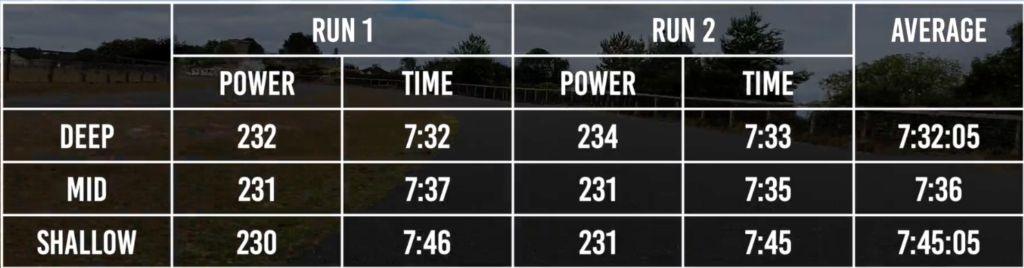
Now for the results from Liam’s real-world testing. At 35kph, deep 54/58 wheels shaved 3.5 seconds off the mid-depth set and 13 seconds off the shallow 34/34 wheels. That might not sound like much over a 7.5-minute run, but extrapolated over a 50km ride, the time savings become substantial.
Of course, numbers can’t capture everything. Conditions, holding perfect power, and maintaining position all affect real-world performance. One reassuring takeaway was that all the wheelsets felt remarkably stable, even in gusty winds.
This wasn’t the most rigorous scientific trial, just two runs on one terrain type, but it was enough to illustrate that, outside of wind tunnels and spreadsheets, a deep-section wheelset can deliver a tangible speed boost.
To find out more about Hunt’s wheelsets, visit huntbikewheels.com



















11 thoughts on “How much faster are deep carbon wheels? We test whether deeper really is faster, and explore which rim depth is best for your riding”
“, and found an average
“, and found an average saving of 5.9 watts across a spread of yaw angles at 45kph. That might not sound like much, but it equates to a 7.3% gain,”
Could you run those figures past me with a bit more context or detail, as at the moment they sound like complete aero PR bullshit.
5.9 watts = 7.3%?
7.3% of 80 watts = 5.9 watts. You can’t ride at 45kph @ 80 watts, so what on earth do those numbers mean? 7.3% gain of what?!!!? It aint speed, and it aint efficiency. So what is it?
I was wondering that!
I was wondering that!
I was thinking maybe they’d done something like put a bike in the wind tunnel with and without wheels to isolate the wheels’ contribution to the bike’s overall drag (without rider) and gone from there? Fool’s errand, obviously, given it’s system drag including pedalling rider in disturbed air that counts.
Fair credit to them though in that they didn’t use as their baseline a 1980s box section rim with 36 round spokes …. and also that they did some real world testing at low power rather than give us wind tunnel results at Ganna watts …
It’s all a bit weird, even a
It’s all a bit weird, even a riderless bicycle would require 200 W plus to achieve a theoretical 45 km/h. One can only assume they have simply stuck the wheels on their own in the wind tunnel and found that the airflow is 7.3% faster over the deep rim. If so, a staggeringly irrelevant statistic.
Hunt have a white paper that
Hunt have a white paper that goes into a bit more detail: https://cdn.shopify.com/s/files/1/0686/6341/files/Aerodynamicist_SL_Wind_Tunnel_Report.pdf?v=1745416779
The “7.8%” figure comes directly from the table in section 13.0.
It’s not just wheels – it is wheels attached to a complete bike. And obviously it’s just air resistance without rolling resistance. But it is very much riderless, and as the rider contributes the majority of the air resistance, the numbers don’t seem too outrageous. Depending on source, I’ve seen it said that the rider contributes around 80% of the total aerodynamic drag, so that means if the bike alone has 80W of drag, the bike + rider would be around 400W (plus rolling resistance), which seems vaguely plausible for speeds of 45 km/h.
I don’t know if this is what
I don’t know if this is what they actually meant but I would read it as 5.9W being a 7.3% reduction in wheel drag – so approx 80W drag for the control wheel with about 74W for the tested deeper wheel.
Testing needs some context though, the 45kph test speed – aero drag goes up at the square of speed so 7% reduction at 45kph is about half that at 30kph, the average speed a fit road rider alone will manage on many roads. Half of 5.9W drag saved is like the 3W the drag I get from my dynamo hub at 30kph and I really can’t tell by speed/effort if it’s on. At 15kph that 5.9W has dropped to ~0.5W.
“The difference grows when
“The difference grows when Hunt’s deep-section wheels are compared with a standard alloy option, such as the brand’s 4 Season Pro Disc (link is external)- the kind of stock wheelset many riders are likely to have. Here, the claimed saving jumps to more than 13 watts, or around 18%.”
OK, 13W for std Al rims Vs deeper carbon.
An OT question for a related interest – does anyone know of any references for the saving when a wheel is scaled down, i.e. a 700C 32mm tyre vs a 20″ / 406 32mm tyre? The rim size and thf approx frontal area decreases about 35% but there’s more to overall wheel drag than that.
Maybe start with an article
Maybe start with an article explaining the different ways of measuring speed/watts output.
“This wasn’t the most rigorous scientific trial….” Then quoting gains of 5.9 watts suggests the results were so accurate that specificity of .1 of a watt was worth reporting.
It is an important topic as people shell out lots of money for wheels for the gains.
Yes – but this is
Yes – but this is ‘advertorial’, so you’re probably looking in the wrong place for that kind of analysis and rigour in the first place.
Gbjbanjs wrote:
To be fair to road.cc, the 5.9 W gain figure came from Hunt’s windtunnel testing, when they say “this wasn’t the most scientific trial” they are referring to Liam’s accurate-as-I-can-get-it real world testing, two different things.
So, if the deep section rims
So, if the deep section rims are ~4sec quicker on average over a 7.5 minute ride at ~35kmh, my calculation on the “…over a 50km ride, the time savings become substantial” suggests that that substantial saving would be ~40 sec.
50km @ 35kmh will take ~76min, or ~10 x the duration of the test.
10 x 4 sec advantage = 40 sec.
However, the article glosses over the fact that the effort given on the deep section wheels averaged 2 watts, or 0.86% higher than for the mid depth.
Refencing wattscalculator.com, a 75kg rider on a typical road bike with mid-depth aero wheels would see around 0.14kmh benefit with a 2 watt increase at 35kmh.
Over 76 minutes of riding with that extra pace, a cyclist would cover approx 50.18km – 180m further.
That 180m at 35.14kmh would take ~18.5 seconds, which represets almost half of the suggested time saving being attributed to the extra rim depth.
My conclusion is that deeper = faster over the course tested, but only by about half as much as the stated benefit.
Note while giving these
Note while giving these largely pointless, expensive irrelevance to recreational, rather than professional, cyclist the hard sell…
No mention of performance in crosswinds?!
So, why don’t they do this in their wind tunnel tests?
Well, perhaps they’d rather you aren’t informed they’re a complete liability?
That will have you blown all over busy public roads in gusty conditions.
So, don’t be a dummy, rather than flush your hard earned down the pan on these. Spend it on something that actually enhances your ride.
Like flat bars and a nice fat Saddle…