



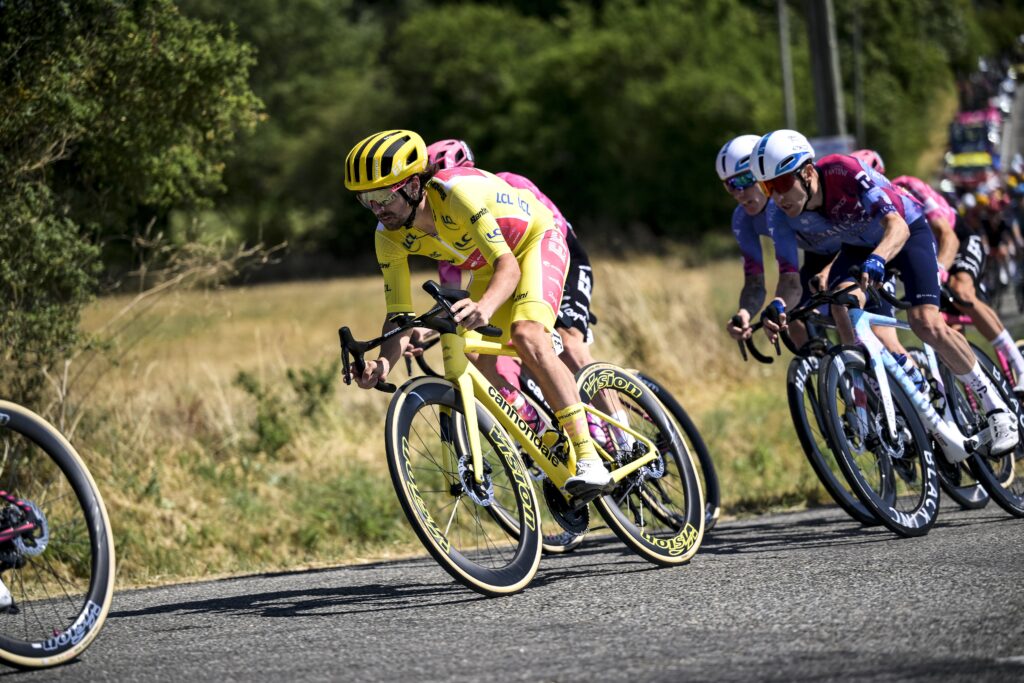
Ireland’s Ben Healy (EF Education-EasyPost) took the overall lead of the Tour de France on Tuesday and was rewarded with a yellow Cannondale SuperSix EVO LAB71 to mark his status on the following stage, and that’s a great excuse to look back at the US brand’s top-level SR2000 from 1987. That bike was also high-end and very yellow but, wow, things have changed.
Readers of my kind of vintage might absent-mindedly think that 1987 was, what, nearly 20 years ago now. But then you think about it for a second and realise that – blimey! – it was actually 38 years ago. No, honestly, take my word for it. I’ve done the maths and everything.
Cannondale has been around since 1971, but it didn’t start producing bikes until 1983. I’ve owned Cannondale bikes since, but not back then. I’m not sure when I was first aware of Cannondale, but it would have been sometime in the mid-eighties. Even without owning one, the things you knew about Cannondales were that the tubes were aluminium and, by 1980s steel standards, massive. Like scaffold poles. They must have been really heavy, then? Nope.
Big metal bike tubes that were also lightweight – that was a foreign concept in the 1980s. Don’t get me wrong, we were used to some big ideas back then – we had Margaret Thatcher, the Rubik’s Cube, and Bananarama – but this was too much to handle. It blew our minds.
“We could have compromised and used conventional-sized steel tubing to build our bikes,” said Cannondale. “But our research and testing showed that a bicycle made of large-diameter aluminium tubing would be stiffer, stronger and more efficient. So that’s what we used.”
We thought we’d focus on the 1987 SR2000 simply because it was the top-end Cannondale road bike at the time, and it was yellow so there’s that connection with the bike that Ben Healy was riding last week. Nothing more complicated than that. We’ll take any excuse.
Back in 1987, Cannondale had 14 aluminium bikes in the range: racing, touring, and all-terrain (mountain bike) models.
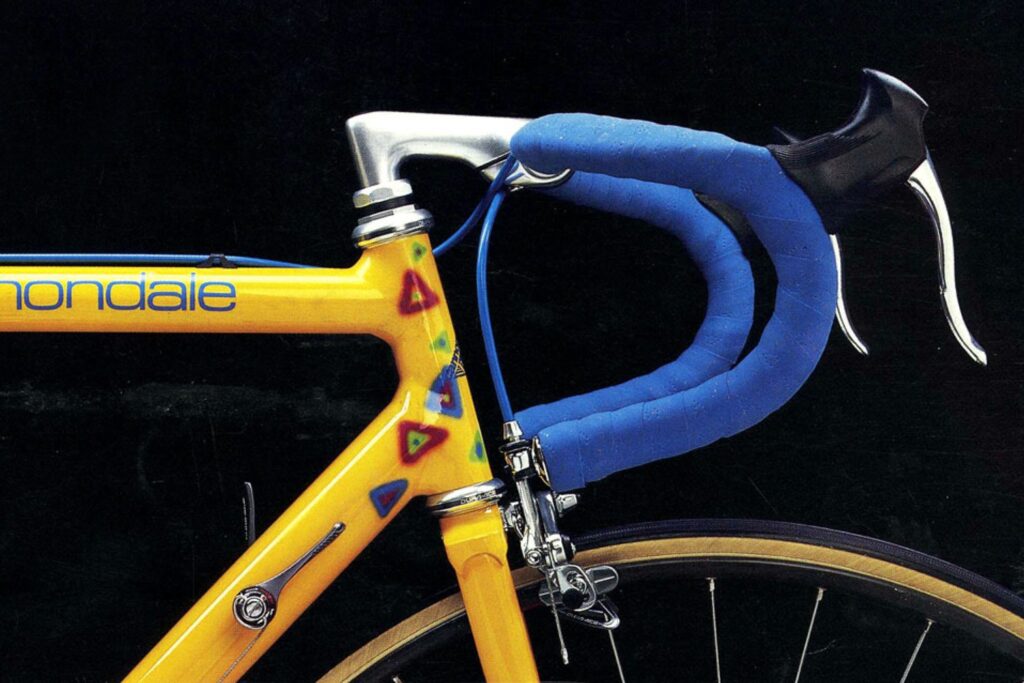
“Every model comes equipped with the new, error-free index shifting systems,” Cannondale boasted.
Wow! Let’s not go fully nostalgic, but it was mostly friction shifting until that point. Move the shifter at the top of your down tube until the resistance in your legs feels about right… then leave it for a bit. Change again when your quads start to ache or you get bored, whichever comes first.
At that time, all Cannondale bikes were made in Bedford, Pennsylvania.
“We could have compromised by joining our tubing using the ‘screwed and glued’ method that some of our competitors employ, said Cannondale. “But we knew that welding and heat treating our tubing would make the frame a single unit without the flexible links that plague frames made with adhesives. That’s why we pioneered our exclusive welding and heat-treating process.
“We could have compromised by leaving the welds unfinished. That would have saved time and money, but our frames wouldn’t have the smooth, sleek handcrafted look you might not have expected from Cannondale. So we hired frame finishers to meticulously sand every weld on every bike.”
Oh yeah! That was the other thing about Cannondale bikes. Those smooth welds were otherworldly back then.
The Cannondale SR2000 sat at the top of the range, equipped with a Tange chromoly steel fork and Shimano’s top-level Dura-Ace groupset. Today’s Dura-Ace is 12-speed with electronic shifting and hydraulic disc brakes, but back in 1987 things were different. Very different. For a start, we’re talking about a 7-speed cassette – 12 to 21-tooth on this bike, since you ask.
The Dura-Ace crankset was a 52/42-tooth double, so your smallest gear was 42 x 21. For comparison, a 2025 Cannondale SuperSix Evo LAB71 Team (£12.500) comes with a 52/36T chainset and an 11-30T cassette as standard – so the smallest gear is a more knee-friendly 36 x 30.
The shifters were positioned at the top of the down tube, as mentioned previously, and the brakes were single pivot (Shimano didn’t introduce its first dual-pivot brake callipers until 1991). I wasn’t posh enough to have Dura-Ace back then so I can’t comment on the performance, but I think we can safely say that brakes have come on a long way since.
The wheels? These are Mavic GP4 tubular rims laced to Dura-Ace 32-hole hubs with 14-gauge stainless spokes. The tyres were Wolber Neo-Pro tubulars. Wolber was a big name back then, although it was later absorbed by Michelin and production ceased a few years later.
Other signs of the times are the quill stem (the shift to threadless systems on most bikes began in the 1990s) and Dura-Ace pedals equipped with clips and straps. Clipless pedals did exist at the time (see below) but Shimano didn’t introduce its SPD pedal system with recessed (mountain bike-style) cleats until 1990, then its SPD-R road design in 1993. This was superseded by SPD-SL, Shimano’s current road pedal system, a decade later. We were a way off any of that.
The handlebar pictured here is a 3TTT (now 3T) Gimondi and Cannondale claimed an all-up bike weight of 21lb, which is about 9.5kg.
Price? We don’t have an official UK price for the 1987 Cannondale SR2000, unfortunately, but it was $1,550 in the USA.
Cutting-edge bike though it was in 1987, we can’t help wondering how Ben Healy would have got on if he’d rocked up to the start of Stage 11 of the 2025 Tour de France sitting astride a 1987 Cannondale SR2000. What do you reckon?

While we’re about it, how about chucking in a pair of Cannondale’s 1987 road shoes with “adjustable cleats for proper foot positioning”? They were also “compatible with the new Look clipless pedal system”.
Look had introduced its first clipless pedals in 1984, and Bernard Hinault (La Vie Claire) won the Tour de France with them the following year.
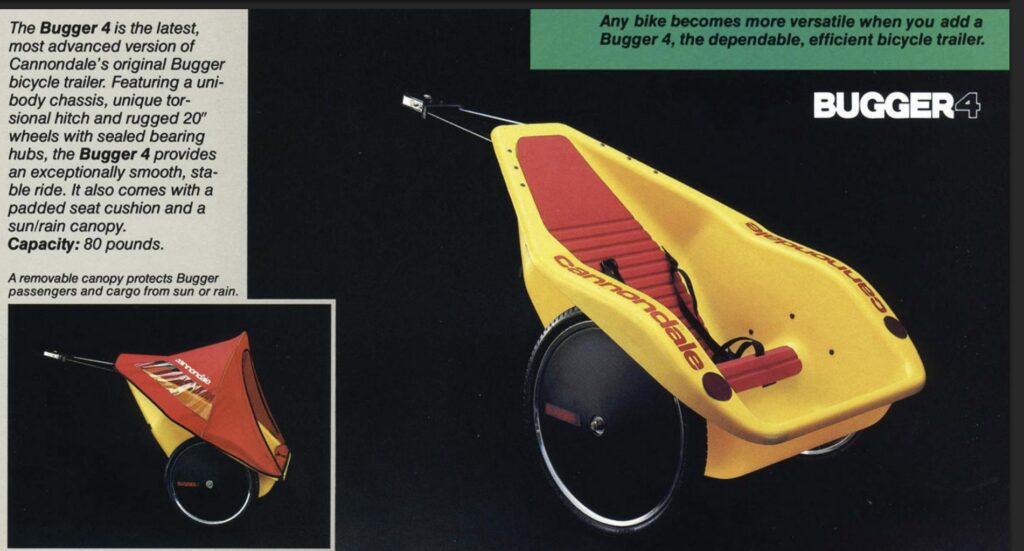
Oh, and it’s not racing-focused, but in 1987 Cannondale was up to the fourth generation of its very first product, a bicycle trailer called Bugger. No, really. There’s a name that didn’t travel well.








2 thoughts on “Check out the very yellow Cannondale SR2000 from 1987”
I rember that bike. I had a
I remember that bike. I had a Cannondale with Shimano 600 in the mid 80s and one with Shimano Sante around 1988. Today I did my first ride on a new Giant Defy with 105Di2, tubeless tires on carbon wheels with disc brakes. Still riding!
Sorry, I am dribbling…..
Sorry, I am dribbling…..
GP4’s, tubs, Dura-Ace, ‘proper gears’ (although a 12-21 would have been better.
Angle the bars down and it is about perfect.
Shit pedals and saddle though….