




When you’re cycling in a group you can’t always see the road ahead as clearly as you would when riding alone so clear communication is essential for keeping everyone safe and moving efficiently, and that means learning a few simple hand signals and calls.
Signals and calls might be confusing at first but they become second nature in no time. When it’s you who’s passing on the information, just make sure that you’re as clear as possible.
Bear in mind that many signals are not universal – they vary regionally and between individual groups – so make sure you pay particular attention on the first couple of rides with a new bunch of people.
If you’re ever in any doubt about whether to call back as well as making a hand signal, do it anyway; you’re better off giving riders behind an unnecessary shout than running the risk of an accident.
Stopping
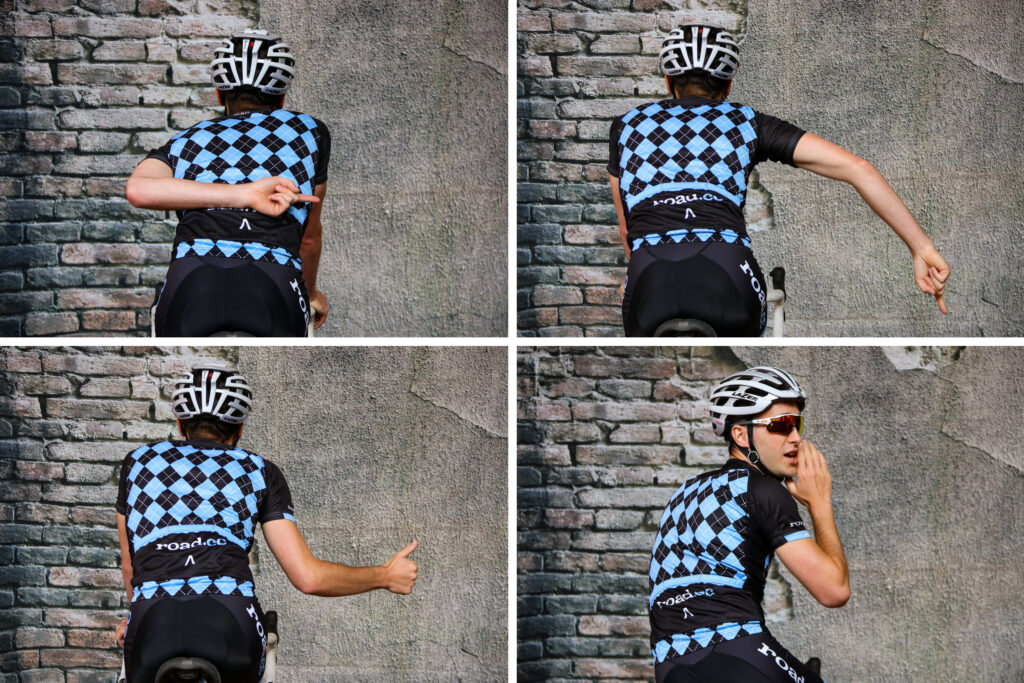
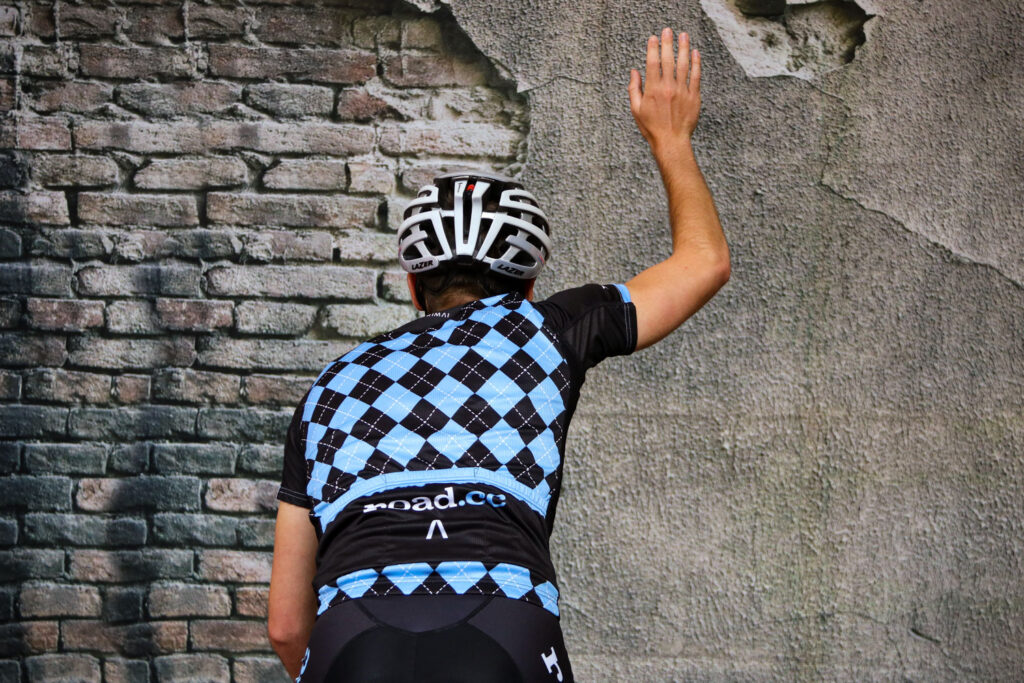
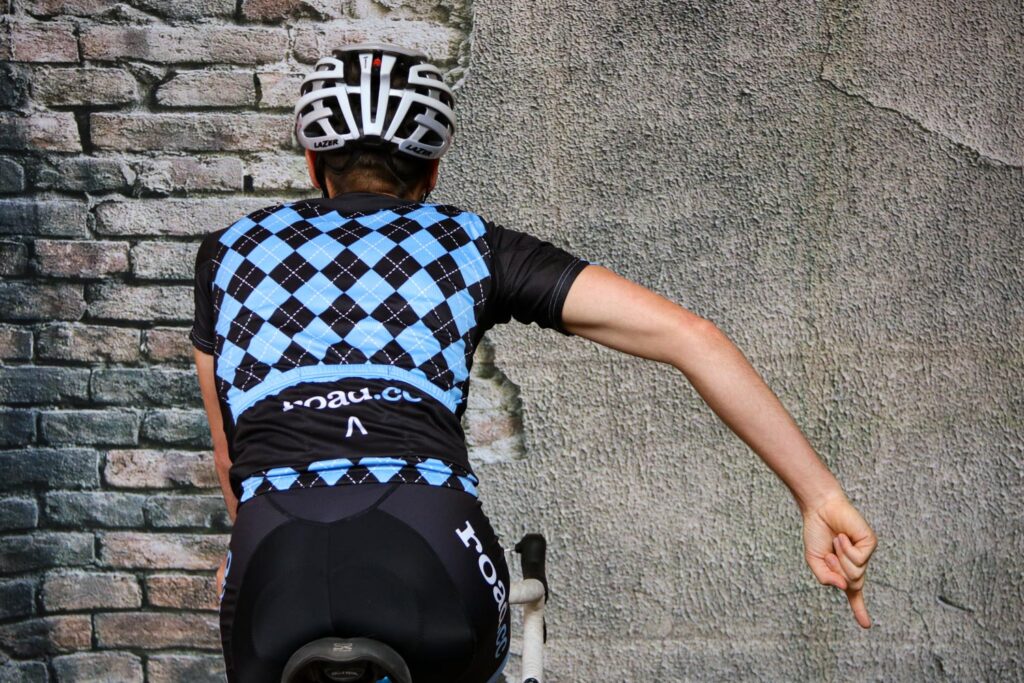
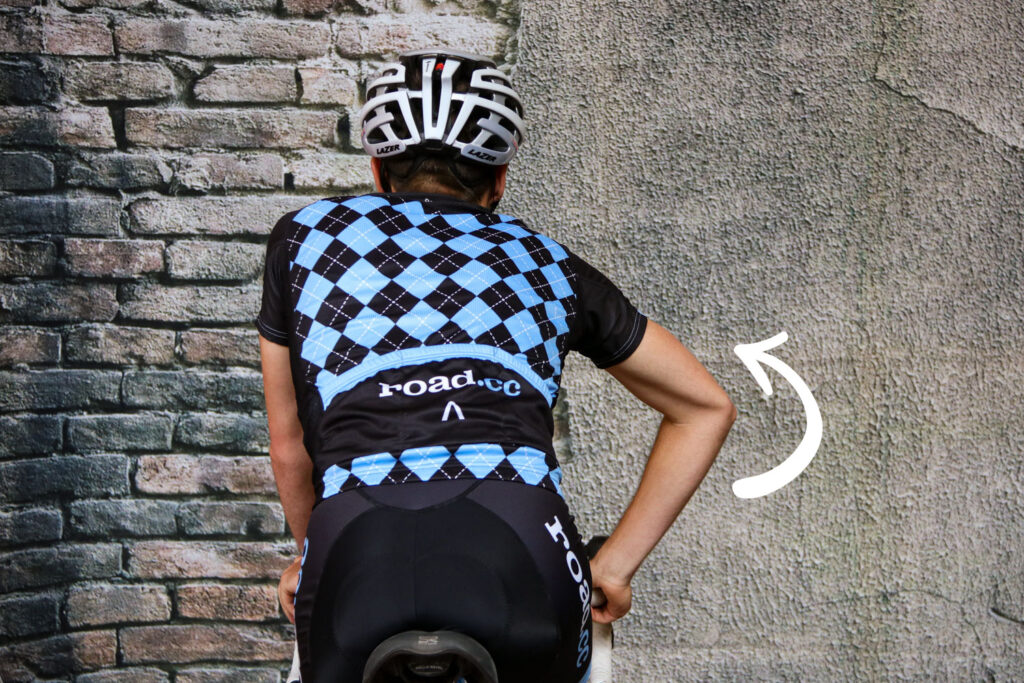
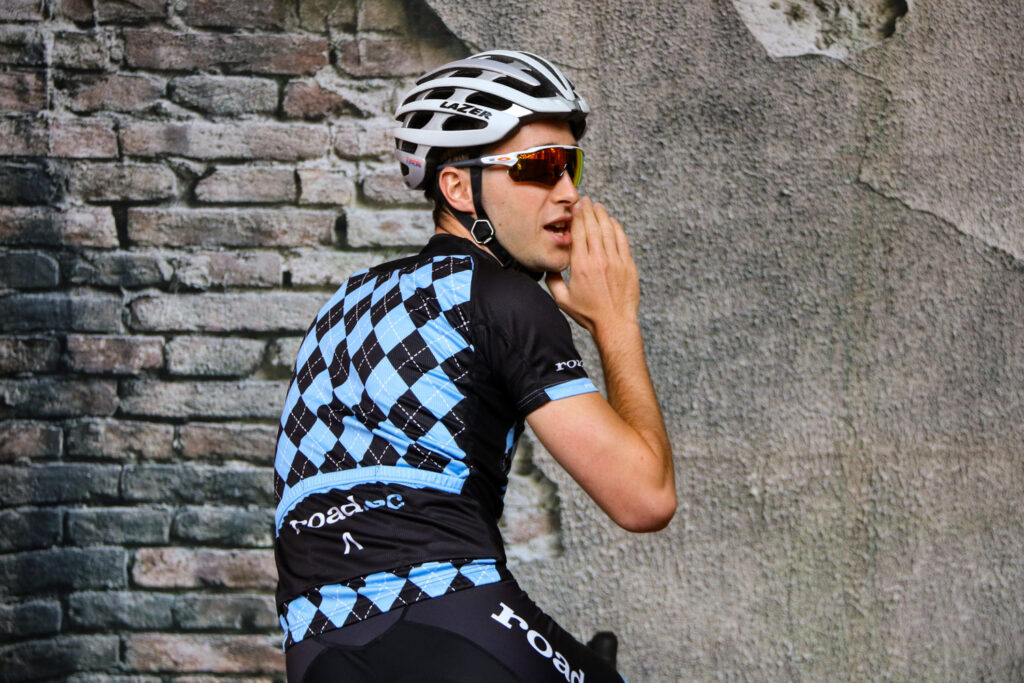
When the group needs to stop at a traffic light or when someone has a puncture, for example, raise your hand straight up.

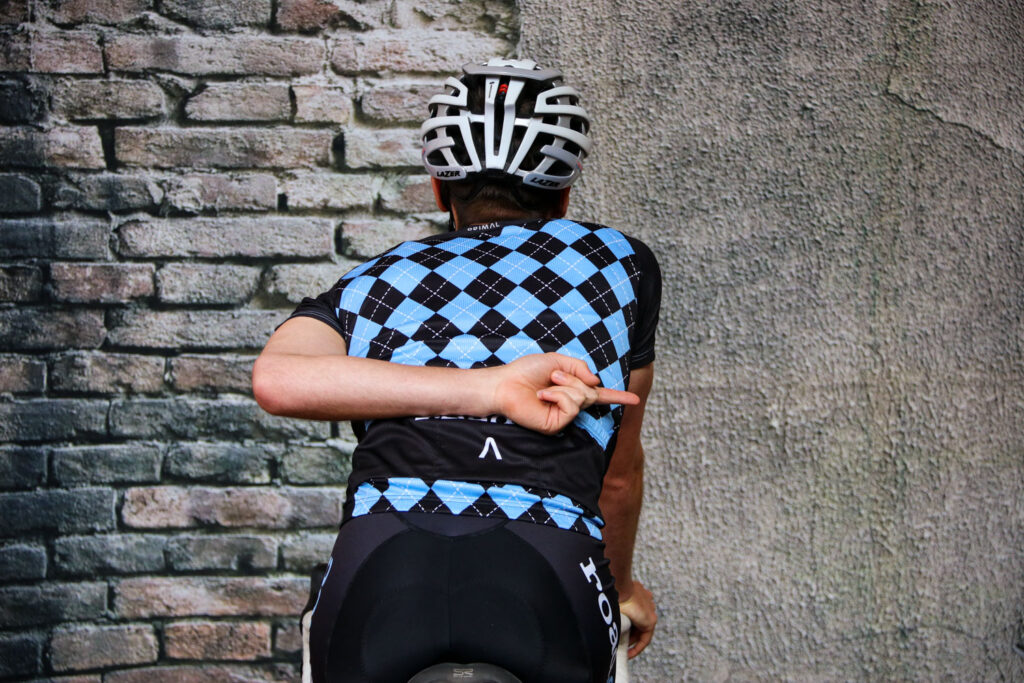
Some people use a closed fist behind the back to indicate stopping, but that’s appropriate only for smaller groups because its visible just to riders immediately behind you.
Other people use an arm out to the side with a flat palm facing backwards.
Calling out “Stopping” is usually a good idea, especially if it’s unexpected, because you might need both hands on the brakes.
[And yes, Liam in our pictures does need to stop quickly before he hits that wall].
Slowing

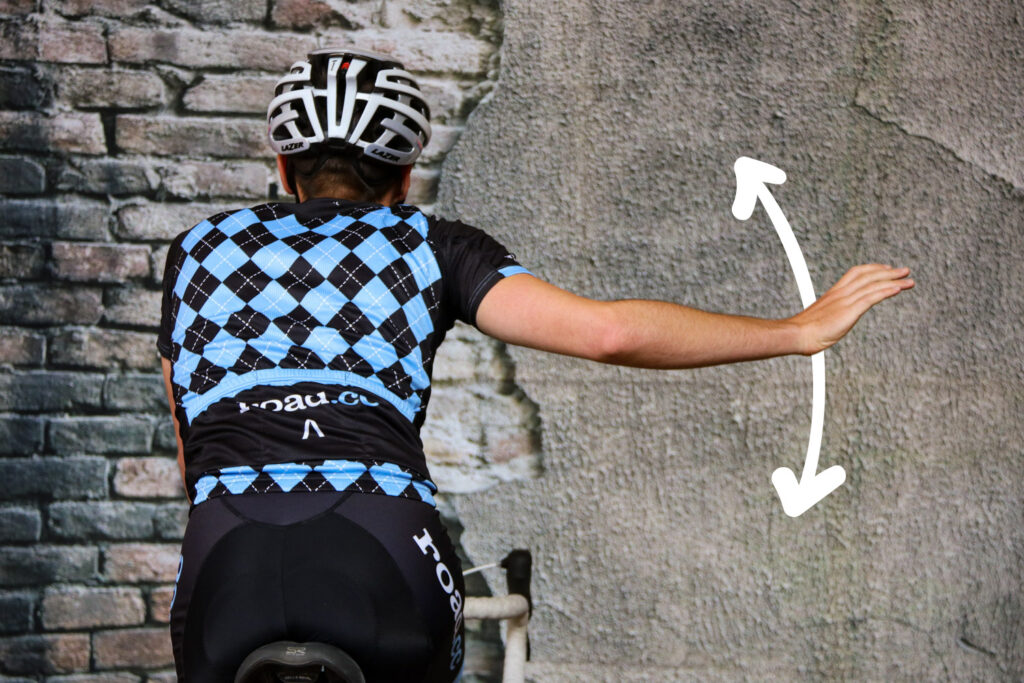
You might need to slow when approaching a tight bend, for instance, or if someone in the group is struggling with the pace. Put your arm out to the side and move it slowly up and down.
Calling out “Slowing” is often appropriate.
Obstruction in the road

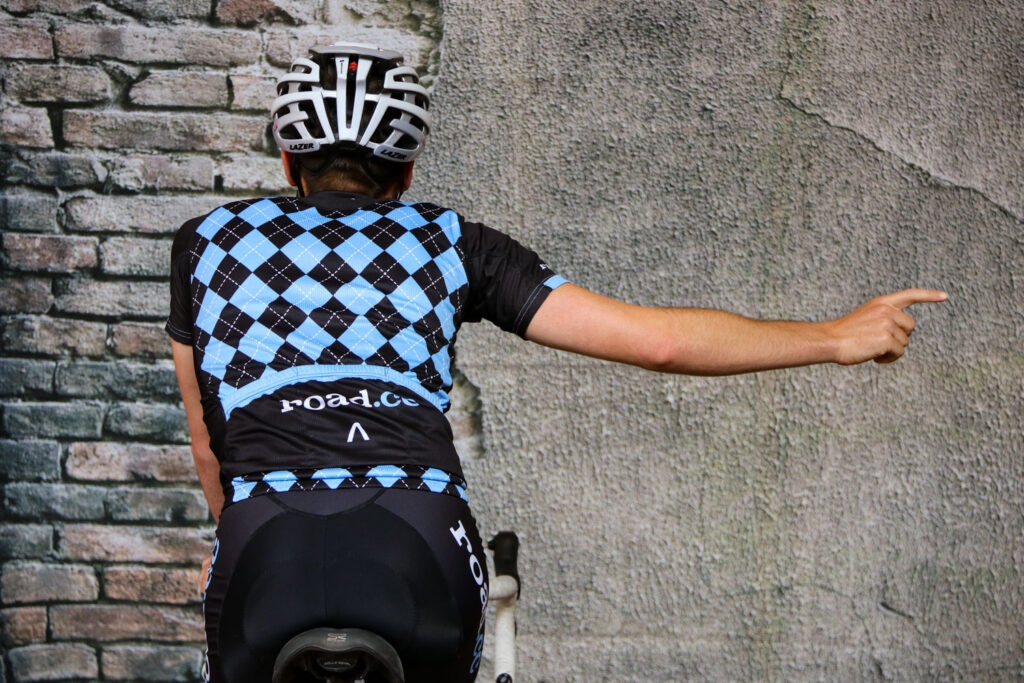
If there’s an obstruction that requires riders to alter their road position, such as a pedestrian or a parked car, point behind your back in the direction you need to move using the arm that’s on the side of the hazard. In countries like the UK where we drive/ride on the left, you’ll usually need to move out to the right, but you’ll occasionally need to tell riders in a group to move further left.
Road surface hazard

Point out potential hazards on the road surface such as potholes and drain covers that need to be avoided. Your hand must be visible to riders behind, of course, so make sure you position your arm out to the side rather than in front of you.
Shout out “Hole” – or whatever other type of hazard is coming up.
Gravel

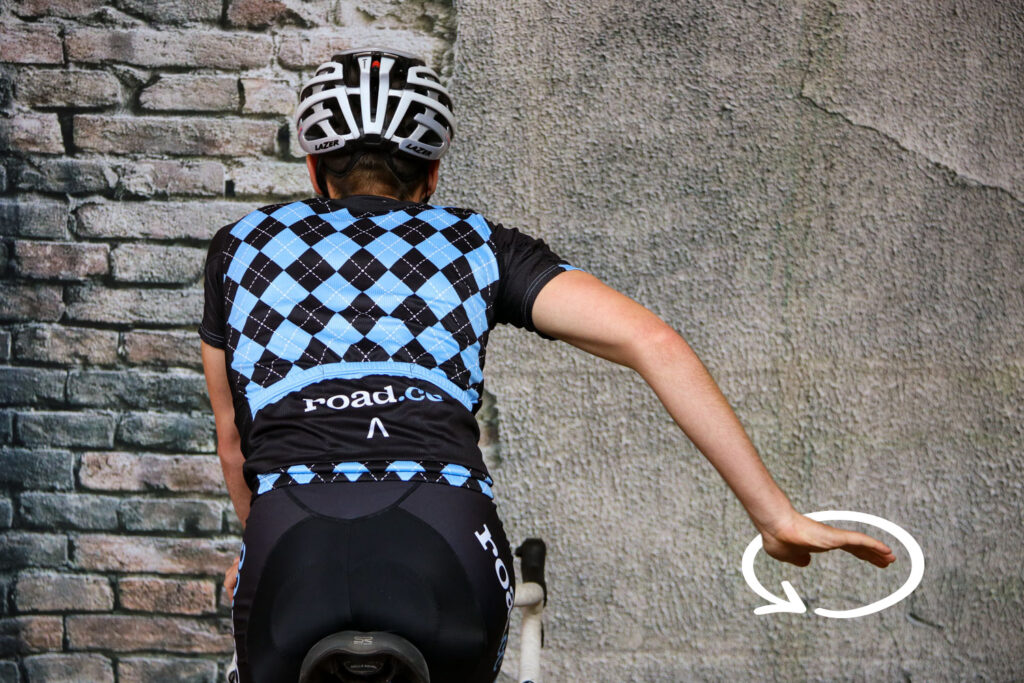
If there’s a patch of gravel (or something similar) that could be loose and treacherous, put your arm out and wave your palm towards the road surface.
Give a “Gravel” shout to avoid any doubt.
Speed bumps, railway tracks and cattle grids

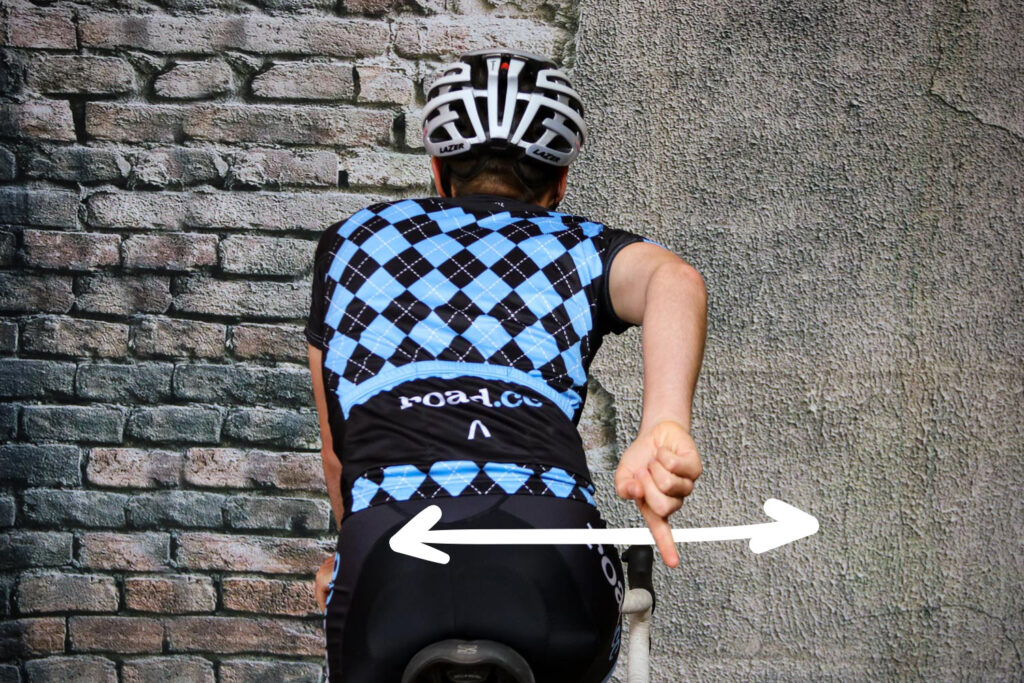
Warn riders behind of features that run across the road ahead by pointing down at the surface and waving your hand laterally. Some people do this with their arm out to the side, others with their arm behind their back.
Shout out the type of hazard you’re about to encounter; riders behind definitely need to know there’s a cattle grid coming up, for instance, especially in wet conditions.
Turning

When you’re approaching a turn, stick your arm out at shoulder height to indicate the change in direction.
A “Turning” shout is often useful, particularly in a large group.
Come through

When you’ve finished your time at the front of the group and want to drift off towards the back, let riders behind you know by flicking your elbow forwards before moving. Flick your left elbow if you want people to come through on the left, flick your right elbow if you want people to come through on the right (that said, we know that some people flick the elbow on the side they intend to drift towards – which is the exact opposite – so make sure you know the etiquette of your particular group).
Thumbs up

A quick thumbs up says “thanks” when a rider moves over to give you a bit more space, for example, or if another road user waits patiently for the group to pass where the road narrows.
And yes, there are plenty of less friendly hand gestures for other road users too. We don’t need to go into those here!
Calls

Always consider calling back to other riders in the group to reinforce your hand signals. Sometimes it’s not necessary, particularly in smaller groups, so use your judgement here.
There are a few other common calls that don’t have accompanying hand movements:
Car up A car is approaching from behind.
Car down A car is approaching from ahead.
Car back Another way of saying that a car is approaching from behind.
Single out or single file Arrange yourselves one behind another.
On the left/right I’m going to pass you on the left/right.
Clear left/right At a junction, the road to the left/right is free of traffic.
If you use any other hand signals (not that type!) or calls, let us know about them in the comments.















50 thoughts on “Know your group riding signals and calls”
Nice work Mat!
Nice work Mat!
FWIW, “Car Up” seems to be used as “Car up ahead” with many groups I now ride with which has taken some getting used to, having been taught to remember it as ‘car up your arse’ or ‘down your throat’ myself.
The “come through” flick of the elbow is perhaps contentious too. I was taught at track sessions to use a flick of the elbow to indicate the direction I was going to move, and wonder if its ubiquitous mentioning as a signal to come through in TV race commentary has altered its understood meaning.
And I’d add “line out” as an alternative to “single out” too.
ped wrote:
I was also taught this at track. Every place I’ve ridden track I’ve only seen it done this way. The ‘wiggle’ for ‘pass me this side’ seems to be used when in a freewheel bunch race. I suspect that it’s because on a track you are only going to want the rider behind to come through on the inside anyway, and you will likely be using the full width of the track to bring you back to the end of the line quicker, thus this warns anyone who might be moving up on your right you are about to go quite wide, rather than ‘flicking through’ a rider on your left.
Thanks for this article.
Thanks for this article.
I don’t ride in a club, so if I’m out on the road and end up cycling with someone who is used to riding in a club, I can not look like such a jerk for not signalling hazards if I’m taking a turn in front.
I do a fair bit of ride
I do a fair bit of ride leading, including some “chaperone” type work on bigger events and we always use and teach Car Up (car coming towards us from the front) and Car Back (car coming towards us from behind). It’s clearer in both the sound it makes as you say it and the actual meaning.
We also make clear that calling out every bloody car you see is incredibly annoying – keep the calls to the ones where the group actually has to do something to facilitate a pass or overtake.
Oh and it’s also always been
Oh and it’s also always been “car up” and “car back” for me too
Easy!/Slowing! – when not
Easy!/Slowing! – when not actually stopping
Clear (left/right/both) – when crossing/turning, to let riders behind know the way its clear
The big question is… can
The big question is… can you work out what I was actually saying in the last gif? Points and a pair of road.cc socks to the first correct answer!
Liam Cahill wrote:
“Pit stop?”
Liam Cahill wrote:
Pee stop!
Liam Cahill wrote:
Piss Stop!
Rider X wrote:
javi_polo and LarryDavidJr were close but Rider X takes the prize!
Stateside the norm for cars
Stateside the norm for cars in the roadway seems to be Car UP for in front and Car BACK for behind. I get the ‘up the bum’ having lived in London in the 70’s (in Edinburgh today for the Fringe) but I fear trying to explain that in the colonies could get me tossed out of the clubs for not being PC 🙂
Again it points out how important it is to know what the group or region is expecting for signals.
Great site btw.
s.
I’ve always used “car up” (it
I’ve always used “car up” (it’s coming from behind) and “car down” (when it’s coming from in front.
Up and down are the two directions from the railway era (possibly canals too?). They make perfect sense to me (and can be remembered by the somewhat crude method enunciated in the first reply).
To avoid any confusion, I
To avoid any confusion, I just shout “car”. It’s obvious from the context which direction it is. If I’m at the back of the pack (as usual), the car is behind.
Though I still have a dilemma when the vehicle isn’t a car.
“Nose” and “Tail” in our
“Nose” and “Tail” in our group rides. Works well because you can’t half-hear either word and then misunderstand. And it doesn’t matter much what the hazard is as long as we all know to be aware.
The main other call is “Horses” because that needs the most action.
These are shouts, as it gets
These are shouts, as it gets pretty dark around here …
Nose – car / vehicle / something coming from the front
Tail – car / vehicle / something coming from the rear
Clear left / right – at junctions so no-one has to stop unless required
All through – after junctions, so lead knows the group is clear of the junction
Clear out – when moving as a group to the centerline to turn right
Left / middle / right – can be followed or preceded by drain, bump, hole
Surface – for when the surface is an issue
Single-up – for when it’s too narrow or too dangerous to ride in pairs
Pace – for when you need the lead to slow
Stopping / slowing
Mechanical – breakdown or other forced stop
Shouts are passed in both directions, depending on where they started.
Handsignals are used, pretty much the same as above, and passed down the line.
Lead looks after the front, rear looks after the back, so in theory, lead never has to look behind.
That ‘thumbs up’ signal looks
That ‘thumbs up’ signal looks impressively (though presumably unintentionally) sarcastic.
It’s always been (as long as
It’s always been (as long as I’ve been cycling….4 decades)
‘Car Up’ – car coming up the group from the rear
‘Car Down’ – Car coming down the group from the front
The _Kaner wrote:
Ive recently joined an Old club and found this very common (and non sensical) terminology being used whereas Ive always used.
‘Car Up’ meaning a car up in front. In English we associate the word ‘Up’ with Front, as in Upfront, Up ahead, etc
‘Car Back’ – car coming from behind – absolutely no room for confusion here, car back cant mean anything other than what it says.
Using ‘car up’ referring to ‘car up a part of your anatomy’ sounds amusing, and might be traditional, but doesnt make sense in m my opinion.
As Judge Dreadful points out people get confused so it clearly is’nt common sense to use car up and car down.
Equally I’ve been riding for
Equally I’ve been riding for a long time (not quite 4 decades but close to 3) and have never heard anyone use ‘Car Up’ to mean a car approaching from the rear.
It’s non-sensical to use ‘Up’ to denote a car coming from the behind!
One thing that really winds
One thing that really winds me up when I’m leading a group ride, is the fact so few people understand “car up, and car down” calls. I try to make it simple, car up ( as in up yer bum ) car down ( as in down your throat). I hate it when they get mixed up especially if they’re behind me and shout “car up” when they’re talking about a car that’s approaching from in front of me. Firstly, I know, I can see it, secondly, it’s “car down”. If I’m having to glance round, for no good reason, it’s not helping. Most of the other stuff is good to have, but not so critical, other than calling “clear” approaching a junction, when it isn’t, that’s a nightmare too. I tend to call “watch your gaps” when approaching junctions, to try and dissuade pile ups due to people getting too close to each other, and then an unexpected incursion by a motorist at the junction ( no indicators / wrong indicators / sudden change of mind ) for example, leading to a smashed up rear mech, because someone was wheel sucking, when they should have backed off ( for example ).
Did you consider that’s
Did you consider that’s because the majority of riders use ‘Car Up’ for a car up ahead and ‘Car Back’ for a Car behind. For the life of me I cannot see why you would use ‘Down’ for a car ahead and ‘Up’ for a car behind. It’s counter intuitive and likely to cause confusion.
A good ride leader needs to appreciate when they need to adapt what they are doing to make it as udnerstood as possible, not get cross with people because they use a different and more simplistic system, that’s just egotistical.
Not to mention that “up” is
Not to mention that “up” is towards my head, which is at the front, and “back” is towards my bum, which is behind. Why on earth would you swap these round?
Bucks Cycle Cammer wrote:
either because some people have an obsession with sticking things in their orifices, or because it’s about keeping outsiders out.
Next time you see someone about to walk into something, shout “look down!”, that way if they are one of the cycling brethan you will have saved them, and if they are infidels it’s their own fault.
cannonchris wrote:
like this guy, who moved to a new club and spent several weeks “trying to educate them”
https://forum.cyclinguk.org/viewtopic.php?t=111731
Way to endear yourself to
Way to endear yourself to your new clubmates …
Judge dreadful wrote:
The fact you need an aide memoire based on spit roasting proves these calls as not as intuitive as you would like to believe. In fact it seems you are the odd one out, because the majority (by your description) interpret them the other way. Almost as if the calls were made deliberately obscure to differentiate between real cyclists and noobs.
If also heard people argue to use car up because it is going up the road, thats nonsense, might as well call car right at a t junction for a car that is travelling to the right. (from the left)
In any other context than group rides If someone told you to look up, would you look behind you or look where you were going?
Anyway the only important really is behind, because the car in front 1) is on the other side and not a problem, 2) can be seen quite easily.
And of course bike down, sounds like a crash, not an oncoming (or overtaking) cyclist.
“Car down” might make some
“Car down” might make some sense to those in the know but it is an example of elitism and daft in common parlance. It cannot safely be used for anything else. Call out “cycle down” or “pedestrian down” meaning to warn of those specific hazards ahead and most normal people are going to think that someone has crashed or that someone is lying in the road.
Mungecrundle wrote:
Yeah, what’s wrong with ‘car ahead’ and ‘car behind’?
I have wondered whether somewhere in the US there’s a cop with the surname ‘Down’. Officer Down must cause a major alert every time he identifies himself on the radio.
Mungecrundle wrote:
Yep, another very good reason for avoiding use of the word “down”. Unless you are actually shouting “Rider down!” ie there’s been a crash.
Up is universally accepted as being up ahead, upfront, up above, up north.
You get similar issues with calls when you’re derny racing on the track and trying to communicate with the pacer on the derny above the engine roar, the noise of the crowd, the windrush and so on. You need clear unambiguous calls so you can’t use Go and Slow because they sound too similar. Hup and Woah are usually used instead.
crazy-legs][quote
Behind the big motors we used to shout “Allez” to go faster and “Ho” to go slower – no other words would be used as they’d not be understood over all the noise – and the pacer would decide whether to do as asked anyway ….
You need to be giving as
You need to be giving as much information as possible, with as few words and syllables as possible. “Car up” says, there’s a car, it’s behind us, and moving towards us, in 2 words, and 2 syllables. It’s quicker ( which is key ) than “car behind” ( 2 words, 3 syllables) and that’s what you need, when you’re dealing with 2 tonnes of metal, approaching at speed. Same deal with “car down” rather than “car in front”. The original convention of “car up / Car down” was developed with hills at the forefront of the idea. As that’s when relative speed differentials ( bikes relative to motorists) is at its greatest. “Car up” = car coming up the hill from behind, “car down” car coming down the hill from in front. There’s an argument about relative positioning ( if you’re heading down hill, and the car is coming up from in front of you, should that not be “car up”?) but you have to choose a convention and stick to it, and the accepted convention is to ignore relative positioning, and that “car up” is approaching from behind, “car down” is car approaching from in front. It’s now found it’s way into the flatter bits of a ride, where the speed differentials shouldn’t be as great, therefore not so much of a problem, but ( I certainly find) that when leading a large group ( 10 or more riders ) the variance in ability and fitness, now makes these calls necessary.
Judge dreadful wrote:
But that seems to presume that ‘up’ is universally and instantly understandable as a synonym for ‘behind’. It clearly isn’t. Nobody, in the real world, uses ‘up’ to mean ‘behind’ and ‘down’ to mean ‘ahead’. That’s a very specialised non-standard meaning.
Therefore any saving in time in saying the word is likely to be counterbalanced by an increase in the mental-processing time required to remember what the word is supposed to mean (especially for anyone new to the terminology).
Edit – if one extra syllable is such an issue, what’s wrong with ‘car front’ and ‘car back’ or ‘car rear’, eh? Loses a syllable but still a lot closer to normal language than ‘up’ and ‘down’.
(I really am arguing for the sake of it, I realise)
FluffyKittenofTindalos wrote:
You may be, but you make exactly the point I would make. Merely by this conversation taking place is evidence that ‘car up’ and ‘car down’, whilst clear to some is completely confusing to others and therefore a crap way of conveying information clearly.
Up and down in this context make little sense to most and if they have to think through the ridiculous explanation about when a car is going up or down a hill (and even that could be interpreted the opposite way round) then this method is clearly seriously flawed in what it is attempting to convey. If even one rider in the group interprets it incorrectly then the call has failed.
My club used it for a long time and many people who joined started getting it wrong. I then just changed and started calling the obvious ‘car front’ and ‘car back’ which work as designed for EVERYONE without exception. Why anyone would try to claim that up and down are better (just because they have used them for ever and understand them) is beyond me.
Another that irked me was calling ‘clear left/ right’ at a junction. The reason it irked me? Because if it wasn’t clear the same individuals would shout ‘car left/ right’. How easily could those be misheard for each other?!
I once again decided I was not going to use those calls and simply call ‘clear’ if it is and ‘NO!’ If it’s not and I am stopping, especially at short notice (you know when you think it is clear then at the last minute a car comes into sight, usually around a blind bend or going pretty quick?) The ‘NO!’ call is also really good if you have to change an already shouted ‘clear’. When shouted with a bit more volume and urgency it is obvious and reaction inducing for those behind to stop. They don’t need to do any thinking.
Another variation that I’ve heard locally is ‘below’ for surface defects, especially when you can’t take a hand off the bars to point it out, often with ‘left/ middle/ right’ appended, especially if travelling in a double line. Again I like it as it is very clear and unambiguous.
PP
The simplest way to avoid up
The simplest way to avoid up/down/back confusion is to ask at the start of the ride, rather than waiting until it becomes a problem
a couple more i’ve Heard which haven’t been mentioned so far:
– half off: reduce the speed a notch so someone at the back can hold the wheel more easily
– all on: everyone is in the wheels after a junction, and whoever is on the front can resume their effort
Always been “(On the) Nose”
Always been “(On the) Nose” and “(On the) Tail” with little ambiguity. Obstacles are “(On the) Left/Right” or occasionally “Middle” – (though I have heard “Underneath” with a resigned sigh) And (unless you are on the track saying you are swinging up) the flicky elbow thing just gets you laughed at…
Mat, what is the shout or
Mat, what is the shout or signal for “shit we are riding directly into a brick wall”?
No mention of it in the article, even though the photographic evidence appears to show that is exactly what is about to happen.
Pushing50 wrote:
Apart from at the end of the ‘Stopping’ section.
Oh yes, sorry it was directly
Oh yes, sorry it was directly beneath an advert that I also ignored
“Car front” and “car back”
“Car front” and “car back” are so obvious and clear, compared to the very ambiguous “car up” and “car down”.
I always use the former and try to encourage that. Newcomers often get confused with the latter, and even experienced riders from other clubs have differing views on the “up” and “down” thing, as evidenced from the discussion here (and what happens on a hill when the “up” is down the hill etc?).
I don’t understand why anyone would use such easily misunderstood terms when there are much clearer ones available.
Stopping!
Hole!
Stopping!
Hole!
I’ve always used Car UP and
I’ve always used Car UP and Car BACK. However this weekend I was at an event with a wide range of experience and found myself going with the majority which was a simple HEAD or TAIL and it worked well for everyone.
Just to add to the confusion,
Just to add to the confusion, I’ve found that Southern/London clubs shout “Oil” instead of “Car”. So it would be “Oil Up/Down”. Not something ever heard up here in the Midlands.
TrevA wrote:
I’ve never heard this, if someone shouted oil, I would expect to worry about surface traction from a spillage. Continue straight, don’t brake.
In my area, Fife and Kinross,
In my area, Fife and Kinross, “nose”, car from the front and “tail”, car from behind are used. They are easy and clear to hear.
I think that is pretty common
I think that is pretty common across Scotland. Certainly is in my Club too.
We decode it to car front or
We decode it to car front or car back.
In our club, at the start of
In our club, at the start of every ride, each rider is given a 10 by 10 matrix on paper, a bit like a BS bingo card that some of you may have played. Along the side are letters and up top are numbers. If a hazard is encountered, the ride leader simply shouts “A 7”, the riders only need to pull their matrix card from their back poket to look up the inference and act accordingly. Easy.
We’ve always done it this way, why change?
So far only 3 major incidents in 3 years of riding. Not bad!
Thia has to be a joke. 7
Thia has to be a joke. 7 likes so far though.
It’s ‘car up’, ‘car down’ as in up your arse and down your throat. Its not confusing and has nothing to do with the terrain.
Only one member in our club doesn’t get it. But she’s northern and cant grasp that you go up north and down south either.
It’s quite a good joke, and
It’s quite a good joke, and would have 8 likes if the site let me like it twice.