


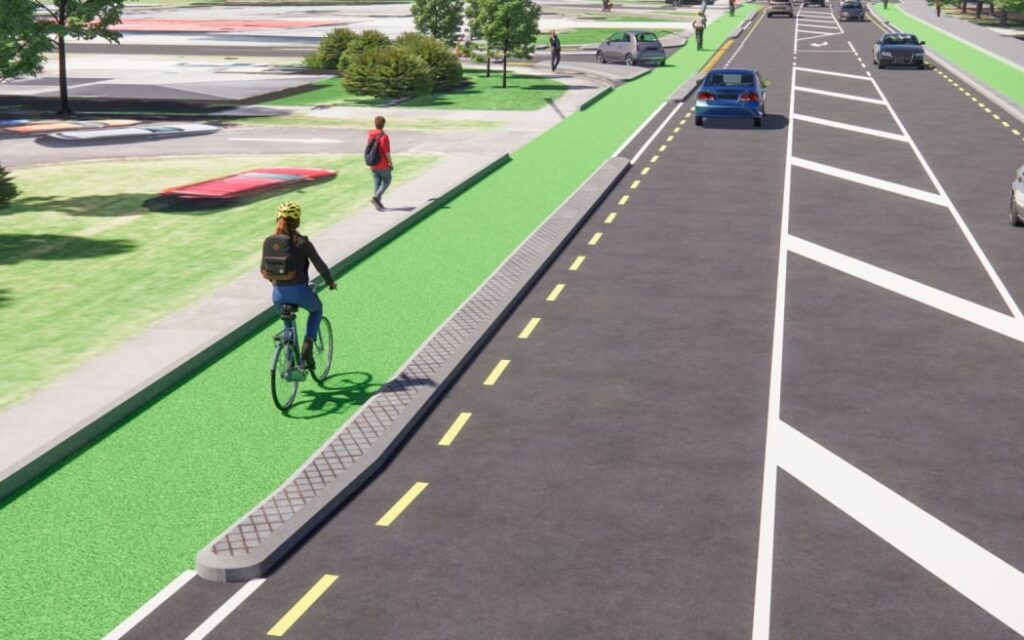

A councillor in New Zealand has made an eyebrow-raising objection to a plan to build a $14 million protected cycle lane, claiming that he would not be able to move out of the way of emergency service vehicles without risking scraping the bottom of his sports car on the infrastructure’s segregation.
This is the bizarre story being reported from New Plymouth, a city on the country’s north island, RNZ stating that, despite Murray Chong’s criticism, at an “extraordinary meeting” New Plymouth District Council voted in favour of submitting the proposal to the New Zealand Transport Agency for approval.
The plan will see four kilometres of protected cycle lanes built, segregating riders from traffic with concrete separation barriers that will be 100mm high, Chong saying he risks damaging his Chevrolet Corvette if he tries to drive out the way of emergency services in his sports car that sits just 160mm off the ground.
“If they are 100mm high and you’ve got the curvature of the road, which might be 20mm either side, you’re getting damned close to the limit,” he said. “My vehicle is on the limit. It’s legal, however, you know, I could rip the bottom sump out of my vehicle and all that.”
The councillor is a former paramedic and raised the often-heard argument, and commonly debunked in response, that emergency services may be slowed down if the cycling infrastructure is built as he would have to carefully move out of their way in order to make sure his car was not damaged.
> Pop-up bike lanes don’t slow ambulances according to… the ambulance service
“You can’t just verge off,” he said. “It will slow emergency services vehicles down and I know — I used to be part of that service.”
He also questioned who would pay for repairs to low-riding vehicles damaged, to top off his cycle lane comments. Mayor Neil Holdom has spoken in support of the project and stressed that “decisions that are going to result in that change” to “protect our young people” were necessary.
He said: “As somebody who has been run over twice and experienced some pretty hostile behaviour, if we want to get people on bikes — and in particular protect our young people — we have to take the decisions that are going to result in that change and make it safer.
“But I’m not a fan of in-lane bus stops. I’m yet to be convinced and I felt that was a bridge too far, but the reality is that if it came down dealing with the bus stops or we don’t get the project, I think the view is what’s more important and there are six schools along the corridor and the safety of those kids is paramount.”
A petition opposing the project has been signed more than 7,000 times, some business owners objecting to the loss of parking spaces to make way for the cycle lane.
However, another councillor Anneka Carlson, said it would make the area “more connected for all different modes of transport”.
“I’m really stoked that we got the numbers and we are setting the direction for government that this is where we want to take our roads. It’s making our roads safer, but also more connected for all different modes of transport,” she said.
“I think the voice of young people gets lost in central and local government and part of the reason I stood was to give a voice to people younger than me and my age. Young people I’ve spoken to want safer cycling and they want public transport, and that’s a lot to do with their own independence, being able to do what they want to do without mums and dads having to drive them everywhere.”













14 thoughts on “Councillor opposes protected cycle lane plan… because it might damage his sports car, he claims”
So he’s saying that his car
So he’s saying that his car isn’t actually fit for purpose anywhere except on a purpose-built racing track…?
Do the roads around Cllr
Do the roads around Cllr Chong’s daily life not already have curbs? I fear for any pedestrians that may fall victim to the councillor plowing his sports car onto the path under the existing arrangements. What is the difference if the users on the other side of that curbstone are travelling on foot or by bike?
ROOTminus1 wrote:
I think that the kerbs on the roads around Cllr Chong’s daily life possibly put a curb on his activities

What entitlement! “Who is
What entitlement! “Who is going to pay for my vehicle when I damage it?”
You are!
What a complete cock.
What a complete cock.
If you follow the link the
If you follow the link the the RNZ article, he also makes the claim that he doesn’t support raised crossings because he doesn’t think they are effective at slowing down SUVs. Presumably however they would be effective at slowing down vehicles such as his very low sports car?
And he also misses the point that raised crossings aren’t purely about slowing vehicles down but also mean the crossing is level with the pavement, which is much nicer for people using wheelcharis etc.
Oddly, he does appear to be supportive of speed cameras.
Because their car is worth
Because their car is worth more than the life of a cyclist: thanks for clearing that up councillor.
An attitude far too depressingly common, and one that should disqualify them from participating in government.
As someone who does operate
As someone who does operate an emergency vehicle I can say that the vehicles that slow us down when going lights and sirens to an emergency aren’t doing so because they can’t get out of the way due to infrastructure, they are doing so because they are bad drivers
– No situational awareness so they only realise we’re there when we’re on their bumper.
– Camping in the fast lane where they shouldn’t be in the first place.
– Don’t know where to go when there is an emergency vehicle behind them.
And on, and on…
And another thing.
And another thing.
It says that businesses are objecting due to the removal of parking for the cycle lane. So working through the logic very slowly… the road is currently lined with parked cars… the esteemed councillor’s Corvette has 160mm ground clearance… a typical car is 1500mm high with maybe 200mm ground clearance… what does he do to get out the way of emergency vehicles now? To quote the George Clinton “so low you can’t get under it, so high you can’t get over it”, and maybe he was talking about a Corvette when he sang “so wide you can’t get around it”!
If the rendering is typical
If the rendering is typical of the road, the great big gap between the car lanes will probably suffice for the emergency services.
They’ll be wanting to use a
They’ll be wanting to use a forgiving kerb on the cycle path (to maximise useable width) and maintaining footway height (and indeed continuity) at side roads, surely?
…although I approve of
…although I approve of their policy of steamrolling any cars which have been abandoned in the wrong places:
We need protected cycleways
We need protected cycleways to protect the rest of us from the bikes but paint it red as that means cycles go at any time no need for any signs though as they wouldn’t take any notice of them anyway
Good plan, painting them red
Good plan, painting them red would hide all the blood too!