


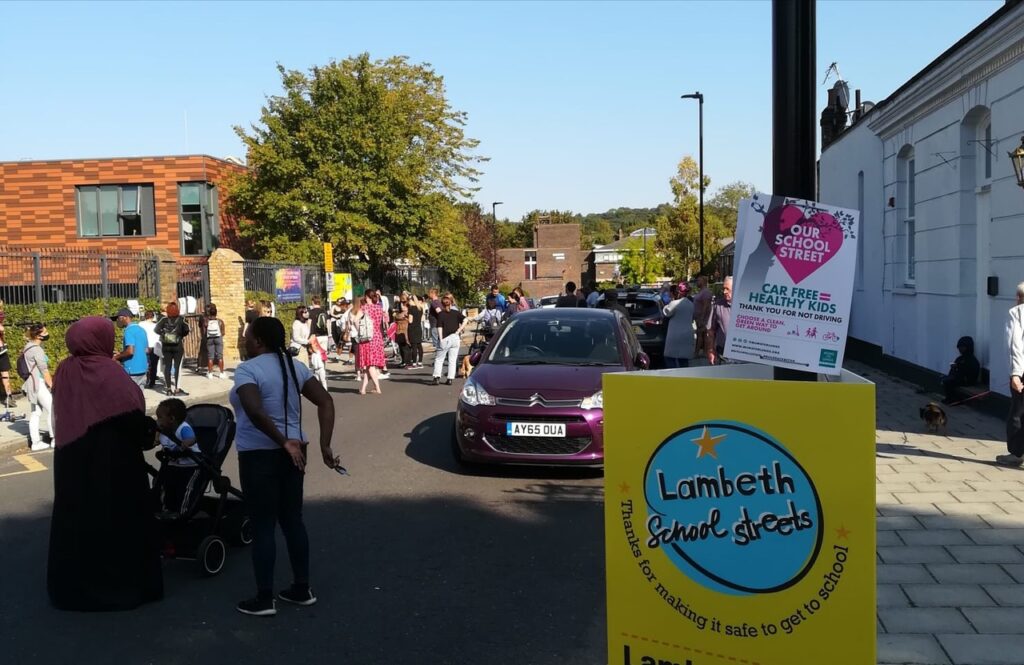

Active travel charity Sustrans has called for the introduction of School Streets in Northern Ireland, the only region in the UK not to have adopted the road safety initiative which aims to encourage children to cycle, scoot, or walk to school, as one parent compared her current school run to “going into battle”.
School Streets, which have been introduced in England, Scotland, and Wales, as well as the Republic of Ireland, in recent years, restrict the use of motor vehicles outside schools at drop-off and pick-up times and apply to both school and through traffic, while typically continuing to permit access for people living in the area.
Despite their success in promoting active travel, tackling congestion and pollution, and improving road safety around schools, the scheme has not yet been adopted in Northern Ireland – where nearly half of the country’s Primary School pupils live less than a mile from their school, yet almost two thirds are taken by car.
Last month, Belfast City Council passed a motion, tabled by SDLP councillor Séamas de Faoite, calling for a pilot School Street scheme to be introduced in the city. However, the statutory powers to implement such a scheme lie with the Department for Infrastructure, which has come under fire in recent months from cyclists unhappy at its failure to implement active travel measures in Northern Ireland.
Responding to De Faoite’s motion, the Department for Infrastructure said that it is “researching this area and has been liaising with contacts in England, Scotland, and Wales with a view to developing a ‘School Street’ policy for Northern Ireland”.
It added: “Once the policy has been developed the Department would seek to identify suitable pilot schools for a scheme.”
However, the delay in implementing the schemes was criticised by De Faoite and his SDLP colleague Gary McKeown, who called on the department to “move beyond the rhetoric and actually deliver” if it is “serious about wanting kids to walk, cycle, and scoot to school”.
“School Streets are a prime example of a scheme that has been proven to work elsewhere on these islands,” McKeown said. “There’s no reason why pilots can’t be rolled out here in locations that will work for pupils, nearby residents, and the wider community.”
> Children take to the barricades to save School Street
That view has been echoed this week by the Northern Ireland branch of Sustrans and cyclist Dr Jen Banks, a parent from Our Lady’s and St Patrick’s Primary School in Downpatrick, who described the current situation on the road around the school as one of “fumes, anxiety, frustration, and danger”.
“My son recently asked me if he could cycle to school on his own bike, and I said, ‘no, it’s not safe’,” Dr Banks said.
“I have heard other parents describe our school run as ‘going into battle’, and whilst they’re joking, they have a point. I can’t imagine the street my children’s school is on being much worse.”
She continued: “Edward Street as a School Street with access by foot, scooter or cycle could become safe and peaceful for everyone to live, learn, play, and breathe.
“At the minute there are parked cars lining both sides of the road and a queue of vehicles waiting, engines rolling, at either end for the chance to dart up or down.
“Huge lorries are having to reverse as they’ve got stuck, school buses can’t access the school, and cars are mounting the pavements. There is a perceivable layer of fumes, anxiety, frustration, and danger.
“But turning a section into a School Street would mean my child and many others could walk or cycle independently to school, which encourages active travel.”
At the moment, Our Lady’s and St Patrick’s Primary School holds a weekly ‘park and stride’ event encouraging parents and carers to adopt active travel, though Banks believes the problem lies in the lack of safe infrastructure.
“The school is not the problem,” she noted. “The infrastructure that these children are striding into undoubtedly is.
“Turning a section of Edward Street into a School Street would mean that residents, school staff, those with blue badges and blue light vehicles would always have access to the street. However, at certain times of the school day, the rest of the public would be asked not to drive down it.”
> Councils across England ignoring government advice to roll out School Streets
Beth Harding, Sustrans’ Active School Travel programme manager, concurred that, while one of the charity’s surveys found that four in five children would like to walk or cycle to school, better infrastructure is needed to make active travel a safe and attractive option for parents.
“More than a quarter of children in Northern Ireland are overweight or obese. Active travel through walking and cycling can help reverse this trend and also help a child’s mental health,” Harding said.
“Reducing traffic and associated carbon emissions around the school gates has the added impact of improving air quality, which has become a significant public health issue, especially in urban areas.
“There is great potential to increase the number of children walking and cycling to school and to reduce car use on the school run. Implementing School Streets initiatives can help, as we’ve seen from their success in the UK and Republic of Ireland.”















12 thoughts on “Mum compares school run to “going into battle” as Sustrans calls for School Streets to be introduced in Northern Ireland”
Some of the most
Some of the most inconsiderate and downright dangerous drivists I’ve ever experienced was when my daughter and I used to cycle to her school. She was only 4 but great on her bike and full of confidence. Of course, there would be parents in such a rush to drop their kids off that they couldn’t wait the extra 5 seconds and had to squeeze past or bully their way past me and a four year old. Some parents weren’t even in a rush and just didn’t know how to drive properly. Going into battle indeed.
My daughters school was the
My daughters school was the same, it had to be seen to be believed and we had similar experiences. We lived half a mile away and my neighbor with one child used to do the school run all year round in a range rover. I was the only parent on a bike, the majority of the rest were like crazed Neanderthals, seeemingly frightened to expose their skin to the air or leave the security of their steel and glass mobile fortresses. It was like a fecking mad max movie, civilisation is the wrong word for our culture.
See my post on this story,
See my post on this story, what is it about mummies in Range Rovers?
The Dept for infrastructure
The Dept for infrastructure isn’t going to move on anything until forced to by the relevant Stormont member. Just another consequence of the DUP weaponising the political situation around Brexit.
They REALLY didn’t like being
They REALLY didn’t like being beaten into second place did they?
Which is what this is really
Which is what this is really all about. I do wonder if their continually mis behaviour will eventually result in the Stormont accords being re-written to encourage alliances among the more progressive unionist and centerist parties.
Its the hypocritcal lack of ownership that really gets me. They happily took bribes from central Govt to support Brexit and then are refusing to own the consequences when they got shafted by Boris. Everyone could see it coming.
Although SF brought the whole
Although SF brought the whole assembly down for 3 years, for much less.
During my morning cycle
During my morning cycle commute, I noticed how light the traffic was, and how much more calmly the drivers were behaving.
Then I remembered that it’s half-term.
Coincidence, or correlation?
The volume of traffic is not
The volume of traffic is not that much less, but the reduction in congestion is massive.
IIRC the difference between
IIRC the difference between gridlock and free flowing traffic is on average only 25% more cars.
Which is why the school
Which is why the school holidays demonstrate why getting a few people out of their motor vehicles and walking, scooting and cycling and make a huge difference to congestion.
There’s a primary school 200
There’s a primary school 200 yards up from my house, on the same road. Drop off/collection time is a daily nightmare. Carnage, cars everywhere, sorry SUVs everywhere, parking on double yellows, zig zag markings on the crossing, obstructing driveways. My next door neighbour drives the precious ( or should that be precocious?) little brat there in her Range Rover Sport! 200 bloody yards, I kid you not!
The primary school one mile away is the same. Carnage at drop off/collection times, SUVs parked everywhere, one BMW X5 parks fully on the pavement, forcing children to walk into the road to pass. And she lives on the estate opposite the school!!!
Coincidence, no correlation at all.