



A distracted lorry driver who hit and killed a cyclist while driving was told ‘no good’ would come from him going to prison.
Shane Gibbs, 37, pleaded guilty at Kingston Crown Court to causing the death of 27-year-old Bianca Dos Santos by careless driving. Your Local Guardian was in court to see Gibbs receive a one-year suspended sentence and a two-year driving ban.
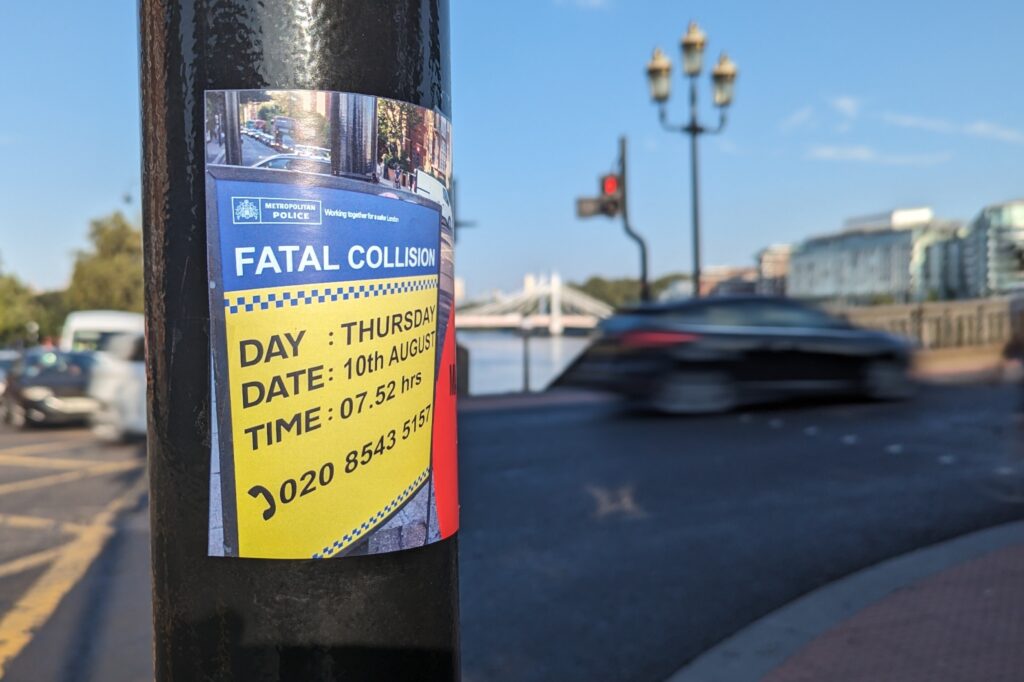
The collision occurred on the morning of 10th August 2023. Gibbs was stationary on Battersea Bridge facing north when Ms Dos Santos passed his 32-tonne lorry on the inside. The court heard that when accelerating to catch up to other stationary traffic, Gibbs did not check his left rear-view mirror, was distracted by the central console of his cab, and was on a hands-free phone call. The emergency services were called shortly before 8am and Ms Dos Santos was found dead at the scene.
Prosecuting, William Martin said “We are not and cannot say that he drove into her. The best we can say is that they came into contact. She may have driven into him, it’s not surprising that being that close to a moving HGV might have spooked her.”
Sentencing, Judge Peter Lodder KC said “I accept that because she was undertaking you she sadly contributed to her own death, but the fact is… you were not paying sufficient attention.
“You did not look into the appropriate mirrors on your vehicle, and had you done so you would have seen this young lady and she would still be alive.”
The court heard that Gibbs took responsibility for not checking his mirror.
“He has described this as a living nightmare,” said Michael Walinson for the defence. “He talks about serving his own life sentence, he’s going to have to live with the consequences of [Ms Dos Santos’ death] for the rest of his life.”
Gibbs, of Millside in Carshalton, was also told his driving license would require an ‘extensive retest’ upon the expiry of his two-year ban. The court heard he does not plan on driving a lorry again.
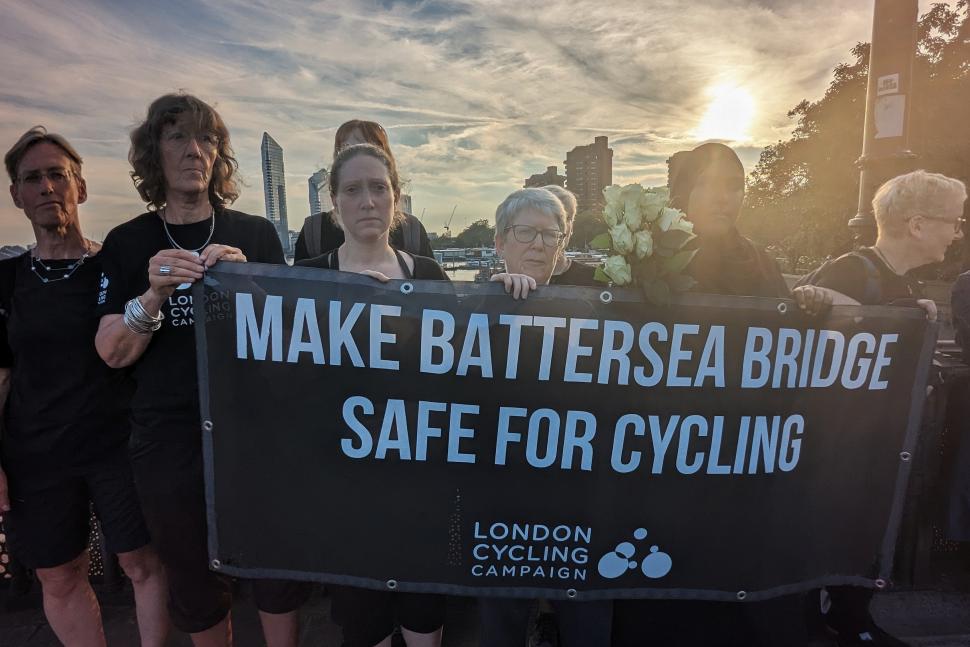
Since Ms Dos Santos’ death, Transport for London have begun construction work around Battersea Bridge aiming to make the roads safer. An estimated 10,000 cyclists use the Chelsea Embankment (leading onto the north side of the bridge) every day.
The work, due for completion next month, will install new pedestrian crossings, wider bridge pavements and a new road layout. The speed limit on Chelsea Embankment has also been reduced from 30mph to 20mph.














35 thoughts on “Cyclist killed by distracted lorry driver on London bridge “sadly contributed to her own death”, says judge as driver avoids prison”
Epic victim blaming. Just
Epic victim blaming. Just epic.
How is stating facts – she
How is stating facts – she undertook a lorry – victim blaming?
On two grounds:
On two grounds:
-firstly, she wasn’t undertaking. Going by the description it looks like, as the lorry was stationary when she started the move, it is best described as “filtering”. Which isn’t a mere technicality, but about what is advisable, legal, the language of the highway code etc. I almost certainly wouldn’t ‘undertake’ a moving lorry, but I might, depending on circumstances, ‘filter’ on the left hand side of a lorry.
-second, the failures on the part of the driver, which are multiple, are overwhelmingly vast compared to any fault on behalf of Ms Dos Santos. Any kind of attempt to see both sades as roughly equally at fault is wrong.
Top comment.
Top comment.
The wording is callous, awful
The wording is callous, awful and horrendous and has no place in a court room.
But equally, I wish that there was a lot more warnings to cyclists about passing on the inside of large vehicles – I have seen so many people squeezing up inside HGVs and buses in London and it’s heart-stopping.
An occasional bumper sticker doesn’t really cut it. The roll-out of the Direct Vision Standard is a positive, and should be introduced in other cities too – and ultimately made a universal requirement.
Agree that in a world of
Agree that in a world of human drivers filtering – or even overtaking – motor vehicles you have to weight up that you’re increasing your risk (even if there isn’t a left / right turn doesn’t mean the driver won’t…).
… but on the other hand drivers overtake cyclists then immediately turn on in them, regularly….
Agree – but just noting there’s nothing to say this would have helped in this case – or others where drivers simply don’t look.
Ultimately the answer for this issue is “don’t mix vulnerable road users with large vehicles”.
I dont know a single cyclist
I dont know a single cyclist who is ever comfortable with a truck alongside them, no-one filters up the inside of one without knowing exactly what can happen.
I had this example just last week, the truck driver not only overtakes too close and in a badly dangerous move towards a junction showing a red light already, but actually then steered in towards me whilst the truck was still alongside me.
lot a use stickers on the back would have done me in that case, in fact it didnt, because thats with a pass pixi displayed too.
Wholly disagree – there are
Wholly disagree – there are many cyclists out there who don’t think at all about taking the inside of a long vehicle, and who don’t realise the level of risk involved even if they do understand there is some risk.
If they did then there would be far less people doing it.
I absolutely don’t condone poor driving by HGV drivers, nor am I suggesting that highlighting the risk of filtering would prevent your scenario or ones like it. But if the objective is to save the maximum number of lives – and if yours isn’t then there’s not point in our discussing any further – then persuading more cyclists not to take risk of filtering inside HGVs also has to be a priority.
Stickers on the back are in the “just about better than nothing” category of measures. Public information campaigns on social media or TV/radio would be a better way – alongside infrastructure and vehicle improvements.
Yes, ideally the problem should be designed out as much as possible. But should we just be ignoring that there are many many people unwittingly putting themselves at huge risk of death daily until we get to that stage? No, absolutely not.
I love those stickers,
I love those stickers, especially when close passed by only a few cm.
Hirsute wrote:
My favourites are the ones that say “IF YOU CAN’T SEE MY MIRRORS I CAN’T SEE YOU” – I always want to grab a marker pen and add underneath “SO I”M GOING TO BE EXTRA CAREFUL, CAUTIOUS AND COURTEOUS TO MAKE SURE I DON’T HARM VULNERABLE ROAD USERS. OH AND I’M GOING TO ASK MY EMPLOYER WHY THE HELL I HAVEN’T GOT MIRRORS AND/OR DETECTION DEVICES/CAMERAS SO THAT I CAN SEE YOU.”
Scariest HGV experience I had
Scariest HGV experience I had was in a car. Parked behind an HGV in a layby while my passenger went to the toilets. HGV Driver walked past on his way back from the toilets, a few minutes after he’d got in the cab the reversing lights came on. I lent on my horn but was shunted several metres backwards, almost running over my passenger as they returned, before he stopped.
When they fail to provide a
When they fail to provide a bike lane, they’re basically telling cyclists on a crowded road or bridge to try to filter past the HGVs and buses. The situation on Battersea is even worse, where there’s no bike lane *and* you can’t even switch to walking, because there’s a fence between the traffic lanes and the pedestrian way. The road design creates a funnel where cyclists end up encouraged to pass the vehicles on the left side – and then we call it an “accident” when this kind of thing happens.
I’m not personally familar
I’m not personally familar with Battersea Bridge, but I do of course understand and know well the urge to try to slip past in such a location.
What i can say, having taken a look on Google Maps, is that it is somewhere that I would absolutely never try to filter inside an HGV, with the knowledge and experience that I have now. Would I have 15/20 years back as a much newer and less experienced city cyclist? It’s possible I would, because I just hadn’t thought all that much about the scale of the risk involved.
tom_london wrote:
There never will be a cycle lane on Battersea Bridge unless they make it one way and take the other carriageway for it, unlikely to happen. I always advise novice commuters to use Albert Bridge, less than a minute’s ride away and accessible from the traffic free riverside path on the south side or the shared pavement on the north side. The width restrictions on Albert Bridge at both ends ensure there are no HGVs or buses or even large vans and the extra width of carriageway means (most) drivers pass at a decent distance.
On hands free phone.
On hands free phone.
So distracted driving and cognitive overload.
Phone use should be banned when driving.
It is easy to fit aftermarket
It is easy to fit aftermarket cameras and parking sensors that alert driver to obstacles, and if fitted as standard will apply brakes. So why is it so difficult to make it law there should be no blind spots on vehicles? This HGV should have detected the cyclist moving up the inside and alerted the driver.
its just easier to accept
its just easier to accept youre driving a vehicle that can kill people, and to focus all your attention on avoiding doing that and driving safely, rather than more gadgets, gizmos and tech to rely on and distract you
Imagine if todays fighter
Imagine if todays fighter pilots had to rely on the technology that a spitfire pilot had, i.e. their vision only. Having gadgets that alert you to things that are difficult or impossible to see are a significant safety improvement. The ‘driving safely’ would include reacting to those alerts.
people on bicycles are not
people on bicycles are not difficult or impossible to see, if you are paying attention to what you are doing.
which should just be the minimum level expected of you if your are driving a machine that is lethal if you arent.
I dont believe technology is the answer to this, it abrogates the responsibility of the driver to actually do basic things, which is look where you are going, check your arent about to drive into something or someone.
and it reinforces reliance on technology that is misplaced and actually lowers concentration in drivers on safety critical functions, because they become used to being saved by a beep, rather than ensuring the beep never happens.
stonojnr wrote:
Or perhaps rather – there is almost always an option to *disable the annoying beep*!
I agree some driving “safety” tech comes with a risk of reduced alertness – for an activity where that is still safety-critical.
There is a balance though – reducing cognitive workload at busier moments can help and “failsafe” reminders catch predicatable human error.
(Hence motorway design – lanes and single-direction only help reduce workload, and rumble strips provide a warning, with energy-absorbing barriers for harm minimisation. BUT they’re built with curves to try to keep some level of awareness.)
OTOH (devil’s advocate) surely it’s just a question of what crashes less – unassisted humans or assisted humans? (With perhaps some nuance about exactly when/ how they crash under the different scenarios).
I’m also a bit tech-skeptic, but I’m even more skeptical about “people should just take more responsibility” in isolation. Making humans consistently pay (more) attention to stuff which doesn’t immediately interest/benefit them really is pushing water uphill!
Hence sustainable safety – a reworking of infra and rules around human behaviour to better serve all road users, not just the motorised ones. Plus knowing that humans plus cars is a recipe for severe damage when they (statistically) mess up is yet another reason for wanting fewer driven journeys.
But beyond that – why not tech which actually does improve safety (not in-car entertainment!) and/or doesn’t have conflicted motives for adoption (autonomous vehicles)?
Around that time,
Around that time, CyclingMikey reported two HGV drivers for using handheld devices. In both cases the Police did not take any action and his reports were recorded as either insufficient evidence or “reporter error” which he double checked, and could not find a single error on his part.
The pitiful “Think” campaign should use this real life case to warn about the dangers of all use of mobile technology, including handsfree.
Undertaking?
Undertaking?
it’s called filtering. The Judge and prosecutor should visit the site. How is the outcome between a bike and a 30 ton lorry blamed on the bike? What evidence do they have as there is none given here. As the driver of a 30 ton lethal Weapon operating in an environment of mixed vehicle use he failed entirely. Would she be dead if he checked his mirrors? Are no vehicles allowed to filter in the left lane?
Just appalling.
Runtilyoudrop wrote:
There is a difference between being permitted to do something and it being a good idea. I don’t think too many on this site would argue that filtering up the left side of a stationery HGV is a good thing to do even though it is perfectly legal to do it.
Users here constantly (and correctly) point out that drivers should drive to the conditions and should not drive at 60mph down a winding country lane just because the law says they can.
It therefore is not unreasonable to point out that cyclists should also ride to the conditions, including not filtering into a dangerous and potentially life-threatening position.
The judge’s language in this case makes me uncomfortable, as does the continued insistence by (presumably) the CPS that “careless driving” is an appropriate charge when any vulnerable road user has been killed, but reminding cyclists to not put themselves in harms way like this is not in itself a problem.
For his words and sentencing,
For his words and sentencing, “Judge” Peter Lodder KC deserves a special place in…
RIP Bianca. HGVs should not
RIP Bianca. HGVs should not be permitted on Battersea Bridge, which I think I’m right in saying has the narrowest roadbed of any of the central London bridges, one lane each way and those extremely tight.
My late father , a petro-chem
My late father , a petro-chem tanker driver, absolutely drummed into me the potential consequences of going up the inside of an artic on approaching a junction, both on bike and in car. He also refused to use the in cab telephone system his employers fitted their vehicles with unless parked up off the road.
At the time it was reported
At the time it was reported that the driver failed to stop at the scene and was tracked down by the police.
https://www.mylondon.news/news/south-london-news/battersea-bridge-crash-met-appeal-27499706
Why was this “detail” not worth reporting?
Very much not in the business
Very much not in the business of defending the driver but with a vehicle that size and being, as admitted, distracted by other things quite possible that he didn’t realise he had hit her.
If a lorry is stationary – or
If a lorry is stationary – or moving, never, never cycle on the inside. The driver cannot see you. Even if the driver looks at his mirror there are large areas where the cyclist is invisible. I urge anyone to go and sit in the cab of a large lorry – then you will get an idea of the challenges a driver faces, even when they are driving at their optimum.
I agree the infrastructure is poor, I agree that Lorrys should not be in central London, I agree that those that are require modification like door windows and sensors for better visibility, I agree that some drivers are negligent and criminal in their driving. But until then – do not cycle up the inside of a stationary or moving lorry. Let the lorry go first.
My thoughts for what they are
My thoughts for what they are worth.
From the article
I completely agree.
I strongly disagree. (I was going to write somethig else but it was a bit rude)
Why not make this part of the sentence then, just in case he changes his mind.
And finally, once again killing a cyclist is considered merely careless.
FYI – Driver eye examples of
FYI – Driver eye examples of the visibility around an HGV.
The point I’d like to make is
The point I’d like to make is that these cyclists and the little boy didn’t appear from nowhere and would have been visible at some point prior to the video. This makes it even more important to check mirrors regularly, rather than look down at the mobile phone or whatever other distractions are in the cab.
The videos also don’t show how much more you could see if you moved your head and body, both are possible if stationary.
In my opinion this is no excuse for lack of attention.
Interesting mix of comments –
Interesting mix of comments – on video 1, several suggesting this isn’t a good demo as mirrors are bad / poorly adjusted. One comment stood out as needing a tweak:
Needs “and just because you can see them don’t assume they *have* seen you either”.
Not with trucks thankfully but have had my share of “looking straight at me but not seeing me” moments.
She contributed to her own
She contributed to her own death by daring to ride a bicycle.
Frankly is one of the most terrifying things I’ve heard and it rams it home that my life as a cyclist is worth nothing.
“She may have driven into him
“She may have driven into him, it’s not surprising that being that close to a moving HGV might have spooked her.”
Whenever I am spooked by a close passing vehicle, I never turn into it! Even hopping a curb to get away.