


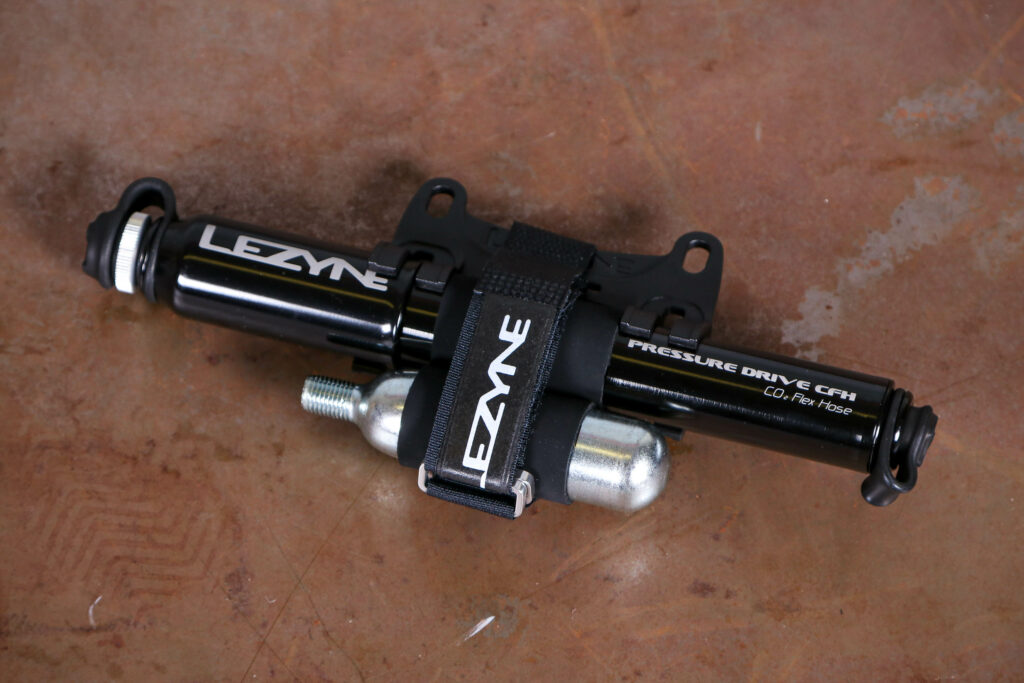

In the endless march of cycling tech progress the days of hand pumps were interrupted by the dawn of CO2 canisters, but just as quickly as roadside inflation got all scientific and chanelled a shift in a comercial kitchen, so too has the boom of the electronic mini pump changed the game once again.
We say ‘boom’ not literally, perhaps an inreasingly loud crescendo of robotic whirring would be a more fitting sound-related metaphor for the electic pump’s rise to prominence.
These nifty portable devices sit small enough to be easily transported in a back jersey pocket and can avoid many of the downsides of using a CO2 cartridge.
They are not without their downsides of course, and we suspect many reading this do and will continue to stick with their trusty hand pump for roadside tyre inflation, but there’s no denying electric pumps have turned a lot of heads very quickly.
How? Why? And have they killed off the CO2 cartridge in cycling for good?
Electric pumps are a fairly simple product. Using a battery-powered motor to inflate tyres quickly and precisely, the small, portable devices offer an alternative to: 1. lugging a frame pump about 2. leaving your arm filled with lactic acid as you thrash away at your hand pump 3. accepting the risk and occasional faff of CO2 canisters.
Simply charge it up, take it on your ride and watch your tyres effortlessly inflate to your desired pressure when required. Factor in that many will come with Presta and Schrader compatibility and a digital display to ensure you get that PSI spot on, it’s a no-brainer, right?















4 thoughts on “Is the CO2 canister dead? The rise of the electric pump”
CO2 fire once? What are you
CO2 fire once? What are you talking about? I’ve used mine for slow punctures before, no issue.
Just a simple Birzman pump. No, it won’t keep pressure for weeks, but easily hours, maybe even days.
Aren’t all like that?
My Cycplus AS2 Ultra is great
My Cycplus AS2 Ultra is great. 3.5 inflations per charge for my 28mm tyres (to exactly 65psi and in about a minute).
On the group ride, it’s always the first pump called into action when a clubmate has a puncture – and fits into a small saddlebag where my old hand pump had to take up jersey pocket space.
Like electronic shifting, it’s hard to imagine going back.
1 GREAT thing about the old
1 GREAT thing about the old school hand pump – you keep warm in colder weather.. ?
I carry an AS2 as well as CO2
I carry an AS2 as well as CO2 … with the latter being last resort.
Legend has it that CO2 can freeze sealant, causing it to bind together in to hard, useless clumps.
Dunno if legend is right or not, but between my AS2 and DynoPlugs, I’ve never had to find out.