



Time trialling is a British institution, synonymous with the history of cycling and bike racing in the UK, and one built on the work of thousands of volunteers who, over the years, have stood on the sides of dual carriageways and rural roads, in searing sunshine and bone-chilling rain, stopwatches, whistles, and hi-vis vests at the ready, giving up their free time to keep a proud tradition alive.
And thanks to an important High Court ruling earlier this summer, the volunteer-driven character of Britain’s time trialling scene is set to continue – despite the best efforts of a motorist and his legal team.
Listen to the road.cc Podcast on Apple Podcasts
Listen to the road.cc Podcast on Spotify
Listen to the road.cc Podcast on Amazon Music
In June, we reported that a judge ruled that Ferryhill Wheelers cycling club was not liable for a time trial collision which left a promising young cyclist in hospital for three months with serious life-changing injuries, after the driver who hit the rider accused the volunteer-run club of a negligent risk assessment and insufficient signage and marshals.
Discussing the case on the road.cc Podcast, the lawyers who represented the cyclist and the club at the High Court described its outcome as “very important”, while noting that it would have been “dismaying” and potentially hugely damaging for grassroots racing in the UK had the judgement gone the other way.
During a lengthy, detailed conversation, the lawyers also criticised the initial criminal response to the crash, which saw the driver escape punishment despite what they viewed as a flimsy defence, and emphasised the judge’s conclusion that time trialling is beneficial for society, insisting that it “should not be shut down unnecessarily because of the negligence” of car drivers.
Tuesday, 23 May 2019
On the evening of Tuesday 23 May 2019, Ben Hetherington’s life changed forever.
Ben, then 23-years-old, was one of the most exciting young prospects in British cycling. In 2018, he finished sixth at the national road race championships, and, while riding for Swedish Continental team Memil Pro Cycling, won two stages of the Tour of Morocco, in 2017 and 2019.
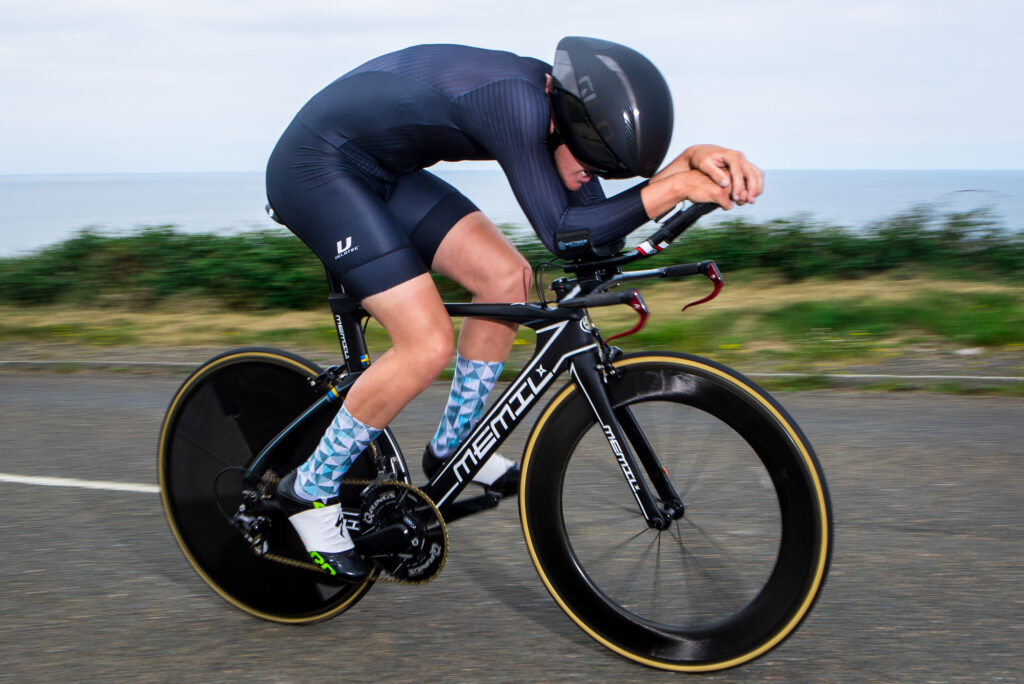
However, a month after that second victory in Morocco, while racing a 10-mile time trial on the A689 dual carriageway in Co. Durham, organised by his club Ferryhill Wheelers, he was struck by motorist Raymond Fell.
After failing to give way or slow down before exiting the junction in the middle of the road, Fell turned right across the carriageway’s eastbound lanes, straight into the path of Hetherington, who was given little to no time to react.
Ben suffered serious, life-threatening injuries in the crash, including a traumatic brain injury, and spent several weeks in an induced coma and three months in hospital.
He spent the first few years after the crash relearning how to walk and ride, driven by a burning desire to race his bike again.
And in 2022, less than three years after the crash, Ben pinned on a number once again, taking silver in the C3 3km individual pursuit at the national track championships, his very first race back. Since then, he has picked up a number of top results on the road and track in para-cycling, including another silver in the 1km time trial at this year’s national track championships in February.

Meanwhile, on the legal side of things, Ben brought civil proceedings against the motorist, Raymond Fell, for negligent driving.
However, after he avoided punishment for careless driving in the criminal courts, Fell’s representatives then pursued their own case against Ferryhill Wheelers.
The motorist accused the club of carrying out a negligent risk assessment and failing to put out adequate signage on the road and employ a sufficient number of marshals, while also blaming Ben himself for the collision, accusing him of wearing dark clothing and failing to keep an adequate look-out for motorists, among other things.
The club denied liability and the case was set for a High Court trial. Then, shortly before the trial, the driver’s insurers admitted liability in full for the collision, but continued to argue for a contribution from the cycling club.
However, in what was deemed an “important judgement” for grassroots cycling clubs, Mr Justice Ritchie dismissed the case and stated that the risk assessments were carried out properly and sufficiently, and that Fell had simply failed to see the hazard warning signs informing road users of the cycling event, along with marshals with hi-vis jackets at two roundabouts which he passed shortly before the collision.
Ritchie deemed that, contrary to Fell’s arguments, the standard of care applied by the club was that of a reasonably competent and reasonably informed volunteer, and that as far as they reasonably could, Ferryhill Wheelers had brought its event to the attention of road users on the A689.
The judge also, in a ruling that impacts the entirety of Britain’s grassroots cycling, and even sporting, scene, concluded that Ferryhill Wheelers are “a voluntary organisation carrying out tasks for free for the benefit of members of society and the standard of care placed upon them in law is not so high that it would discourage such beneficial voluntary activities”.
Following the judgement, Laura Murphy, the partner at Leigh Day solicitors who acted on behalf of British Cycling member Ben, and Martin Porter KC, the joint head of chambers at 2 Temple Gardens and barrister for Ferryhill Wheelers, noted that the case “represents a significant development in the law concerning liability and duty of care for anyone organising or participating in amateur sporting events, especially cycling road races”.
The judgment, they said, also highlighted “the importance of volunteers, stating that people giving up their time for the benefit of cycling members of the community should be encouraged.”
“When it comes to police investigations of cyclist injuries, we really should expect better”
Speaking to the road.cc Podcast this week, Porter noted that the judge’s ruling highlighted the social benefits of cycling and time trialling – and why it needs to be maintained, despite the poor state of driving on British roads.
“There’s an obvious social utility to cycling in general, and sport cycling in particular,” Martin told road.cc.
“And it’s obviously a beneficial thing for society that people participate in sport and keep fit, and participate in time trials – and that time trialling should not be shut down unnecessarily because of the negligence of other road users.”

Porter and Murphy also criticised Fell’s stubborn refusal to accept blame for the crash. During the High Court trial, and the criminal proceedings before it, the motorist’s legal expert claimed that the time trial course itself was dangerous, pointing to a previous crash and the club’s decision to remove it from their calendar in the wake of Ben’s injuries.
They argued that the low sunlight had made it impossible to see the approaching time trialist, who was wearing dark kit, and claimed that Ben was obscured by the tree line on the road (despite the crash taking place long after that particular tree line had ended).
Fell’s team also accused the cyclist of lacking appreciation of his own speed and failing to keep a proper lookout.
These arguments were quashed by Leigh Day during the High Court trial – although they did manage to secure Fell an acquittal in the criminal courts, which Murphy believes owed to a failure by police to investigate the incident properly.
“These arguments were put forward without any challenge, so the magistrates acquitted,” she tells road.cc.
“And that was unfortunately an injustice – and it emboldened the insurers to think they might have a chance of getting out of a potentially very significant claim, or at least getting a contribution from the cycling club.”
“The quality of police investigations is patchy and inconsistent around the country,” Porter agrees. “Police resources are stretched – but when it’s a serious injury like in Ben’s case, we really should expect better.
“And tragically I’ve done fatal cases where the standard of enquiry has been unacceptable and criminal charges haven’t been brought because the police have been over-keen to immediately ascribe fault to a cyclist. And when it’s a dead cyclist that can be very unfortunate and very unacceptable.”
> Why the 20mph zone time trial ban could be the “tip of the iceberg” for British racing
Reflecting on the potential implications of the ruling for cycling clubs across the UK, Porter continued: “The outcome of this case is very important, but more so because it would have been very dismaying if it had gone the other way.
“If the judge had imposed a higher duty on volunteer organisers, that would – subject to appeal – have caused considerable concern within the cycling community.
“That he didn’t do that is entirely predictable and right, and it should discourage anyone from making similar claims. So, it is positive that it went the way it did.”
However, Murphy notes that, despite the ruling’s defence of volunteers and the expectations placed upon them, clubs must still be aware of their duty to carry out sufficient risk assessments, especially with the number of cars on the road continuing to increase.
“Although we’ve said the duty isn’t so high, there still is a duty for clubs to take risks, such as the volume of traffic, into account. And traffic is increasing, so that is something I expect organisers to take into account,” she says.
“And just like if you didn’t have enough marshals your race wouldn’t go ahead, if the traffic count is deemed to be too dangerous, then that should be taken into account, sadly.”
However, Murphy is adamant that the biggest threat to cyclists on the road remains dangerous and careless drivers – whether you’re on a time trial bike aiming for a PB or commuting to work.
“But it all comes back to the basic rules of the road,” she says. “I don’t see it as any different just because it’s a time trial. Ben could have just been doing a training ride – any cyclist is entitled to ride on the dual carriageway at any time.”
So, what does the ruling mean for the future of time trialling in the UK?
“It’s essential that time trialling continues,” Porter says. “And you can find enough quiet places on a weekend or an evening where they can happen.
“And we should never forget, time trialling is something the British have historically been good at, because it was so hard to organise road racing in the early 20th century, they went to secret locations and found 10 mile stretches of road.
“We’ve produced the likes of Chris Boardman, who time trialled his way to the yellow jersey at the Tour de France.
“There’s a lot of history behind all this. And it would be a tragedy in this country if we threw up our hands and said, because drivers can’t behave themselves, we’re going to have to abandon this sport. That would be completely unacceptable.”
The road.cc Podcast is available on Apple Podcasts, Spotify, and Amazon Music, and if you have an Alexa you can just tell it to play the road.cc Podcast. It’s also embedded further up the page, so you can just press play.












11 thoughts on ““It would be a tragedy if we abandoned time trialling in Britain because of bad drivers”: Lawyers discuss duty of cycling clubs after rider seriously injured by motorist during time trial – and why cyclists should “expect better” from the police”
Quote:
This could be better written. Firstly, I don’t think a solicitors firm has any authority to ‘quash’ anything (though they may have sucessfully countered them, leading to the judge rejecting them). Secondly, it makes it sound like Leigh Day secured the acquittal, rather than (as I assume you meant) the arguments.
A thought provoking article.
A thought provoking article.
It highlighted the difference in the way drivers hitting cyclists Vs other cars are viewed by the legal system. Had the driver turned right, hitting an oncoming car, it would have been a slam dunk guilty with no arguments about visibility etc.
One recent improvement in time trials has been the requirement to have a front light. I am unsure whether the cyclist had one or not – I cannot recall whether this was introduced in 2022 or 2023.
One other significant threat to time trials is the 20mph speed limit. My midweek club time trial has had to be rerouted to avoid such limits. A village on the current route is about to have a 20mph introduced, meaning that we will have to reroute again and are running out of options.
I am told that one argument for 20mph limits is that it makes it more likely that motorists will not exceed 30mph!
Time Trials on open roads
Time Trials on open roads shouldn’t be allowed – it’s not safe, nor great from a PR perspective. It’s just ‘racing on open roads’. As a rallyfan, there is a solution – either closed roads, or race on a circuit/ country park type venue.
It might have been fine in the last century, but with all the traffic around it beggars belief people think it’s acceptable. Heads down in a TT position amongst traffic isn’t sensible at all. No matter how poorly drivers can be, it’s really not on to continue.
People associated with TT-ing need to take their blinkers off…..
Velophaart_95 wrote:
You mean, like, say, Richmond Pa… Oh…
Its not time trials that are
Its not time trials that are dangerous it is the drivers who refuse to pay attention to other traffic on the road, as such any rider on that road is at risk and there are many reports of riders not taking part in time trials being hit by drivers, your attitude would be the end of all road cycling!
Risk assessment is an
Risk assessment is an essential part of being a responsible road-user.
For example, I avoid driving if there’s a significant risk of black ice. At dusk, I change my route to avoid motorcycling through forests where deer live. Similarly, I avoid cycling on dual carriageways because the speed differential between cars and my bicycle is too high.
I take responsibility for my own safety, and that includes avoiding dual carriageways when I’m cycling. Why put our lives in the hands of increasingly distracted drivers?
Another_MAMIL wrote:
All authorised TT courses have been risk assessed, we lost the use of several for our club events because we couldn’t guarantee to have enough marshals.
I’m not sure that the difference between traffic at 60mph and 70mph is significant, I think visibility is more significant and on a quiet DC you usually have better visibility and better space for the motorist to overtake.
Distracted drivers don’t just use DCs, as I said above, with that attitude why bother with road cycling at all?
Everyone has a level of tisk beyond which they are not comfortable, but please don’t judge those comfortable with a higher risk level than you as being irresponsible.
Yet another TT “expert” who
Yet another TT “expert” who has never ridden a TT or a TT bike.
All events are risk assessed, taking into account factors such as junctions / traffic density etc, and remedial measures such as signage / marshalls put in place.
Last Saturday afternoon I raced a TT on the A11 near Newmarket. It was perfectly safe. However such an event would be unthinkable on a weekday morning or afternoon.
Riders cannot and do not ride with their head completely down in events on open roads. They have to look forward for traffic and potholes, deer etc.
And your comment about PR perspective – sounds like PR gobbledygook. I wonder what it means.
In my view , car rallys should be stopped because it encourages a lot of sedentary people to talk loudly and excitedly about fuel injection and to wear jackets emblazoned with “SAAB” or “Castrol GTX” on the back. ( I may be wrong about this but I am almost as ignorant about rally racing as you are about cycling time trials.)
I wouldn’t call myself a TT
I wouldn’t call myself a TT expert but I am definitely a time triallist and while I wouldn’t go as far as saying open-road TTs should be banned, I personally don’t race them any more. It should be up to each individual rider to assess the risks and decide if they want to take part. But having been struck from behind on a DC course by a vehicle at high speed, despite having a front light (not much help really), rear light, and the event being properly risk-assessed, clearly signed, and taking place on a quiet Sunday morning, I decided open roads weren’t for me.
I am lucky enough to live relatively close to a cycling track where the local club runs weekly 10s without having to worry about traffic. I have also participated in an open VTTA event at Goodwood, which was an absolute blast. We need more events like this. If you are a time triallist then you’ll probably have noticed a big decline in participation. There are multiple reasons for this and I won’t pretend that safety considerations are the only factor but inattentive drivers on congested roads in a poor state of repair must surely play a role. I certainly wouldn’t be keen on my teenagers racing on open roads even if they wanted to.
Sorry to hear about your
Sorry to hear about your experience.
And the idea of closed circuit TTs sounds good.
However, you probably spend many more hours training on open roads, than you do time trialling?
I know I do.
Some events don’t have full fields anymore, but many still do. Our weekly club time trial (held on rural roads) has almost doubled it’s entries this year. The 4 event inter club league in which my club takes part has had a bumper year.
Some events have restricted entries to society member clubs, to try and exclude riders who aren’t prepared to take their turn at marshalling.
You are correct in saying that racing on open roads is an individual choice. There are riders in my club who don’t ride DC courses for example. I personally have never fancied road racing (held on managed traffic roads) because of the risk of crashing. But any choice should be made on an informed basis and not by right wing tabloid style hysteria.
Solicitors have an ego full
Solicitors have an ego full stop don’t matter what law they practice for example most lawyers on training tend to get a telling off if they break the law and that’s it all they’ve learnt is nothing. As for the driver one can only hope he sticks an appendage or three where they don’t belong.
Amateur groups of all sporting activities shouldn’t be targeted in this manner as the benefits of these clubs go beyond any monetary value!