


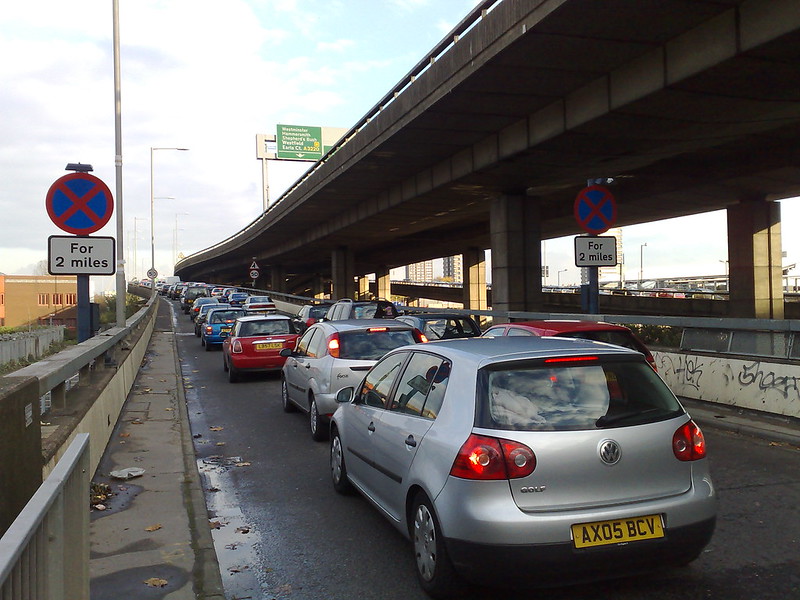

Year-on-year motor traffic congestion levels in London have soared in areas outside the city centre with schools reopening for the new academic year as lockdown restrictions ease.
According to a report in the Guardian, during August levels of traffic outside the central Congestion Charge Zone (CCZ) – which includes the whole of the City of London, plus parts of the City of Westminster, Camden, Islington, Southwark and Lambeth – were already ahead of 2019 levels.
On average, while falling sharply within the CCZ itself, the levels of congestion outside the zone are a fifth higher than they were at the same point last year, with a 153 per cent year-on-year rise recorded on Monday September 7 – the day many of the capital’s schools went back.
The figures come from direction finding app Waze’s programme, Waze for Cities, in which it partners with municipalities throughout the world to harness GPS data provided by users of the app to provide insights on where problems arise on the road network and help inform decision-making going forward.
Using data from around 1 million active monthly users in the capital, which includes their journey times, Waze for Cities is able to calculate daily congestion, which it defines as roads on which traffic moves at 80 per cent or less of the speed achieved when traffic there flows freely.
Within the CCZ itself, levels of congestion have fallen by half year on year – possibly due to an increase in the cost of the congestion charge introduced in June following a suspension of it earlier in lockdown leading motorists to seek routes that avoid it altogether.
Stephen Edwards, director of policy at the walking charity Living Streets, said: “This concerning data should serve as a warning that the opportunity to embed the health and environmental benefits of fewer vehicles is not lost.
“Better streets for walking and cycling are better for us all. We must move ahead with schemes to promote these behaviours.”
News of the increase in traffic in London comes amid continued small but vocal opposition to Low Traffic Neighbourhoods in boroughs around the country, with such schemes aimed at removing rat-running drivers from residential roads and make them less dangerous and more pleasant for the people who live there.
> There are probably more low traffic neighbourhoods on the cards than you think















36 thoughts on “Year-on-year congestion levels in London soar outside city centre as schools go back”
It was inevitable really. We
It was inevitable really. We saw back in April/May data from Asian countries coming out of lockdown that there was a huge modal shift towards cars and away from public transport with little growth in walking and cycling.
Knowing this information the UK had time to plan but squandered it. They waited until 9 May to announce the EATF and then on 10 May told people to get back in their cars and take a long drive to go exercise, thereby normalising driving again. The bike repair scheme was so onerous on both retailer and consumer that it must be questionable if there was any real benefit. The small positives have been some of the LTNs and school streets but we know there’s continual pressure to allow cars to return.
I really don’t think there was or is any real intent to change things even when given evidence that this modal shift was most likely.
I think another part of the
I think another part of the problem is far too many people “just can’t” cycle because of (something).
And the Govt had been spending months saying “Don’t use public transport because you’ll DIE!”.
It isn’t surprising that people just got back in their cars…
Bears really do shit in the
Bears really do shit in the woods!
brooksby wrote:
But what? Surely if someone is capable of driving a car they are capable of riding a bike? (possible exception of some people with disabilities but even then there is probably an alternative to the car).
The disability thing is a
The disability thing is a crap excuse usually made by people without one. Disability is the subset of society that is most likely to use car alternatives and are most hindered by a societal reliance on cars. We shouldn’t use the word disability as a cover for people who are just lazy, and afraid of sun/rain/heat/cold or whatever other pathetic excuse they come up with to justify driving two miles.
Philh68 wrote:
See also: “ambulances won’t be able to get through”.
Christopher TR1 wrote:
I know that. I was alluding to how people seem to constantly come up with excuses as to why they “just can’t cycle”:
I just can’t cycle because I’ll get all sweaty.
I just can’t cycle because the roads are too busy.
I just can’t cycle because of all the hills.
I would cycle but its raining.
I would cycle but its too sunny.
I would cycle but I have to do some shopping.
I would cycle but I don’t own a helmet.
I would cycle but … <fill in some other excuse here>.
brooksby wrote:
And when you provide them with the solution to whatever excuse they give for not cycling, they immediately find another. It doesn’t matter if all their perceived problems are addressed, they are literally addicted to their cars, which was a finding of an RAC report about ten years ago.
eburtthebike wrote:
Hey – isn’t that about the time that the Govt announced a comprehensive road safety review…?
brooksby wrote:
Or the more reasonable reason is that if the road isn’t congested driving two miles is just a lot less of a faff and quicker if you have a drive and there is parking at the other end.
No need to find bag, find suitable shoes, find water/weatherproof clothes, find helmet, unlock bike, get bike out.
The solution is walkable neighbourhoods, in big cities it should be possible to get everything you need within 800m.
Where is this city without
Where is this city without congestion?
These didn’t just normalise
These didn’t just normalise driving again, they made it the safety option.
I think there was initially
I think there was initially intent, but I think circumstances around the economy have shifted the focus though and we never hit that cascade point where the modal shift became self reinforcing, and now the message is we dont really care how you get around anymore,just get around to keep the service sector going.
Plus you are battling things like pre-covid my workplace had quite good cycling facilities,storage lockers, drying rooms, showers, perfect for a newbie cycling commuter to get used to cycling over the winter months, but all that stuff is currently off limits due to their interpretation of covid rules, so even existing regular cyclists are probably thinking well weve probably got to drive now for the time being if we have to be back in the office.
We have lost the drying
We have lost the drying cabinet but the rest is ok to use. No use if you want a shower or if it is raining though as there is no where to hang and dry your wet towels or clothes. I would now have to bring them up into the office with me which would probably spread it more then the 5 people who cycle in.
If only they had really
If only they had really invested in proper cycling facilities and made them permanent, not allowed local authorities to whip them out at the first sign of opposition.
Bloody cyclists !
Bloody cyclists !
Must be a London thing as
Must be a London thing as traffic levels here in the Midlands are still significantly lower than they were 6 months ago. I rode back to Derby this evening from the eastern edge of Nottingham, right through both city centres and traffic levels were more turn of the century than the usual bumper to bumper norm.
Then again we haven’t had the significant infrastructure remodelling that cuts off communities for the sake of the all powerful motor vehicle.
Thank God.
Cargobike wrote:
You reckon? My ommute by bike from Sutton Coldfield to Walsall has been every bit as busy (and as hostile, and as impatient, as far as the motorists are concerned) as it was last year. Things have pretty much gone back t normal now the schools are back.
I haven’t noticed it myself
I haven’t noticed it myself as much but then I’m not commuting still as the office didn’t open due to the uptick in cases in Birmingham.
I was in that der London the weekend for the MiL’s Birthday. I normally do M11 / A12 / Blackwall Tunnel and the traffic on Saturday night and Sunday Evening return seems to indicate all the cars are back on the road down there.
Richard D wrote:
Not everywhere in the Midlands is Birmingham either.
Major cities are far more likely to suffer a greater return to congestion as commuters turn to the car rather than the train as they’ve moved further away from the city centre in search of a better quality of life at a half decent price.
My examples were Derby and Nottingham, two cities far smaller than Birmingham and London. It’s noticeable that Nottingham is busier than Derby, it’s a bigger city, but the need for the grand commute is far smaller than in Birmingham, or London too.
I thnk the reason it’s hit
I thnk the reason it’s hit harder in London is that the public transport infrastructure is normally used ahead of cars for the majority of people; however we’re being told to avoid buses, tubes, trains etc for distancing reasons and to allow those who need to use them to do so. So we have the weird situation of a huge visible rise in people on cycles, on electric scooters and walking in parallel with the creeping rise of motor traffic (despite so many people still working from home). The removal of public transport as an option is displacing workers in both directions.
At my work I have 5 people who had never cycled in London now cycling to work and a couple more walking the sort of distance where they’d always taken a bus before. This sounds like a gain but I also have a couple of colleagues who are now driving to work who previously would have got a combination of tubes/buses. I know it’s just one example but at my workplace the comparatively large increase in cyclists and walkers has not got anyone out of a car yet the increase in drivers is +2 cars on the road.
Why do people do it?! I just
Why do people do it?! I just don’t understand it. Is it because they’ve spent so much money on a car that they are happy to sit in it, even in stationary traffic?
I’ve really no idea why
I’ve really no idea why people are prepared to sit in a jam in their car. Is it because they’re lazy or scared? I’ve lived in London for several decades and have cycled around the city for much of that time. I’ve also owned numerous motorbikes. I simply cannot understand why anyone would want to drive a car across London on a regular basis. And I do own a car now, having bought (the first one when I became a parent.
I’ve commuted on two wheels across London for years (with and without an engine) and have no idea why people value their time so little that they’ll willingly sit in a traffic queue. When I raise this point with people they’ll say they don’t want to get sweaty or are nervous of being on two wheels or that they have stuff to carry. But every time I come to a set of traffic lights on two wheels, I simply pass by most of the drivers sitting in their cars by themselves. And DfT data shows 40% of journeys made by car in the UK are for distances of two miles or less.
You answered your own
You answered your own question. You’ve become a parent and ferry the kids around in a car. Me too. I’ve tried cycling with them but it really is rubbish most of the time. i did look at a cargo bike as an option but wouldn’t have worked due to the the route to school being the south circular (pollution), or through parks with anti-motorbike gates that i can’t even get the tagalong through. Also I’d have to park in in the street becasue i couldn’t carry it down my front steps or get through the door.
Most of them arent willing to
Most of them arent willing to accept what they are doing is part of the problem,they’ll blame cyclists for taking space,or not enough new roads being built, or if only more car parks were free so they could park there etc etc. For some I genuinely think they are so wedded to their cars and effortlessly driving everywhere the thought of making any physical effort probably scares them more than mixing with traffic does
Christopher TR1 wrote:
That’s very large factor. Once you’ve spent all that capital in buying and insuring it and effectively written them off, the cost of each journey is marginal. There have been many proposals to switch the costs to per journey by increasing the cost of fuel (fuel duty escalator) but the government wanted the votes of drivers, so they froze the duty instead; we see the result.
For some there is definitely
For some there is definitely a sunk cost element. But aren’t many cars leased now? Meaning that the cost isn’t marginal, people are sinking hundreds of pounds a month on leasing the thing, then start again with a new one in 2-3 years.
The cost of the lease is
The cost of the lease is basically sunk once you sign it and you only pay per mile once you have got to a level of usage few cars in London will achieve (10,000 a year)
It’s not sunk. It is a
It’s not sunk. It is a committed future cost which may not be realised. It also may give rise to other costs during the life of the lease.
If it wasn’t that we had to
If it wasn’t that we had to breathe the polluted air I just think ‘whatever, get on with it. If you want to spend hours sitting in a car, whatever’.
I know my way around London by bike. I know the quiet ways, the parks, the shared use routes, the cut throughs, canals, superhighways, the filtered roads, the pavements where there are never any pedestrians, the blocked off roads, the segregated lanes and the many alternatives that keep me away from the ridiculous traffic queues.
But we have to breathe the same air. And that’s a problem.
I think we saw during
I think we saw during lockdown that many of those people don’t want to spend hours sitting in a car, and would love to to get out and about on foot or by bike. But they don’t know the quietways, cut-throughs, etc., because they’re obscure and fragmented, so they default to to the car and suffer the congestion.
mdavidford wrote:
But they’d learn all that in no time if they weren’t wasting time sat in traffic
Well, yes – but that isn’t
I’m not convinced about ‘in no time’ – I think those of us who have gained that knowledge underestimate the investment we’ve made to get to that place.
In any case, that isn’t how human psychology works, and wishing it was otherwise doesn’t really get us anywhere.
What we could do is make it easier to find and use those routes and remove the mental hurdle.
mdavidford wrote:
You only have to put a vague post on a local cycling FB group and you’ll get a hundred keen and eager cyclists proposing routing options with all the advantages and disadvantages etc. We all want to help ease the big change!
I’ll never understand how so
I’ll never understand how so many people in London need to drive their kids to school, the catchment area for where mine go is 400m yet it seems like half the children are driven in every day
I suspect a lot of it is that
I suspect a lot of it is that people get the kids into a great school whilst renting expensive places. Then move out of the catchment area to cheaper places but drive the kids to school.
Or in our case live in the catchment of the local sink school – but manage to get into an excellent school nearly 2 miles away. That would be cyclable distance, but isn’t cycle friendly due to being on the south circular.