



Welcome to Wednesday’s live blog, with Jack Sexty, Simon MacMichael and the rest of the team.
20 November 2019, 22:45
Steve Cummings retires
Pod alert.
.@StevoCummings announces his retirement. https://t.co/KP7SrETthJ
— Ned Boulting (@nedboulting) November 19, 2019
According to Ned Boulting, Steve Cummings has announced his retirement at the age of 38. Cummings also wasn’t named on the NTT (formerly Team Dimension Data) roster for the 2020 season.
20 November 2019, 22:45
Nothing to see here...
Is this normal in Dublin? Jesus above. pic.twitter.com/7bbshxQ89L
— Limerick Cycle Design (@LkCycleDesign) November 19, 2019
20 November 2019, 22:45
Strava's new Metro 3.0 update with 84 million commutes is 'the world's largest transportation dataset' - and they also reveal UK's top cycling cities

Not content with being the self-proclaim world’s largest sports participation platform, Strava also have an urban planning wing to their business – and the new, improved version of Metro 3.0 offers data from over 84 million commutes recorded in 2018, which makes it the largest set of transport data in the world according to Strava.
The data on Metro 3.0 allows city planners to analyse when, where and how citizens are commuting by bike and on foot to help with building infrastructure and identifying areas where cycling and walking provisions need to be improved – city planners can sign up to get access to the data which shows popular or avoided routes, peak commute times, crossing times and origin/destination zones.
To coincide with the launch of the updated platform, Strava have also mined the 84 million commutes uploaded in 2018 to give us some stats about the UK’s commuting habits – they revealed that Bristol is the top city for cycle commuting in terms of numbers, with 28.9 people per 1,000 citizens commuting by bike. Bristol is followed by Newcastle (20.8), and Southampton (16.4), while London is in 6th place with 11.9 per 1000, although the capital has the largest total number of cycle commuters. Manchester and Liverpool have the fewest amongst major cities, with 7.7 and 6.6 cycle commuters per 1000 respectively.
The data also revealed that the 35-55 age bracket is the most active commuter group, closely followed by 20-35’s. Strava also said there was “a clear correlation between the amount invested in cycling infrastructure in urban environments and the concentration of cycling commuters within that city’s population”, with cities that have invested more in cycling infrastructure generally having more cycle commuters.
The UK Country Manager for Strava Gareth Mills said: “If we’re serious about tackling climate change, air quality and the obesity epidemic, we need to improve the commuting experience across the UK. The new Strava Metro 3.0 platform enables a wealth of information which local authorities can use to enhance infrastructure and keep us safe and motivated to ride or run to work. Renewing our partnership with TfL is evidence that our community data can be used for the benefit of everyone who strives for cleaner, safer cities.”
You can take a look at the Metro 3.0 platform and apply if the data might be of use to you or your business here.
20 November 2019, 22:45
Walking better than cycling for short distances, says Oxford cycle campaigner
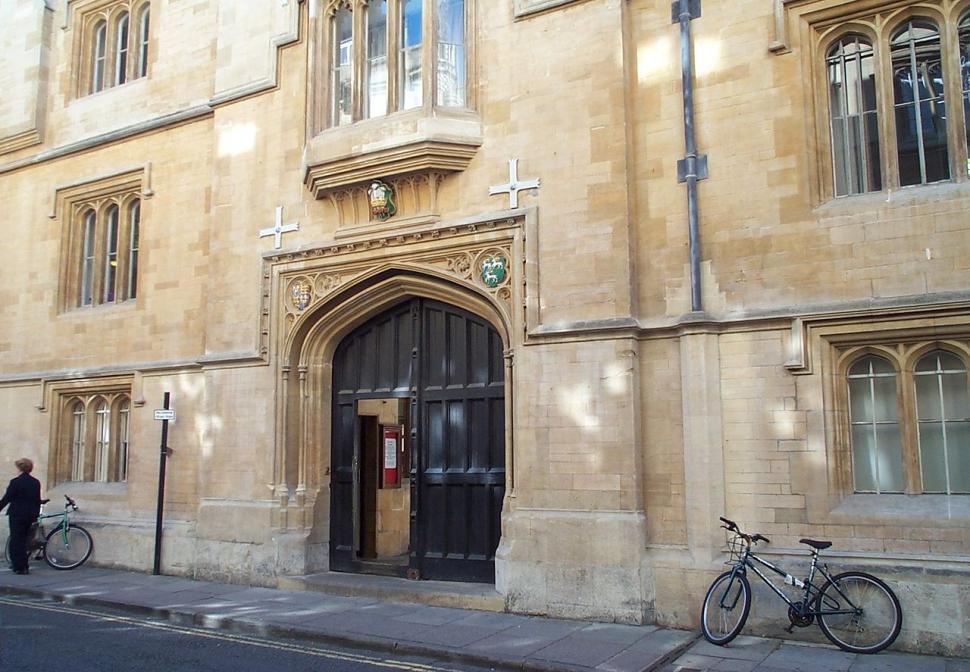
The head of the Oxford cycling lobby group Cyclox has said that she’d encourage walking over cycling for short journeys of a mile or less because of the greater health benefits.
Dr Alison Hill told the Oxford Mail: “If your journey is about a mile walking is actually better for you in health terms than cycling – in terms of energy expended you will be using more walking.
That’s because the bike does so much of the work for you – you need to be travelling at 12mph or more to actually get a bit breathless but you won’t necessarily reach that speed over such a short distance in the city centre.”
She also made comments about dockless bike schemes – of which there are three in Oxford – saying there needs to be greater regulation to stop swathes of bikes being ‘dumped’ around the city, and that more should be strategically placed around park and rides and residential areas to make best use of them.
20 November 2019, 22:45
Merlin Cycles' graphic to show health and financial benefits of cycle commuting
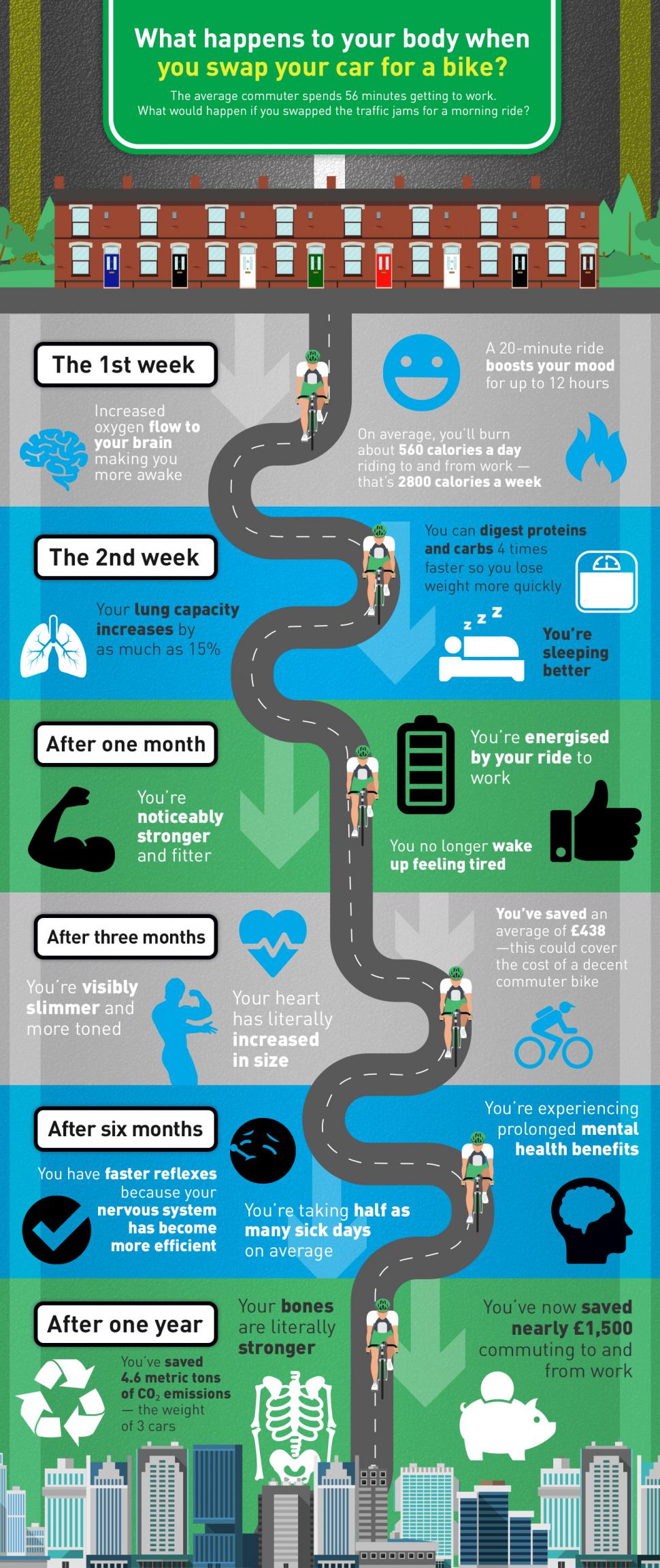
Merlin quote the RAC Foundation’s research that found 16.7 million drive to work every day, with a huge 73.4% taking the car in rural areas. The stats they’ve put together claim that a 20-minute bike ride can boost your mood for up to 12 hours, make the brai more alert and increase lumg capacity by 15% in just the second week of cycling to work.
The moral of the story? Buy a bike from Merlin Cycles! (Just kidding how cynical of us, cheers for the stats Merlin)
20 November 2019, 22:45
Laura Kenny launches free weekly cycling lessons, as alarming stats find only 4% of women feel comfortable cycling on the road
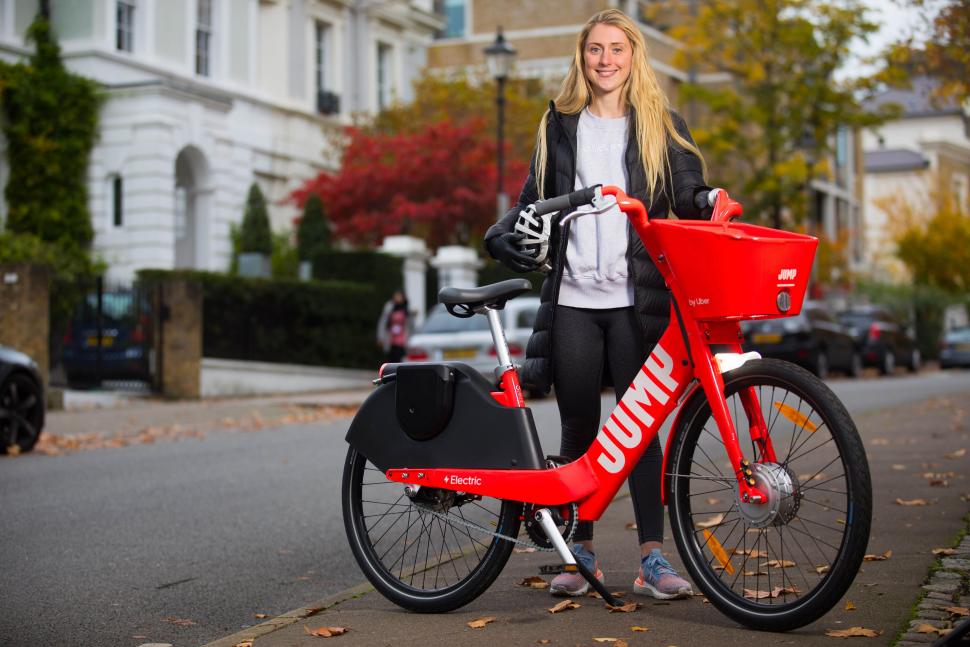
We’ve gone stat mad this morning, and these latest ones make for pretty depressing reading for women’s cycling – although Laura Kenny in partnership with Jump (Uber’s bikeshare scheme) and Cycle Confident is looking to do something about it by launching free cycling lessons in London that will take place every evening next week.
Jump’s research found that just 4% of women said they feel confident riding a bike on the road, while 41% haven’t ridden a bike as an adult at all because they felt unsafe. Some of the stats include gender comparisons, and found that 40% of men would be willing to cycle to the office compared to just 23% of women, while a quarter of men said they would be comfortable ‘cycling anywhere’ compared to 9% of women. It was also found that 18% of female respondents said they couldn’t ride a bike at all.
Laura Kenny said: “I grew up cycling because my mum wanted to get fit and I got hooked on how it made me feel. I think it’s very important to see more women cycling and to ensure that they feel safe and confident on the roads.
“I had a lot of fun contributing to the lessons with Cycle Confident and hope that the lessons will break down any fears or pre-conceptions that exist about road cycling. I understand that it can feel intimidating, but once you feel comfortable on a bike and get to grips with the rules of the road, it gets easier!”
The Jump lessons will run every night from Monday 25th until Friday 29th November starting outside Highbury Leisure Centre from 6pm – those interested can sign up here.
20 November 2019, 22:45
How do Strava gather their data? Here's what they told us...
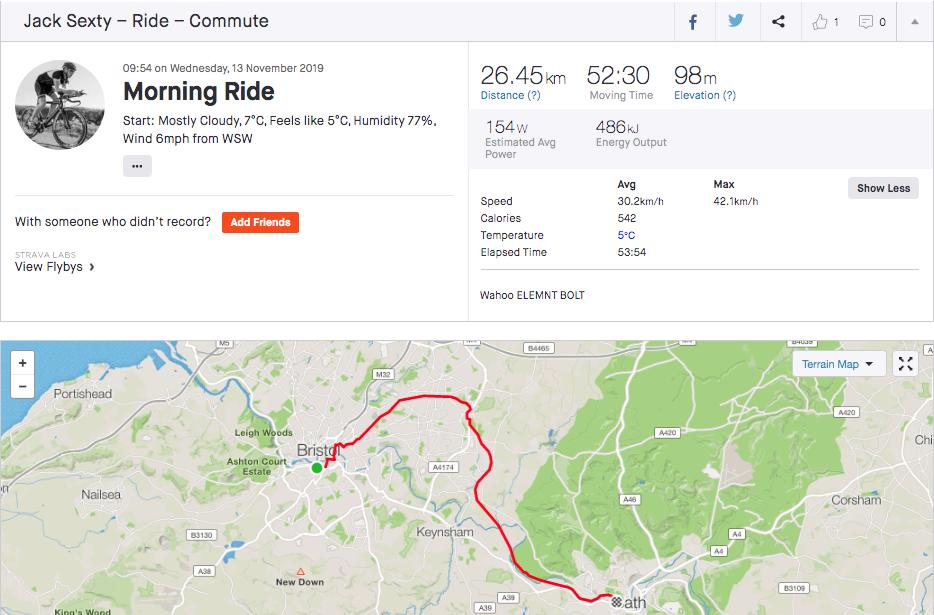
Scroll down to the comments and some of our readers were discussing exactly how Strava come up with their stats and figures on cycle commuting habits (that Bristol has the most cycle commuters per 1000, for example); because of course, not everyone uses Strava. And what if you don’t tag your commute as a commute? Here’s what they told us…
“Strava use Strava data only. Research from the Centers for Disease Control shows that Strava Metro data closely resembles Census data about biking and walking activity by the general public.
“Since not all Strava members use the commute tag — and definitions of a commute vary — we can use a variety of other techniques to identify these trips. For instance, using the straight-line distance between the latitudes & longitudes of where a trip begins and where it ends. When that distance is greater than 1 kilometer, that activity is likely a commute. In order to exclude false positives such as long point-to-point races, we can further filter for long-distance rides that would be indicative of a non-utilitarian trip. Meanwhile, the trips that community members have tagged commutes serve as an essential ground truth to validate and improve different models we use over time.”
There’s some more in-depth info on Strava’s Metro site here.
20 November 2019, 22:45
Dedication...
Just bump train ??? pic.twitter.com/HSx6CIaPFD
— DYNASTY PROGRAM OUT NOW ON SPOTIFY! (@ablsaint) November 19, 2019
20 November 2019, 22:45
Team Retiree?
Thinking about making a team for retired cyclists of 2019. I reckon it would be a bloody good team!!
— Adam Blythe (@AdamBlythe89) November 20, 2019
Wonder if Steve Cummings would still be propping up the rear?
20 November 2019, 22:45
Ineos sign promising Spanish youngster Carlos Rodriguez
“To be a part of Team INEOS is incredible. You can see that young riders are doing so well within this team.”
We’re pleased to announce the signing of exciting young talent Carlos Rodriguez (@_rccarlos)
https://t.co/LrhWyQiOZL pic.twitter.com/5HiM1PmUx6
— Team INEOS (@TeamINEOS) November 20, 2019
The 18-year-old Spaniard has signed his first full pro contract with Ineos, and will also carry on studying for a degree in engineering. He said: “I am under no illusions it is a big step up to the professional level. The training is going to be harder and the races much faster. I think that if I work hard, step by step, I can progress and adapt myself to the World Tour. That’s my main objective for the next few seasons and I’m in the best place to do that.”
20 November 2019, 22:45
Steve Cummings' palmares
Best wishes in retirement @stevocummings
Steve is only the second ever male rider to win the Road Race and TT National Championships in the same year amongst some amazing results
@Olympics
Commonwealth Games
@TourofBritain
Stages of @LeTour #Stevo pic.twitter.com/x3Qon7IyiN— British Cycling (@BritishCycling) November 20, 2019
The popular rider from the Wirral has retired from pro cycling aged 38.
20 November 2019, 22:45
Sandstorm
Getting the sand skills ‘dialed’ good fun with @Tompid pic.twitter.com/utPuIoUUgH
— Cameron Mason (@camerooney_) November 20, 2019
20 November 2019, 22:45
Good point!
…in the last 100.years.
— Aberdeen Cycle Cam (@ABZ_Cyclecam) November 20, 2019
20 November 2019, 22:45
New Arizona housing development will be "first car-free neighbourhood built from scratch in the US"
Excited to announce Culdesac Tempe – the first car-free neighborhood built from scratch in the U.S. #carfree https://t.co/F4xpsvRolC
— Culdesac (@liveculdesac) November 19, 2019
While the US doesn’t have the best reputation for bike-friendliness and active travel, this new neighbourhood being developed in Arizona could be a step in the right direction.
Culdesac say their Culdesac Tempe site will be home to over 1,000 residents, and cars are banned with no parking spaces available. Instead they will offer a range of services including bikes and scooters, ride sharing and an on-site light rail stop to make it easy for residents to get around without needing private cars. More than half of the land area will also be covered in landscaping, public courtyards and greenery, as opposed to mostly concrete pavement in car-centric neighbourhoods.
Culdesac founders Ryan Johnson and Jeff Berens say of their development: “At Culdesac, we see a way out of this cycle and it starts with transportation. How we move determines how we live, and how we move is changing.
“We’re undergoing the first major shift in transportation since the interstate highway system. Private car ownership is giving ground to transportation that is on-demand, shared, and (on average) more environmentally friendly. That 1-mile trip to get ice cream is increasingly happening on shared bikes, electric scooters, or on foot. Lyft Shared and Uber Pool make daily trips more affordable.
“Culdesac is the first post-car real estate developer in the US. We want to demonstrate a new possibility for formerly car-centric cities.”
20 November 2019, 22:45
Commitment...
20 November 2019, 22:45
Brace yourself for the UCI Indoor Cycling World Championships
The @Cristiano of Cycleball ?
The 2019 UCI Indoor Cycling World Championships are coming soon to Basel in Switzerland! #Basel2019 pic.twitter.com/iJQY96a9qx
— UCI (@UCI_cycling) November 20, 2019
The event wil be held in Basel between 6-8 December, featuring delights such as Cycleball and Artistic Cycling…
20 November 2019, 22:45
Happy Transport Planning Day! This cartoon nails it when it comes to new housing...
It's Transport Planning Day! Cycling UK believes that new housing should be designed to help people think walking, cycling and public transport rather than driving This brilliant cartoon from @davewalker shows what this might look like! #TPDay2019
https://t.co/lIu17h6c62 https://t.co/sWbTOAjzeD pic.twitter.com/9dlRFMFSCU
— Cycling UK (@WeAreCyclingUK) November 20, 2019
20 November 2019, 22:45
This looks like a lovely place to ride a bike
Galloway Forest Park sits along the stunning Lochs and Glens South on the #NationalCycleNetwork. The forest is a designated Dark Skies Park & contains over a million trees pic.twitter.com/ERAOwaYWyl
— Sustrans (@sustrans) November 19, 2019
20 November 2019, 22:45
See.Sense AIR anti-theft bike tracker doubles Kickstarter target – in 24 hours
Northern Ireland-based See.Sense is no stranger to Kickstarter – its range of bike lights have been successfully launched through the crowdfunding platform. Now, its latest product, the AIR bike tracker has doubled its fundraising target just a day after its launch.
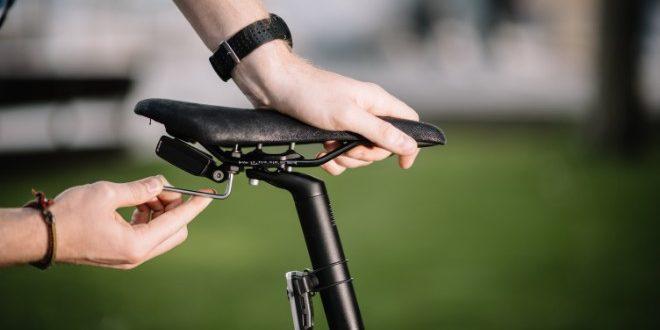
At the time of writing, it has raised pledges of more than £40,000 against a £18,000 goal. According to the company,
AIR is the first dedicated bike tracking device to be built on the new Narrowband Internet of Things (NB-IoT) low power wide area network (LPWAN).
LPWA was the missing link in creating a truly effective bike tracking device; under LPWA, See.Sense AIR can connect wider and deeper across the network for a fraction of the power required under the old technology.
This means a properly effective bike tracker is now viable for the very first time. AIR’s coverage is powered by the Vodafone NB-IoT network, which is launching in Europe in early 2020 and into the USA later in the year; See.Sense Kickstarter backers will be the first to experience AIR across these territories. The device was validated by early access to the Vodafone IoT lab in Newbury, enabling See.Sense to develop against the new NB-IoT standard before the network is fully rolled out.
CEO Philip McAleese said: “We’re totally fed up with bike vandalism and theft; even the best locks and chains can’t stop a bike being damaged or stolen. Our See.Sense lights brought a new solution to an old problem through technology and innovation and we always wanted to do the same in the bicycle security space. Now is the perfect time.
“AIR was developed after listening to what our cycling community wanted. It’s a smart device, reacting automatically to its situation. If the bike is moved or tampered with, AIR will sound an alarm and send an SMS to the rider; we call this ‘Fight Mode’.
“If the bike is stolen, AIR will detect this, switching in to ‘Flight’ setting, rapidly transmitting high-powered tracking signals to allow the owner to quickly and accurately locate their bike to the nearest couple of metres. This tracking information can then be passed to local police increasing the chances of recovery. We believe it’s a game-changer.”










30 thoughts on “See.Sense AIR anti-theft bike tracker doubles Kickstarter target – in 24 hours; Happy Transport Planning Day; US’s first car-free neighbourhood coming to Arizona; Strava unveils Metro 3.0; Steve Cummings retires + more on the live blog”
Am I missing something?
Am I missing something?
Surely all that Strava can accurately say is that – for example – “Bristol is the top city for cycle commuting in terms of
numbersnumbers of Strava users who have uploaded the data“, etc?This is back to making use of / money out of the behavioural surplus type stuff , isn’t it? (why yes, I did just finish reading ‘The Age of Surveillance Capitalism’, thanks for asking).
brooksby wrote:
That’s kind of what I was saying, perhaps I phrased it clumsily – but of course they can only go off of uploads to Strava, which indeed may not be reflective of some age-groups/demographics.
Jack Sexty wrote:
Sorry, Jack – I totally agree.
brooksby wrote:
Well if they’ve done it properly they will have normalised the data taking into account what they know about strava adoption. Of course they may know nothing about that…
visionset wrote:
I’ve actually asked them because I’m interested myself! You’d think they’d take some other info into account, I also never remember to tag my rides as commutes so wondering if they dig deeper and do manual checks.
And on the flaming bike –
And on the flaming bike – maybe they were just sick of not being seen by motorists…?
On the Strava thing, I was
On the Strava thing, I was thinking similar brooksby, perhaps Strava is not as popular in the 20-35 age group.
I doubt if they get many commutes registered by those on cheap bikes either, doesn’t mean there aren’t a lot of people out there.
Cambridge has a lot of cyclists, but by the look of a lot of them, I doubt many were subscribers.
ktache wrote:
Exactly. I suspect they’ve – if anything – under estimated cycling figures. I don’t appear in their numbers, because I don’t use Strava. And I imagine even a real hardcore roadie doesn’t use Strava for their commute / run to work, so how many more people are invisible to their data-gathering?
brooksby wrote:
You imagine wrong. How else would you track the mileage you’d done on the commute bike ?
brooksby wrote:
Well I’m a roadie (Hardcore? That’s debatable!) and use Strava every time I commute, and always make sure I click the ‘Commute’ button as I was aware that they gathered the data. My colleague does even more mileage than me (he IS hardcore – 75km every day, cyclocross at the weekend etc) and does the same.
Kendalred wrote:
OK, fenix and Kendalred, I stand corrected. I didn’t realise you could describe the ‘type’ of ride you were doing in Strava.
brooksby wrote:
I have a response from Strava already that gives a little info on how they gather data, see latest blog post.
ktache wrote:
Do you mean students and working adults riding around towns on sit-up bikes? Because all the young ‘uns in our club are totally into Strava, 10 years and upwards. There are only a few Luddites like me that don’t use it. I’m a roadie (but unlikely to ever be called ‘hardcore’) and have clocked up 100 miles+ a week for a number of years now. The people I see cycle commuting around Shrewsbury don’t generally look like they’d be using Strava.
Nice to see Laura Kenny doing something for women cyclists, and I agree that confidence makes a huge difference, but free lessons – even if rolled out nationwide – won’t make any difference to that dreadful 4% figure. Segregated infrastructure is the only way to do it. And I can see absolutely no way of doing that for less densely populated areas or country roads.
Simon E wrote:
No and you don’t want to either, that’d be massively detrimental
visionset wrote:
After lots of opposition,railtrails have done wonders for several country towns.Many new ones are being built,or are in the pipeline.I can’t see a downside.
Argus Tuft wrote:
I’d say that’s wildly optimistic. AFAIK the only railtrail that could be converted near here, a handful of miles between 2 villages, was blocked by farmers. Even if it was built it wouldn’t help anyone commuting into Shrewsbury. I’m sure many large towns are the same. 🙁
Simon E wrote:
I was responding to Visionset,wondering how separate infrastructure in rural areas could be detrimental. Railtrails are only one example.
Argus Tuft wrote:
Because when you remove cyclists from roads driving gets worse. I would speculate that the major safety factor on roads is the presence of cyclists. Since you will never infra everywhere you need lots of cyclists on roads. In numbers we are safer. Obviously a disused railway line is not a problem. My main (bit of a soapbox really) argument is against those (typically Londeners et al) who can only see infra as the solution and in fact are completely unhelpful & counter productive when it comes to the drive to make the roads we already have (that are completely fit for purpose, bar the odd pothole eh), safer.
visionset wrote:
I follow your reasoning,but fear you’re swimming against the tide.The overwhelming perception is that cycling with traffic is dangerous.What you or I think is irrelevant.Better driving is not going to happen,neither is improved enforcement.If the carnage of the last few decades hasn’t forced a change,what will? Actually it has,and the change is bikeways.
Have you ever been able to ride wherever you choose on a car free, cycle only path?Once you have you never want to go back to sharing the road.
Inner City real estate serviced by bike infra commands higher prices and outlying estates provide it as a development condition.Politicians love to announce the opening of x new ks of bikeway. The motoring lobby loves it.As for not being everywhere,if Wagga can build 45ks of new cycle paths,anywhere can.
Argus Tuft wrote:
Have you ever ridden on quiet country lanes? Who would ever want to give that up? How is cycling infra ever going to replace that? I can do a hundred mile ride where at least 80 miles is like that. Cycling through 100s of years of historical countryside. The only reason that feels safe is because most drivers drive expecting cyclists, you never want that reversing.
visionset wrote:
Not sure I like the idea of being treated as a human traffic-calming measure (doesn’t that fail Kant’s categorical imperative? Treat people as ends, not means?). And, while I simply don’t care as much about what happens in rural areas (by definition there aren’t as many people in such areas to be affected or benefit), it seems to me that separated routes are often possible. If they can build new roads they can build a few new properly-surfaced cycle routes.
FluffyKittenofTindalos][quote
Not sure I like the idea of being treated as a human traffic-calming measure.
And, while I simply don’t care as much about what happens in rural areas (by definition there aren’t as many people in such areas to be affected or benefit), it seems to me that separated routes are often possible. If they can build new roads they can build a few new properly-surfaced cycle routes.— FluffyKittenofTindalos
Like it or not it’s always going to be the case. I’m sure many of us here appreciate the difference between cycling on equally busy roads of similar types but in different areas of the country that have a different cycling uptake. For me Nottm isn’t too bad, but parts of Lincolnshire are terrible. It’s just adjustment. Not only for drivers directly encountering cyclists but for the (admittedly pitiful) enforcement of road laws. Nothing would ever have been done about close passes 20 years ago. But now, at least it’s starting to happen. If cycling volume on roads drops due to infrastructure or any other reason, there’s no need to enforce anymore, that’s a vote winner with the motorist, they can carry on with car is king mentallity. It isn’t just about our cycling concerns, it’s about the whole nice place to live, tavel, work etc thing for everything/one that isn’t a car. Cyclists on the road is vital.
The reason I cycle the way to
The reason I cycle the way to work that I do is because the fastest way is more dangerous because of the lack of infurstructure.
So my route will show an already quieter and safer route
On the subject of forgetting
On the subject of forgetting to mark your commute as a commute, you can use http://commutemarker.com/ to do it automatically for you.
I believe it’s developed by Strava or some of their staff and is pretty good at identifying even if you vary your route quite a lot.
Saves 10 taps a day!
cycling nirvana
cycling nirvana
visionset wrote:
I couldn’t agree more.If the lanes are that quiet they won’t need infra. I’m a forager myself,poking around looking for abandoned and self-sown fruit trees.
Usually I try not to touch
Usually I try not to touch electronic devices on Kickstarter as they tend to go south a lot of the time, but I’m intrigued enough by that bike tracker to give it a punt. My ideal tracker device would be one that you can fit into the frame and charge easily (e.g. through wireless charging from the outside of the frame or integrating with electronic shifting to use the same charge port).
hawkinspeter wrote:
Yes exactly. I like the look of the See Sense device, but feel it’s just too visible and open to vandalism. Not sure how much effort would be needed to wrench if off the saddle, then all you’ll be doing is sending the police to a ditch somewhere about half a mile from where the bike was stolen. Although given resources I suspect by the time plod got round to it the battery would have given up.
Something that made the same noise, but far more difficult to locate would be ideal.
Kendalred wrote:
Difficult to tell without actually knowing what’s everthings made of. Squinting at the funding page i’d guess not much, maybe a couple of seconds, if that mount and/or fixing spur are rigid plastics like they sort of look like. Decent hammer or bolt-cutters would make it a moot point.
See.sense Air….
See.sense Air….
Hello 1982 wants its pager back…