-1024x683.jpg)

The Livall PikaBoost 2 is a friction drive kit. That makes it the latest in a long line of products that look to turn an appealingly simple idea – adding power directly to the surface of your bike tyre – into a practical e-bike conversion kit. It has to be said that many of these kits have come and gone, which hints at some fundamental weaknesses in the concept. Will the PikaBoost buck the trend and prove a long term practical option?
Up to now, Livall has been known for smart helmets with features such as indicator lights and fall detection with wireless technology and smartphone control at the heart of many of its products. The PikaBoost kit is no different in the last respect as the main unit that clamps to the seatpost is linked to your phone via Bluetooth. A small handlebar push button unit is also linked wirelessly, allowing the rider to easily control power levels and also the lights that feature on the rear of the drive unit.
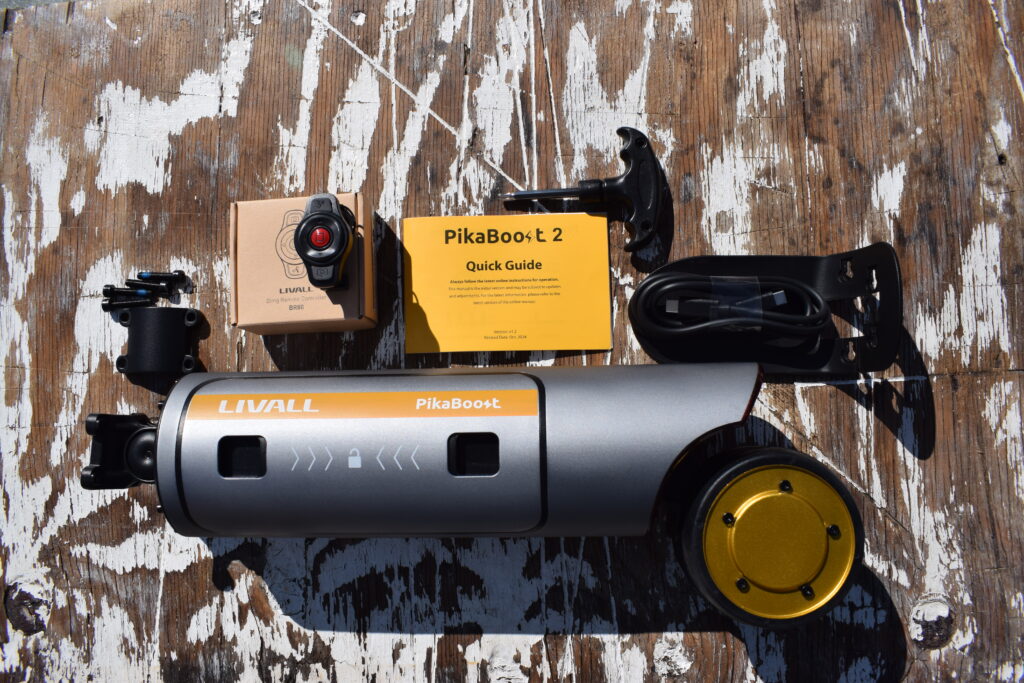
Out of the box, the PikaBoost certainly looks robustly constructed and the initial inspection gave me high hopes. At exactly 3kg, the main unit (including a removable very compact 260Wh battery) is heavier than some of its predecessors, such as the Revos, which we tried and found a little underwhelming.
-1024x683.jpg)
The battery is another impressive bit of design. It’s easily and quickly removable without a key and is impressively small and light for a 260Wh unit. (It weighs 1kg and is therefore pretty easy to carry around in a small backpack.) Moreover, it is charged using a USB-C cable. You need a high power 65W output though – something like this, which is little bigger than a regular plug. (It can be used independently of the drive unit as a standalone powerpack and is doing a nice job of keeping my HP Elitebook laptop topped up with power as I write this article.)
-1024x683.jpg)
The Pikaboost was easy to set up and took around 15 minutes to install, which included bolting the unit onto the seatpost clamp using a special security key and then installing the app that allowed the unit to ‘calibrate’ itself – i.e. exert sufficient pressure on the tyre.
The large roller contains the drive motor, but there is also a second motor within the unit’s silver body whose job it is to press the roller drive onto the tyre with sufficient force. Again, another seemingly high tech but quite well-thought-out bit of design.
-1024x683.jpg)
Finally there is a bar mounted push button, which means you don’t have to rely on the smartphone app display to control the unit.
Riding the PikaBoost
Once underway, the PikaBoost is supposedly self-regulating – i.e. detecting the steepness of a hill and when you are pedalling and applying power accordingly.
-1024x683.jpg)
Sadly, like all other friction drive kits I’ve tried, power was underwhelming. It was certainly there, but the steeper the hill, the less it was noticeable. There are clearly limits on how much power can be delivered via a rubber to rubber contact – especially one that by its very nature increases rolling resistance to the rear tyre.
More worryingly, up steeper hills the rubber began to spin and lost any drive power. Once it ended up spinning madly on its own with smoke coming from the tyre. This didn’t last too long and didn’t happen again after the system was recalibrated, but it does show the limits and fallibility of supposedly ‘smart’ technology.
-1024x683.jpg)
Interestingly, I started off with knobbly tyres as, despite my doubts, Livall assured me they were suitable. I later changed to slick type tyres but couldn’t detect any improvement in performance.
-1024x683.jpg)
Whilst Livall claims that the system detects when you stop pedalling and will cut power, I couldn’t see how this would be physically possible and it certainly didn’t feel the case. It appeared to simply operate on the basis of a speed sensor on the drive unit. Once above about 3mph on the flat, the motor gently kicked in and powered me along without any pedalling needed – albeit at a sedate price and running out of power on even slight inclines. Whilst technically illegal, I’m not this would alarm law enforcement too much.
In summary, I think there are much better kits out there. The most attractive thing about the PikaBoost is the low price. At current exchange rates, it is retailing in the UK at a very precise £311.22.
However, for not a massive amount more cash, I’d suggest taking a look at the Swytch Go (currently available from around £400). For even more choice check out our article on the best e-bike conversion kits.