


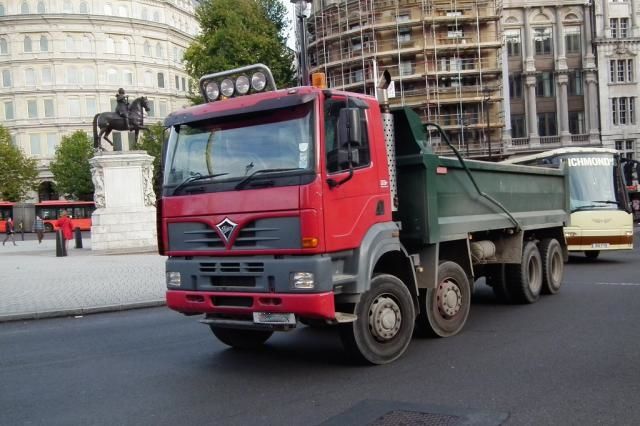

A petition calling on the Mayor of London to ban lorries from the capital's streets during rush hour has received 2,500 signatures in the first 10 hours.
The London Cycling Campaign's (LCC) petition, which has received hundreds of impassioned comments from concerned cyclists, was launched one month after 26-year-old newlywed, Ying Tao, was crushed to death by a lorry while cycling at Bank junction in the City of London. Tao was the eighth cyclist to die on London's roads this year, seven of whom were killed in collisions with lorries.
From 1 September a ban of all lorries of more than 3.5 tonnes without side guards and mirrors comes into force in the capital but the LCC's Chief Executive, Ashok Sinha, says this is not enough and lorries should be banned from London's streets between 8-9.30am.
– Freight Transport Association agrees – government needs to incentivise safer lorry design
He said: “It is unacceptable that seven cyclists have lost their lives after being involved in collisions with lorries on London’s roads in the first half of 2015. 40% of cycling fatalities involving lorries occur in the morning rush hour. Almost all of these fatalities involve the construction and waste industry lorries that flood onto our roads at the same time thousands of people are cycling to work.
"The Safer Lorry scheme will do nothing to prevent this from happening, nor will it protect cyclists from lorries with restricted vision or unlicensed, untrained lorry drivers on London’s roads. Unless more is done, more people will lose their lives. We’re calling on the Mayor to end lorry danger now.”
Last week the Freight Transport Association's (FTA) Head of Urban Logistics, Christopher Snelling, said he believes a rush hour lorry ban is not the answer, arguing it will increase lorry numbers later, when there are more pedestrians on the roads, while increasing the use of smaller vehicles.
Snelling said: “Even a medium-sized lorry would have to be replaced with 10 vans – which means overall safety would not be improved, let alone the emissions and congestion consequences. It has to be remembered that we don’t choose to deliver at peak times on a whim – our customers need goods at the start of the working day.”
HGV deliveries must avoid rush hour for safety
The LCC's Rosie Downes said although the charity is supportive of the FTA's work to move delivery times outside of rush hour, an outright ban is the only way to prevent less scrupulous firms from operating in rush hour regardless of the risks. She said individual councils can play their role by moving delivery times outside of rush hour, too.
She said: "We believe regulation is needed to ensure that London’s most dangerous lorries – often the ones who are less proactive about reducing danger to vulnerable road users – aren’t on our roads at the busiest times.
"In addition to a rush hour lorry ban, it must be down to local authorities, construction clients and fleet operators to ensure they're reducing risk to vulnerable road users through measures like retiming deliveries to avoid London’s roads when they’re busy – not just between 8am and 9.30am – and improving vehicle safety," she said.
The lorry blind spot to the left of the driver's cab is implicated in 80% of cycling fatalities involving HGVs and the LCC is calling on the Mayor to ensure only direct vision lorries without that blind spot are used on projects that receive funding from the Mayor's offices.
A spokesman for the Mayor told the Evening Standard: "There are many difficulties and practicalities with imposing a rush hour ban in a major city like London. What we don’t want to see is heavy goods vehicle activity simply dispersed to other times of the day – HGVs flooding into town once the rush hour is over won’t deliver benefits for cyclists or pedestrians.
“In September, we will be banning lorries and construction vehicles without certain safety equipment from entering London at all – at any time of the day or week.”
Mayoral candidates: stop HGVs helping build Russian oligarchs' yuppie flats
Speaking to LondonLovesBusiness, Labour mayoral hopeful Christian Wolmar said: “I would support a ban for lorries between 8 and 9.30 in the morning. There are all these construction trucks building yuppie flats for Russian oligarchs.
“I think you could ban most lorries at these times. I’d particularly like to see more control over the construction industry lorries. It’s the construction lorries that have been causing all the danger.”
Conservative Mayoral hopeful, Zac Goldsmith, said he supports the lorry ban as well as the upcoming safer lorry standards in the capital. Goldsmith believes more freight needs to be shipped by river.





















44 thoughts on “Petition to ban lorries from London’s streets during rush hour receives 2,500 signatures in first 10 hours”
I would ask why the HSE are
I would ask why the HSE are not involved as the design of these Lorries are simply dangerous and killers.
Of course this video helps all cyclists to show how much these killers are.
Quote:Snelling said: “Even a
This is excellent news. If they can afford to replace one lorry and one driver with 10 vans and 10 drivers, they can sure-as-fuck afford to equip their lorries with additional mirrors, a co-driver for spotting, sensors and side/rear-mounted cameras.
But of course this won’t happen because they’ll bleat that they can’t afford it. Double-standard pricks are full of shit.
danthomascyclist
Clearly he was talking from a volume and weight perspective. Cost would need to be picked up by the client. Cant imagine most people would tick the option ‘charge me 10x cost to deliver using smaller vehicle’ next time they get a washing machine or large building load delivered.
I wonder how many cyclists would vote with their feet if say Tesco adopted use of safer small vehicles as policy (hundreds of small vans rather than a few articulated lorries), given the hatred of Tesco by many.
STATO wrote:
I wonder how
Not sure what your point is.
I hate Tesco because they are a pretty crap supermarket – more a chain of very overpriced ‘convenience stores’ with astonishingly slow service. (Usual experience, go in, get some things off the shelf, notice there’s an enormous queue and only one person serving…put things back on shelf and go find a Sainsbury’s or Costcutter or Asda instead, where it will likely be cheaper and I might actually get served before dying of old age).
I don’t know about the details of deliveries, or why we now have all these large lorries on the roads. I wouldn’t blame it all on the freight industry itself, it clearly is a complex problem, but that doesn’t mean everyone should just give up and accept the deaths.
One thing, amongst many, that I don’t get is why there seem to be so many large lorries trying to negotiate narrow roads and tight junctions that they can’t get through without driving over the pavement. Surely they should be confined to specific routes? More could be done to keep cyclists and lorries apart.
FluffyKittenofTindalos
Not sure what your point is.
I hate Tesco because they are a pretty crap supermarket – more a chain of very overpriced ‘convenience stores’ with astonishingly slow service. (Usual experience, go in, get some things off the shelf, notice there’s an enormous queue and only one person serving…put things back on shelf and go find a Sainsbury’s or Costcutter or Asda instead, where it will likely be cheaper and I might actually get served before dying of old age).
I don’t know about the details of deliveries, or why we now have all these large lorries on the roads. I wouldn’t blame it all on the freight industry itself, it clearly is a complex problem, but that doesn’t mean everyone should just give up and accept the deaths.— STATO
My point was, we (the public) want low costs, so shops work out ways to make themselves cheaper by economies of scale, i.e. bigger lorries. Would shops be more inclined to move to or request from suppliers safer lorries if they could expect ‘public support’ in extra footfall. At the moment they are more likely to lose custom by improving safety (increasing cost) and are only doing so as mandated by law.
Im saying there is an opportunity to move to safer lorries sooner by getting shops/brands to see it as a marketing benefit. Lets face it, getting Waitrose or Sainsburys to buy 5 or 10 safer lorries for use in city centres would barely register in their profits and could give a major publicity boost.
Its not just London, though,
Its not just London, though, is it? We are constantly being told (disclaimer: not constantly) about how British cities are small and old and their roads are too narrow for cycle lanes, so how come we allow articulated lorries towing 40 foot trailers to come through _any_ of them?
Distribution centre at the edge of the city, then smaller (electric, or other low emission) to actually move stuff into the city centre.
Maybe a special dispensation for construction vehicles, for a specific site and for a limited time and only if they have all the blind spot cancelling gubbins that’s being talked about elsewhere.
Seriously, if their blind spots are so all-pervasive that the driver cannot see what is around their cab, then they should be kept as far away from pedestrians and vulnerable road users as possible.
brooksby wrote:
Distribution
It is exactly how the big delivery operators like TNT, UPS, DHL now operate and have done for a while. For example in Birmingham TNT closed a city centre office and moved to a large centre on the middle ring road.
brooksby wrote:Its not just
Thats why we cant have lanes, because space is needed for Buses (which are the same size as the lorries).
Its a nice idea but there are a lot of problems with this, how do you define when its needed? your essentially condemning some towns/cities to be at risk and only protecting some.
When i worked in Aberdeen for a few weeks i walked down the main street in the early morning, there were 2 small Sainsburys which got delivered too by 1 wagon each (that i saw), it must have delivered 30-40 trolleys to each store. That would probably require upto 10 transit van trips per store, so maybe 15-20 vehicles driving for just one morning delivery. Now multiply that for the fact there are 2 other supermarket chains on that street, plus a load of other shops, and the other deliveries that happen throughout the day… an easy way to kill the high-street through traffic alone (never mind the added cost thats got to be made back) and drive out-of-town shopping, reducing one of the key drives that could get people cycling.
I agree they need to be kept away from people, but they are an important part of how our society works, and a smart solution needs to be found.
Timings and routing should be set by authorities in my eyes, find the most appropriate routes into/through a town/city from a major trunk road and define that as the route for ALL goods traffic. Where diversion off this are required (shop in other area) it must be processed and a route defined. Fines for regular deliveries that are off approved routes. For one-off deliveries vehicle sizes can be restricted or require additional co-drivers.
Given the prevalence for GPS these days it would be very easy to set-up and run, and could allow road design to be improved on higher risk routes (so cycle lanes required if road to be used by 10t or above vehicles, otherwise the lorries have to go another way).
brooksby wrote: SNIP… how
Great points. I imagine it all comes down to the cheapness of 1 40ft artic driver.
So, the same lorries will be
So, the same lorries will be rushing even more to complete their deliveries by 07:59 to beat the ban, and others at 09:31 because they didn’t make it before 08:00 – great!
Could work though, if ‘safest’ lorries were exempt from the ban.
We still need to be careful
We still need to be careful and anticipate the worst what can happen. We have seen how banned drivers kill cyclist on lorries so a ban won’t stop some companies. Not to mention that some of those lorries wouldn’t pass MOT…
Doesn’t Paris already have
Doesn’t Paris already have this policy in place? Has it collapsed into chaos and the apocalypse of more expensive deliveries?
I can’t help thinking that
I can’t help thinking that this is a sticking plaster approach. There needs to be infrastructure changes to make cities and towns safer. As @I Love My Bike says, it just shifts the problem, not solves it.
harragan wrote:I can’t help
The problem is we have too many road users in a variety of transport modes all trying to use the same limited, shared infrastructure. We don’t have the physical space or the money to solve all these issues so shifting them is the best we can do.
When it comes to the roads, there always needs to be a compromise between everyone and calling for a full ban on all HGVs is no more constructive than the other side calling for a total ban on cyclists.
use the river a bit more?
use the river a bit more? barges can carry even more than lorries, much easier to design them to be lower polluting, electric vans pick up at points close to the city centre. You wouldn’t need to massively increase the traffic on the river, because one boat can carry a lot of containers.
Instead of restricting
Instead of restricting movements of HGVs at peak times … given that the issue is more one of visibility from the drivers perspective, why not just require that all HGVs that are driving at peak times in city centres to have a passenger (co-driver). This co-driver would have their own set of mirrors fitted on the left of the vehicle, thus allowing them to easily check the left-hand-side blind spots that the driver can’t see from their side. With regards other solutions being proposed this is probably one of the cheaper solutions.
dee4life2005 wrote:Instead of
Because he’d just be sitting there smoking, picking his nose or playing on his smartphone and generally distracting the driver….
This is London, all day is
This is London, all day is rush hour now, seriously, I’m not exaggerating.
I’d love to see a comparison between 1980 traffic flow levels at 5pm and 2015 traffic flow level at 9pm, I’d bet 2015 is more busy.
Anyone have access to that data?
kie7077 wrote:This is London,
I can’t say about 1980 but I can say congestion levels were higher when the congestion charge was introduced. Congestion and traffic volumes were also higher from the late 80s until the congestion charge was introduced.
40% of cycling fatalities
And 60% don’t, that’s not really much of an increase during rush hour.
Policing HGVs heavily and mandating mirrors that eliminate blind spots should be the priority.
This really says it all, that blind-spot needs to be eliminated.
The LCC is totally missing
The LCC is totally missing the point. Sorry, but it has to be said. The problem is not one of all HGVs, it involves specific categories of HGVs, namely tipper trucks and skip delivery lorries.
A rush hour ban on HGVs will target those many trucks that are not causing a problem. And this will drive up construction costs and making building (and homes) even more expensive, at a time when London is expanding fast.
There are ways to improve safety for construction HGVs such as tippers, skip trucks and concrete mixer trucks. The LCC would be far better to target those safety measures than calling for an outright ban.
The Evening Standard has an excellent article on truck safety. If the people at the LCC would only read this, they’d perhaps appreciate the problem and how best to address it:
http://www.standard.co.uk/lifestyle/london-life/why-are-hgv-lorries-so-dangerous-and-how-can-the-industry-make-londons-streets-safer-for-cyclists-10409783.html
As for traffic figures, London’s congestion levels and traffic volumes are lower than in the noughties at the turn of the millennium.
From the Standard
From the Standard article:
“Because the guys are paid by load rather than per hour, they drive like maniacs.”
That needs to be banned, for all delivery drivers, it is a direct encouragement to break the law.
Re traffic levels, I expect traffic has increased hugely outside of the City of London whilst it had already hit saturation within the City. If we get autonomous cars the saturation limit will increase and we will have far worse congestion.
Just take a look a how bad it is at all times of day:
Traffic Map
kie7077 wrote:From the
The sentence in the article following that one was particularly frightening:
“You can tell that with tippers in particular as their mirrors are protected by steel [guards]— that’s because they’re driving aggressively and trying to get through spaces they shouldn’t.”
thesaladdays wrote:kie7077
Yes, this is the problem, tipper trucks being driven aggressively.
Banning all HGVs as the LCC is suggesting is missing the point. It’s like finding evidence that BMW car drivers are all psychopaths and then banning all car drivers as a result.
OldRidgeback wrote:And this
I’m not at all sure about this whole topic, but…since when is all this construction about building affordable homes for ordinary people? As far as I can see its all office developments and luxury housing to be bought as investments by foreigners.
We have all this construction going on, but housing isn’t getting any cheaper as a consequence.
The major issue is that
The major issue is that health and safety legislation doesn’t apply on the roads so that companies don’t have to apply the care they take with their staff and contractors at their work sites to the population at large. This results in the ridiculous situation where a lorry is legal on the roads but once it arrives on a building site it is “illegal” because it doesn’t have a mirror (for example) that eliminates a blind spot.
If HSE legislation applied to operations on the road then organisations would have to apply the HSE hierarchy (any HSE professionals out there feel free to correct me) Eliminate (stop doing the dangerous operation) Segregate (Barriers ) Training (It’s a dumb idea, please don’t do it) Personal Protection (please wear a helmet). You start at the top “eliminate” and work your way down with Personal Protection judged to be the minimum and least satisfactory level.
If companies had to show that they’d completed this kind of analysis then you’d find a lot less trucks on the road, using appropriate roads with better trained and equipped drivers as HSE prosecutions can go all the way to the top.
As for bleating about cost I wouldn’t worry too much about that, most industries when forced to can sort that out pretty effectively themselves with enough pressure.
gmac101 wrote:The major issue
You’ve thought this through more than I have.
How many here would support a petition to transfer investigation of collisions involving commercial vehicles from the police to the HSE?
Another good
Another good reason:-
I know this ain’t gonna be
I know this ain’t gonna be popular, but, ban cycling during rush hour. It pains me to say that, but some of the idiotic riding I’ve witnessed during rush hour, is worthy of it.
Judge dreadful wrote:I know
I appreciate that you are trolling, but…
If were going to ban entire modes of transport based just on “some of the idiotic riding I’ve witnessed” then I think the roads are going to be completely empty very quickly.
Nobody’s saying ban HGVs during rush hour because of the quality of their driving; they’re saying it because HGVs are huge juggernauts with blind spots the size of Pluto which in any rational world would not be allowed onto the narrow streets alongside pedestrians and cyclists.
Judge dreadful wrote:I know
Yeah, because it would be far better if all those bad rush-hour cyclists were driving cars instead. As, obviously, they’d all be fantastic drivers and there’s just too much space on rush-hour roads at the moment.
Think about it for a minute,
Think about it for a minute, you’re banning cyclists only at rush hour. If businesses allowed their cycling employee’s flexibility in their start / finish times, based on this, you incentivise more people to ride, and you reduce the lorry vs. cyclist issue.
There aren’t safe and unsafe
There aren’t safe and unsafe vehicles, these are just machines. there are brainless and balless drivers hidden behind a steering wheel, and there is an equal amount of them behind a handle bar…
To talk about DEATH count of more than 5 a year in a civilized world as the UK, shows no civilized world at all, in the contrary it shows the dark ages of the uk where human life was insignificant are back. what I suggest? very high penalties in confirmed deliberate actions (25 to life) even if there is no death and high penalties in deliberate negligence (yes there is deliberate negligence). but don’t be fooled, never will a day come where cycling will be completely away from cars, because everything in this world is fit and constructed for cars, planes, boats and generally everything that runs on PETROL. if bicycles were run on petrol, there will be highways built for them and not for cars…
Distribution companies do not
Distribution companies do not want their vehicles stuck in traffic. Most would want to operate efficiently in light traffic conditions. The problem is they are banned at night from many London boroughs because of noise nuisance legislation. Paris bans HGV’s in the rush hour to save lives and London bans HGV’s at night to reduce noise pollution. Two cities with very different priorities.
In our view there are a
In our view there are a number of specific measures which should be implemented, mainly:
1. Redesign of HGVs re- “blind spots” (by retro-fitting transparent doors and infra-red sensors on existing vehicles and having new low cab direct vision vehicles and reducing the space between the vehicle body and tarmac (by retro-fitting side ad front guards and again newly designed HGVs with bodies closer to the ground/tarmac).
2. Enforcement: for rogue operators, “normal” rule and law breaking by HGV rivers like close overtaking and having a proper health and safety regime governing freight on the roads.
3. A morning rush hour ban could be a useful adjunct, but is of relatively little importance – perhaps HGVs with right design features and adherence to safety regime could be exempted.
4. Training of drivers – a minor but significant potential contribution. And training of cyclists – although even well-trained cyclists make mistake and don’t deserve to die for them.
5. And of course, engineering the highway to reduce the potential for collision in the first place – although this isn’t going to cover all junctions and will take loads of time to implement.
All this is explained in our summary here : http://rdrf.org.uk/2015/07/21/what-transport-for-london-needs-to-do-for-lorry-safety/
By the way, a pedestrian was killed under the wheels of an HGV just near me today – it isn’t just cyclists at risk.
Another crucial point: if the
Another crucial point: if the safety regime is to be changed, there are concerns about how Transport for London’s Fleet Operators Recognition Scheme has been not pushing as hard as it should have been on HGV safety : http://rdrf.org.uk/2015/07/20/what-transport-for-london-is-still-getting-wrong-on-fleet-and-lorry-safety/
Me again: OldRidgeback’s
Me again: OldRidgeback’s point about LCC missing the point is, er, missing the point.
If you go to the three point list of LCC objectives, the morning rush hour ban is only one of them. LCC has done a lot of work on alternative lorry design, and is well versed in the particular issues around the problems of construction vehicles.
I have been working through Road Danger Reduction Forum with the LCC on this for ages and it’s largely due to them, RoadPeace and See me Save Me that we have managed to get TfL to do anything on this issue.
ChairRDRF wrote:Me again:
Not it’s not. Look at the statistics. The majority of crashes involve construction trucks, tippers and skippers particularly. The incidents do not involve supermarket trucks for instance. There is a specific problem involving construction trucks and how these are operated. There are ways to improve the safety of those trucks without banning all HGVs. The article does cover the ways the safety of construction trucks could be improved and in some detail.
There are examples of best practice from within the industry. And there is a lot of proven safety technology available to make construction trucks safer. Some companies are using this technology but not all, and those that don’t are undercutting those that do. The technology needs to be made compulsory and the firms not using best practice need to be kept out of London. That’s the smart way to boost safety.
I get a lot of crash statistics across my desk at work. I also know a fair bit about the construction industry and how it operates and what needs to be addressed with regard to the operation of truck fleets.
OldRidgeback: I have been
OldRidgeback: I have been looking at HV /cyclist statistics since the early 90s. Take Rosamund Irwin’s article today http://www.standard.co.uk/lifestyle/london-life/why-are-hgv-lorries-so-dangerous-and-how-can-the-industry-make-londons-streets-safer-for-cyclists-10409783.html which shows that about half the HGVs involved with cycling fatalities from January 2008 until today were in the construction industry.
As I pointed out above, differently designed industry vehicles, or retro-fits on existing ones, are one of the key aims of both us in the RDRF and LCC. LCC have been working with CLoCS to produce new designs over the last 2 years and point this out in their press release today. they, like RDRF, are also into enforcement, training, highway design as key elements – the ban in the morning rush hour is just one element which the press and politicians have zeroed in on.
So I have already made the points you are making.
Re-the a.m. rush hour ban: I have argued that it could be useful if adequately safe vehicles and drivers were exempted – it would give a kick start to the necessary compulsion. BTW, non-construction HGVs often avoid the rush hour so they wouldn’t be affected anyway.
As Jim Morrison sang,
“Riders
As Jim Morrison sang,
“Riders on the storm.
There’s a killer on the road.
His brain is squirming’ like a toad.
Take a long holiday ………”
In an ideal world the idea of
In an ideal world the idea of banning HGVs at rush hour and separating cyclists away from other vehicles every where is great but in reality it’ll never happen.
I’ve been disliked for saying this but I’ll always say it, cyclists need to be more careful and less blasé when it comes to cycling.
embattle wrote:In an ideal
Some cyclists you mean, I don’t cycle down the LHS of HGVs unless I’m sure I can get past before it can move.
And it’s nothing to do with ‘Blazé’ it’s a lack of public awareness – education is the key.
kie7077 wrote:embattle
Some cyclists you mean, I don’t cycle down the LHS of HGVs unless I’m sure I can get past before it can move.
And it’s nothing to do with ‘Blazé’ it’s a lack of public awareness – education is the key.— embattle
Agreed. Cyclists need to know that they’re not only _allowed_ to occupy the center of a lane, but that if they want to reduce the danger to themselves then they’d better do it. There’s a very mixed(*) set of reports in the Irish Independent on cycling in the city one of which includes this video, which at 11 seconds in shows a woman who might benefit from the encouragement and normalisation of riding assertively http://www.independent.ie/life/city-cycling/citycycling-near-misses-the-reality-of-cycling-along-dublins-streets-31396197.html
* It’s a whole series which completely plays up the danger angle of cycling. Reading it, if I were not already a happy cyclist, I would be scared off cycling for ever. The series is prompted by the introduction of a bunch of fixed penalty notices for cyclists in Ireland.
It doesn’t look very
It doesn’t look very constructive, more cyclist-bashing than cyclist educating.