


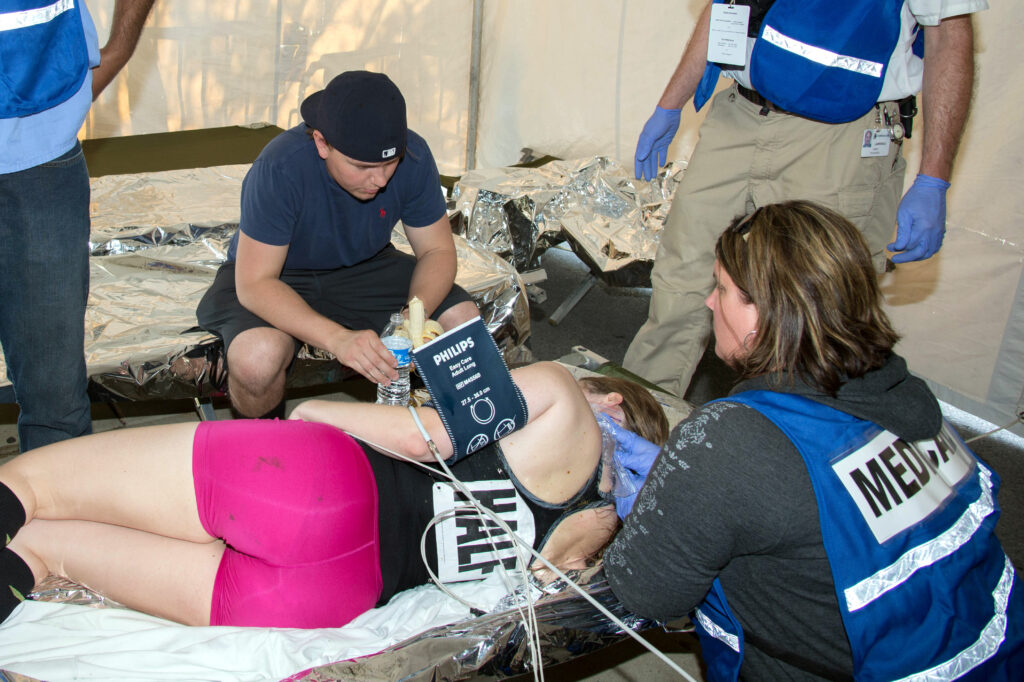

When a participant in a major event like a sportive or marathon suffers a heart attack, it makes headlines. But there's no need for MAMILs and MAWILs to panic: a new study shows middle-aged athletes are at low risk for having a sudden cardiac arrest while playing sports, and those who do have a greater chance of surviving.
"Because there is so much media attention when someone has a sudden cardiac arrest while playing sports, we want to make sure people know that the benefits of exercise far outweigh the risk of having a cardiac arrest," says Sumeet S. Chugh, MD, an expert in heart rhythm abnormalities.
"Even for middle-aged men, who are more susceptible to heart rhythm disturbances, the risk is quite low."
Dr Chugh is associate director of the Cedars-Sinai Heart Institute, Los Angeles California and one of the authors of the paper Sudden Cardiac Arrest During Sports Activity in Middle Age, published in the journal Circulation.
In the study, investigators studied the 1,247 people aged 35-65 from the Portland, Oregon, metropolitan area who had a sudden cardiac arrest between 2002 and 2013. Results include: Just 5 percent, or 63 people, had a sudden cardiac arrest during sports activities.
The study also found that the survival rate of 23 percent was markedly higher for those who had a sudden cardiac arrest while exercising compared to just 13 percent for those who had a sudden cardiac arrest during other activities.
That higher survival rate is likely to be down to the sporting environment though. Cardiopulmonary resuscitation (CPR) was applied to 87% of those who had a sudden cardiac arrest while engaged in sports, but only 53% of those who had a cardiac arrest during other activities.
Although "sudden cardiac arrest" and "heart attack" often are used interchangeably, the terms are not synonymous. Unlike heart attacks (myocardial infarctions), which are typically caused by clogged coronary arteries reducing blood flow to the heart muscle, sudden cardiac arrest is the result of defective electrical activity of the heart. Patients may have little or no warning, and the disorder usually causes instantaneous death.
"The chance of surviving sudden cardiac arrest is better if the episode occurs while exercising, probably because there are likely to be others around who can do chest compressions until paramedics arrive," said Chugh.
"What this study shows is that most middle-aged athletes don’t need to worry about sudden cardiac arrest while they are working out," Chugh said. "As our population ages, it’s important to know that older people can exercise without worrying about triggering a heart rhythm disturbance."
And if you don't know how to perform CPR, you might want to learn how.










7 thoughts on “MAMILs shouldn’t worry about cardiac arrest while riding, says new study”
Wasn’t really worried about
Wasn’t really worried about this before, so “thanks?”
As far a CPR, Vinnie sys it best…
http://youtu.be/ILxjxfB4zNk.
I guess sitting around on my
I guess sitting around on my arse, eating, smoking and drinking is fine then. These people who do this ‘research’ do state the bloody obvious eh ?
wonder if they work for the Daily Express headline writers – yesterday’s treat was ‘Exercise makes you less likely to die young’ or similar, gee whizz
After x 4 Ironman triathlon,
After x 4 Ironman triathlon, 8 marathons, 20 years of all manner of cycling and racing, and of course sportives, I beg to differ after suffering a myocardial infarction in December 2010 suffering 12% heart damage and getting a few more new parts fitted (I asked for titanium of course!). Since then I have had to reassess my sporting life and ambitions, but do try to enjoy every day and ride to the maximum. But its bloody hard when people say “at least you are still doing it” – I’m not, I’m going through the motions at a much lower level.
Remember everyone, get your cholesterol checked regularly, and a medical with your doctor annually. Just because you are perceived to be “fit” its not necessarily true on your insides.
Gary613 wrote:After x 4
Sour grapes… At least it’s not your wife/significant other posting saying “Gary613 died in 2010”. Hell we all perform worse as we get older cardiac arrest or not. I’d have gone for carbon fibre 😉
Gary613 wrote:After x 4
After racing at international level and for 37 years at all cycling disciplines (except sportives of course) I died (several times) from cardiac arrests and now have a defibrillator permanently fitted in my chest and hard wired directly into my heart.
Like you Gary, I had to reassess my cycling abilities and didn’t enjoy riding the bike much for a while but now, 4 years on, I enjoy every ride I do. The adjustment was hard, I no longer blast up short hills (I have to sit in the saddle and use a lower gear), if I see someone in the distance I don’t chase them down and if someone passes me I accept it and give them a cheerful word or two.
Ask yourself why you rode a bike in the first place, was it for pleasure or to compete? If it was for pleasure then still being able to ride it should still be a pleasure. If it was just to compete then accept that those days are over and take up some other activity where you can be competitive without stressing your heart (fishing or snooker maybe?).
Go through the motions a bit longer and remember that the people wishing you well have no idea of the mental adjustment needed to function after such an experience, I am sure that the pleasure or riding a bike will return and I wish you well with your recovery and hope the sheer joy of riding a bike at any level soon comes back to you.
If the study participants all
If the study participants all exercise for more than 72 minutes a day (72 mins = 5% of their time) then having “just 5%” of heart incidents happen during exercise is indeed reassuring. 😕
My guess is that people average about 3.5 minutes of exercise a day and so exercise increases the risk “just 20 fold”. <:P
Bugger it, when it’s my time
Bugger it, when it’s my time to I hope I just don’t wake up after a mega ride through the Lake District countryside in early spring. I’ll go happy and content with life then, but hopefully not just yet. 😀