


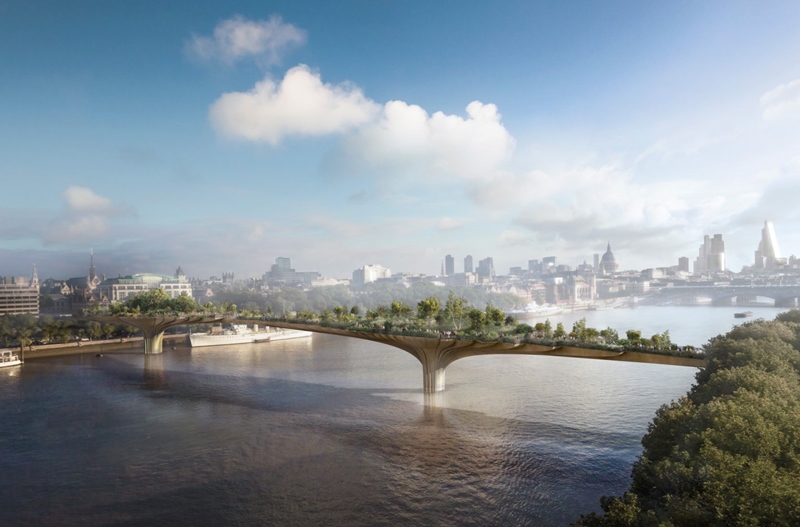

Michael Ball, from Tulse Hill in south London, says that some of the best views of the City and St Paul’s Cathedral will be compromised by the proposed £175m Garden Bridge. The Guardian reports that he believes that the London Borough of Lambeth unlawfully granted planning permission, arguing that it has a duty to protect the historic settings of listed buildings in the area.
Ball, a former director of Waterloo Community Development Group (WCDG), a community planning organisation, will challenge the plans in the High Court.
“The impact of the garden bridge will be devastating. The best views of the City and St Paul’s will be compromised from Waterloo Bridge and entirely blocked along the South Bank, one of the great promenades of Europe and London’s most popular walking area.
“In return for this we get a private bridge with no right of way, closed once or twice a month, and with restricted access.”
It has previously been reported that the bridge, which will receive £60m of public money, will be closed between midnight and 6am with groups of more than eight people having to apply for permission to visit. Cyclists would also be banned, with Joanna Lumley somewhat bizarrely claiming sole responsibility for that particular decision.
“Being a Lambeth resident and using the Tube, I walk a lot. I don’t walk in cycle lanes and that’s the reason why I – and I’m the only one you can blame for not having cycles on this bridge – I said that I believe that cyclists speeding over the bridge would stop it being a peaceful place to walk and a safe place maybe to take a wheelchair.”
The London Cycling Campaign has reported how Caroline Pidgeon, deputy chair of the London Assembly Transport Committee, has pleaded for bikes to be allowed. “At the very least cyclists should be able to use it as a safe route across the Thames. It would be appalling if so much public money was spent on a new Thames crossing which totally excluded cyclists."
However, Lambeth council’s planning report explained why cyclists would be able to push bikes over, but not ride. It is apparently because cycle lanes or wider paths “would result in a much reduced planted area” – a sentiment which has since been reiterated by the Garden Bridge Trust on Twitter.
The lack of cycling provision was given as a key reason by many respondents who opposed the project during the initial consultation at the end of 2013.
Ball’s solicitor Richard Stein, from the human rights team at law firm Leigh Day, said:
“This seems like a poorly thought-through project which, although attractive at first glance, on reflection is seriously deficient in a number of important respects. This is reflected by the growing public concern expressed about the bridge.
“We are asking the court to quash the planning permission and to send the project back to Lambeth for much more careful consideration before such a significant change is made to the historic heart of London.”




















9 thoughts on “Objector plants High Court legal challenge on bike-free Garden Bridge”
The Garden Carbuncle should
The Garden Carbuncle should be rejected because it’s a stupid waste of public money on a private project.
A bridge that isn’t a bridge.
A bridge that isn’t a bridge. Having lots of plants and no cars is a lovely idea but let’s hope they see sense and allow the public (on foot and on bike) to use it.
What a lot of old tosh!
they could hang a walkway
they could hang a walkway under the bridge (or inside the structure) so the none paying plebs dont get to see the plants/trees for free. either that or blind fold them.
In this age of restricted
In this age of restricted public money there is no reason or explanation why this bridge should receive a penny of taxpayers cash ? If there is a demand for yet another bridge in London (try and get £60M for this project elsewhere !) then it should not be exclusive and used for the benefit of all non car users in effect.
£60 million of public money
£60 million of public money on a private bridge in London!
They are sacking lollipop men/women in the Midlands due to ‘cash shortages’.
Must be nice to live in London.
I quite like the idea of the
I quite like the idea of the bridge, but to not have two paths, one for pedestrians and one for cyclists is ridiculous. It would be such a wasted opportunity.
PS. What happens to the tree roots? Surely they will mess the bridge up big time in 20 odd years time.
PaulBox wrote:PS. What
The solution to that is quite obvious, and intrinsic to the concept of a garden bridge in the middle of a major river. The trees die.
bikebot wrote:PaulBox
:))
latest as revealed in the
latest as revealed in the guardian is that Boris (friend of the organisers of course) has committed the public purse to spending money on maintenance if the trust can not raise it (up to £3,5M a year).
Tell me what the incentive is on them to raise the money.
Corruption rife in this country.