


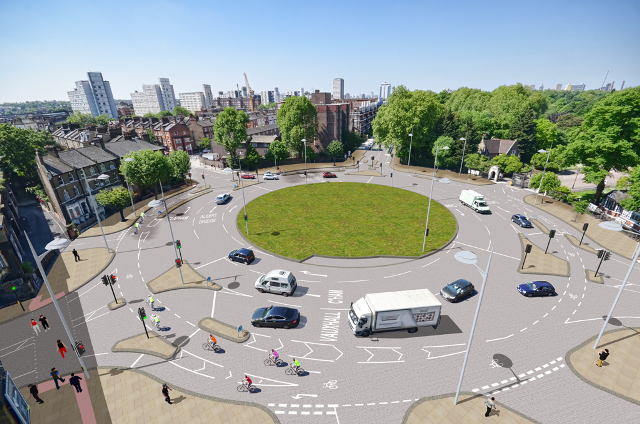

The London Borough of Wandsworth has announced plans for London's first roundabout with segregated routes for cycling, but critics have said it does not meet Dutch standards of cycling provision and have called it "hugely complicated".
The Queen’s Circus roundabout in Battersea is being revamped as part of a plan to overhaul large sections of the street network in Nine Elms on the South Bank to prepare the former industrial area for a major increase in the residential and working population. Wandsworth Council says the long-term aim is to make Nine Elms one of the most cycle and pedestrian friendly districts in central London.
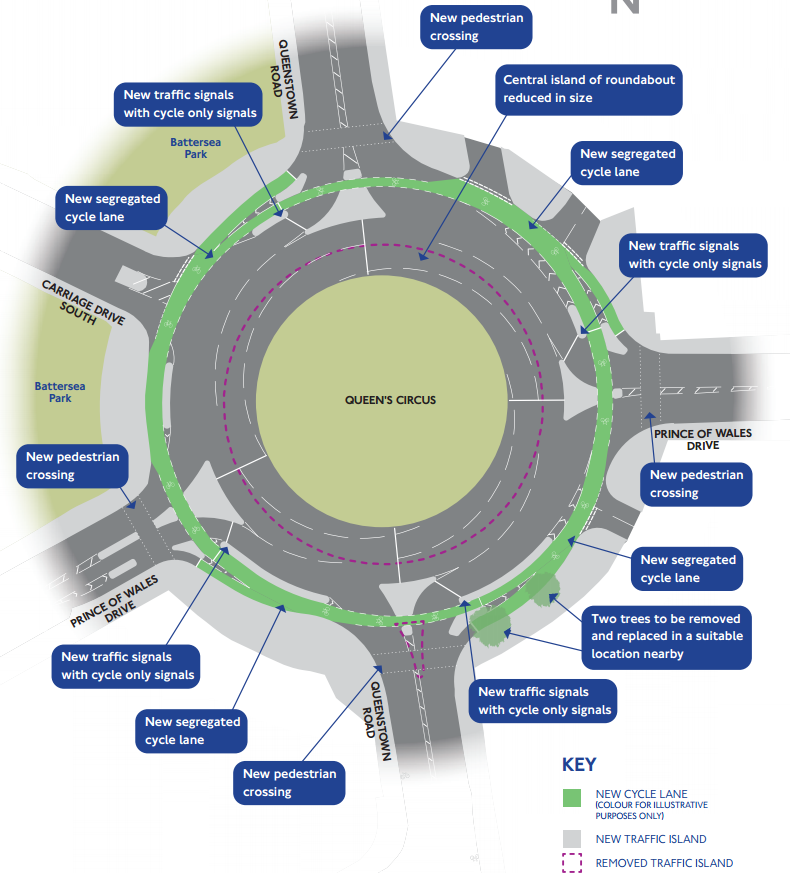
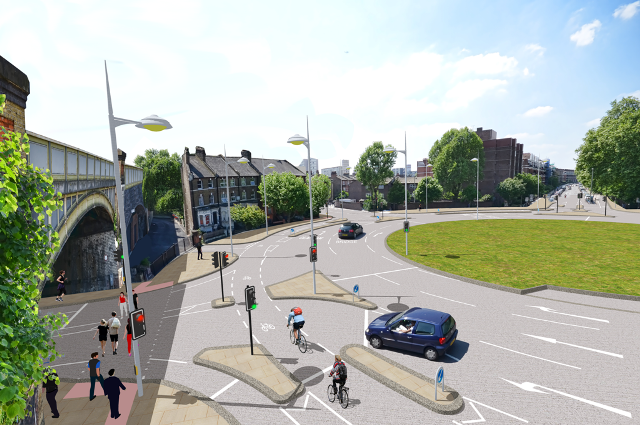
The roundabout design puts a cycle path round the perimeter of the roundabout, separated from motor traffic by kerbs and traffic islands.
Progress through the roundabout will be controlled by traffic lights. Stop Killing Cyclists co-founder Donnachadh McCarthy was one of many critics pointing out that this was not up to the standards of cycling provision at roundabouts in the Netherlands. He said: "in Dutch designs, the cyclists would have right of way."
It's this feature of the design that has that has attracted criticism, with campaigners saying the proliferation of lights is "confusing", "hugely complicated" and "like a traffic light engineer's dream".
In a blog post the London Cycling Campaign said: "London Cycling Campaign expressed serious concerns about this design when we saw them last year.
"Currently cyclists make up about a third of the morning peak hour flow on the roundabout. Often there are so many that they fill a whole traffic lane and cars give them space.
"The new design gives less space to cyclists with added delay… That can only lead to congestion and risk taking behaviour.
"While the proposals at Battersea provide segregation from motor traffic at the busiest points it is at the cost of a confusing set of signals which are likely to increase the number of times cyclists have to stop and increase the waiting time, especially for those coming out of town in the evening peak."
The LCC's Charlie Lloyd told Kaya Burgess of The Times: “Our view is that it’s far too complicated and people won’t understand it. Dutch designers would not put traffic lights on a roundabout in this position. More likely, it would work better to take out the roundabout and have a crossroads, especially because of the massive north-south flow.”
Wandsworth transport spokesman Cllr Jonathan Cook said: “This is an innovative design and we expect it will be the first major roundabout in London which separates cyclists from other traffic in this way. There will be segregated cycle lanes and the points at which riders cross the road will be controlled by traffic lights to avoid any potential conflict. We hope this will be a blueprint others can follow."
More detailed critiques of the design came from Danny Williams on his Cyclists in the City blog, and Stop Killing Cyclists co-founder Donnachadh McCarthy.
McCarthy said that making provision for cycling at all was an improvement on Wandsworth's "terrible record on cycling provision (zero segregated cycle lanes over last 4 years built)" and noted that the new roundabout design has "protected left-hand turns at all relevant points… This is the key pinch-point where trucks kill cyclists most often."
However, he said, "It is NOT a segregated cycle lane – the vast majority of it is just the usual paint on the ground and so not child friendly. If infrastructure fails the 8 year old test – it is not up to Dutch standards.
"The design at present is quite confusing, which makes it more dangerous.
"The design requires the cyclists to stop at lights, whereas in Dutch designs, the cyclists would have right of way. This could add up to one minute to a commute, which is a lot for just one junction.
"Ideally they would have removed car-access/egress from the minor roads to make the junction simpler."
Danny Williams writes: "What we have here is have a heavily-engineered and heavily-managed splurge on traffic-lights to manage motor traffic queues, with bike tracks and pedestrian crossings working around the motor flow. It feels like the traffic light people gatecrashed a party that would have worked much better without them."
According to Williams, the design's problems have their roots in the council's choice of which road users are being given most weight in the plan.
He writes: "The clue is in the Wandsworth council committee papers. Three of the five justifications for this design are related to motor traffic flow and guess which is the top priority?"
According to the committee papers: "There is limited means of managing queues that develop or ensuring equitable discharge of traffic around the roundabout."
Williams adds: "There's no getting away from the fact, this roundabout has been designed to manage motor traffic flow first and foremost. It does create significantly better crossings for pedestrians. And it does create a Dutch-"style" approach that gives space for safer cycling around the roundabout. The whole thing feels over-complicated for both pedestrians and cyclists who could have benefited better from a proper Dutch roundabout. This would have given people on foot and on bikes priority over motor vehicles."














57 thoughts on “Cool reception for “hugely complicated” London segregated roundabout plan”
Quote:“This is an innovative
Why does it need to be ‘innovative’? Copying the Dutch infrastructure may not be innovative but it’d be more effective.
At least they’re thinking about better cycle infrastructure, but the simple fact is that it’s yet another case of them being too scared to go all the way with it, because they’re afraid of the backlash from motorists and associated adverse publicity.
I find that design bizarre
I find that design bizarre and confusing – and I’m from Swindon.
The lines would seem to indicate that motor vehicles coming off the roundabout have to give way to bicycles on the lane to the left of them. Some questions:
a) Will they see them?
b) Even if they see them, will they give way?
c) If they do give way and a queue builds up back onto the rest of the roundabout, how is it not going to cause chaos?
d) Why?
SteppenHerring wrote:I find
there are traffic lights there to stop motor vehicles exiting when cyclists have a green!!!!! But crucially, not on all the exits and entrances… it’s basically a clusterf*ck… to put it politely.
Yep. I think the point is
Yep. I think the point is that cyclists have priority, which is great. But, as stated, the chances of cars entering and exiting the roundabout are slim. It will be like entering the twilight zone or something.
bendertherobot wrote:Yep. I
Do cyclists have priority? I don’t think they do. There aren’t give-way markings on the exits from the on-roundabout car lanes. Each exit is a two-way signalised junction with one cycling and one motor arm.
FFS, why can’t we do this properly!
cat1commuter
Why wouldn’t, in the absence of a light stopping one party or another, the inside lane not have priority from the vehicle seeking to cut across it to exit?
Looks like an absolute mind

Looks like an absolute mind fuck to me.
It is a confusing mess. How
It is a confusing mess. How many cars are going to end up in the cycle lane section?
We all know that the white lines are going to end up being worn off, and that really doesn’t help deliniate between “motor lane” and “cycle lane”, a raise curb for protection should do the job.
It doesn’t even come close,
It doesn’t even come close, only similarity is that it’s a roundabout. I would have struggles there driving or cycling and I’m Dutch.
F*ck me, an extra minute to
F*ck me, an extra minute to the commute? Better let the boss know you’ll be late!
London is never going to be like the Netherlands, get over it! They’re doing their best. Giving cyclists right of way on one junction is a recipe for disaster if they don’t have it everywhere (which isn’t going to happen), so you can’t do it here. Most cyclists I see on my commute would ignore the lights anyway!
Lot of assumptions you are
Lot of assumptions you are making there.
-Part of encouraging cycling (good for cyclists and drivers) is creating a positive differential for cyclists. Easier, faster.
-No reason London couldn’t function like NL.
-Agree about one junction. Revision of Highway Code is long overdue and could include rights of way. Why not; see point 1.
What’s the idea with blocking
What’s the idea with blocking off the left lane with islands ? Get in the wrong one and drivers are going to be left being jettisoned down a road they don’t want to be on, probably just as they’re thinking about that theres a cycle lane to give way to….. accident waiting to happen. 8}
It /is/ a Dutch
It /is/ a Dutch roundabout…only designed by a committee.
Complaining about lights
Complaining about lights regulating the cycle lane while wanting to foist them on drivers is contrary. As is moaning about motor traffic flow being prioritised (a two thirds majority of traffic at peak hours and therefore the key determinant of congestion which affects cyclists as well as motorists).
The most worrying parts of this design aren’t the traffic light-managed major entrances/exits but the minor exits which have no controls and are therefore at the whim of motorists checking their mirror and blind spot properly for cyclists in their lane around the periphery. The key problems here being motorists are not used to doing that anywhere else and are having to deal with many small and unpredictable hazards simultaneously (which they struggle with while texting their mum about what they’re having for tea…).
As with all these things the solution will inevitably be a compromise balancing the needs of different user groups. As cyclists we despair when our needs are not considered but that doesn’t mean we should take to demanding they’re considered above everyone else’s.
Cantab wrote:
As with all
Not really. If less traffic congestion from cars is desired then you have to make the alternatives of cycling or public transport more convenient/faster/cheaper (and safe). This can be achieved in part by prioritising cyclists over motorists and providing less space on the road for motor vehicles … and more for cyclists.
Bristol’s red-trouser-wearing mayor George Ferguson is doing precisely that despite the protests from the pro-car lobby. Here’s an interview with him in Cycling Weekly;
http://www.cyclingweekly.co.uk/news/latest-news/interview-bristols-mayor-george-ferguson-24114
Cantab wrote:Complaining
No-one else is going to demand rights for cycling, why shouldn’t we? I don’t see Stagecoach going round saying ‘No sure, we don’t really need a bus lane, there are private motor vehicles to consider’.
And as far as good of the city goes, why shouldn’t we be, if not at the top, then just under pedestrians?
Car use didn’t come out of a vacuum. We built for cars for decades, so that’s what we got. If we start building for cycling – really building for cycling, of all abilities and ages, we’ll get more cycling. The distances aren’t too great – 69% of journeys in the UK are under 5 miles.
You don’t need to remove access for motor vehicles, but if we take out a few car lanes, the world will not fall in. People adjust to the circumstances.
The sad thing is this will
The sad thing is this will probably be built despite all the opposition, it being a waste of money and will not improve the situation at all.
Cycling infra is utterly fucked in this country until all these shitheads in local government (who have spent far too long with their snouts buried deep in the trough) are removed and replaced by people who care and have a fucking clue.
It is being built, the work
It is being built, the work has started.
it would be more helpful if
it would be more helpful if that CGI showed the roundabout working in rush hour traffic
Even on this picture to
Even on this picture to demonstrate how it works, bottom left, would a cyclist be able to know which light was which? Red light on the left of the road, green light on the right. Plus, I have used this roundabout hundreds of times and is actually one of the safer ones because its lanes are so wide, it’s easy to hug the edge.
How much money has been wasted just coming up with this design? Looks like the kind of thing I would have made with a spirograph, at 4 years old.
There has long been a school
There has long been a school of thought that confusing road layoutss cause everyone to be more careful drivers, peds and cyclists a like.
The problem is that in London especially,but across the uk now, there seems to be a me me me mentality when on the roads which just isnt compatible. It might work ok in town centres, but on major thoroughfairs?
Just when we thought we’d
Just when we thought we’d sorted out the drugs problem in cycling, this comes along.
Looks ok to me as a first
Looks ok to me as a first effort- cyclists are segregated? The point is drivers need to start to learn cyclists have priority in these situations. This kind of segregation is part of that education process. It has to start somewhere.
I don’t see why it’s that complicated -it’s just an inner roundabout and an outer one where the cyclists have priority. Yes the responsibility will be on drivers to give priority but unless we attempt things like this there is no progression or evolution. Hopefully this will be another step forward. This kind of investment in cycling infrastructure should be encouraged. If the road CC community can’t encourage it how can we expect things to move forward?
vanmildert wrote:Looks ok to
Looks ok as a first effort? This is the design that is going in. It is considered the final design.
It is a fucking shambles.
Why mix traffic lights with roundabouts: have either but mixing them is an instant cause of confusion.
There is no real segregation: its just more paint with a few islands that creates more points of conflict.
Better solutions have already been devised that iron out all of the issues that this design introduces (and fails to eradicate from the current roundabout).
The price to pay for that learning process (which should be on the drawing board and testing centre, not on the roads) is going to be collisions involving, and injuring, cyclists.
The bottom line of why this design is so shit is because it comes from a mindset where traffic flow is paramount and everything else is an afterthought.
zanf wrote:vanmildert
Looks ok as a first effort? This is the design that is going in. It is considered the final design.
It is a fucking shambles.
Why mix traffic lights with roundabouts: have either but mixing them is an instant cause of confusion.
There is no real segregation: its just more paint with a few islands that creates more points of conflict.
Better solutions have already been devised that iron out all of the issues that this design introduces (and fails to eradicate from the current roundabout).
The price to pay for that learning process (which should be on the drawing board and testing centre, not on the roads) is going to be collisions involving, and injuring, cyclists.
The bottom line of why this design is so shit is because it comes from a mindset where traffic flow is paramount and everything else is an afterthought.— vanmildert
First effort as in future years we will hopefully develop it to make it better. The people that design these things are not idiots.
Not sure you need to resort to abusive language in your post- discredits your point I’m my opinion.
vanmildert wrote:Not sure you
My language was neither abusive, nor aimed at you. Please do not think it was.
Unfortunately, we can not allow huge swathes of money to be spent on half baked schemes that are ‘valiant attempts’ at thinking of cycling provisions, and hope that they get better in the future. I absolutely refused to put up with second best. Too many people have been killed on the roads because of shoddy, negligently planned infrastructure.
As the saying goes: measure twice (or thrice), cut once.
As I said before, the additional issues this design introduces, and fails to solve from the current situation, have been dealt with elegantly by engineers in other European countries. If the planners had actually spent a short amount of time examining those solutions, and had correctly prioritised vulnerable road users, we would not be looking at this joke.
Unfortunately, that is not true.
I know someone who works within Surface Transport in TfL and if you heard some of the stories they have told about the ‘discussions’ had with engineers about provisions for cycling in upcoming infra designs, you would march to the offices at Southwark and wring their bloody necks.
We have engineers planning our roads that are stuck in the era of Ernest Marples, where they need to get in the era of the likes of Jan Gehl.
zanf wrote:vanmildert
My language was neither abusive, nor aimed at you. Please do not think it was.
Unfortunately, we can not allow huge swathes of money to be spent on half baked schemes that are ‘valiant attempts’ at thinking of cycling provisions, and hope that they get better in the future. I absolutely refused to put up with second best. Too many people have been killed on the roads because of shoddy, negligently planned infrastructure.
As the saying goes: measure twice (or thrice), cut once.
As I said before, the additional issues this design introduces, and fails to solve from the current situation, have been dealt with elegantly by engineers in other European countries. If the planners had actually spent a short amount of time examining those solutions, and had correctly prioritised vulnerable road users, we would not be looking at this joke.
Unfortunately, that is not true.
I know someone who works within Surface Transport in TfL and if you heard some of the stories they have told about the ‘discussions’ had with engineers about provisions for cycling in upcoming infra designs, you would march to the offices at Southwark and wring their bloody necks.
We have engineers planning our roads that are stuck in the era of Ernest Marples, where they need to get in the era of the likes of Jan Gehl.— vanmildert
I’m just saying surely it is better to have something than nothing, start somewhere rather than not start at all, which as far as I can see is the current situation.
vanmildert wrote:The people
Well they’re not doing a particularly good job of demonstrating that.
vanmildert wrote:First effort
1 – We will live with today’s mistakes for decades. Solutions are proven and available in a number of countries. A ‘first effort’ is both unnecessarily dangerous and financially wasteful
2 – I refer to the new Elephant and Castle layout. Yes, they are idiots, and right there you have lots of money wasted to prove that exact point
zanf wrote:Why mix traffic
To be fair, there are stacks of roundabouts (and gyratories/one way systems which work on the same principle – stay right to keep going round, left to come off) with traffic lights on them, especially in London. There are two on my commute. No-one seems to have a problem with the concept of two road features at once. As said above, with appropriate masks on the lights, this could work perfectly safely.
If nothing else, it’s a step in the right direction simply because they’ve thought about specific cycle provision beyond some paint on the road. Even if they get it wrong, it starts the process of education.
vanmildert wrote:Looks ok to
unfortunately here, this most definitely is NOT Dutch… cyclists are being held at several points around the “roundabout” while cars exit it or enter it… I can see the traffic light timings being horrendously biased in favour of motor traffic…
In Birmingham an artists
In Birmingham an artists impression would need to have a van parked on every curb and minicabs in all 5 lanes
The lights for exiting the
The lights for exiting the roundabout seem confusing. While a driver may have red on his right and ahead, if turning and looking let he/she is perhaps more likely to have the single cyclist-intended green in their line of sight.
Likewise cyclists wishing to continue on the roundabout may have the driver-intended light more clearly in their vision. And this is before the lights get even slightly twisted out of position or the cowlings fall off.
Agree that some physical barrier between the cycle and motor lanes would be preferable (and more space-efficient) too.
I’d guess that the cyclists’
I’d guess that the cyclists’ lights will have the little bicycle mask on them, as is tradition.
My guess, “Dutch-style” means
My guess, “Dutch-style” means the designers were stoned.
Can anyone imagine WVM or a
Can anyone imagine WVM or a taxi driver going from 6 o’clock to 12 o’oclock.
Carnage 8}
A major problem with this
A major problem with this design is its ‘schizophrenic’ nature.
Queenstown Road and Prince of Wales Drive – entry and exit controlled by lights. Carriage Drive South, Service Station access and the Retail access are not.
I fear there will be blood if this design is implemented as it is.
Take a good look at the exit from the retail between Queenstown [North] and Prince of Wales Drive [East], cars have to cross two lanes of cycles to get to a car lane. Cars entering this retail have to cross over a chevron ‘ghost’ island. In case your wondering look at picture 1, this retail access/egress is at the bottom of the picture.
motor-centric knob-jockey
motor-centric knob-jockey designed fuck-shambling omni-shite twattery that will kill people.
and when it does the same knob-jockey will re-design it to make it even more motor-centric and even more dangerous for cyclists.
Can’t see why the hysteria
Can’t see why the hysteria because it’s not “Dutch”. There appears to be a growing presumption that if the dutch do it then it’s perfect, a assumption that at times verges on dogma.
There is nothing wrong with this design, it’s logical , easy to follow and, with the use of lights, most conflicts have been designed out. If you can’t figure out which lights to look at you shouldn’t be on the road, or frankly let out on your own
Where’s the problem?
spen wrote:Can’t see why the
It’s because the Dutch can cycle without helmets and never suffer serious injury due to the clever way they build and manage their roads. It’s like cycling on pillows, because they’re MAGIC and INVINCIBLE.
truffy wrote:spen wrote:Can’t
Bloody hell – helmets are like a religious faith for you, aren’t they? You actually seem _angry_ that the Dutch do fine without mass helmet use!
spen wrote:Can’t see why the
Don’t worry it’s clearly not the done thing to be positive about efforts to make cycling on out roads!
vanmildert wrote:spen
Don’t worry it’s clearly not the done thing to be positive about efforts to make cycling on out roads!— spen
The ‘hysteria’, as you put it, about it not being ‘Dutch’ is quite simple: people are pissed off at constantly showing road engineers and planners how they are designing for vehicles, not people.
‘Dutch’ is a shorthand word for infrastructure designed for people, not cars. jacknorell lays it out quite simply why design should not be tolerated, let alone built: we will be stuck with it for years and it will be used to bash the heads of those who make calls for better infrastructure, with the words “well, you had plenty of money spent on you then but you’re still not happy”.
Simply put, its a false economy that will cost peoples health and lives, as well as money. If the people who come up with these designs cannot accommodate the needs of people then they need to step aside and let those through who can.
spen wrote:If you can’t
There are plenty of people driving on a daily basis who shouldn’t be on the road. Whilst government policy and the courts seem to view taking licences off such people is a last resort, it seems prudent to engineer road design to minimise the risk posed by the terminally stupid as much as possible. This doesn’t.
That is a complete and utter
That is a complete and utter mess. It’s a very busy junction and one I know very well. I used to ride that way to and from work every day. It is a tricky junction and certainly needs improvement, but not this over-complex design. I agree that giving cyclists priority as is the case on Dutch (or German) roundabouts would simplify traffic use. I still go that way quite often and I know that when I’ll be driving through there in the car, I’ll have to be hyper aware of everything around me. Not all drivers are cyclist or motorcyclist aware though and that is a cause for concern. Having all those traffic lights will actually slow the flow through it and allowing cyclists priority instead would probably reduce overall congestion too. The design does not appear to account for the huge volume of traffic heading north-south and this will increase the tailbacks and congestion suffered by drivers, which won’t help matters for cyclists using the route. Even the artist’s impression of a few vehicles scattered here and there is rather far from the truth as a more accurate representation would depict a queue of vehicles heading both ways north-south. It is a pity that such an ill-conceived design is being promoted as an answer to an existing problem on that site. I can’t see how this mess will improve either safety or congestion.
There is a lot of guff is
There is a lot of guff is being spouted by people who know very little about road design. As someone who is involved in road design for a local authourity I can say for certain that Zanf’s description of engineers is not the case in our organisation. Many of our engineers are cyclists and care about providing proper provisions for cyclists which can be difficult when the press and politicians take a disliking to the designs.
Road design in this country is restricted by the guidelines set out in the Traffic Signs Regulations and General Directions (TSRGD) and the more detailed chapters of the Traffic Signs Manual set out by the DfT. Any deviation from this guidelines requires permission from the DfT and this takes an age. So if we want to see a more Dutch style of road design central government must do it as they are responsible for the DfT and guidance it publishes. I would certainly support presumed liability for motorists in the event of an accident with a vunerable road users as it would perhaps focus drivers’ minds a bit more than they are currently, which would allow for more Dutch style road designs where cars give way to cyclists.
The junction appears to be an utter nightmare with many roads feeding into it making a simple traffic signal controlled junction unworkable if there are high traffic volumes on all or many of the junction’s arms. Roundabouts struggle with high traffic volumes especially if there are a couple of dominant traffic movements through the junction that prevent vehicles from other arms getting onto the roundabout. The traffic signal controlled roundabout is probably the best option but trying to fit cyclists into this melee must have given the designers plenty of sleepless nights.
@ s_smith
The traffic signal
@ s_smith
Conflicts with.
As the 1st quote implies to me that they haven’t been trained and don’t know how to build decent cycling infrastructure.
That is the biggest problem in this country, like Zanf said, the engineers don’t know how to build decent cycling infrastructure. After all we have plenty of abysmal cycling infrastructure that is not fit for purpose in this country, half of it is outright dangerous, such as 1to2-foot wide cycle lanes that are painted on to the road and seem only to be there in order to keep cyclists from using the road.
So, yes DFTs guidlines may need to be amended and the countries road engineers need to be trained – so they don’t have ‘sleepless nights’ trying to re-invent the wheel.
You shouldn’t be “trying to fit cyclists in” like it’s some kind of afterthought, you should be designing all street infrastructure for pedestrians, cyclists and motor-vehicles.
Prioritising ‘traffic flow’ is the problem.
kie7077 wrote:@ s_smith
The
Kie, the reason they are having so many sleepless nights is because they know they can’t “go Dutch” because the road laws and guidance in this country doesn’t allow them to do it. There is no conflict in those two statements! There is also a lack of political will both at a national and local level in many places as well and ultimately they call the shots and hold the purse strings. Engineers do get training and there have been visits to the Netherlands to find out how the Dutch do it. Also other professionals, such as transport planners, who are very clued up on cycle friendly design, have an imput into the design process at least where I work (some of the time the transport planners are the ones commisioning the engineers to design new schemes).
Traffic flow is important, the problem is you don’t see cyclists (or pedestrians) as traffic which they are and they are all putting competing demands on the junction, trying to maintain the balance so that everyone gets through the junction in a timely and safe fashion can be a real headache.
If it was my choice I would
If it was my choice I would have well lit cycleways under the roundabout that then merge carefully with the roadways. Or alternatively bury the roundabout and create a lovely cycle and pedestrian friendly park on top.. B-)
Bigcog wrote:If it was my
Wouldn’t it be better to elevate the cycle paths? That’s how it used to be done and worked.
What’s wrong with the Magic
What’s wrong with the Magic roundabout design, so loved in Swindon 51.562993, -1.771178?
All that ridiculous 8 way
All that ridiculous 8 way junction needs is bollards at every entrance to prevent access by motor traffic, simples.
Just what cyclist need, more
Just what cyclist need, more traffic lights.
Stop wasting money and start requiring vehicles to have collision avoidance and mitigation tech.
These dutch rbts aren’t much
These dutch rbts aren’t much better than ours, they rely on the users to use them correctly – have a look at this especially at around 6:45 and 12:33 and cyclists appear to think that give way arrows don’t apply to them. (https://www.youtube.com/watch?v=cQKjc_xZq6s#t=343)
or the several right hook on here https://www.youtube.com/watch?v=EXUF97p8fXQ, and cyclist s are supposed to give way to peds on the zebras
spen wrote:These dutch rbts
Have you ridden a modern Dutch roundabout? From observation, this one is evidently the Weteringcircuit in Amsterdam, near the Heineken brewery. It is enormously busy and the users do indeed use it correctly. Don’t all road and cycle path infrastructure rely on the users to use them correctly? This design works. I have ridden round it at all times of day, lots of times.
The times you state in the video linked does not feature cyclists arriving at give way arrows. How do you discern that the cyclists think that give way arrows do not apply to them, when cyclists do not have to give way on this roundabout? That’s the whole point. The cars have to give way to the cycles, and they do.
Maybe you don’t understand road markings?
In the Netherlands, and for
In the Netherlands, and for that matter in Germany or the USA or Switzerland, the default is for all drivers to obey the law, whereas here it is to do what you like when there isn’t a policeman watching.
And that makes all the difference. In Netherlands, if a cyclist is going round the outside of a roundabout, the car driver will give him or her right of way. Hence you don’t need traffic lights.
This appalling mess of a design is created because we can’t rely on drivers giving way to cyclists. And even with that in mind it doesn’t work.
Servers1966 – “The times you
Servers1966 – “The times you state in the video linked does not feature cyclists arriving at give way arrows. How do you discern that the cyclists think that give way arrows do not apply to them, when cyclists do not have to give way on this roundabout? That’s the whole point. The cars have to give way to the cycles, and they do.”
No the times cited don’t show cyclists ignoring give arrows, bu then I didn’t say they did, they show near misses involving vehicles. Cars may have to give way but they clearly don’t always do so. So how is this any better than a light controlled system where users are clearly told when to stop and go? As for the arrows, as I understand it, you give way if the arrows point towards you, which they do where cyclists join nearest the camera. Most cyclists on that video do not.
Maybe your too much of an apologist for your on behavior to accept that cyclists can be at fault
As for Edgeley’s “In the Netherlands, and for that matter in Germany or the USA or Switzerland, the default is for all drivers to obey the law, whereas here it is to do what you like when there isn’t a policeman watching.” who are you trying to kid? Perhaps this one escaped your attention?
http://vimeo.com/105250259