


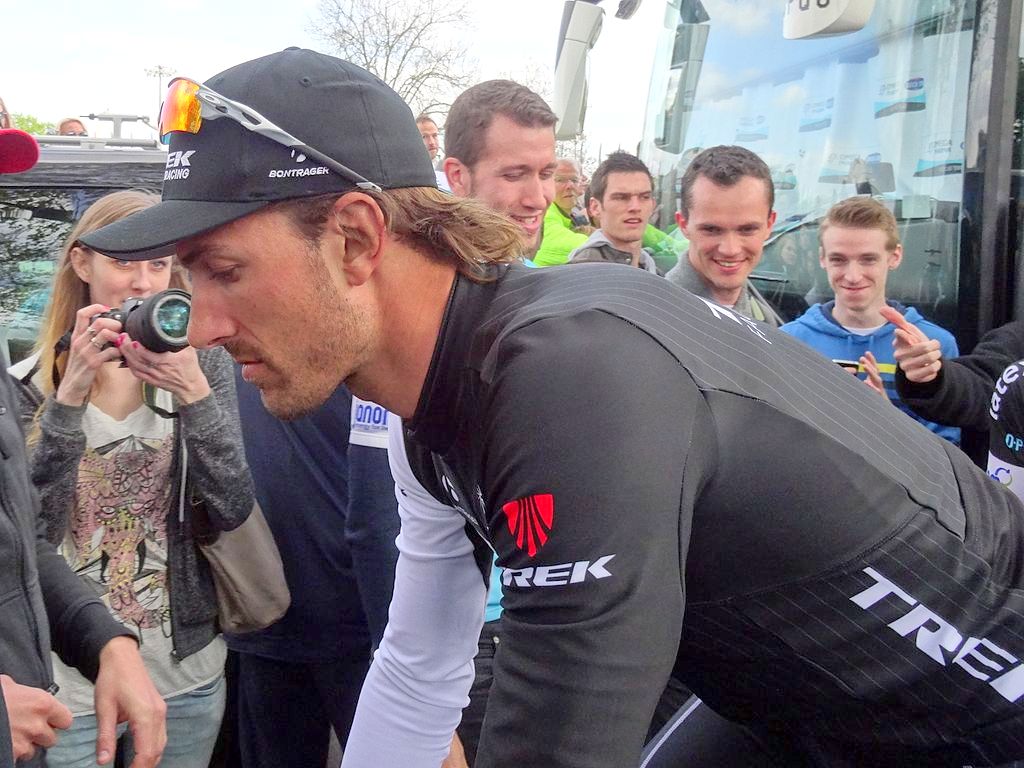

Fabian Cancellara has this morning sparked a revival on Twitter of the eternal helmet debate, after saying that all cyclists should wear the headgear – his comments prompted by the sight of bare-headed people riding bikes in the Netherlands, where he is currently taking part in the Eneco Tour.
The Trek Factory Racing rider tweeted:
Yesterday i saw a lot of people in Breda on they normal bike riding around.got surprised by all of them not riding with the helmet #notSafe
— Fabian cancellara (@f_cancellara) August 14, 2014
Shortly afterwards, he added:
It is important to wear a helmet and wear it right, specialy the kids.
— Fabian cancellara (@f_cancellara) August 14, 2014
The fact Cancellara was tweeting about the Netherlands, which together with Denmark has the highest levels of cycling in Europe but one of the best safety records, did not escape attention:
.@f_cancellara How do explain that cycling in Holland, where they don't wear helmets, is safer than anywhere else? It's not sports-cycling!
— Stan, SpecialEyedLez (@geckobike) August 14, 2014
@f_cancellara Casualty rates are lowest in the world in Holland and Denmark. Helmet use is almost zero in both countries.
— Jon (@ormondroyd) August 14, 2014
Some also pointed out that everyday cycling is an entirely different proposition from racing, where helmets have been compulsory since 2003 – although the speeds that racers travel at means that the velocity of any impact would in all likelihood be well above the maximum stipulated under EU standards for cycle helmets.
@f_cancellara That's just RIDICULOUS for utility riding on utility bikes with flat pedals on safe streets! You are helping anti-cyclists!
— George White (@ExtAnimal) August 14, 2014
@f_cancellara the operative word is ‘normal’. Stop spreading notion that everyday cycling is inherently dangerous. You should know better.
— Amsterdamize (@amsterdamized) August 14, 2014
@f_cancellara The higher the modal split of bicycles in traffic, the lower the percentage of people with helmets > Amsterdam, Copenhaguen.
— Laurens van Rooijen (@bikejourno) August 14, 2014
@f_cancellara It's the safety of the swarm, and it takes away the notion of cycling being dangerous. It's not if the infra is right.
— Laurens van Rooijen (@bikejourno) August 14, 2014
While Cancellara’s original posts were widely retweeted and favourited, that doesn’t necessarily mean that Twitter users doing that were endorsing his views.
One person who lives in the town where Cancellara noticed the lack of helmets happened to be visiting the rider’s home country, Switzerland, and said:
@f_cancellara Today in Bern I see a lot of people on bikes with helmets. It looks strange to me, as I live in Breda normally.
— peter van leeuwen (@bigpete46) August 14, 2014
Not everyone took exception to Cancellara’s stance. One Twitter user said:
@f_cancellara just been involved in road traffic accident mother bike hit me from behind at speed cycle helmet saved my life
— carl easom (@jakk15) August 14, 2014
Another added:
@tweetymike @Al__S @f_cancellara my child will be on a bike soon as she can. I'll also make sure she wears a helmet. You do what you want.
— Matt Kitson (@mattkitson) August 14, 2014
Finally, this tweet sums up an opinion shared by many:
@f_cancellara Stick to racing yeh?
— William Bradley (@W_Bradley) August 14, 2014










110 thoughts on “Fabian Cancellara sparks helmet debate on Twitter, says all cyclists should wear one”
OMG!! here we go again.
OMG!! here we go again.
It seem funny to me that you
It seem funny to me that you see pros pootling around on bikes at the end of races without helmets (eg the photo above), or taking off their helmets after completing a race in a velodrome, etc, and then one of them criticises people who are just pootling to the shops etc for not wearing one.
I wear a helmet when cycling but really it’s not that clear-cut an issue and IMHO we ought to respect each other’s ability to make a rational decision on it. We don’t all wear full body amour when cycling even though it could potentially save us from a serious injury. Everyone has to decide what is a sensible level of protection for them and the inconvenince/comfort vs risk equation works out differently for everyone.
Just to be provocative, could
Just to be provocative, could sponsorship from helmet manufacturers be a factor? 😉 (No I don’t really think so!)
SPORTYMAN OUT OF DEPTH KLAXON
SPORTYMAN OUT OF DEPTH KLAXON
Hit by a Mother Bike?
Christ,
Hit by a Mother Bike?
Christ, the Parliament/Funkadelic stage show has really been hit hard by the recession hasn’t it?
Well all I know is that when
Well all I know is that when I was hit and knocked off by a motorist I was glad I had my helmet on. The damage to the helmet was minimal, but without it my head would have connected with the tarmac.
Das wrote:Well all I know is
Or maybe your neck would have been able to support a lighter helmet-less head and avoided any impact with the tarmac at all? Would you like to repeat the experiment multiple times with and without helmet to verify the anecdote?
It’s sort of outside the real debate though, because not even helmet makers claim they offer any protection in collisions or falls onto spiky things at the minute. They’re nearly all designed for protection in standing falls onto flat surfaces and personally, I’ve not done that since I learned to ride a bike.
a.jumper wrote:Das wrote:Well
Maybe it would have, maybe it wouldnt have. I have no idea. All I remember is saying to myself “the car has stopped, hes seen me………WTF why am I lying in the middle of the road!!!!” I never fell on a spikey thing, I fell on to a perfectly flat road surface. It was a sideways motion, like a scraping motion, so I doubt the instant hit allowed my body to tense up, so yes im still happy I had a helmet on. I pretty sure the outcome was much better than a scalping and “Gravel rash” through my hair.
Das wrote:I never fell on a
A baseball cap or even a trendy retro cycling cap would probably offer enough sacrificial protection to avoid gravel rash on the head.
And yes, you fell onto a flat road surface, but in a manner outside the design parameters of current casual cycling helmets. It’s just chance that it seems to have helped.
Are you sure?
Are you sure?
One of the problems with
One of the problems with cycling is that we can do it in very different ways – one rule frequently doesn’t work for us all – and it can sometimes it be difficult to remember that.
For the cycling I do (road bike, skinny tires, high speed), I feel that a helmet should be worn.
But for people who are happy riding along at a more gentle pace, on more stable (upright) bikes, away from busy traffic… I can see that a helmet probably isn’t necessary
FWIW I felt safer on the
FWIW I felt safer on the roads in the Netherlands without a helmet because of their roads infrastructure, attitudes and laws towards cycling/cyclists. Its probably also a safety in numbers type of preconception that people have.
I feel very vulnerable and unsafe on UK roads if I dont wear me helmet. Thats why I could half understand FC’s comments if he were riding in the UK, but not the Netherlands… Weird.
“velocity of any impact would
“velocity of any impact would in all likelihood be well above the maximum stipulated under EU standards”
Doesn’t mean the helmet isn’t effective. Better to have concussion than mashed brains.
HarryCallahan wrote:”velocity
Except the impact mitigation for cycle helmet material is not to lessen the impact, but in fact to take it all unto itself
This results in the rule that ANY impact involving your helmet has almost certainly resulted in it splitting
In a real crash, impact directly to the helmet will result in it splitting like a watermelon hit by a hammer – providing NO protection to the rider
mad_scot_rider
Except the impact mitigation for cycle helmet material is not to lessen the impact, but in fact to take it all unto itself— HarryCallahan
No, that’s not a fact – one of the primary functions is to increase the time over which deceleration of the head occurs. That is mitigation not prevention or total protection.
There is no such rule.
Come on, that’s clearly dependant on the impact unless you’re appealing to your ‘rule’.
Nah – just doesn’t follow.
If the helmet isn’t there
If the helmet isn’t there where does the energy that cracks the helmet go?
HarryCallahan wrote:If the
Often some of the energy is lost to air resistance and some is transferred to the impact of whatever part of the body hits the ground instead of the smaller, lighter head which the body can now protect by tucking in.
I tell you what, strap a large half-pound weight to the outside of your elbow, then try walking around and see how many door frames and walls you hit that you usually avoid. That’s not dissimilar to the effect of these crap commuter cycle helmets on a head.
Now if you’re taking risks like racing or doing serious mountain biking or BMXing, then I can understand that you’d want a decent helmet, probably stronger than the junk sold to commuters, but that’s a different calculation to everyday cycling.
a.jumper wrote:HarryCallahan
That’s great advice.
.
.
.
For Turtles!
HarryCallahan wrote:If the
It gets focussed into a raw concentrated form of idiocy that’s then handed out to people like you.
Tell me, how much energy, in J or kCal if you like, is required to create a few square inches of crack in expanded polycarbonate?
nuclear coffee
Do you know there’s a difference between cracking and instantaneous disintegration?
The damaged, compressed, helmet structure sat between the head and hard ground (wall, pole, windscreen etc) and took some of the impact.
Go do a simple experiment using a hammer, a helmet and your head. Which hurts more, with or without helmet?
HarryCallahan wrote:nuclear
Do you know there’s a difference between cracking and instantaneous disintegration?
The damaged, compressed, helmet structure sat between the head and hard ground (wall, pole, windscreen etc) and took some of the impact.
Go do a simple experiment using a hammer, a helmet and your head. Which hurts more, with or without helmet?— HarryCallahan
MSCi in materials science, so yes, I do. The post just above this one is pretty relevant. Unlike your answer, which *completely* ignored my question, suggesting you don’t have a clue.
nuclear coffee
Do you know there’s a difference between cracking and instantaneous disintegration?
The damaged, compressed, helmet structure sat between the head and hard ground (wall, pole, windscreen etc) and took some of the impact.
Go do a simple experiment using a hammer, a helmet and your head. Which hurts more, with or without helmet?— nuclear coffee
MSCi in materials science, so yes, I do. The post just above this one is pretty relevant. Unlike your answer, which *completely* ignored my question, suggesting you don’t have a clue.— HarryCallahan
To be fair, I think Harry might have been saying much of what I was, but in a different way. I might well be wrong about that mind.
fukawitribe wrote:nuclear
Do you know there’s a difference between cracking and instantaneous disintegration?
The damaged, compressed, helmet structure sat between the head and hard ground (wall, pole, windscreen etc) and took some of the impact.
Go do a simple experiment using a hammer, a helmet and your head. Which hurts more, with or without helmet?— HarryCallahan
MSCi in materials science, so yes, I do. The post just above this one is pretty relevant. Unlike your answer, which *completely* ignored my question, suggesting you don’t have a clue.— nuclear coffee
To be fair, I think Harry might have been saying much of what I was, but in a different way. I might well be wrong about that mind.— HarryCallahan
Yes, you provided useful information. He asked a rather stupid leading question and looked smart.
nuclear coffee
Do you know there’s a difference between cracking and instantaneous disintegration?
The damaged, compressed, helmet structure sat between the head and hard ground (wall, pole, windscreen etc) and took some of the impact.
Go do a simple experiment using a hammer, a helmet and your head. Which hurts more, with or without helmet?— nuclear coffee
MSCi in materials science, so yes, I do. The post just above this one is pretty relevant. Unlike your answer, which *completely* ignored my question, suggesting you don’t have a clue.— HarryCallahan
Well back to your irrelevant question then.
You could drive a steam roller over helmet foam and not crack it in the sense of large visible separations. Concentrated force on a section can cause separation at the edge, say a high heal creating a sharp indentation. Then again pushing a cricket ball into it won’t necessarily cause separation because the impact force reduces smoothly over a distance.
In the end it’s just a dumb irrelevant question which doesn’t have a precise answer as requested because there are too many unknowns.
And also, as an MSc whatever, surely you know that an impact is measured in terms of FORCE and PRESSURE not energy??
The foam is there to lengthen the deceleration by way of compression, so our concern is compressibility, thickness, not “what ‘energy’ is required to crack it” .
HarryCallahan wrote:nuclear
Do you know there’s a difference between cracking and instantaneous disintegration?
The damaged, compressed, helmet structure sat between the head and hard ground (wall, pole, windscreen etc) and took some of the impact.
Go do a simple experiment using a hammer, a helmet and your head. Which hurts more, with or without helmet?— HarryCallahan
MSCi in materials science, so yes, I do. The post just above this one is pretty relevant. Unlike your answer, which *completely* ignored my question, suggesting you don’t have a clue.— nuclear coffee
Well back to your irrelevant question then.
You could drive a steam roller over helmet foam and not crack it in the sense of large visible separations. Concentrated force on a section can cause separation at the edge, say a high heal creating a sharp indentation. Then again pushing a cricket ball into it won’t necessarily cause separation because the impact force reduces smoothly over a distance.
In the end it’s just a dumb irrelevant question which doesn’t have a precise answer as requested because there are too many unknowns.
And also, as an MSc whatever, surely you know that an impact is measured in terms of FORCE and PRESSURE not energy??
The foam is there to lengthen the deceleration by way of compression, so our concern is compressibility, thickness, not “what ‘energy’ is required to crack it” .— HarryCallahan
Too much stupid to bother replying to everything.
Look up “impact test” about anywhere really. Energy is absolutely relevant, as is stress. And no, you absolutely cannot drive a steamroller over a helmet and have it survive, idiot.
nuclear coffee
Just quickly.
What is the answer to your question?
HarryCallahan wrote:nuclear
Just quickly.
What is the answer to your question?— HarryCallahan
Normally, I’d be charging for that information, since it took labour to acquire.
Pro bono, to crack a helmet in two you’d need to create at least 0.01 +/-0.005 square metres of crack (on mine anyway), you’d need about 200 +/- 100J. Really of course you’re not going to create the one crack, and I haven’t taken into account the covering, so 200J is highly unlikely to cause a major failure. Since unlike you I’m not actually trying to prove anything about helmets themselves, for any more I will have to charge. Given that unlike you I’m not trying to prove anything about helmets themselves, it’s pretty shameful that I’ve done the work and you haven’t.
nuclear coffee
You could have shown some evidence you did some work and didn’t pluck numbers out of thin air.
What physical formulas are you using here?
What application of force (to the helmet) is performing 200J of work?
For a materials scientist you seem to have grossly simplified the problem.
For instance, a surgeons scalpel applied to the foam would require far much less force than a hammer to break it. (less work, joules).
A different experiment might try to laterally shear it, that has its own unique set of parameters.
You seem to have your materials science mixed up with collision physics. A full helmet doesn’t lend itself to materials analysis i.e. they wouldn’t work out the tensile strength of “expanded polycarbonate” (your original question) by stress testing a helmet.
You’ve provided unexplained answers to a problem which hasn’t even been defined.
And it’s still irrelevant because the foam is there to cushion the impact – it’s supposed to give! (crack/compress)
HarryCallahan wrote:nuclear
You could have shown some evidence you did some work and didn’t pluck numbers out of thin air.
What physical formulas are you using here?
What application of force (to the helmet) is performing 200J of work?
For a materials scientist you seem to have grossly simplified the problem.
For instance, a surgeons scalpel applied to the foam would require far much less force than a hammer to break it. (less work, joules).
A different experiment might try to laterally shear it, that has its own unique set of parameters.
You seem to have your materials science mixed up with collision physics. A full helmet doesn’t lend itself to materials analysis i.e. they wouldn’t work out the tensile strength of “expanded polycarbonate” (your original question) by stress testing a helmet.
You’ve provided unexplained answers to a problem which hasn’t even been defined.
And it’s still irrelevant because the foam is there to cushion the impact – it’s supposed to give! (crack/compress)— nuclear coffee
As previously stated, I do not spend my own time explaining formula, finding data and doing calculations for lazy and ungrateful people for free. Nothing I used was propietary, and my question was entirely well-defined, thank you very much, so if you can’t answer it that is entirely down to the work I have done and you have not.
I suppose what remains is for me to call you a passive aggressive douche for asking a question with a clear implication (“where does the energy go?”) without providing clearly relevant information (such as the amount of energy we might be talking about), and an ungrateful douche for your behaviour towards someone who has provided you with at least some of the relevant information.
HarryCallahan wrote:Go do a
No. Since you’re the one with such faith in the powers of this supposed safety intervention in bike accidents, you go and do it, then get back to us with the results.
Not that it will mean anything if you do, of course, as it’s got nothing to do with cycling.
congokid wrote:HarryCallahan
Well, quite. The actual analogy here is that my head will be much better off not being hit by the hammer at all, never mind whether I’m wearing a helmet.
Hence spending my energy campaigning for better cycle infrastructure, rather than the marginal intervention of encouraging helmet use.
nuclear coffee
It’s not the energy in the crack creation/propagation itself which is the main factor (although I guess some enterprising engineer might tell us as the Youngs modulus, fracture toughness, surface energy etc are probably easily available).
If the crack occurs but the foam underneath is not compressed then it’s likely that the fracture itself provided little protection (it may have slowed things a little or hardly at all).
If the foam is compressed then the helmet will likely have slowed the impact – although that may not be sufficient to prevent injury (or maybe irrelevant to the outcome).
HarryCallahan wrote:”velocity
Except the impact mitigation for cycle helmet material is not to lessen the impact, but in fact to take it all unto itself
This results in the rule that ANY impact involving your helmet has almost certainly resulted in it splitting
In a real crash, impact directly to the helmet will result in it splitting like a watermelon hit by a hammer – providing NO protection to the rider
HarryCallahan wrote:”velocity
Indeed, there often appears to be an issue with understanding how helmets work to try and mitigate physical damage in these debates – and equating bike velocity with velocity of the head in accidents, impact mass with total body mass, efficacy with KSI tables and so on and so on.
There certainly are issues with helmets and helmet use, physically and psychologically, but IMO they aren’t always sensibly dealt with by some of the more simplistic arguments that tend to appear.
I think one issue which most or many of us can agree on is that blanket compulsion is not the answer.
I wear a helmet and I am a
I wear a helmet and I am a proud helmet wearer and I went out of my way finding a helmet that fitted my head… some would say my big head…. properly, but I am constantly amazed by the fact that professional riders in the same team and even when they go from one team to another they all wear the same brand of helmet – they all wear a Specialized helmet – all wear a Kask – all wear a Bell or a Giro or a you perm any brand name of helmet and every single rider on the team is wearing that brand of helmet.
Forgive me if I am stupid, but how on earth can professional riders on the same team all have the same shape head, or do they have helmets specifically made to fit their head, or are the helmets adapted in some way to make it that the helmet fits each riders head perfectly.
If as I suspect is the case, which is that the helmet is just another piece of team sponsorship advertising then that means that most of the riders in the peleton are riding without helmets that fit their heads properly, or at least not as properly as the one I wear – a Specialized and only after trying endless brands and models… oh and I still try out any new helmets I happen upon just in case I can find a better fitting helmet.
If that is the case – that it is just sponsorship money – then that means that there is a very good chance that Fabian Cancellara is compromising his own safety, or his own interpretation of safety, for money rather than just in case he gets involved in a accident and needs his helmet to fit his head properly and so it helps save him from injury because the helmet he is wearing fits correctly.
The only word you need to
The only word you need to read in the article is “eternal”.
Carry on…
the man is being a bit of a
the man is being a bit of a silly boy for advocating helmet uise for all cycling…
i commute on my foldable and I don’t go more than 15mph on it and constantly slowing down and weaving in and out of traffice…so i don’t wear helmet and touch wood never had an accident on it.
however when i am training on my road bike i wear helmet as i intend to go a bit faster and is on roads that are likely to be quieter but still with occasional traffic…and the helmet has saved me a couple of times when i fell off so all for it in those instances.
although he does have a point regarding children…
Pro cyclist sparks helmet row
Pro cyclist sparks helmet row on Twitter that sparks helmet row in comments section of road.cc ………
And so the wheel keeps on turning ……
Sweepstake on how many
Sweepstake on how many comments this article will get…?!
And Cancellara gets paid how
And Cancellara gets paid how much by a company which makes cycle helmets? Does he think we are stupid? It is not as if the damn things make a significant difference to safety.
Hey Fabian, just tell kids not to cycle at all, it will have the same effect!
Love the helmetless Fabs pic
Love the helmetless Fabs pic at the top!
I think, at last, I get
I think, at last, I get it.
Helmets aren’t about preventing injuries. They’re about Being Safe. How foolish I was to think the number of injuries was in any way related.
You missed the best Twitter
You missed the best Twitter response, from the always-on-the-money @AsEasyAsRiding
Being Safe is wearing a
Being Safe is wearing a helmet. Being Safe cannot be questioned or challenged with numbers. It is above that.
Next: Lewis Hamilton’s
Next: Lewis Hamilton’s opinion on 20mph zones. Not relevant, don’t care.
Was Fabian paid to tweet
Was Fabian paid to tweet about helmets by cycling websites eager to get clicks?
We’ve been here before. Many, many times. Please make it stop.
rode to school with my
rode to school with my daughter today as we do most days – live in Melbourne, Victoria and helmets are mandatory
we rode defensively and dealt with one illegal right turn across us, a fast approach no look and hard accelerate thru a stop line in front of us and a fail to give way at a crossing when turning at lights (busy junction and legal for us to use crossing) a pretty average 15minute ride at rush hour
a helmet might have mitigated some of the injuries if we’d failed to assess the poor driving and failed to react in time
– the helmets didn’t make the ride to school any safer.
The debate on helmet wearing
The debate on helmet wearing should never go away. It has to be kept very much in the publics consciousness … otherwise we might not have any conscious to ponder?
batch2103 wrote:The debate on
Don’t be ridiculous. The ‘helmet debate’ most definitely *should* go away as there is no evidence whatsoever that helmets do anything to reduce injury rates.
We’ve been running ‘studies’ of compulsory helmet-wearing in Australia, New Zealand and some parts of Canada for nearly 20 years now. If helmets really did help, then it should have shown up in the statistics by now.
I visited Bern recently and I
I visited Bern recently and I was surprised by how few motorists were wearing helmets.
Wow, its hard to argue with
Wow, its hard to argue with the anti-helmet brigade when physics are being applied so rigorously..
ahhhhhhhhhhhhhhhhhhhhhhhhhhhh
ahhhhhhhhhhhhhhhhhhhhhhhhhhhh not this boloody topic again ffs ~X(
Fabian cancellara is
Fabian cancellara is sponsored by Bell. he has his name all over a range of their premium helmets.
You should wear a helmet he says.
Call it performance pay shall we?
Excellent bike racer
Excellent bike racer (ignoring rumours). Bit of an idiot off the bike, it seems.
Boardman: “Helmets not even
Boardman: “Helmets not even in top 10 of things that keep cycling safe”
http://road.cc/content/news/111258-chris-boardman-helmets-not-even-top-10-things-keep-cycling-safe
I’m with the William Bradley tweet quoted above. Just because Fabian Cancellara says something doesn’t mean he is better informed about it than the rest of us.
Famously, Merckx & Hinault
Famously, Merckx & Hinault both died awful deaths racing on the road….except they didn’t. Wear or don’t wear, your call.
Beaufort wrote:Famously,
Well, look at you. Quite the rhetorical master…..it’s not the riding it’s the crashing. Just ask Casartelli and Wouters, oh, wait, you can’t!
But I do agree with you. People seem to talk about safety in absolute terms, but you cannot legislate for it. I don’t say you have to wear a helmet, but that you should do so by choice. You take a gamble when you don’t, and less of one when you do.
I’ve never needed a helmet, and hopefully I never do. But I have no problem wearing one.
Colin Peyresourde
You mean Wouter Weylandts who died Giro? When he was wearing a crash helmet? There is (admittedly unresolved) argument about whether a lid would have saved Casartelli.
Colin Peyresourde wrote: I
Tell me, is walking to the shops without a helmet ‘taking a gamble’? You could fall and hit your head on a pavement. A helmet might make a difference to the outcome.
This is where the ridiculousness of helmets and cycling really comes in. The ‘if it saves one life’ bollocks. The same is true for wearing helmets in cars, but it’ll be a cold day in hell before any government in the world even suggests it’s a good idea, let alone legislates for it. The disadvantages of doing so would be considered far in excess of the benefits.
The last serious crash I had,
The last serious crash I had, I hit the asphalt head first, I was going about 20mph. Glad I was wearing a helmet, don’t really see the disadvantage of wearing one. I think it helped me this time.
tmz wrote:The last serious
They’re dorky and uncomfortable, and if they’re only saving me from gravel rash and other minor injuries, and had to use one every day to do so when I’ve not hit my head in several years and several crashes, I’d say the cure is worse than the disease.
But if your valuation of obviously subjective things like comfort is different, that’s fine. 🙂
Just don’t lie and say you know it saved your life, because you don’t. And respect the fact that other people’s opinion of things like “how dorky they are” is just as valid as yours.
Sorry but bollocks are the two sides as bad as each other – the helmet evangelists commit those sins (dodgy claims, refusing to admit some things are subjective) [i]far[/i] more often than “helmet sceptics”.
The UK has 7 times the rate
The UK has 7 times the rate of KSI amongst its cyclists as the Netherlands does.
Clearly the Netherlands is doing something better than the UK when it comes to cycling safety.
The UK has quite high rates of helmet use amongst cyclists – circa 30% if I remember right. This is in the order of a factor of 10 higher than in the Netherlands, where very few cyclists wear helmets (circa 2% overall).
Clearly, the UK’s obsession with making cyclists wear polystyrene is, in the grand scheme of things, not very effective at actually making them safe. If the goal is cycling safety then clearly helmets aren’t at all the solution.
It’s so damn inarguable that helmets are (in the grand scheme of things) shit at keeping cyclists safe, and it’s so damn obvious what it is needed. Which makes it so frustrating to have to listen to the “But my friend fell of his bike and his helmet cracked, so he must have been saved!” brigade.
Another tidbit, just over half of the KSIs in the Netherlands are old people. Many of these (I don’t have figured) are not dying because of anything to do with cycling, but dying cause they’re old, had some health problem and just happened to be on a bicycle. They probably lived several years longer than they would have lived without having regular cycling in their lives.
E.g., this happened to a dutch friend of my mothers this year. She fell off her bicycle because of chest pain, and died later that evening from a heart attack.
But yeah, cyclists wearing helmets, keep obsessing over that UK. So long as you do, you’ll never have *actual* safe cycling.
For what happens when lots
For what happens when lots more people start to wear cycle helmets, see http://rdrf.org.uk/2013/12/17/the-effects-of-new-zealands-cycle-helmet-law/ and for the possible explanations, see http://rdrf.org.uk/2013/12/27/the-effects-of-new-zealands-cycle-helmet-law-the-evidence-and-what-it-means/
On the physics of impacts on
On the physics of impacts on cycle helmets see http://www.cyclehelmets.org/1209.html
Fabian Cancellara is not the
Fabian Cancellara is not the first racing cyclist to get cycling as transport all wrong. See our beloved Wiggo on helmets here: http://rdrf.org.uk/2012/08/09/why-bradley-wiggins-is-so-wrong-part-three-should-cyclists-be-allowed-to-wear-helmets/, here http://rdrf.org.uk/2012/08/03/why-bradley-wiggins-is-so-wrong-part-one-sport-transport-and-role-models/ and other posts under
http://rdrf.org.uk/category/bradley-wiggins/
I yield to nobody in my
I yield to nobody in my admiration for Cancellara. Take a look at this, for example: http://www.youtube.com/watch?v=RxXqQqAc2pA&feature=player_embedded.
Thing is – if he had to come to grief doing this, just how much good would a lid have done, and of course he would have been elss likely to do it lidless.
And should he actually be lecturing those of us who ride in urban areas with a far lower casualty level per time spent cycling than Tour de France riders, even in the UIK, let alone the Netherlands? On cyclist safety?
ChairRDRF wrote:I yield to
Exactly. Can I be alone in thinking that a nice wicker basket, mounted on the *front* of his bike, would have saved him from having to reach backwards into his jersey pockets too __ much safer. Mr Cancellara needs to demonstrate safe cycling in his own actions before lecturing anyone else.
Whoops, last post should read
Whoops, last post should read “less likely to do ti lidless” to refer to risk compensation
Check out the entrance to the
Check out the entrance to the bike shed at Rotterdam Central railway station at 8:00 am. Neither young nor old wears a helmet, and they all ride like hooligans, barely respecting the code. One almost gets a heart attack fearing for their life. And zero crashes with cars. Why? Probably because the car drivers themselves are also regular cyclists, and therefore utterly respectful of cyclists (with the helping hand of Draconian laws protecting cyclists). Safe cycling is a matter of numbers, infrastructure, legislation, mentality. Did I mention helmets?
By the way, from the discussion on the (lack of) shock absorption of helmets upon impact, it seems MIPS makes sense. Right or wrong?
I just love it when people
I just love it when people quote stats in favour of not adding to safety. It’s utter bollocks.
The pont is, whether any given safety device is proven effective 100% of the time, or not using said device is proven effective 0% of the time, is irrelevant. Its use shifts the odds in your favour.
That’s not to say that wearing safety devices should be compulsory. But we shouldn’t shed tears for those given plenty of warning/encouragement but who decide not to heed it. In a free society we should be free to make our choices. And that includes the right to forfeit one’s own life when a simple safety feature MIGHT be beneficial.
But do carry on.
truffy wrote:I just love it
I take it you disagree with scientific concepts such as proof then too?
Wearing a rabbits foot MIGHT actually help too, so do you have one of those? Or a dreamcatcher hanging from your handlebars, they’re good luck. Or armoured shoes, just in case your feet get run over?
No?
I love it when people use emotional arguments not backed up by facts or study: Unless about their love lives, they’re commonly quite wrong.
When I used to take my
When I used to take my Caterham on the track I wore a full face helmet and Nomex fireproof suit – when I drove it on the road I didn’t.
If I was in DK or NL on a normal bike I wouldn’t wear a helmet as the level of danger is low – In Seattle I do as it isn’t DK or NL and the danger level is higher….
So the level of helmet wear is a direct correlation to how unsafe the roads are… Therefore the govt should try to get to a very low usage of helmet wear, due to the roads being low risk…
What I never understood is
What I never understood is why parents don’t wear helmets when they ride with their children. The children are often seen wearing their own helmets, yet their own “role models” rarely have a helmet. How big a hypocrite can you be if you don’t practice what you preach?
Personally I’ve been using hard-shell helmets for over 30 years and a hairnet head cover before that.
I was wiped out whilst riding
I was wiped out whilst riding a ‘ten’, due to my Look pedals the bike went under the car and I sailed over the bonnet landing in the side of a car waiting to join the carriageway. A&E visit by ambulance, lots of bruising, external and internal but no head trauma, I wasn’t wearing a helmet. Damn it, if I had been wearing one I could have joined the happy band of cyclists declaring ‘I would have died but for my helmet’.
antonio wrote:I was wiped out
It’s truly fucking amazing how many “I would have died but for my helmet” posts there are.
If helmets *hadn’t* been invented, right when they did, it must undoubtedly be the case that the number of cyclists killed per year would have absolutely sky-rocketed from the late-80’s onwards.
Very fortunately cycling helmets *were* invented just-in-time to prevent this imminent catastrophe and therefore the numbers of cyclists killed per year has actually remained remarkably stable throughout the decades __ all thanks to cycling helmets.
Phew! Thank goodness for the cycling helmet being invented at the exact time when deaths would otherwise have gone off the scale. That was a close one!
One odd thing I’ve noticed is
One odd thing I’ve noticed is that people seem to either view helmets as holy life-saving miracles, or as UTTERLY worthless bits of foam.
Would a third option not be simply be to treat them in the same way we treat shinpads, or similar? I’ve never heard people evangelising about their divine life-giving properties, but they DO get used (on occasion), and people seem happy enough with the idea that the pads might protect them from the odd graze.
The only time I’ve ever had a real traffic collision (*ANECDOTE ALERT*) was also the only time I rode my normal route home without a helmet. I ended up hitting the floor with my head, resulting in some bleeding and bruising, which was all gone in around 2 weeks. A helmet couldn’t have saved my life, because… well, I didn’t die, but I might have left things a bit cleaner. The same way knee pads may have kept a few scratches off me knees.
I don’t really WANT to wear safety equipment for something as innocuous as getting around town. I generally feel more secure on two wheels than I do on my own two feet (and I don’t WALK around with my head covered in polystyrene); but there are environments on the bike in which I feel things are outside of my control; in which I feel I might suddenly hit the deck. It’s sorting those environments out that is the issue. Helmets are a complete red herring.
However, even if they are no more effective at ‘saving lives’ than a couple of elbow guards, I don’t think it’s sensible to mock people for using them outright. There’s too much moralising over frivolous elements of cycling as it is. Better to focus indignation and column inches into getting the few people who can make concrete differences (literally) into making real investments in improving cycling environments.
Until that happens, everything else is white noise.
[/mini blog over] [/sorry] [/going to bed now]
Quince wrote:One odd thing
You’ve done it now, there’s no sense or context allowed in helmet ‘debates’!
BTW, yes, exactly.
I’m kind of happy to wear mine when MTBing, but not for utility cycling. I *expect* to knock into something during the former by headbutting a branch or whatever.
What I would like to ask,
Do
What I would like to ask,
Do you think Forumula 1/Indy Car racing drivers need a helmet?
Do you think a Motocycle rider doing 70mph on a motoway needs a helmet?
Do you think a pro bike rider on a closed road doing 70kph needs a helmet?
Do you think a club rider descending a hill on open roads at 60 kph needs a helmet?
Do you think a commuter at 30kph in heavy traffic needs a helmet?
Do you think a 14 year-old cycling to school on back roads at 15kph needs a helmet?
Do you think a child learning to ride a bike at 5 kph in the front yard needs a helmet?
There would be a range of answers from people above with no clear line(s) being able to be drawn, because there is too much conflicting information. Given that we more likely to be “informed” cyclists, what hope does the rest of cycling humanity have?
I agree with Joinpoole, above, that it would be much more sensible to take a middle ground and realise that helmets provide protection in a certain set of cases. They reduce injury when a head would have hit something but also may increase the chance of a head hitting something through extra weight or inbuing the wearer with confidence to go faster.
I happen to wear a helmet 100% of the time because I like the extra protection it would give me a in a small number of cases, just the same way I choose to wear shin pads in football, a box in cricket and a 14th century knights helmet when playing darts (okay, lied about the last one)
I wouldn’t wear those things for a simple knock-about in the back yard and I (personally) wouldn’t want to wear a helmet if I was cycling a couple of mile down the road on a pavement (which I can living in the country I do).
Thats what we should tell people – it will provide protection but not remove injury. It is not a sunstitute for good road infrastructure and better car drivers. It is there for you and your family to have a choice
S’pose if you are riding down
S’pose if you are riding down mountains at 60-70 mph a helmet is a good idea maybe full leathers as well. Respect or madness the distinction can become blurred. Respect I think.
In Australia bike helmets are
In Australia bike helmets are legislated by law to be compulsory, with a $200 on-the-spot fine for non-compliance. It is rare to see anyone riding there without one. They tend not to arguments about the pros or cons of helmet use 🙂
koorby wrote:In Australia
What has happened to the bloody minded individualism and self reliance of the diggers?
Yar… nothing gets my back
Yar… nothing gets my back up more than helmet evangelists…
I think there are plenty of moderate views posted here, which is where we should all be… wear a helmet, enjoy some extra protection should the highly unlikely event of you banging your head in an accident.
Don’t wear a helmet and don’t protect yourself for the once in a lifetime event where you not only fall off, but you fall off and bang your head… not only do you bang your head, but you bang your head hard enough that protection is needed, but indeed, not quite so hard that you go beyond the protective limitations of your helmet.
Its your choice.
More than likely, as mentioned, a helmet is going to save you from some road rash and a head ache. Thats gotta be worth wearing one for some of us… but lets not get precious about needing to take responsibility for protecting yourself against something that is so incredibly unlikely to happen.
I want to preach the argument that rather than those not wearing helmets are being irresponsible, those choosing to wear protection are being extra responsible.
Oh, quickly, how many of us
Oh, quickly, how many of us have experience of crashing and hitting their heads both with and without a helmet?
I have, and I’m still very much in the camp of only using helmets for racing and solo MTB rides.
Where do these professional
Where do these professional cyclists get off having their own opinion really! X(
Don’t worry, Wesselwookie, –
Don’t worry, Wesselwookie, – it’s just the drugs talking….. :))
In fifty five years of
In fifty five years of cycling – including several spells as a ”pushie” in London – I have never worn a helmet and I have never been dislodged from my saddle by either motorist, careless pedestrian or exponent of equestrianism; even the dreaded diesel slick has failed to discombobulate. I filter shamelessly, ride fast, obey traffic signals and follow the highway code but here’s the thing…I keep my eyes open and my wits about me.
I anticipate that my smugness will be rewarded with an appropriate level of pain, if not permanent injury, commensurate with the opprobrium of the be-helmeted. :S :S
3wheelsgood wrote:In fifty
Same experience here although slightly fewer years in the saddle. How hard is it to *not* fall off a bicycle? Answer … not very.
I’ve always found ‘cycling without falling off’ quite an easy thing to do. It’s something I learned as a young boy whilst riding to school and back.
Of course that was 20 years before helmets appeared in the shops so the false promise of ‘protection’ from PPE wasn’t an option. The only protection available was your own alertness and skills.
I’m completely mystified by these helmet-evangelists who apparently keep crashing and falling off their bicycles. Why don’t they simply watch the road ahead, as I do, and modulate their speed according to the conditions?
I’m starting to wonder if there might be a business opportunity here for experienced cyclists. How many of you helmet-evangelists would be interested in attending an instructional course entitled “How to cycle without falling off”?
It would be one-on-one and take 15-20 minutes. The course will cover all the tricky things like ‘going downhill’, ‘door zones’ and ‘road junctions’ and how to negotiate them safely … without falling off your bicycle.
Joeinpoole wrote:I’ve always
You ain’t trying hard enough then boiy…. 😉
fukawitribe wrote:Joeinpoole
Edited this for accuracy.
fukawitribe wrote:Joeinpoole
I’ve always assumed that a detour via A&E would actually *slow* my progress to my destination.
Joeinpoole wrote:fukawitribe
I’ve always assumed that a detour via A&E would actually *slow* my progress to my destination.— Joeinpoole
Who said anything about a destination ?
I recall 20 years ago
I recall 20 years ago attempting to ride back home from the pub, in the dark, with no lights on through the unlit Fog Lane Park, Manchester.
I went into a massive pothole and went over my handlebars, cutting my hands and forearms (but fortunately my newly bought Levi’s survived with no markings).
I was wearing a helmet, but it was completely scratch free as I had miraculously avoided hitting it on the ground. I attribute this miracle to the consumption of 5 pints of beer before setting off. Beer saved my life.
On balance the statistical
On balance the statistical evidence (at a population level) and the engineering (design parameters and standards of a bike helmet) suggest that in an accident involving enough force to be seriously life threatening a cycle helmet is of no benefit. It may be that the helmet protects from more minor injuries in lower force accidents. Most “evidence” counter to this is just wrong/flawed research/deliberate bad science. Most opinion counter to this is confirmation bias from normal humans who don’t understand statistical analysis and the relevant engineering/physics and want simple solutions whether right or wrong.
Compulsion to prevent minor injury and compulsion to save lives are different things and the evidence says that life saving isn’t an outcome of helmet compulsion.
I wear a helmet mostly, I want to avoid minor injury in a fall or topple. I don’t expect it to make a difference when hit by a truck or hitting a lamp post at 40mph. I don’t want to be unable to ride just because I forgot my helmet. I’ve no problem with helmet promotion – it might save a few minor injuries with little downside. Like the poster above said “consider them like shin-pads”. Those who want to move from promotion to compulsion can shove off because compulsion to wear non lifesaving shin-pads is proper silly.
It’s a big old debate and one
It’s a big old debate and one that’ll go round for years no doubt.
Helmets have saved a number of my mates from head injuries…myself included…so I’d endorse them.
When my kids were little (and even now) I’d not be a hypocrite and wear one as an example to them. Makes perfect sense to me!
In fact I jokingly told my neighbour off for not wearing one and she went back to her house to put it on!
It’s not gonna stop a car. It’s not gonna make me bulletproof but it’ll stop minor accidents becoming more serious head injuries.
Use your head and wear a helmet!
Previously I poked fun at
Previously I poked fun at those who advocated for helmets because their friend crashed while wearing one and so, of course, it must have saved them! However, I had never considered Philly’s amazing experience that helmets had saved not just one mate, but a number of mates from head injuries. While one vague friend can easily be dismissed as an anecdote, Philly’s “number of mates” have a clear statistical power that can not possibly be discounted.
Bravo to Philly for doing his bit to save heads. His neighbour would have cycled off to a certain death had not her eagle-eyed neighbour Phil spotted her and quickly run from his spot by his curtains and out the door to remind her that she’d forgotten her helmet.
I’m sure he also tells all his mates in the pub about the dangers of drinking without a helmet – alcohol being responsible for *far* more head injuries in our society than cycling. If it saves one head, a beer helmet surely is worth it? And Phil isn’t the type of guy to be illogically singling out cyclists, oh no.
Go on, dashing Phil, you hero.
Everyone needs a helmet.
Everyone needs a helmet. Where else would you put your helmet camera? 😉
Matt eaton wrote:Everyone
Yeah, strap on a lump that stabs you in the head if you crash.
Or put it on your handlebars.
a.jumper wrote:Matt eaton
Was there just the teeeeeenyist sense of humour failure there ? 🙂
has anyone from the ‘helmet
has anyone from the ‘helmet saved my life’ brigade considered possibly learning how to ride a bike without falling off? it’s not difficult, really it isn’t – start slow, maybe with an adult to steady you or stablisers on the back wheel then gradually go quicker and as you gain in confidence and you’ll be riding round without falling off or crashing into things in no time at all.
Until you’ve learned to do something as easy as ride a bike properly and safely you rather lack the authority to lecture others on road safety don’t you think?
Northernbike wrote:has anyone
Sir – alas that particular bit of sanctimonious sniping has already been done a bit further up the thread. Do keep up please.
Cycling helmets are not fit
Cycling helmets are not fit for purpose – the EU standard is only to test for a stationary fall, which isn’t a realistic simulation. The industry response to this should be to improve their function, not their form. Functioning helmets would move the debate from whether they are effective to whether they are prudent.
tomturcan: Quite. The
tomturcan: Quite. The EN1078:1997 standard is pretty pathetic. The Snell standard is a bit better. It’s interesting to note that *no* helmet makers make safety claims in their marketing. They seem to be able to find improvements in aerodynamics, or weight, or style, etc., to trumpet, but never any improvements in safety. Kind of strange that, for a safety device, no?
Paul J wrote:tomturcan:
Well…. Kask make quite a thing of safety about their helmets in general, but then they come from a different direction and history to most helmet manufacturers. That aside I have to agree with you that it is certainly strange, bloody ridiculous really, that it is not front and centre in many claims.
Cancellara is entitled to his
Cancellara is entitled to his view and to express it, even if I or you don’t agree with it.
And, equally, we’re entitled to disagree with him and say so.
That’s democracy, isn’t it?
But just because you or I may disagree, it doesn’t justify responding with abusive language.
A complicated, that one. Of
A complicated, that one. Of course Cancellara is free to express his opinions, but he is also considered an “expert” with access to the mass-media, therefore an opinion maker. This makes the voice of contrarians even harder to be heard. His outrageous opinion should therefore be met with outrage. Australian cyclists are already paying the price for daft regulation. Fortunately, many replied to his blog with the necessary vigour. His next tweet will surely read: in Holland, no one wears helmets when cycling through town, and cycling accidents are the lowest worldwide. Why is that? Makes no sense to me.
Happy to wake up andò find
Happy to wake up andò find some pretty funny comments on this post, mixing up all kind of cycling, “philosophers” and “scientists”.
Commuting and road cycling have wide different security needs. Especially on commuting this is about the place and your behaviour. If you are pedaling always off the roads and walking speed then all the protection you need is a rain coat. If you share the car’s domain then you better to wear a helmet.
On a road cycling talk I personally consider gloves, glasses, helmet and under helmet the minimum protection pack, so I think all this is needed, not the helmet only. Wearing it I feel and I am protect against many dangerous things, like like the stuff that vehicle tires can project against me (happen once I had no glasses, luckily ended up in a three days black eye only), or any other flying things like insects. Also protect me against trees branch, and let me feel safe while riding at 60 km/h on a descent.
So my choice is to take the minimum actions to back home to my family safe, you are free to continue to show off about materials phisics and philosophy about men freedom of choice.
In April I hit a stone wall
In April I hit a stone wall descending at 40mph after getting into a speed wobble and slid 25 yards to a halt. Broken shoulder blade, collarbone, 6 ribs, dislocated shoulder and a broken/ground away Giro helmet. I can remember the impact and sliding down the tarmac with my helmet grinding.
I am thankful I was wearing it.
This said, I didn’t wear a helmet on my first ride after the accident (almost 4 months later and still unable to ride a road bike) on my hybrid because it was a gentle pace to test things out.
I will always wear a helmet on a road bike where I am riding at speed but will continue to ride in a cap on my hybrid when going to the shops or similar.
Chrisc wrote:In April I hit a
I’m much the same. If I’m going out for the express purpose of riding my bike I’ll put my lid on. Also at the BMX track or trails I always lid up (but not always at the skatepark or on street). If I’m going to the shops or similar I don’t really want to have to carry an extra thing with me. It’s already a point of pain to have to remove lights etc. and carry a heavy lock (which seems even heavier on the way home with a load of shopping).
Well, lots of fors & againsts
Well, lots of fors & againsts posted. Personally, I find helmets hot in summer, heavy, put pressure on the neck, not as warm as a beanie on a cold winter morning (ok, I’m not in Antarctica but even Central London in dead of winter can be cold on the bonce when you have no hair on your head…), extra item to take/wear/think about etc. etc. Also remembering the years cycling in my youth when helmets were unknown (I think).
So far I’ve never had a real problem riding around London since getting a bike again in the 80s, either just out for a ride or as a bike courier, & never wearing a helmet. Unfortunately now, for me, this debate is affecting me going out on the bike – I don’t want to ride a bike wearing a helmet but there’s so much pressure from the must-wear-a-helmet-or-you’ll-die-today brigade, from the law (daft judge’s rulings) & from drivers (using lack of a helmet as an excuse for their bad driving) that I find myself thinking ‘sod it, I’ll just jump on a bus’…
No point in arguing about it,
No point in arguing about it, For the everyday cyclist as long as it is personal choice whether you wear a helmet or not that’s all that matters.