


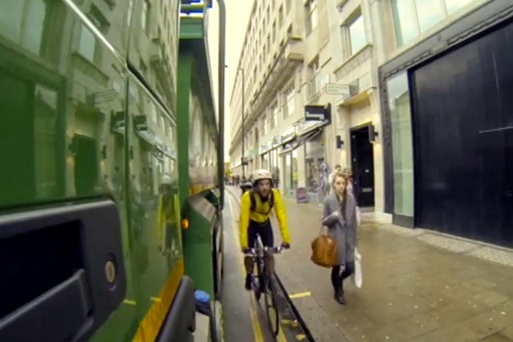

The Metropolitan Police has released a video showing a cyclist and a lorry driver taking part in one of its Exchanging Places events, aimed at fostering better understanding between the two types of road user.
The scheme, which last month won a Prince Michael International Road Safety Award, has been running since 2007 but the impetus for making the video is the deaths in the first half of November of six cyclists in London, all of them killed in collisions with lorries.
In the short film, cyclist Christopher and tipper truck driver Darren, accompanied by Sergeant Simon Castle from the Metropolitan Police’s Cycle Task Force, gain an appreciation of how things are from the other’s perspective.
Christopher, who cycles daily, says: “London traffic for me is the most intense traffic. I am extremely careful around trucks – it’s not a good mix, it’s not a good match.”
Darren, who’s been driving tipper lorries for about a decade, comments: “The limitations I have driving the lorry around London is that I’m very high up and the cyclists are very low down, and there’s lots of blind spots around the vehicle.”
Once Christopher is in the cab, and with Sergeant Castle moving around the vehicle with a bicycle, Derek explains when the cyclist can and can’t be seen.
With the camera also showing the driver’s point of view, it’s quite an eye-opener to learn just how easy it is for a bike rider to disappear from sight.
“In the moment it takes for him to look to his right to see if there’s any traffic, by the time he’s looked back, a cyclist could have come up along the side of the truck and be hidden,” says Christopher. “If you’re in that place, you’re in trouble.”
“My recommendation would be to a cyclist, number one, try to avoid at all costs going up the side of an HGV at lights, try and avoid coming up the inside of a lorry at these traffic lights especially if the lorry’s turning left,” adds Darren.
Later, Christopher says: “Having had this day, there’s certain things I could do which would be really easy. I definitely will be wearing a visible top – a truck driver’s going to pick you up, they know you’re there, you’re in a much better position.”
Darren reflects: “I’ve gained from this experience that you have to have a bit of teamwork, you have to have a bit of eye contact, you have to have a bit of hand manoeuvres between the cyclist and the lorry driver. You’ve both got to look out for each other.”
That sense of working together is something picked up on by Christopher, too, who says: ““It’s a team effort and that’s really clear to me now.”
Sergeant Castle explains the thinking behind the initiative: “The number one cause of serious crashes in London involving cyclists involves HGVs, heavy goods vehicles, and we know why – the lorry driver can’t see the cyclist, and the cyclist isn’t aware of what the lorry driver can and can’t see.
“What we do is we get the cyclists to sit in the cab of the lorry and explain how these crashes tend to happen and crucially, how to avoid them.”
While riding a bike along the road with Christopher and Derek, he points out: “The more space the lorry has left you, the more likely it is he’s going to turn left. The more tempting it looks, the more dangerous it is.”
A scheme that aims to enable lorry drivers and bike riders to get an insight into the other’s experience forms can only form part of trying to make conditions safer for cyclists when sharing the road with large vehicles.
Safety equipment such as mirrors, sensors and side guards, along with improvements to infrastructure such as early start traffic lights or proper provision for cyclists at junctions and enforcement of Advanced Stop Lines, are just some of the other measures that can reduce the danger.
But given that in some instances lorry drivers have been found guilty of causing deaths of cyclists in London, and that a recent Metropolitan Police road safety operation saw 15 out of 70 lorry drivers fined for a variety of offences, it’s perhaps wishful thinking when Sergeant Castle says: “My key message is that these crashes are avoidable.”
He adds: “We’re not talking about massive changes to the way we ride our bikes, we’re talking about a few sensible precautions.”
Forthcoming Exchanging Places events are scheduled for Wednesday 11 December from 0730-1000 at Factory Road E16 at the junction with North Woolwich Road, and on Friday 20 December from 0730-1000 at Kings Mews, Holborn, WC1.
Another London cyclist who has taken part in a similar scheme is road.cc’s own Sarah Barth, who attended one last year. Here’s what she had to say:
The opportunity to sit in the cab of an HGV is one of the most significant things I've done to improve my safety on the streets of London.
The cab is filled with mirrors, so it is possible to see the sides of the lorries from most angles, but it's not always easy.
A cyclist is just about visible coming up on the left — but the improvement once you add a high-viz jacket is astonishing. If you've any sense though, you'd ride up the right, or go nowhere near.
There clearly are blind spots, and these are different on different vehicles, so you come away with the impression that the safest place to be is well out of the way.
And the safety features only work if the driver is using them – one can only imagine the dangers posed by a tired or distracted driver.








50 thoughts on “Video: Cyclist & lorry driver experience Met’s Exchanging Places scheme”
Recently I started taking up
Recently I started taking up a blocking position at the RNS corner of large vehicles. Blocks off the temptation to for other cyclists to try to zoom up the inside. Might get on some people’s nerves, but I’m used to that anyway from taking the primary at junctions and pinch points.
Argos74 wrote:Recently I
It’s a good call – I’d take a bit of verbal for the knowledge that I may have helped avoid a KSI of a careless/inexperienced cyclist.
Red herring, next?
Red herring, next?
Fairly obvious stuff…
Fairly obvious stuff…
A really useful tool would be
A really useful tool would be some sort of blinking light on the left-hand side that could be illuminated by the driver some time before they want to turn left. Perhaps we could name this innovation an ‘indicator’? Then cyclists could simply avoid going down the left-hand side in that circumstance…
Cars and vans seem to have a matched pair of lights that are illuminated together to mean “I’ll stop wherever the f**k I like”, so perhaps if these could be controlled individually, they could be repurposed for this?
adamthekiwi wrote:Then
Not to be rude, but I have seen cyclists do some very stupid things, even if the truck is using indicators.
Mind you the most stupid is this. Truck in right lane approaching roundabout, indicating left. If you saw the junction the tractor trailer and thought, it makes sense, the truck needed the room to make the manoeuvre. Didn’t stop a car go up the inside and end up half under the trailer.
I still have to say why are ASL and ASL feeder lanes in the blindspot of trucks, if you are designing roads, surely the first rule, if you follow the markings you are safe? What we are actually being told is that the feeder and ASL are in truck blindspots, that they may be safe, but they may actually get you killed!!!!
mrmo wrote:adamthekiwi
Saw something similar with larger tractor and trailer unit position itself in the middle of 2 lanes coming up to a roundabout and indicating to make a left turn, there’s me and the family in the car and I’m thinking hang back give this guy some room, next minute I hear a horn being sounded and there’s this idiot in a 4×4 trying to squeeze up the inside of this trailer as it’s turning left !!!
Some people just don’t have any common sense or ability to be on the roads, and that goes for drivers, cyclists, pedestrians, horse riders.
adamthekiwi wrote:A really
I want one of those matched light pairs to wear on my person. Because, apparently, if you turn them on you are allowed to do pretty much anything you want and its fine, as the rules no longer apply because you’ve got two rear lights on. Brilliant invention, surprised its not more widely used.
FluffyKittenofTindalos
I want one of those matched light pairs to wear on my person. Because, apparently, if you turn them on you are allowed to do pretty much anything you want and its fine, as the rules no longer apply because you’ve got two rear lights on. Brilliant invention, surprised its not more widely used.— adamthekiwi
I would like them too, but not for that. I want them so that _after_ I have started to make a change in my road position I can turn them on and then act surprised when things don’t work out. I think there may be a conspiracy to restrict these devices to the illuminati.
adamthekiwi wrote:A really
Those solutions really work in situations like this and this.
@Beztweets writes about “Exchanging Places” or exchanging responsibility?
adamthekiwi wrote:A really
Just avoid going down the left at all. And if the lorry draws alongside you then drop straight back.
Apart from being a #bloodycyclist I’m also an #bloodyadvanceddriver. So this goes if you are driving as well. Even in a car don’t get alongside a lorry on either side if you can help it (sometimes you can’t). Get past it or drop back one or the other. I see motorists on motorways sitting alongside lorries in heavy traffic for ages. These things will kill you sat in your car almost as quick as they will if you are riding your bike.
“Fairly obvious
“Fairly obvious stuff…”
Perhaps but if it leads to some mutual understanding and helps avoid another KSI then it’s a worthwhile exercise.
However the main problem still remains – poor driver behaviour and poor road design. I’ve been hugely frustrated this week by the ignorance of the Transport Select committee on cycling. None of the MP’s involved are in any way informed and seem completely unwilling to acknowledge the careless and dangerous attitudes of sizeable minority of drivers.
This scheme from the Met is great and Darren seems like a responsible and caring guy, however it’s the HGV drivers who aren’t like him that I’m scared of. They should make this scheme mandatory for all truck drivers.
It’s not a bad idea,
It’s not a bad idea, certainly for those who might be interested in policy. It’s very easy for debates to become “you suck/no you suck” bitchfights, when both parties are really open to solutions if treated like decent human beings.
At the same time, this is never going to happen to everyone, and the people most likely to be involved in a collision are those least likely to turn up to one of these experiences. It’s a complement, not an alternative.
There’s a huge amount of
There’s a huge amount of hypocrisy in this issue. By continuing to design roads and junctions that visually suggest that cyclists go up the left-hand-side of traffic it really shouldn’t be a surprise when people do. To then have to recommend that cyclists ignore the infrastructure for their own safety strongly suggests that the infrastructure in question is at best not fit for purpose, and at worst responsible for the deaths of people.
When the people in government say that there are laws to prevent cycle traffic lights for the often-proposed ‘early start’, yet don’t do anything to change this we can see that the major issue is with political will.
teaboy wrote:There’s a huge
Boom.
Quote:Not to be rude, but I
It was meant to be tongue-in-cheek – but too often trucks (and vans and cars) don’t signal, or start signalling once they’ve already started their manoeuvre.
You are right, though, that the problem is that most of our road-design has cyclists sharing the road in an entirely optional lane on the far inside, which only works OK (and never well) when drivers are observant (particularly when travelling slower than bikes, or stopped), considerate and indicate in good time before manoeuvring. These are traits I rarely see together on our roads.
The thing that struck me most
The thing that struck me most is the invisibility in front of the truck. The cyclist has to be a good 6ft in front of the truck to make sure they’re fully in the drivers view. Often I would roll up to a couple of feet in front on the LHS, now I know I’m still invisible!
kitkat wrote:The thing that
If you can’t make eye contact you can’t be seen, same thing as if you can’t see a lorries mirrors he can’t see you.
Why can’t lorries have the
Why can’t lorries have the same kind of indicators what very old cars used to have. The indicators where the light pops out on the end of a stick.
If big enough could be an indicator and a way of detering cycles coming up the side of truck.
The driver flags up a very
The driver flags up a very interesting point that, even as an hgv driver myself, I haven’t heard before. “The more room a driver leaves, the more likely he will be turning left”.
Also interesting is the cyclist’s announcement that he will wear hi viz from now on. Indeed, road.cc reporter Sarah Barth’s previous comments, where she reports the improvement a hi viz makes (in visibility for cyclists coming up the inside of an hgv) as “astonishing”, are repeated.
There’s a lot of comments about the use of indicators but, as an hgv driver, I would ask one simple question. Why would anyone base a potentially life threatening decision on the twin assumptions that the indicator was working, and that the driver’s decision not to use the indicator is a sure fire signal that the truck was going straight ahead? Bulbs can be faulty, drivers can forget. It’s not rocket science.
Even though there may be a filter lane, enticing you into danger, the golden rule is “keep back”. Once this message becomes sufficiently accepted, and anyone still failing to grasp the concept risks being labelled a tw*t, deaths at junctions will become very rare.
“Wear visible clothing, make
“Wear visible clothing, make sure you can see the vehicle’s mirrors” – Works fine as long as the driver is looking for you, and not checking any of their other 15 or so blind spots.
“Don’t go up the left hand side of heavy vehicles” – What happens when one pulls up alongside you, or overtakes you at 50 mph with inches to spare?
All these well-meaning bits of advice remind me of the 1950s public information films that made out you could survive a nuclear explosion if you put a blanket over your kitchen table, or hid beneath some sofa cushions.
And they do nothing to address the fact that for most of the population, riding a bike on the road is an unthinkably scary thing to do.
Victim blaming at it’s most
Victim blaming at it’s most amazing it seems., re-design public highways – problem solved.
northstar wrote:Victim
I bet you write strongly worded emails to the local authority to have them tie your shoelaces and wipe your arse for you as well?
It’s not victim blaming, it’s just common fcuking sense: don’t ride up the inside of a lorry, if you’re in the bike box look back – if you can’t see the lorry driver he can’t see you, don’t ride like a bellend.
William Black wrote:It’s not
Part of me agrees.
But remember where people painted the cycle lanes and ASLs: right up the nearside of HGVs and across the front of them.
To many people, following the paint laid down by trained, experienced highway engineers is common sense.
The one truth that comes out of all of this is that if avoiding the blind spots of HGVs is to be called “common sense”, it’s not so common as to be common amongst the people who design and approve the roads we all use.
William Black wrote:northstar
Yes it is, next?
This is just constantly
This is just constantly ignoring the real issue.
I’d be interested to know if
I’d be interested to know if there’s any vaguely-rigourous (if that’s not an oxymoron) formal study to show how common ‘going up the left of large vehicles at junctions’ actually is. And, furthermore, if there are any common traits either of those who do it or the junctions they do it at. And also, how many accidents involve a cyclist doing that.
Because its something that is reiterated in every thread on almost anything in any way bike-related, but I don’t do it, and I don’t seem to see others do it very frequently (not that I necessarily cycle on the heavy cycle-traffic routes where it perhaps is more likely to arise).
FluffyKittenofTindalos
I’m afraid it’s indemic.
The two most common traits are:
1. Not realising the danger.
2. Knowing the danger but deciding to risk it anyway.
@ Mr Agreeable.
The max speed
@ Mr Agreeable.
The max speed for an hgv is 40mph for a single carriageway. If he’s doing 50, report him. If he’s doing 50 on a dual carriageway, and fails to move into lane 2 when overtaking you, report him. Camera evidence should be sufficient. Transport managers generally take a dim view of poor driving, in my experience, and no company wants their sign written truck on Youtube.
@Neil753 – From what I’ve
@Neil753 – From what I’ve read on Martin Porter QC’s blog, among others, camera evidence is not enough for the police to take action against a dangerous driver. I don’t think you would be able to establish speed from the footage either. A phone call to their boss could work, but that would rely on you catching them up later to take the details.
I feel like the overall standard of driving from HGV drivers is actually among the best of any road user group. It’s just that there are dire consequences when either the HGV driver or another road user gets it wrong.
Expecting people’s skills and behaviour to be perfect, all the time, with potentially fatal consequences for getting it wrong, has been designed out of pretty much every area of industry apart from jobs involving bomb disposal, surgery, and driving.
I never assume any driver has
I never assume any driver has seen me, I don’t bother wasting time playing get eye contact, I’m typically going too fast, it’s dark or the sky is reflecting off of the windscreen.
I’ve had drivers look right at me and still not see me.
Instead I use a bright light, drivers would have to be blind not to see me coming with., I cycle in the middle of the lane or even further out which makes me more visible and gives me more time to respond if a car starts pulling out. I don’t weave in and out of parked cars. I don’t cycle in the door zone, ok, rarely – but slowly and cautiously, sometimes you get forced there by inconsiderate drivers coming the other way.
I do cycle down the left hand side of trucks but only when traffic is stopped, 3+ vehicles are stopped in front of the truck and there is a big gap which I can cycle down quickly. Otherwise I keep my distance.
@Mr Agreeable – I agree, the
@Mr Agreeable – I agree, the Police may not take action. But get the registration number, and film the near miss if you can, and approach the transport firm. They’re all well aware of this issue, and don’t want the adverse publicity. You may not get a prosecution, but you can be sure they will know who the driver is, and give him or her a bit of “advice”. They may even be on a bonus scheme that rewards careful drivers, as an incentive to not drive like a tw*t. Either way, reporting the incident to the firm is something your fellow cyclists will appreciate. But equally, if you see an exemplary piece of driving, please don’t hesitate to report it too. Other drivers get to hear about it, maybe in the company magazine, and it encourages their colleagues to improve their driving too.
@kie7077 – your “3 vehicle” rule of thumb is quite a good one.
@ John Stevenson – ASLs are flawed, as you say, and the filter lanes that feed into them encourage cyclists to do just that, but we’re getting to the point, certainly in London, where crowded ASL zones are becoming a real problem. I would suggest that, rightly or wrongly, the typical jockying for position witnessed at many junctions, far from being being a way to “get the heck out the way”, put the cyclist back into the firing line at the next pinch point or row of parked cars. Apart from the risk of collision, there’s no guarantee that the driver behind you isn’t going to dish out a punishment pass. I certainly believe that the safest place to be is behind a truck, not in front of it, especially since (as you rightly point out) the cyclist always comes off worse.
There’s an ASL in Bath that
There’s an ASL in Bath that has a ‘Keep Clear’ area behind it, about 8m of it. And then the stop line for vehicles. Never felt safer in an ASL than I do in that one. You know everyone can see you, and it’s not a race to go because you’re already a decent distance in front.
always makes me wonder: why aren’t they all like that? The keep clear is for vehicles to go through on one phase, but it’d be easy to rework 90% of ASLs like that.
on the subject of bellends, if you stop your vehicle, especially a big one, at an ASL that you know will fill with cyclists, and you stop in a position that means you can’t see them, then that’s driving like a bellend. Just because you can’t go past the line, that doesn’t mean you *have* to drive right up to it. have some common sense, eh, since that’s what we’re expecting of cyclists, who stand only to lose from their actions.
Dave Atkinson wrote:on the
No it really isn’t. It is the job of the overtaker to carry out the manoeuvre safely and there is no excuse for getting it wrong especially when overtaking a stationary vehicle.
The Highway Code states that “before overtaking you should make sure there is a suitable gap in front of the road user you plan to overtake”. So it is up to the cyclist to decide whether or not there is sufficient room ahead of the large vehicle to take up a safe position after the overtake.
Simply do not do it. It is totally unnecessary. If a large vehicle is first in the queue, take the primary position behind it and keep that position through the junction until you do not need it any more. If there are three large vehicles, sit behind the third one.
ASLs are there to make it easier for cyclists to execute right turns at difficult junctions. They should not be viewed IMO as a means to facilitate queue jumping.
GoingRoundInCycles wrote:
No
you seem to be a bit fixated about cyclists undertaking lorries. a lot of the time cyclists are in front of large vehicles as they approach a red light, and the large vehicles stop right on the line (or in front of it) meaning they can’t see the cyclists. that’s what i’m talking about.
Dave Atkinson
I agree. It’s important for us hgv drivers not to pull up alongside cyclists who have already arrived at the junction. But it’s equally important for cyclists not to pull up alongside our lorries, when we’ve already come to a standstill.
I guess the reason why cyclists with hgv licences keep banging on about this, is because a lot of other cyclists still aren’t listening.
Dave Atkinson
Hardly! This article is about the driver’s hampered vision of cyclists undertaking lorries. Talk of cyclists undertaking lorries is wholly pertinent.
Ah … but that isn’t what you wrote ……
… your use of the future tense led me to imagine a situation where an HGV driver arrives at an empty ASL but before stopping, he/she must use magic powers to predict how many cyclists are likely to appear before the lights change, and leave enough room for them all.
If what you really mean is that an HGV driver should stop before the line in a position where he/she can see all of the cyclists who are already stopped ahead of the ASL, I agree with you 100%. Failing to do so would be bellendery beyond the call of duty.
GoingRoundInCycles wrote:ASLs
Is that something you’ve unilaterally decided? I can’t see any mention of it in road laws or the highway code.
GoingRoundInCycles wrote:Dave
If you can’t filter, you might as well take a bus. If I filter to the front and there’s either some vehicle in the ASL or a HGV parked with it’s nose to the ASL then I will move forward until I consider myself to be in a safe position where-ever that may be.
Sit behind the vehicle – How? in that 30cm between the HGV and the car behind, get real.
kie7077 wrote:
If you can’t
Agreed, completely. Filtering is a necessary, efficient and safe manoeuver as long as the people driving the dangerous vehicles cop the fuck on.
from my experiences commuting
from my experiences commuting in London for many years, the design of ASL is seriously flawed and needs an urgent redesign
the ASL leading strip on many of the junctions’ left kerbs draws cyclists up the inside of vehicles already parked at the ASL stop line
in some instances the ASL leading strip sits in the middle of lane 1 and 2 in a 2/3 lane wide road, leading cyclists between 2 lanes of cars to get to the ASL.
Woe betide any cyclist using this when the lights suddenly change…
Considering these road markings are placed by governmental authorities, there are serious grounds for a legal action brought about by any cyclist involved in a RTC following the “marked advise” of this signage
Having watched the vid I was
Having watched the vid I was struck by the words at the very end as recommendations by the Metropolitan Police. It finishes with:
‘For everyone – obey the rules of the road’
And here lies the real problem does it not? However, what do we see our MPs doing about this…absolutely nothing.
They do want to encourage cycling though and ensure we all feel safe to hit urban and rural roads :))
Shambolic.
Daft cyclists taking on a
Daft cyclists taking on a lorry without an ounce of sense that the driver won’t stop with his right of way especially if he can’t/didn’t see you.
I would recommend anyone,
I would recommend anyone, driver, cyclist or pedestrian, to take the opportunity of sitting in the cab of an HGV, if available. I did so a few years ago at a cycling event and now give HGV’s an even wider berth than I did before, when cycling, driving a car or as a pedestrian. It only takes a moment’s inattention by the HGV driver to that panel of mirrors or for you to be in a blind spot and you’re going to get squished, whatever the rights and wrongs of it and no matter who was at fault.
Vercors wrote:I would
.
I’m pleased that you got to sit behind the wheel of an hgv. All cyclists should do this if they get the chance and, equally, all hgv drivers should do some urban cycling.
But it’s important to recognise that drivers will not have the luxury of focussing on one mirror at a time. Keeping track of everything that’s going on, using all six mirrors simultaneously (not just one at a time), when the lorry is moving, whilst keeping an eye out for pedstrians and other traffic, with a plethora of road signs to look out for, and mindful of the fact that a single mistake could result in a KSI, or an expensive breech of one of the many hgv related regulations, is quite another matter. And things become markedly more difficult at night, in the rain, or with high powered, poorly adjusted lights making it difficult to use the mirrors in the first place.
The sensible thing to do, as always, is to keep back; not just to keep yourself safe, but also to act as a role model for less experienced cyclists following your wheel.
Vercors wrote:I would
i agree we should all “see it from an hgv drivers position”.
but isnt it sort of like saying
“hey, theres a really dangerous seating position, high up, where they can see naff-all. we should all have a go to see how much we cant see. then we will accept that the way the lorry is designed is dangerous”
thats rubbish! why should we ACCEPT how dangerous it is to drice a lorry!?
why should we all “come around” to their point of view (literally)…..
WHY arent we tackling this problem by saying
“lower the drivng position, change the design of the lorry, design out the dangers of hgvs, put more glazing on the cab doors…. etc”
instead we just all jump in a cab and go, oh yea, its dangerous up here because you cant see anything!
to go a step further, i’d say the driving cab of a lorry is not actually fit for purpose!!!
you know those patronising
you know those patronising signs on the back of minibusses, vans, busses, lorries
“cyclists stay back”….
(im not against the ones warning not to overtake ont he inside though)
how about all cyclists get one on the back of their t shirt
“motorists stay back”
^^^ To the joker.
The very
^^^ To the joker.
The very nature of a lorry’s design is to optimise space and put the cabin ontop of the engine. The combustion engine itself can’t be made smaller due to the size and torque required to spin the drive shaft at load.
Maybe what you have in mind is to put the engine in the middle, between the payload and the cabin. With the cabin at vehicle height level just to save some other lousy road users.
dogcc wrote:^^^ To the
hello. my name is “joker” and i was thinking about saving lives rather than £.
Sorry, i must have forgotten which is priority. i will pipe down now and let the big lorries keep squashing people to death
@ GoingRoundInCycles – re:
@ GoingRoundInCycles – re: ASL zones.
As an hgv driver, who aims to stop a few feet before the ASL line, I sometimes find that the extra gap I leave fills with even more cyclists. But I still think that leaving a gap is the best policy on balance.