


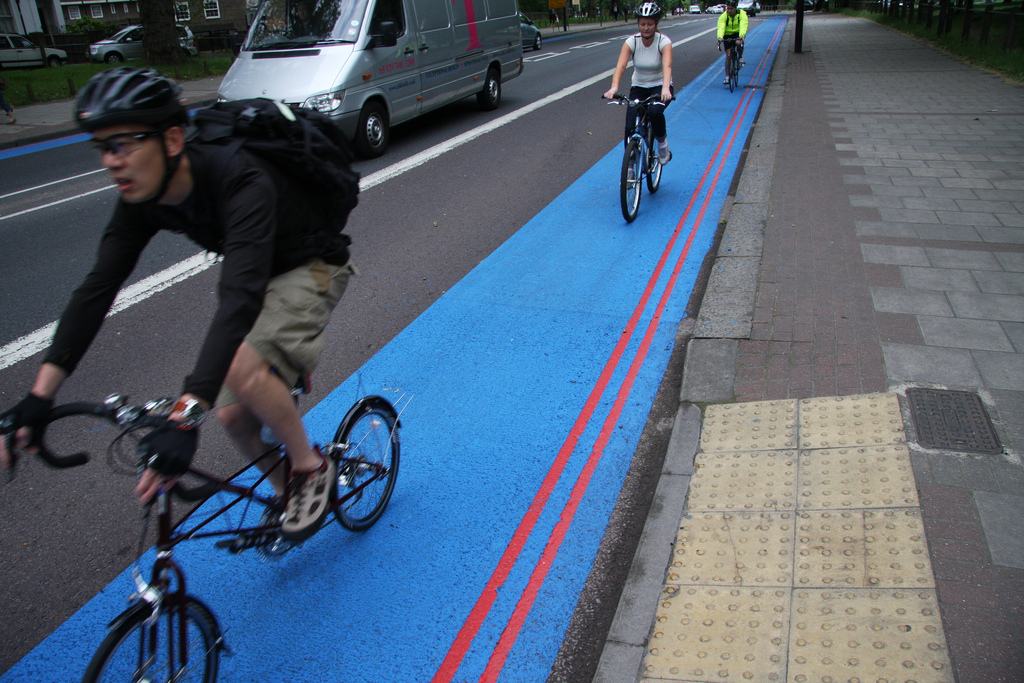

Minister for cycling Robert Goodwill says he does not feel in danger when cycling in London traffic, although he understands why others might. He also wants to see more women and people in suits riding in the city, rather than cyclists in Lycra – but is sceptical that fully segregated cycle lanes and a rush-hour ban on HGVs is the answer to getting more people cycling in the capital.
Mr Goodwill was speaking after taking to the city’s streets on his Brompton on Friday on a route designed by staff at the Department for Transport to highlight the best and worst of the city’s cycling infrastructure.
His trip came at the end of a month in which six cyclists were killed in London, all of them following collisions with large vehicles such as lorries and buses.
His itinerary took Mr Goodwill, who regularly rides his bike in London as well as in the Scarborough & Whitby constituency he represents, from Kings Cross to Westminster by way of Camden, Southwark and Lambeth reports the London Evening Standard.
“I didn't feel in danger at any time,” he reflected afterwards. “I do cycle in London but I think if I was a London cycling virgin I would have been a little bit nervous, possibly.”
The minister said that he wanted to see more infrastructure of the type in place in Royal College Street in Camden, where ‘armadillo bumps’ and flower planters provide a form of segregation, without being the type of fully segregated lane many cyclists and campaigners are calling for.
"When we came out of Kings Cross, we got on to some quite good segregated routes, some quiet routes I didn't even know existed. We went down Royal College Street where they have spent a lot of money… I thought that was fine and I felt safe. Because of the little armadillos, if the cyclist did need to cross over the road to get to a shop they can weave in between, but a car can't get over.
"In a way, because it's much cheaper [than fully segregated lanes] I would rather see a lot of that and less total segregation, which is quite expensive.”
However, he was less impressed with his experience once he ventured onto the south side of the Thames, saying: “There was a bizarre one in Southwark where I went across the road and there was a cycle lane coming the other way, but the cycle lane on our side started three metres later and then it was on a footpath. It was marked on the footpath but there was no ramp or anything."
Mr Goodwill said that cyclists needed to be assertive when taking position on the road, and noted that perception of danger was a common barrier to would-be cyclists, especially women.
"The advice I get from my officials is women are more nervous about going on the roads than men," he said.
"Also, sadly, women are possibly more likely – or inexperienced older people, men as well – to be at the left-hand side of the road, thinking they are safe near the kerb when actually they should be in the box at the front, behind the advance stop line, taking possession of their lane, making it clear to people behind they are turning or going straight on.
"If people around you know what you intend to do, you're much safer."
Mr Goodwill’s remarks reflect the fact a disproportionate number of cycling fatalities in London in recent years have been of female cyclists killed by left-turning lorries at traffic lights.
Transport for London and Mayor Boris Johnson have come under particular criticism for the design of Barclays Cycle Superhighways that take cyclists along the kerb then.
In October, the coroner in the inquiry of the Brian Dorling case noted the design gives riders a false sense of security and puts them in a position of danger at junctions; Mr Goodwill’s comments about riding away from the gutter suggest he may share that view.
He did say that he appreciated why some people might be fearful of sharing road space with large vehicles: "I can understand why people do feel a bit nervous and why you have to have your wits about you in London – for example, don't cycle when you're drunk.
"I sometimes think people on Boris bikes who have not much experience cycling in London are probably putting themselves in danger – but I didn't feel any danger."
However, he reiterated that he did not see a ban on lorries at rush hour in London and other cities as the solution, something that British Cycling policy advisor Chris Boardman has called on, although he said other measures could be taken.
"There are issues to be looked at in terms of side protection bars on tipper lorries, on skip wagons, on certain other refuse wagons," the minister explained.
"Experience in other countries like Denmark and Holland has shown you can design a network in an urban environment which is safe for cyclists and we do need to do more.
"What we need to do is transplant the best I have seen into some of the areas where I have also seen the worst.
"Some of the worst areas are because of not much investment. But some of them are actually areas where they have spent quite a bit of money but it has not been spent intelligently.
"We need to review some of the road-marking legislation, low-level signals for cyclists so they can see them, there's things like that we can do," he added.




















45 thoughts on “Minister for cycling says he feels safe riding on London roads – but understands why others don’t”
Where’s the ‘less lycra’
Where’s the ‘less lycra’ quote? Why would anyone want fewer people to wear appropriate clothing?
andyp wrote:Where’s the ‘less
What he means (I think) is that cycling should be a relaxed and safe means of transport. Dutch people don’t need to dress up and get a shower at work because they’ve meandered at a comfortable pace along lovely segregated infrastructure. Trouble is..he seems to be against such infrastructure because it is “quite expensive” (unlike public transport subsidies, roads, A&E treatment for injured cyclists…).
The guy is a nobber.
The guy is a nobber.
Quote:”In a way, because it’s
That’s all you really need to know about this. It’s all about the money.
Yes. That would involve spending money though. Which you’ve already indicated isn’t going to happen.
dp24 wrote:Quote:”In a way,
My thoughts too.
He feels safe but recognises others will not, yet when the crunch comes he doesn’t want to do anything about it. A waste of time.
So you ride to work in your
So you ride to work in your suit and honk all day?….or maybe change into your Lycra?
What has wearing Lycra got to do with it???
I’m willing to give anyone a
I’m willing to give anyone a chance but this guy is an endbell. His quote a couple of months ago was “we want to give drivers a bigger say in what happens to THEIR roads”. He’s now said segregation is out if it costs much more than a few flower pots, and banning HGV’s wont happen, presumably because they don’t want flak from “business”.
I’m more and more coming to the conclusion that the government, central and local in London, think a dozen or so deaths a year is a price worth paying to keep the delivery companies happy and save them spending on some decent infrastructure. If the recent spate of deaths hadn’t have happened in such a short space of time, if they’d be spread over the full year, they wouldn’t be going through the motions of pretending to give a toss now.
I’ve been a conservative voter for quite a while but not any more, I’ll be voting for whoever has the best transport policy in future, probably Green
colinth wrote:He’s now said
It might have something to do with the fact that any restrictions that ramp up the prices in the shops, with so many vulnerable groups already having to choose between heating and eating, in a country that is struggling to keep many essential services running, is barking.
Sure, he’s been wheeled out to utter a few placitudes at a politically sensitive time, but at least he rides a bike. Let’s face it, we could have had much worse.
But get real guys, even the sort of money that has allegedly been earmarked for cycling infrastructure is hardly going to make much of a dent in KSI rates nationally. As people who happen to use bicycles as part of our own individual transport solution, we have to be far more concilliatory, and engage with all interested parties, to create a step change in attitude on the roads.
We certainly don’t have to wait to be drip fed flagship schemes by successively incompetent governments.
Neil753 wrote:colinth
Banning HGV’s doesn’t have to add anything to costs, one of the biggest costs to transport is the delays caused by congestion. Smaller vehicles, alternative delivery methods, off peak hgv’s when the roads are quieter, there are lots of options. They seem to manage fine in Paris, or we could just carry on having people killed so that the price of a pair of designer jeans or plasma tv doesn’t go up by a couple of quid.
colinth wrote:Neil753
Banning HGV’s doesn’t have to add anything to costs, one of the biggest costs to transport is the delays caused by congestion. Smaller vehicles, alternative delivery methods, off peak hgv’s when the roads are quieter, there are lots of options. They seem to manage fine in Paris, or we could just carry on having people killed so that the price of a pair of designer jeans or plasma tv doesn’t go up by a couple of quid.— colinth
The Paris lorry ban only restricts trucks with a gross weight of 28 tonnes or more. Most lorries are less than this.
One artic is equivalent to 13 transit vans or 5 7.5t box vans. More vans mean more congestion, more pollution, more deaths from respiratory diseases. Currently, 3,000 die from vehicle related pollution per year, just in London.
Most delivery and collection points in London do not run 24/7. More complex distribution would require a fundamental step chage in the working arrangements of large numbers of Londoners.
It’s unlikely that vulnerable groups will be shopping for designer jeans or plasma TVs. I was referring, fairly obviously, to food and other essentials, all of which will indeed rise in price.
Yes there’d have to be
Yes there’d have to be fundamental change, but if that’s what’s needed then that’s what’s needed. Don’t confuse can’t with can’t be bothered. Hgv can still deliver, just not during peak hours, they’d be stuck in traffic less so there’d be less pollution, not more. For deliveries that must be made by smaller vehicles, why not invest in electric vehicles ?
The cost to major food retailers in central London would be negligible compared to their turnover. It would be less, probably, than the increase to their costs caused by the national minimum wage, which didn’t increase prices at all.
It would be difficult, and it would cost money, but seeing as people are being killed using the roads and as you point out, through pollution, I think we should work on a proper long term solution rather than accepting the status quo
Next excuse?
Next excuse?
Hmm, maybe he should do the
Hmm, maybe he should do the same tour again (on a heavier bike? pulling a trailer?) wearing one of those suits that make you older than your years (vision a bit worse, hearing a bit worse, joints a bit stiffer.) The fact that an able-bodied middle-aged man can use a bike to get around in relative safety doesn’t necessarily mean that the infra is adequate for the young, the old, the heavily laden etc.
But I think he’s on to something when it comes to the benefits of “soft” segregation with paint (and maybe a few strategically-placed armadillos.) It’s all too easy to interpret a desire to build infrastructure cheaply as a lack of willingness to spend serious money on it, but just as easy to argue that building cycling infrastructure cheaply allows you to put in lots of it very fast. Paint and armadillos can also be moved easily to give cyclists more roadspace if cyclist numbers rise further. And soft segregation allows cyclists to leave segregated infrastructure to overtake slower cyclists and then to return to it seamlessly afterwards.
That’s not, of course, to say that all cycling infrastructure should be cheap, or as cheap as possible. I think it’s very worthwhile to spend serious money on cycling when it obviously adds value. Superhighways worthy of the name that would allow cyclists to make fifteen mile journeys into city centres without having to wait at lights or yield to other traffic more than a handful of times wouldn’t be cheap, but they would definitely generate modal shift to cycling and ultimately work out less expensive than providing other ways for the same people to travel.
So my preferred approach would be two-pronged: lots of decent, cheap infrastructure now and a much smaller number of projects that are expensive and that need careful planning and will take time to come to fruition, but are worth doing and worth getting right.
Mr Goodwill’s remarks reflect
Whoever wrote this story hasn’t actually added up the number of male/female fatalities in London over the last five years, because if you do you’d find they’re pretty much equal – about 40 of each sex.
Of course, more men cycle, so there’s a slight over-representation of women but it’s nothing like as much as this implies.
To Fluffy Mike, You missed
To Fluffy Mike, You missed the word ‘disproportionate’ then? Its been well-publicised that only a small fraction of London cyclists are female (e.g. 3 times more male than female cyclists http://www.theguardian.com/environment/green-living-blog/2010/may/13/cycling-lorries-women-road-deaths). yet (as you point out) half the fatalities have been female. We need to understand why this group is so much more likely to be killed. :/ That grauniad article has some discussion of the question.
I’m sick of seeing quotes
I’m sick of seeing quotes about lycra like it’s some sort of cycling requirement. If anything, it just highlights how little the speaker knows of the topic. It’s a nice, tidy catch-all insult to reduce cyclists to being a group of TdF wannabes.
You also see it portrayed in sitcoms. Watch any programme where one of the characters takes up cycling. I guarantee, they will be made to look ridiculous in a lycra skinsuit and aero helmet while riding a hybrid.
Thanks for appearing so
Thanks for appearing so concerned, helpful and caring?
Now put your money where your mouth is!!!!!
Would I let my 8yr old ride
Would I let my 8yr old ride in the Netherlands alone to a friends? Probably. In the UK? Not a chance. Even on the few times I’ve ridden on quiet roads with him, I’ve been constantly on edge awaiting that next car. Says it all really.
On the ‘soft segregation’
On the ‘soft segregation’ done on Royal College Street, I actually think this is a very good solution. They’ve taken out a full lane for cars, make the road two-way for cyclists, and it’s done without spending loads of cash on kerbs etc.
Not quite perfect (a few squeeze points) but much better than 95%* of other cycling infrastructure.
*Yeah, I guesstimated that…
Neil –
You keep popping up in
Neil –
You keep popping up in these threads defending commercial vehicle operators. Do you have a vested intrest?
Most of the vehicles involved in incidents with vulnerable road users are not delivering life saving goods for little old ladies.
There pay per load construction industry vehicles poorly maintained with stressed drivers. The benefits of their cut cost operation goes into the coffers of property developers and if it cost a bit more to do the job safely so be it.
There may well be economic implications for other operators as well but the costs in the entire chain are insignificant when compared to safety and quality of life for everyone else.
The pollution thing is also a red herring, you’ve either been reading too many trade papers or as suggested earlier have have no intrest in cycling and pedestrians and actually have stronger allegiances to an industry which is struggling to turn a buck at the moment and doesn’t want more costs.
IanW1968 wrote:Neil –
You
Ian, as you rightly point out, I am interested in this issue, as apparently are you. But that is where the similarities end.
When I post, I state my opinion, and some facts to support my opinion. It’s called reasoned debate. But you seem keen to state your opinion, without any supporting argument.
In answer to your question, I have a vested interest in moving towards more sustainable, localised economies, in which the bicycle would play a major role, as we enter an era of increasingly expensive energy. And part of that interest includes looking at cost effective ways to reduce KSIs involving cyclists.
IanW1968 wrote:Neil –
You
The ‘pollution thing’ is most certainly not a red herring, London has missed it EU targets for acceptable pollution levels year after year and uses the loophole of the promise of making improvements whilst actually doing naff all. I hope the EU throws the book at us, maybe then things will change.
Quote:
“The Greater London Authority (GLA) estimated that in 2008 there were 4,267 deaths attributable to long-term exposure to small particles. More information about air quality and health can be found in our useful documents.” from Air pollution and public health And that’s just from the small particles, which aren’t the only deadly vehicle emissions.
And:
“In Marylebone Road on 28 July, one of the hottest days of the year, NOx levels rose to 1,912 microgrammes per cubic metre, the equivalent of motorists and pedestrians breathing in four cigarettes a minute.”. From London’s air ‘as bad as smoking’
Just because you can’t see it doesn’t mean it’s not there. Just because you hadn’t heard of the deaths happening, doesn’t mean they aren’t happening.
4,267+ deaths attributable to long-term exposure to small particles.
14 deaths whilst cycling on London’s roads, you tell me, which is the red herring?
kie7077 wrote:IanW1968
The ‘pollution thing’ is most certainly not a red herring, London has missed it EU targets for acceptable pollution levels year after year and uses the loophole of the promise of making improvements whilst actually doing naff all. I hope the EU throws the book at us, maybe then things will change.
Quote:
“The Greater London Authority (GLA) estimated that in 2008 there were 4,267 deaths attributable to long-term exposure to small particles. More information about air quality and health can be found in our useful documents.” from Air pollution and public health And that’s just from the small particles, which aren’t the only deadly vehicle emissions.
And:
“In Marylebone Road on 28 July, one of the hottest days of the year, NOx levels rose to 1,912 microgrammes per cubic metre, the equivalent of motorists and pedestrians breathing in four cigarettes a minute.”. From London’s air ‘as bad as smoking’
Just because you can’t see it doesn’t mean it’s not there. Just because you hadn’t heard of the deaths happening, doesn’t mean they aren’t happening.
4,267+ deaths attributable to long-term exposure to small particles.
14 deaths whilst cycling on London’s roads, you tell me, which is the red herring?— IanW1968
I didn’t really have time to explain the whole pollution issue to Ian, but your explanation is much better than mine would have been. As you point out, the death rate amongst cyclists, terrible as it is, when compared to deaths attributable to long-term exposure to small particles, is considerably lower.
For your interest; sometimes when I’m heading towards London on the M4 in my artic, when the light is right, I can see a distinct brown layer of visible pollution cloaking the capital.
My solution for London’s pollution crisis would be larger (but fewer) trucks with tighter emission limits, a lifting of all hgv time restrictions to avoid “rushing”, tougher restrictions on cars at peak times, tax incentives to remove old taxis from London’s streets, the encouragement of electrically assisted cargo bike adoption by trademen through generous tax breaks, a widespread reduction in speed limits to 20 mph, a corresponding raising of electric bike speeds, also to 20 mph, and, somewhat controversially, greater focus on the speedy provision of a clearly identifiable network of “quiet ways” and soft segregation for cyclists elsewhere, with the aim of removing 90 percent of all cycle traffic from historically dangerous junctions.
I gather that the initial
I gather that the initial cost of the “superhighways” was of the order of £400m. For that money, how much education could you buy (TV, newspaper spots etc.)? We know that a substantial proportion of motorists think cyclists should be in the gutter/have no rights to be there/it’s their fault if they get hit. Fix that mindset. We also know that some cyclists are nervous and don’t follow the rules of being: visible, predictable, assertive and courteous.
Everybody (particularly those in multi-tonne metal vehicles) needs to be aware of how to behave and needs to play nice and share.
Apparently John Lewis spent £7m on their Christmas ad that’s all over the media. Londoners spent £400m on some blue paint.
6 killed in 2 weeks and they
6 killed in 2 weeks and they reckon it costs the economy £1.5 MILLION per death – how much mor for the seriously injured to boot? Yep that’s 9 million quid never mind the incalculable human suffering of someone losing a parent, sibling, offspring. An average of 14-16 a year in London alone and that’s already a much larger figure than that promised for cycling infrastructure for the UK at the moment.
IHphoto wrote:6 killed in 2
Where does the 1.5m per death cost come from?
dullard wrote:
Where does the
Its probably from the formal cost benefit analysis that the highwaymen use to try to make the decision to build a road appear more rational and objective.
I used to know about this, I think it was called COBAx.
I live on Royal College
I live on Royal College Street and have been using this street for commuting on my bike every day in both directions for some years (well over 12 years)
Its funny how the minister seems to highlight this street during his trip, because in my opinion its become more dangerous since the rebuild
The old layout involved a north/south dual-lane cycle path running up the northbound side of R.C.S. which is a 1-way street. This had a solid concrete dividing strip to physically seperate the motor traffic from cyclists; this actually won awards.
Yes, there were a number of RTC and near collisions between cyclists and motorists at the several right-angle junctions which intersected this setup:-
Motorists would be looking to their right for one-way traffic and would not see south-bound cyclists, or would park their vehicle beyond the hard ‘stop’ line with their bonnet in the northbound cycle lane, or just ignore any cycle traffic in either direction…
When it was announced the cycle lane was being rebuilt with north bound on left side, and south bound on right side, we had hope it would get sorted out properly. We had months of disruption with the closure of the cycle lane, alternative routes and very little evidence of any work being done on the closed cycle lane.
However, we soon saw strange rubber ‘armadillo’ , intermittent paint strips and 2 metre long metal plant pots being installed along the road.
The problem from actually using this new design is that the northbound lane does not offer cyclists any more protection from motorists driving across the right hand junction in R.C.S., and numerous instances of motorists parking vehicles in the cycle lane where the armadillos (oversized cat eyes) or gaps in paint / plant pots allow easy vehicle parking
its not uncommon to see a courier vehicle parked after the bus stop where the paint lines stops. In the past 2 weeks, I have seen two of the metal plant pots smashed and pushed into the cycle lane from vehicle collisions, presenting an obstruction and hazard to cyclists.
You can see the replacement plant pots because they don’t have the reflective tape that had to be applied to the first installation of the pots when it was realised their black paint made them a hazard to cyclists using the northbound lane at night…
On the new southbound cycle lane its not uncommon to have people from cars and couriers with packages from delivery vehicles stepping out in the cycle lane without looking, straight into the path of oncoming cyclists!
I tried raising these issues with LB Camden and also Camden Cycling and LB Camden Cycling officials at cycling events and there is no interest in examining these new problems because the officials responsible for this new scheme are too busy patting each other on the back for the success of their ‘Go Dutch” scheme for R.C.S. in Camden
These people need to wake up and realise this is not Holland but London; we have an aggressive motoring culture, a lack of Policing and a number of uneducated or arrogant cyclists which means the motorised community will do whatever they can get away with when the road layout presents that opportunity!
The new scheme in Royal College Street is not a good example of cycle-safe road design as the minister and LB Camden might have you believe, but merely an example of doing the redesign on the ‘cheap’ whilst still having serious safety implications for cyclists:(
Try using R.C.S. every day and report back!
Mr. Goodwill says: “I didn’t
Mr. Goodwill says: “I didn’t feel in danger at any time,” he reflected afterwards. “I do cycle in London but I think if I was a London cycling virgin I would have been a little bit nervous, possibly.”
Doesn’t that say it all? If cycling is too scary for those who aren’t already having a go then there there is something badly wrong. Cycling is the sort of activity one should feel confident in letting children do. But no-one in their right mind would allow a child to cycle on most of London’s road because it is perceived as too dangerous for adults let alone children. The war for safe cycling infrastructure will not be won until everyone feels safe getting on a bike.
As an aside I am not a London cycling virgin but, after forty years cycling in this city, I am still scared every time I have to fight it out with juggernauts, buses and the rest on my bike. If ever I lose that fear, and cycling infrastructure has not improved, I expect that is the day I die.
There’s a reason people wear
There’s a reason people wear Lycra, It helps you move more fluidly on the bike, Suits are normally tight fitting and restrict movement and can get ripped easily while riding.
If you don’t have mudguards like my bike, You can get spray all over your back like you’ve just shit sprayed everywhere.
Who wants to get to work with massive sweaty arse and pits in a suit.
Think it through Son.
RoadbikerAlex wrote:There’s a
Then invest in a hybrid/utility bike with flat bars, mud guards (full), chain guard. All the stuff bikes used to come with apart from racers. This attitude of needing Lycra and drops is what keeps folk away from cycling.
giff77 wrote:Then invest in a
It does rather depend, to be fair.
I do 40 miles a day on a drop bar with guards. Generally I wear lycra on the basis that it’s pretty much a mini urban rural sportive daily. I am lucky that I get to drop my shirts etc for the week at work on a Sunday evening, thus freeing me up for the wearing of lycra.
But yes, over short distances, there’s no benefit to it. But neither is there any disadvantage other than the fact that the less enlightened in society have marked you down as a knob based on stereotyping.
bendertherobot wrote:giff77
Agreed. I’ve a 30 mile round commute so Lycra it is for me. One of my managers who is closer rolls up on his brompton dressed up to the nines. Mind you he literally has put no effort into getting to work as he is barely glowing let alone sweating. 🙂
My suggestion that the
My suggestion that the pollution argument is a red herring is not because I don’t believe there is a problem but because it’s not an excuse.
You can save your time copy pasting stuff from the net. Off course any solutions would need to be balanced against secondary effects.
I will however leave those to the experts whom will hopefully avoiding using google facts to develop them.
Now it’s about getting commercial vehicle operators to take responsibility for killing and seriously injuring people which they will today, tommorow and the day after.
I want to see less people
I want to see less people wearing highly inappropriate trainers with their suits on their way to work, what can be done about that? Style wise it’s a disaster, I can’t see how the rest of the world can begin to take us seriously when they see how incompetently dressed we are as a nation.
The lycra thing is a
The lycra thing is a non-issue. i wear lycra to commute because it is comfortable, and convenient. If it rains i dont mind, if i have a flat and get dirty hands, i don’t mind, if my chain comes off and i get greasy hands, i don’t mind. It means that my work clothes arrive clean, dry and looking presentable. I arrive looking however i look, until i shower and get clean fresh clothes on. It doesn’t matter what bike (hybrid or roadie) I’m on, i dress for that reason. If i wore a suit to cycle it would be f**ked within a few weeks.
The most telling thing for me is that ”When we came out of Kings Cross, we got on to some quite good segregated routes, some quiet routes I didn’t even know existed” That would be the area he cycles routinely and regularly but isn’t aware of the infrastructure.
He says:
“What we need to do
He says:
“What we need to do is transplant the best I have seen into some of the areas where I have also seen the worst.”
I think he means the best bits of London, but the best London has to offer is waaay behind the state of the art.
Sad that he has translated what he is confident in doing onto other people, just like Boris did with his “if you keep your wits about you ” comments on Aldgate giratory.
We need infrastructure you’d be happy sending your mum or your 8 yr old down.
regarding the 20mph speed
regarding the 20mph speed limit for London its already been adopted by 2 boroughs including LB Camden, which installed a borough wide 20mph speed limit in the Summer.
However, the local Police commander admitted in an interview in the Camden Journal newspaper, that they do not have the resources to effectively Police this speed limit across the Borough
its great making rules but then not enforcing!
it just makes a mockery of all the hard political work done by cycle campaigners and road safety campaigners for this 20mph speed limit (this apparently is critical for survivability of RTC for pedestrians as well as cyclists).
In my experience, those
In my experience, those wearing lycra tend to know what they’re doing on a bike more than those not in lycra!
AyBee wrote:In my experience,
Seriously? I see a lot of Lycra clad cyclists who are total f***wits on the road. What you wear does not determine your competency on the road.
giff77 wrote:Seriously? I see
You’re lucky – at least yours are on the road. I see one riding up my street on the pavement in full club strip!
Anyway, this minister, does he have any decent positive suggestions for strengthening the guidance from his department (maybe giving Cycle-Friendly Infrastructure, Manual for Streets and Cyclists and Road Works legal teeth) and changing the intimidating streetscapes, or is it just no-no-no-no-there’s no limits to motor traffic and leave it all to the failing local councils while he does a bit of fiddling with rules for white paint and traffic lights?
The bashing of people on hire bikes seems a bit rich: a lot of them are experienced cyclists from further away who no longer their own bikes into central London because public transprot operators make it so difficult.
Is there a map of his route
Is there a map of his route anywhere?
Was Upper Thames Street or Blackfriars Bridge on it?
How about a trip down the Mall into the mess of the roundabout at the end and then along Fleet Street?
I can think of some really well used, but utterly shit parts of London’s cycling infrastructure that thousands of cyclists have to endure every day. It’s not all about the junctions, but the general conditions between them as well.
I disagree with some on here.
I disagree with some on here. I think the message was positive. People thinking that they’ll get an HGV ban straight off the bat are being a bit optimistic. I agree with a ban on HGVs but under no illusions that this will take a heck of push and long while to implement.
And yes it is all about the money. Everything is. I would rather have a lot of cheap(er) but effective infrastructure implemented quickly and widely than a little bit of more expensive gold plated infrastructure in a few places when they get round to it.
So yes a few more armadillos and flower pots that work and bit less bright blue paint and hoo haa about cycle superhighways that don’t.
I once worked on a road safety project at an accident black spot where several people had died and loads of other crashes and injuries. We had some quite expensive suggestions and amendments to roads mooted to improve the sight line. However, the best solution came when they looked at when the accidents happened. During the day and in the summer. The cause was that this was when the vegetation obscured the view. At night people could see lights of oncoming vehicles. In the winter the vegetation wasn’t there. The simple answer was cutting the vegetation right back and about 3m of hard standing to prevent its encroachment. Cost was minimal. No more black spot.
Sometimes simple cheap solutions work better and you can have more of them.
I’m a life long cyclist like
I’m a life long cyclist like many on here and I had the opportunity to ride London roads for the first time in January 2011 whilst attending a bikeability instructors course held at the Liverpool Grove church in the Walworth area.
I found that although many motorists were pretty good the ones who weren’t were exceptionally hostile. Courier white vans and general privately owned cars were driven with excessive speed and seemingly engaged in a Santa Pod type exercise of racing away from lights just to stop further down the road in time to do it all again.
An abundant display of mobiles pressed to the ‘hidden’ side of faces or balanced on the shoulder held by a leaning head also. Did I feel safe?
Not really.
Would I have felt comfortable taking inexperienced children out onto the roads?
I feel it would have been irresponsible to do so other than on the very quietest of roads with good visibility to give you enough time to spot the next speeding BMW coming your way.
Of course this is a common issue on the majority of roads, I didn’t personally feel that London roads were any better or any worse than other busy cities or towns I’ve ridden in…and that is not a positive comment.
In summary…London roads are like the majority of others in that traffic is too fast and many motorists are engaged in anything but focusing on the immediate task at hand. Much more work to be done then.
Just near my house is the
Just near my house is the junction between Royal College Street and Kentish Town Road, London, NW1
This morning I made several back and forth trips on foot through this area, between 8.30am and 9.30am
This junction sees a huge amount of traffic (its the one next to cash converters) and I am sad to say I witnessed way too many cyclists breezing straight through the red lights coming south down Kentish Town Road.
Saw several of these RLJ’s forced to brake hard to a stop after motor traffic going north up R.C.S. started moving across this junction after the R.C.S. lights turned green.
Seemed to be an equal mix of lycra clad (road bikes) and casually clothed cyclists (dutch bikes / urban singlespeed) doing this red light jumping
Did not see a single motorist jumping this junction this morning, as its well covered with CCTV and yellow no stop grid in the middle.