


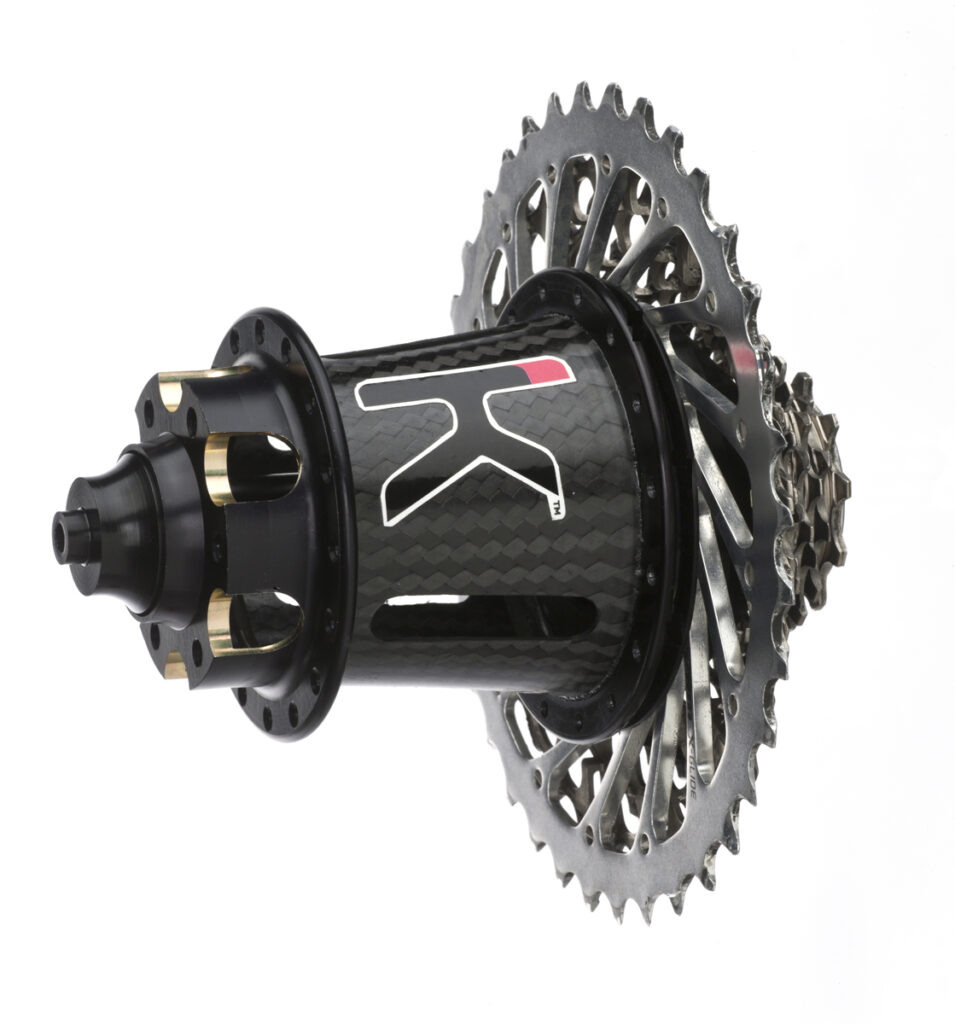

So, the freehub and cassette system has been with us for over 25 years now. Is it time for a change? Kappius Components think so, and while their $999 hub might be a touch spendy to instantly consign the current system to the annals of history, its design is based on some sound engineering and could be the shape of things to come. Let's have a look at how it works.
We've seen in recent years how parts of the bike we hadn't considered can suddenly become the focus of development. The bottom bracket is a prime example. Sealed square taper units ruled for many years, then all of a sudden we had Hollowtech 2 and outboard bearings, we had press fit and BB30, we're just getting our head round BB386… that's a lot of design thinking going into two bearings and a tube. Will hubs be next? Kappius think so, and they're ahead of the the curve with a brand new system already in production.
Father and son team Russell and Brady Kappius are not happy with the current setup, and that's been the driving force behind the development of the Evolution hub. "I wouldn’t have moved forward with the Evolution hub if I didn’t firmly believe I could make a significant change for the better", says Russell in his design philosophy. So, what's to change?
Well the freehub, for all its ability to make the process of swapping cassettes a fairly simple process, places serious design limitations on the hub itself. Chief among them is the placement of the wheel bearings, which on the drive side of the rear wheel have to be inboard of the cassette, and in many cases that means they're even inside the wheel flange: almost on the centre line of the wheel itself. In an ideal world, says Kappius, the bearings would be as widely spaced as possible to make for a more stable load bearing structure. We've seen exactly that progression with bottom bracket bearings moving outwards to create a lighter, stiffer platform.
The freehub system also places constraints on the size and positioning of the drive transfer system; normally this is a tooth/pawl system and sits inboard of the cassette, again near the centre line of the wheel. The small diameter of the drive transfer system also means that it's transmitting very high loads, making it prone to failure.
So, how does the Evolution hub differ? Well, there's no freehub. the hub body extends all the way to the dropouts through the middle of the drive cluster, allowing the bearings to be placed as widely as possible within the space available. This means that the forces the axle has to cope with are reduced, allowing a lighter axle to be used, and the wider base of the wheel hub makes for a more rigid structure.
The drive system is mounted externally on the hub body and a series of splines engage with the drive cluster. It's larger than the tooth and pawl system of a freehub (57mm compared to 35mm) and it's placed further out on the axle to keep all the wheel forces as close as possible to the 'ideal trajectory' which Kappius define as a straight line from the centre of the rim to the outside faces of the hub. The drive ring engages 240 times in a revolution, almost four times as many as even a Chris King hub; there's 60 teeth and 8 pawls (using rare earth magnets instead of springs) that are offest such that two are engaged at opposite sides of the hub at any one time. The greater diameter, and the positioning of, the drive ring mean that the drive cluster can be made lighter but the whole system is stronger. The conical internal face of the cluster narrows to a cartridge bearing in the far end and the whole thing attaches to the hub body with an 18mm cone spanner; there's no need for chain whips. The drive clusters are currently engineered from SRAM Red and XX cassettes.
And the benefits? Stronger, lighter hubs that deal much better with the forces involved in driving a bike forwards. The design incorporates a wider hub body and bigger flanges along with the new drive system, with disc mounts incorporated into the flange design instead of using a separate mount, driving weight down. Current production hubs are about 270g but Russell is confident that weights as low as 200g are possible once production ramps up. That's comparable to the very lightest hubs out there, but there are also big gains in reliability too. The oversized drive ring (for which Kappius has a patent) has to cope with lower forces and should be much more durable. It should, says Kappius, "last forever". Here's hoping. Currently the hubs are available in 135mm and 142×12 for mountain bike frames, but Russell is looking at road bikes too. Although his opinion is that road bikes will adopt 135mm spacing soon.
"I'm very much a proponent of discs on all bikes, and am actually riding a Specialized Crux with BB7s right now, with my hubset," he says. "That said, I don't intend at this point to have a 130mm disc rear hub, but rather a 135mm. I'm betting that is where we end up once the 130/135 choice is made. And heck, I can interchange that wheel from the Crux to my Cannondale Flash 29er with just a cogset swap. But if it looks like frame manufacturers decide on the 130mm spacing for disc road wheels then I'll support it. It's pretty easy to do."
The major downside for now is the cost: at $999 with a drive cluster, it's a pricy thing indeed. But these are early days and small runs; assuming that the feedback is positive it'll be interesting to see whether the design principles in the Kappius hub get more widely adpopted. "Time for the bicycle hub to catch up with the other exciting cycling technological advancements", says Russell. Maybe he's right.



















12 thoughts on “Kappius Components: the death of the freehub?”
Chief among them is the
Chief among them is the placement of the wheel bearings, which on the drive side of the rear wheel have to be inboard of the cassette, and in many cases that means they’re even inside the wheel flange: almost on the centre line of the wheel itself.
Last time I serviced my freehub the drive bearings were near the axle ends as per the diagram below so apart from the larger ratchet it doesn’t sound that advantageous
http://sheldonbrown.com/k7.html
joemmo wrote:Chief among them
The freehub bearings aren’t part of the load bearing mechanism for the axle though. They’re just to make the cassette spin
Barry Fry-up wrote:
The
On Shimano freehubs (the ones shown on Sheldon Brown), the cassette body is certainly load-bearing – that’s why it needs to be attached to the hub shell via a stout 10mm or 14 mm hollow steel hex bolt, and there’s no bearing between the cassette body and the hub shell. The cassette body spins on two rows of tiny balls inside the body itself. The increased distance between bearings compared to older screw-on hubs was touted as one of the main advantages of the Shimano freehubs, way back in the days when they were introduced. The other was of course easy interchangeability.
That said Campagnolo, and most hubs with cartridge bearings, have none-load-bearing cassette bodies which are held on only by the hub axle itself; half of the hub bearings are between the cassette and the hub shell, almost directly under the spokes. This basically negates half of the reason why Shimano went with freehubs in the first place.
I think the Shimano design is far superior for this reason, though it wouldn’t surprise me at all if it’s actually protected by patents. Now if only someone made hubs with Shimano’s bearing placement plus Campag’s replaceable bearing cups…
Thanks so much for all the
Thanks so much for all the comments! I wanted to clear up some misconceptions regarding freehubs and my design. While it’s possible to place wheel bearings wider using a standard cassette spline, the common Shimano designs do not do this. The outer bearing pictured on Sheldon Brown’s site is not a wheel bearing. The discussion of freehubs on that site is erroneous.
If you get a complete cross section of a typical freehub and ask yourself “What does that innermost bearing on the drive side do?” you’ll understand.
Nothing in my design is a result of working around existing patents. Both Shimano and Mavic have some hub designs with wide wheel bearings, but none of them have utilized the space under the cogset as I have.
Wide wheel bearings are good. Big flanges are good. But one of the biggest pleasures of riding my hub is the quick engagement. Especially in low gear on my mountain bike, and while cyclocross racing where you start and stop pedaling a bunch.
Thanks again for the comments!
Rus
rkappius wrote:Thanks so much
Respectfully Rus, I think you are mistaken – this is what a typical Shimano freehub looks like once the cassette body is removed:
http://sheldonbrown.com/images/uniglide-oldhub.jpg
http://www.parktool.com/uploads/images/blog/repair_help/frhub_parts.jpg
There is no “innermost bearing on the drive side”. As shown in the pictures there’s no bearing at all between cassette body and the hub shell. The Shimano cassette body screws onto the splines seen there, and the right-side wheel bearing cup is part of the cassette body:
http://www3.big.or.jp/~number-1/Image.ShimanoFH6401RP.gif
The cassette itself rolls on more balls inside the cassette body itself (inside part no. 11 above), but it cannot normally be disassembled. This is only Shimano freehubs though, and all other freehubs I have seen are NOT designed this way.
But now that you are here Rus, I do have two questions for you. You mentioned cyclocross, so I’m wondering how well the cut-out design of the hub sheds mud. I think a lot of us would think it’s annoying to have a large amount of mud trapped in the hub shell, even if it doesn’t affect the bearings.
Secondly I wonder if the choice of re-manufactured XX and Red cassettes is necessitated by the larger freewheel mechanisms in your hubs. I was just looking at the Campag cassette on my bike, and the old eye-measurement seems to say that there’s simply no room in there for a 57mm freewheel mechanism if the cassette isn’t hollow like the XX. Those things are over £200 a pop, and must certainly be part of the high cost of your hubs.
Thank you and keep up the great work.
Well I stand corrected!
Well I stand corrected! Thanks for the education – every hub I’ve ever dissected, including Shimano’s, has had narrowly set drive side bearings, Including modern Dura-Ace:
http://techdocs.shimano.com/media/techdocs/content/cycle/EV/bikecomponents/FH/EV-FH-7800-2252A_v1_m56577569830728254.pdf
Knowing that some freehubs have wheel bearings outboard changes my argument, but only slightly. To me, It still seems unnatural and unnecessary to interface the inner cogs to the small diameter of the standard cassette body. Why not use that space to make the hub shell simpler and more purpose built? That’s what I’ve done, and sized my external drive to fit comfortably under an 11-23 road cogset.
After multiple hub failures personally over 30 years of racing I sat down and drew what I thought would be the simplest and most direct hub design. I alway use as a guide Albert Einstein’s Constraint: “Everything should be kept as simple as possible, but no simpler.”
That’s what I’ve tried to accomplish. Traditional freehubs seem unnatural and complicated to me.
Now to address a couple of thoughts and questions.
Regarding stiffness of the hub, and whether it can be felt. Unfortunately the flex in rims, spokes, and hubs are all additive. So yes, you can feel the stiffness afforded by large flanges and wide wheel bearings.
Cut-outs, and especially when used in cyclocross. At first blush it seems that the hub will “fill with mud.” In practice it’s not been a problem. The spinning spokes first deflect most debris. The debris that does get get in is forced away from the hub due to the effects of inertia. What does end up on the hub is easily washed away. In 2 years of use mostly on the mountain bike it’s been a non-issue.
One thing the cut-outs do accomplish is making people take pause and think. I want people to think about hubs and the cut-outs are a great way to make that happen. They are not core to the design, and can easily be deleted.
With regard to your Campy cassette. Yes there is room for my drive under it. Think about the space between the innermost cog and the cassette body. There is plenty of room, a 23 tooth cog is 85mm in diameter. A 21 is about 78mm. But your cassette does need to change to transfer to my large drive, and the SRAM cogsets are the simplest for me to rework today.
What I’ve strived for is a simple, reliable, well performing hub. When I described it to Joe Breeze and compared it to the change from interior bearings on a BB to external bearings, he exclaimed “it’s far more important than that!”
I hope you agree. Thanks again for the comments, Rus
I guess I wouldn’t have
I guess I wouldn’t have thought that hubs suffered paticularly from a lack of stiffness. Given that the major difference between a stiff wheel and a flexy one seems to be in the build quality and spokes, I wonder if it will be possible easily to notice the difference. But I guess a stiffer design means less material can be used and thus weight saving, rather than additional stiffness, is the main advantage? 😕
step-hent wrote:I guess I
I guess people thought the same about bottom brackets though, eh. We weren’t bemoaning the square taper particularly but external cups are certainly an improvement
shimano’s design is patent
shimano’s design is patent protected so perhaps the kappius hub is partly about getting round that. I reckon the key to success for parts like this is whether they can be replicated with lower cost materials and manufacturing or whether they rely on high tech & lightweight gubbins to work. Rare earth magnets..? This looks a little bit niche at the moment.
Like the idea of being able to remove the cassette without a chainwhip though.
all techy comments
all techy comments aside….
this thing is gorgeous!
Very interesting. To my
Very interesting. To my layman’s eye it looks like Shimano has removed the main advantage of the freehub from their road groupsets.
A quick look at the Simano tech-docs appears to show the XTR mtb freehub still has the outboard bearing design mentioned by Shanghaied:
http://techdocs.shimano.com/media/techdocs/content/cycle/EV/bikecomponents/FH/EV-FH-M985-3012_v1_m56577569830703727.pdf
http://techdocs.shimano.com/media/techdocs/content/cycle/EV/bikecomponents/FH/EV-FH-M988-3009_v1_m56577569830700090.pdf
Very nice looking design.
240
Very nice looking design.
240 engagements per revolution? I’d be interested to hear how that sounds when freewheeling!
…and thanks Rus for joining the discussion, it’s fantastic to hear direct from the designer.