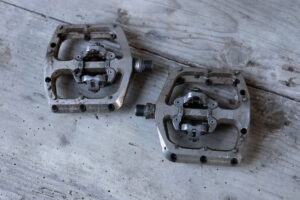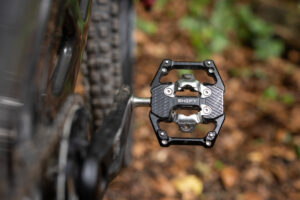


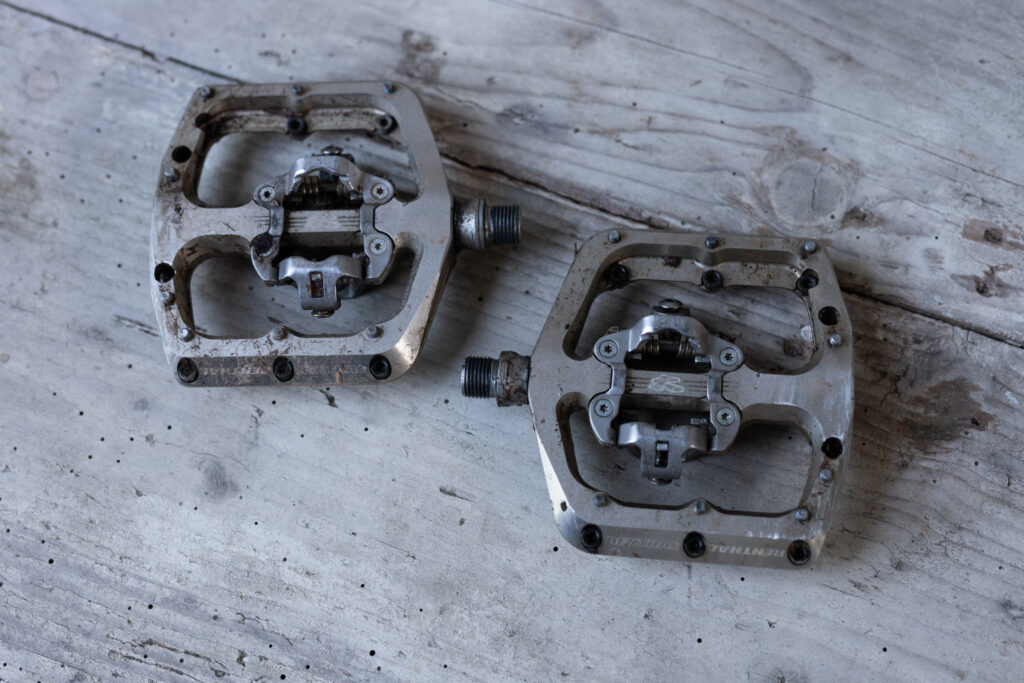

Built for the rigors of downhill riding, Renthal’s Revo-DHC offers the platform size you would expect from a flat pedal while adding a clipless mechanism. The result is perhaps the most supportive clipless pedal on the market, and it’s incredibly easy to clip into. However, it’s not without a weight penalty; it’s rather pricey, and I would like to see a longer axle option.
Renthal Revo DHC Downhill Clip Pedals – Technical details
As you might be able to see from the Revo-DHC pedals, there’s quite a bit going on, but there’s a lot of familiarity behind them, especially if you’ve been riding SPD pedals, or even other pedals in Renthal’s range. That’s because they use Renthal’s own spin on an SPD binding, and they borrow many of the technologies we’ve seen on its other pedals.
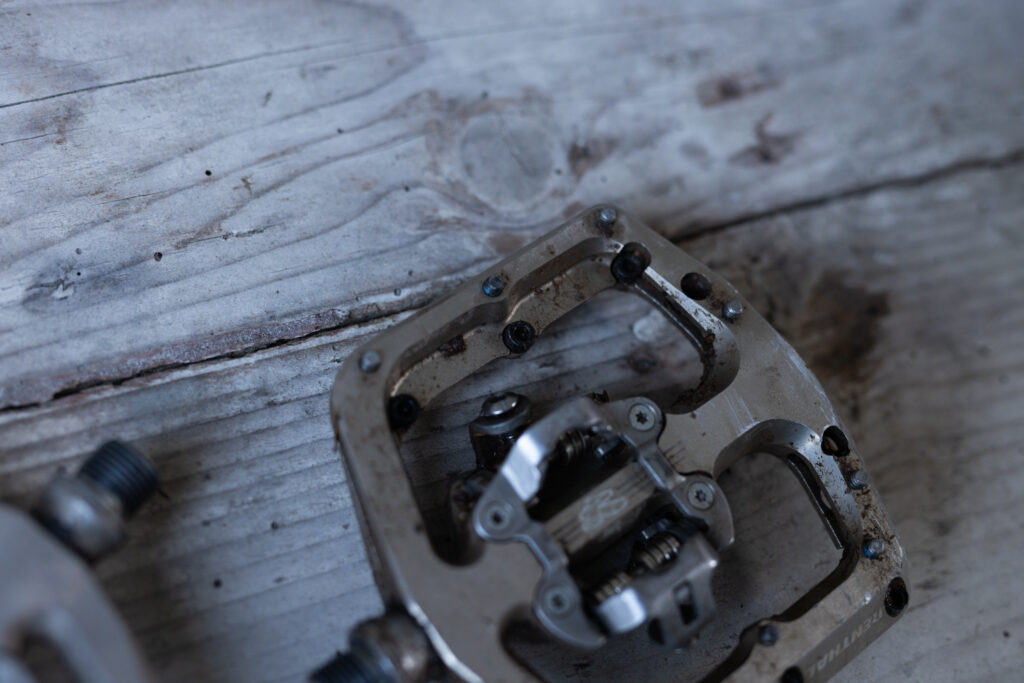
The idea behind it is to take advantage of the benefits that come with SPD pedals and, mostly, the cleat’s availability, but the brand has rejigged how the mechanism moves upon engagement. It all revolves around the rear claw as it moves backwards and down. This movement is said to reduce the force that’s needed to engage with the cleat, so clipping in should be easier. Of course, each binding, or mechanism, comes with its own tension adjuster and a wide range of adjustment.
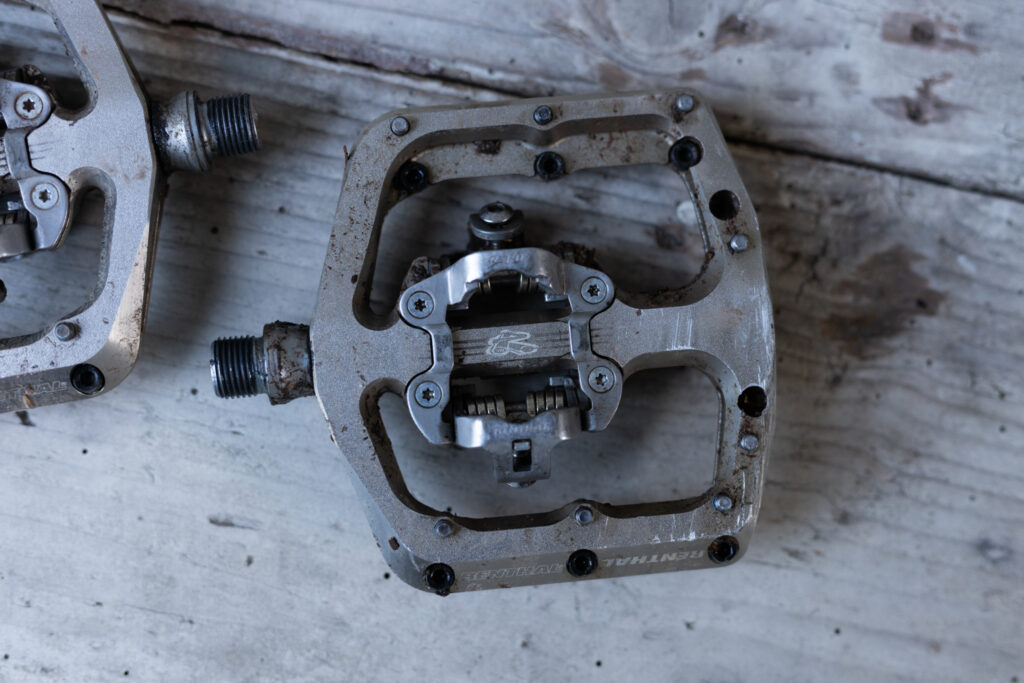
But moving onto that platform, that’s where things really get different. It’s large, and it’s designed to provide the support and control that you’ll get with a flat pedal, but combined with a clipless mechanism. It measures 100mm by 104mm, so it’s the same as the Revo-F, the brand’s flat pedal, but importantly, the binding looks offset (kind of). This is to offer support in all of the right places, while offering the same mechanism placement that you’ll find on a regular Shimano SPD pedal. So the distance between the centre of the mechanism and the axle’s thread is 54mm.
That platform is home to eight pins per side, and Renthal includes two full sets of different sizes in the pack, along with a good handful of spacers. This means riders can adjust the pin height from 1.5mm up to 5.5mm in one millimetre increments.
As for the internals, the Revo-DHC rotates on the same axle system that was introduced with the Revo-F, Renthal’s flat pedal. That means that it can be serviced using regular tools that you’ve probably got lying at home. It also uses the axle itself to remove and reinstall the extra-wide Igus bushing.
Alongside that bushing are three cartridge bearings, two of them being smaller, with a larger one set more outboard. That axle is a full-length axle, and combined with the bearing arrangement, Renthal says the pedal will offer increased durability, as the whole pedal is better supported across its axle.
Renthal Revo DHC Downhill Clip Pedals – Performance
Before coming to the Revo-DHC, I had a great time with the Revo-TRC, the smaller, trail-going pedal that uses the same mechanism. I was also lucky enough to try some pre-production DHC pedals, but after something of a rocky experience with the unrefined version, I’m pleased to say that the production model has become one of my favourite pedals to date.
It does require a bit of setup, though. Thrown into the box are two full sets of pins, offering two length options, and then there are a load of spacers to help fine-tune that pin height. And tuning that pin height is a very important part of the pedal’s setup. If your pins are too long, they’ll make it hard to clip in and out of the pedal. Too short, and the pedal provides no traction – granted, some people like that.
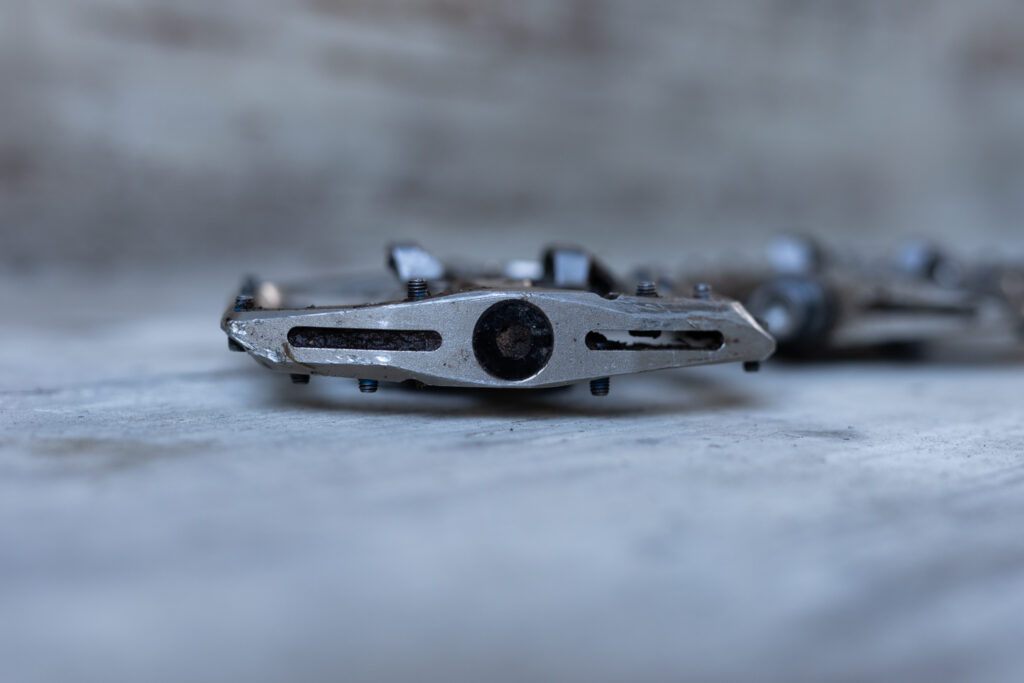
Renthal recommends around a millimetre of space between a shoe’s sole and the tops of the pins, and achieving that takes a good deal of trial and error, and given the fact that there are a fair few pins to dial in, it’s fairly time-consuming. But it’s a one-and-done job that you shouldn’t have to revisit, unless you’re experimenting.
I have tried the pedal with its pins at max length, but I found it difficult to clip in and out, settling on the shorter pins with a spacer underneath. I’ve ridden these pedals with Crankbrothers’ Mallet Trail, Crankbrothers’ Trail Speed Lace Seal waterproof shoes, and Leatt’s ProClip 4.0 MTB shoes and have had consistent performance with each. And owing to the fact that the depths of their cleat tracks are similar, they didn’t require readjustment of the pins for each shoe.
The Revo-DHC uses the same mechanism as what’s found on the Revo-TRC, and it takes the usual form of an SPD binding and uses the classic Shimano-shaped cleats, but it works slightly differently. The rear claw of the mechanism moves backwards and downwards as a cleat is presented to it, rather than just backwards. As a result, it’s incredibly easy to clip into. You still get that positive, audible snap once you’re engaged; it’s just a smoother motion that takes noticeably less effort. After mid-corner dabs and mid-trail panics, this is a surprisingly powerful saving grace, as I very rarely found myself hunting for the mechanism as I was riding. The cleat just slipped into the binding predictably and consistently.
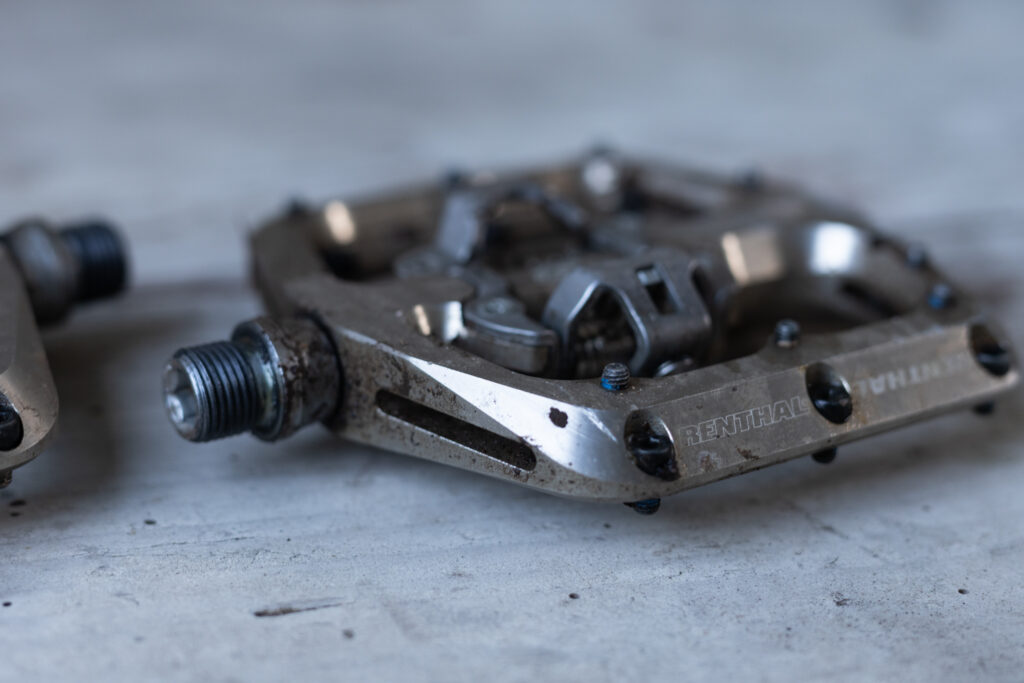
The pedal’s platform uses a carefully sculpted convex profile for a very good reason. It presents the mechanism closer to the shoe than the pins, depending on their length, so it aids clipping in and out, but when weighted, it allows the shoe to comply with its shape, forcing the pedals to sink into the sole. And when weighted, that’s where the Revo-DHC makes sense. It really does balance the best of both worlds of flat pedals and clipless, and its massive platform spans the breadth of the shoe. The result is superb support at a level that no other clipless pedal offers, making for a clipless pedal that can be ridden like a flat one.
What I mean by that is the width of the pedal boosts support to the outer edges of the shoe, which brings a useful touch of control when cornering, as it can be weighted in ways other pedals cannot.
Then, as the shoe flexes to conform to the Revo-DHC’s profile, you get good traction. With the pins how I’ve set them up, it balances a smidgeon of float with a near locked-in feel that doles out confidence by the shed load. Of course, the freedom of float can be tuned depending on how you have the pins set. With them in their longest setup, it’s as locked in as a pedal can get, as the long pins are forced deep into a shoe’s rubber when engaged with the pedal. However, it is noticeably harder to clip in and out with that setup.
As much as I like the Revo-DHC, it’s not without a few fairly noteworthy downsides. First of all, it’s not a light pedal, with a pair weighing 643g. There’s also no option for longer axles, which I would appreciate for a small boost in stability. Of course, there’s also the extra time spent setting them up properly.
Finishing up with durability, it’s very good. I’ve ridden these pedals on and off throughout the year, and they’ve withstood absolutely everything. Yes, there’s the odd scratch, but in terms of performance, they’re just like new.
Renthal Revo-DHC – Verdict
It’s also a rather expensive pair of pedals. As much as I like them, £189.95 is quite a lot to ask, especially when there are other excellent pedals available for considerably less. Albeit none provide quite the support these do. One of which is OneUp Components’ Clip Pedals. These will set you back £142.99, and although they’re not nearly as large, they’re certainly lighter and thinner, if that’s what you value.
They do beat the Wolf Tooth Components Shift pedals, however. But at £205, they’re lighter, still fairly supportive, and they get a neat axle length adjustment.
If you’ve always shunned clipless pedals for the comparative lack of support, the Renthal Revo-DHC pedals are well worth a try. In their size, they offer flat pedal-like support, and the easy engagement of Renthal’s mechanism makes them a breeze to use. They do require a bit more setup time, but the performance is well worth it. However, if you’re on a budget or you’re after lightweight, these pedals aren’t for you.
Test Report
What does the manufacturer say about this product?:
Renthal says, “The radical new Revo-DHC is a downhill race pedal which gives all the control benefits of a flat pedal, with the security and pedalling efficiency of a clip pedal.”
Tell us some more about the technical aspects of this product:
1.5 to 5.5mm pins, renthal binding,
Any further comments on quality?:
Excellent quality but heavy
Any further comments on performance?:
No clipless pedal offers support quite like it but requires more setup time
How does the price compare to that of similar products in the market, including ones recently tested?:
Cheaper than WolfTooth SHIFT but pricier than many other products.
Did you enjoy using the product? Yes
Would you consider buying the product? Yes
Would you recommend the product to a friend? Yes
Use this box to explain your overall score
What the Renthal Revo-DHC offers is unlike anything else on the market, but its heavy, expensive and takes more time to set up than others.
About the tester
Age: 34
I usually ride: Santa Cruz Bronson
I’ve been riding for: 10-20 yearsI ride: A few times a weekI would class myself as: Experienced
I regularly do the following types of riding: Mountain bike Enduro