


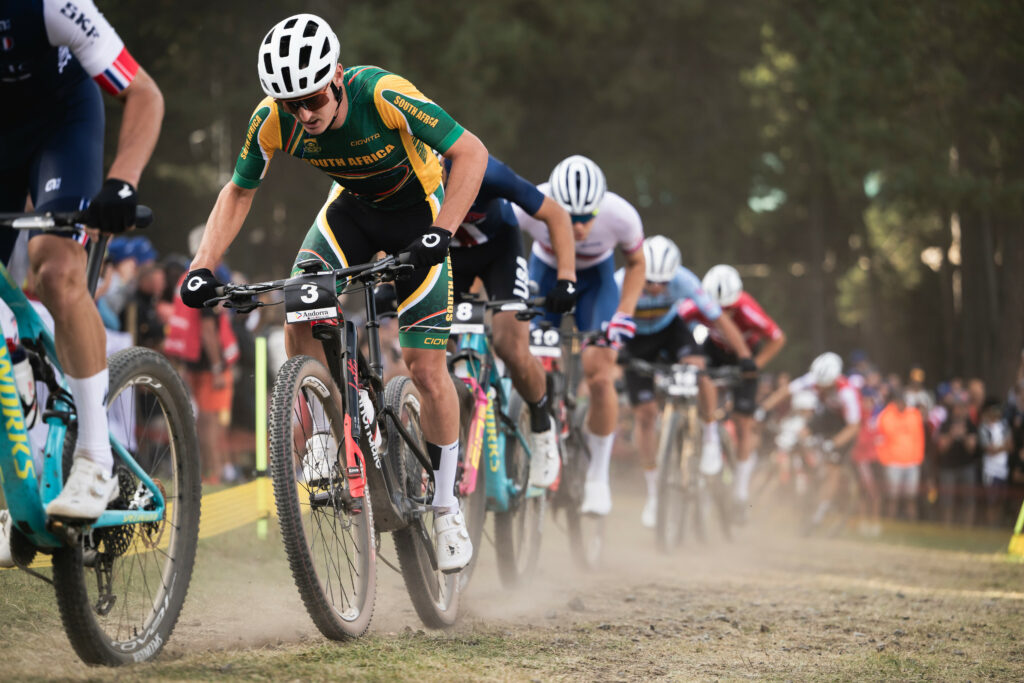

Cross-country mountain bike racing and our sport have come a very long way in the past 40-odd years. In many ways, XC is almost unrecognisable compared to today’s fast and high-flying form when compared to the loose raggedness of the sport’s pioneering days. From the mid-1980s, the genre was etched out and carved from scratch by a group of fun-loving, passionate – and often ingenious – souls in the UK and beyond.
Here we take a hazy look back over the UK and global cross-country racing evolution from the past 42 years, which is when the first officially recorded cross-country ATB (All Terrain Bike) races took place here.
This is not a definitive timeline, and I’m sure some out there will remember slightly different fine details of certain things. Much of this was a long time ago, and it’s intended to show the contrasts of what we’ve seen over the years, stuff younger generations likely know little of.
So, hold on to your Bula hat and enjoy the ride down rattly old memory lane…
In the beginning
“Power is tearing human minds to pieces and putting them together again in new shapes of your own choosing,” wrote Orson Wells in his disturbing warning of the future to come in his novel 1984. Could he, maybe, just maybe, have been predicting that 1984 would be the year that mountain bike racing first came to the UK?
Well, I doubt that very much; his warning was eerily more sinister, and even more so in the times we now live in. However, as much as his hypothetical timeline may have been a bit off, I guess, in cycling terms that line could well apply to the virtually unknown sport of mountain biking, which was set to do for cycling on our shores.
London, May 1984, that was when the first known organised cross-country mountain bike race took place in the UK. This was a short circuit cross-country race held at Eastway, which is now Lee Valley VeloPark. The race was part of a pioneering attempt to launch this whole new and yet-to-be-defined sport in the UK (which was still called ATB, or All Terrain Bike) by most in the U), and was part of what was to be ‘The Fat Tyre Five’, a planned series of five different off-road races, of which I understand only three took place.
Eastway would later go on to be home to the Beastway series, which is, perhaps now, the longest-running UK MTB race series. A month after that came the first edition of the Wendover Bash, a weekend four-parter organised by the ‘grandad” of British MTB, Geoff Apps (RIP). This legendary race was arguably one of the most influential in defining the direction of UK MTB racing through the evolutionary 1980s. Riders rode on a very different kind of mountain bike back then when compared to now; a rider would ride the same bike in a cross-country race, a hill climb, a downhill, and in observed trials – the winner was the fastest overall. Third in the series was a point-to-point cross-country race from Brecon to Hay on Wye.
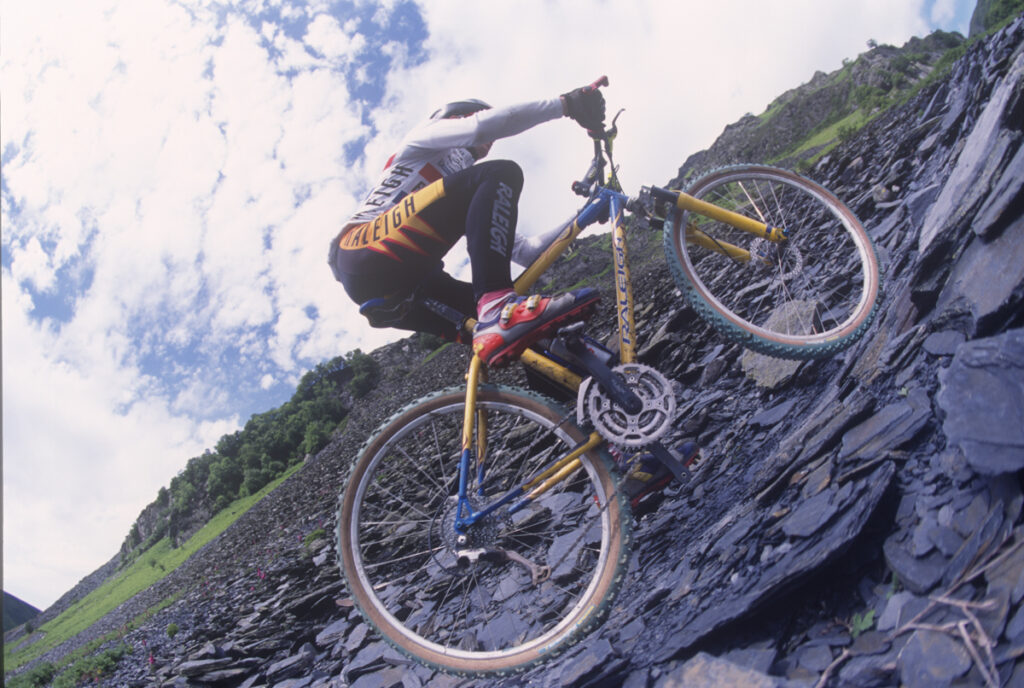
The seeds were sown; all be they randomly. At this stage, mountain biking was very much at the fringe of the spirit of cycling, and largely scorned by the old school establishment. Riders here were not your normal serious racers – on the whole they were there for the hell of it, the fun, the challenge, the rebellious community with rules yet to be written. Naturally, the racing was taken seriously by those at the sharp end of things too.
By 1985 things were hotting up for mountain biking, and the US organisation NORBA ‘extended’ with a UK arm, and more races started to appear. Amongst these was the Man Vs Horse in Wales, a one-lap marathon-distance race around the wilds of Mid Wales, which was set to be a classic for several years to come.
Things were still very much about the ride back then – trail info and resources were almost untapped and largely unwritten, and thus the challenge of competing these races and riding new terrain was a huge draw for regular riders.
In around 1986, bike maker Jeremy Torr and cycling journalist Max Glaskin launched the MBC (Mountain Bike Club), a soul and fun-based organisation that took over from NORBA and launched its own events and series, which was the baseline predecessor for the NPS we now have. In 1987, the MBC held its first National Championship race in Telford.
The sport was gaining mainstream cycling attention by the late 1980s, and brands and sponsors were starting to bank the discipline, although their ideals differed somewhat from the original years. Many races back then, and until the very early ’90s, included XC, DH and trials, with riders racing all three on the same bike. By then, the BMBF (British Mountain Bike Federation (aka British Cycling) had been formed, and was taking a close interest in this thriving young rebel known as mountain biking.
In 1987-1989 the sport went international, with the Grundig World Series and both US and European World Championship races, all still unrecognised by the UCI.
In the UK, things changed when Tim Gould and David Baker showed up and smashed the field at a round of the National Series; Torr and Glaskin’s work was done, the sport had a different flavour now, and they duly moved on. The BMBF took the race organising reins then, and things got serious – and ‘official’.
Becoming official
By the late 1980s British riders Gould and Baker were global stars of the sport, particularly in the USA for Gould. The sport was still very US-dominated then, and many of the courses were held in the high mountains, and races lasted two and a half and three hours, and longer, more like marathon race distances of today.
In 1990 the sport got its first official UCI World Championships, and ‘official’ National Championships followed in the UK and elsewhere. By the early ’90s American-style mountain bikes dominated the scene, and multi-discipline races started to fade towards specialisation. As the ‘official” World Cup and NPS evolved through the early ’90s, the sport thrived globally, including in the UK.
The Olympic dream
When it was announced that mountain biking would become an Olympic sport in 1996, things changed dramatically. The whole world – riders, sponsors, federation and more – took note, and things started to change, both for the better and the worse.
In the UK, through the ’90s, the sport saw a rapid rise in popularity, and numerous race series and regional organisations appeared, such as NEMBA, NWMBA, MBCW, SAMS, etc.
In the early 1990s, races were still long and mostly on natural courses, and winning gaps were often measured in minutes. Still, some riders mixed it up – including the likes of Steve Peat, who won the Sport category in the National Series and raced downhill on a Kona hardtail. Even internationally, several racers still did both – Juli Furtado even became XC and DH World Champion in the early ’90s, but by the mid-90s that was done with.
Pits, rock gardens, short circuits and outside assistance
As the 1990s ‘Golden Era’ faded into the early 2000s, the sport was getting more organised, more regulated, and more serious. Up until this point, riders had to be technically self-sufficient in races, which meant fixing any mechanicals or flats yourself on track. It was commonplace for riders to start with a part-inflated innertube bulging out of their back pockets and with a multi-tool in a seat pack.
In 2005, that changed when the UCI allowed outside assistance and manned pits, which very much changed the original nature of the sport. The decision likely came around in part due to the increasing industry and sponsorship investment, and to also reduce the mechanical risk element for riders in an increasingly high-stakes sport.
Through the second half of the 2000s, the UCI also cut lap distances and race durations – eventually hitting the 80 to 90-minute duration we now have for Elite XCO races. This transition gave the sport a whole different feel and style of racing, and led to a noticeable shift from around 2010 away from natural courses to part, and fully manmade circuits – as have been de rigeur since the 2010 Dalby XCO World Cup and the 2012 London Olympic races. Perhaps the closest course to an old school XC course on the World Cup circuit now is Mont Sainte Anne, in Canada.
Going wide screen and big time
There’s no getting away from the fact that TV broadcast holds a lot of power over mountain bike racing, and the timing and logistics of this directly impact the sport’s direction, format, and the courses. New, shorter, and more intense circuits are far easier for broadcasters to cover, and also make for more dramatic, closer, and entertaining racing
TV coverage is also, in no short order, what rings in the lion’s share of sponsorship money. This coverage, and its importance, has increased dramatically in the past few years, especially since WBD (Warner Bros Discovery) took over organisation and broadcast of the races.
With this, the sport is heading in what could seem to be a more professional, perhaps elitist direction. This direction is something many involved in the sport are all in favour of; though there are also a number out there, on and off track, old and young, who question the trail ahead.
There is no getting away from the fact that the races and the coverage now are next level. The racing is so fast, close, technical, and intense when compared to ’90s racing. Though there was definitely something epic and romantic about watching Ned, Tomac, and Gould smashing seven bells out of each other on a wide-open mountainside for hours on end.
There was also a whole lot of true, original, and relatable soul in watching guys on high-rise bikes wearing T-shirts and trainers while smashing and crashing through the woods.





3 thoughts on “The revolution and evolution of XC: How cross-country racing has changed in the UK and beyond”
1984 was written by George Orwell not Orson Wells.
That’s what Big Brother tells you…
Would you like to take another run at that?