
If you’re new to bikepacking, you’ll likely have figured out that you need an awful lot of kit in order to have a smooth and successful adventure. But your bike is a key tool in building the best experience possible. Here are some tips on finding the best bike for bikepacking.
The beauty of bikepacking is that it can be done on nearly any bike you like, aside from a full-on downhill rig. After all, you’ll want to pedal up the hills. But the real problem that some bikes present is space for luggage, or the lack thereof.
Thankfully, there are a slew of brands that create racks that can up your bike’s cargo capacity, whether you’re riding a full suspension enduro bike, or even a gravel bike. They do add weight, however, and adding more mass to a bike that’s already pretty heavy (like an enduro bike) will spell a very difficult time, as extra weight has a pretty serious effect on how your bike handles.
If you’re looking to invest in a new bike to best prime yourself for a bikepacking career, read on where we’ll expand on things in more depth.
Consider the kind of riding you’ll be doing
As with any kind of bike, take a good, hard think about the kind of riding and terrain you’ll be tackling. It’s a matter of fact that some types of bikes handle different riding styles than others, so pick what’s best for your terrain.
You might also like to keep things familiar. Are you a gravel aficionado or a mountain bike purist? Either way, you’ll already be comfortable riding what you know, and your body will be accustomed to the positions that both bikes command.
Next up, think about how long you want your bikepacking rides to be both in terms of time and distance. For shorter rides, you won’t need to carry all that much, so you can get away with less cargo space. For longer rides, yep, you’ll need more space in the front triangle, more mounting points, and it’ll be worth taking a look at some racks.
Lastly, where do you plan on eating and sleeping? If you’re going to go for the luxury of a hostel or hotel, you won’t need to carry around a tent or sleeping gear. If you intend on stopping off at the shop, then lugging food around isn’t as much of a concern. Therefore, you won’t need to carry as much, and you won’t need the space to hang more packs. Vice versa, if you’re looking to go for a proper off-grid adventure.
Gravel bike or mountain bike?
When it comes to bikepacking, two main bikes spring to mind: mountain and gravel bikes. There are a few that straddle that line, too. All of them come with a variety of pros and cons.
Starting with gravel bikes, these can be a bikepacker’s favourite as modern gravel bikes are more than capable of tackling the majority of terrain you’ll encounter. Throw on some fatter tyres and vibration-damping components, like a stem, and you’ll be up for a comfortable, luggage-laden time.
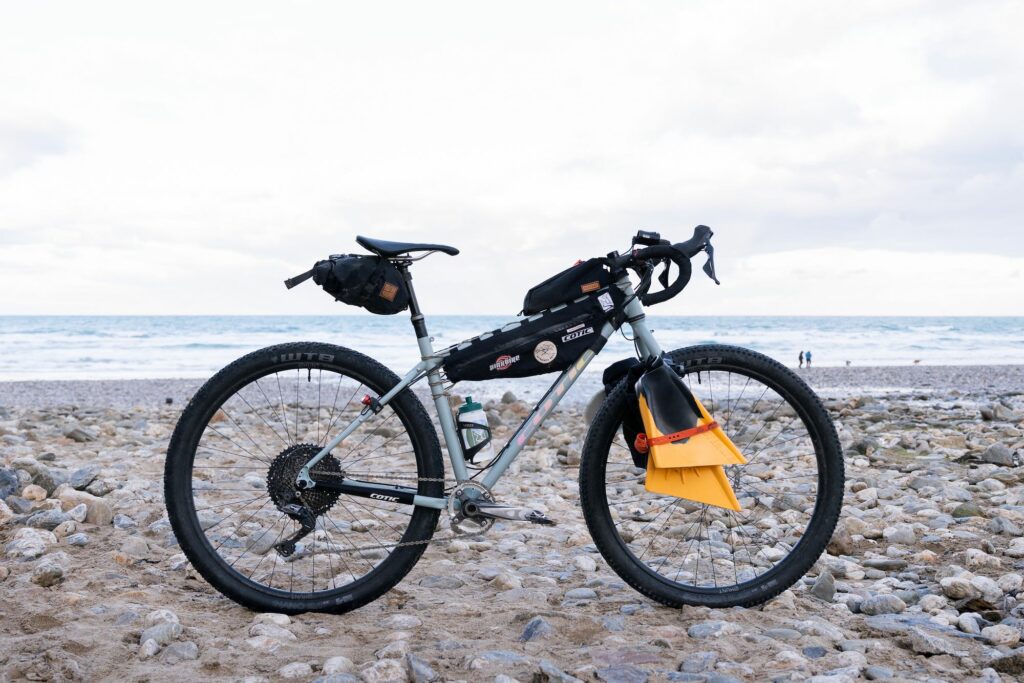
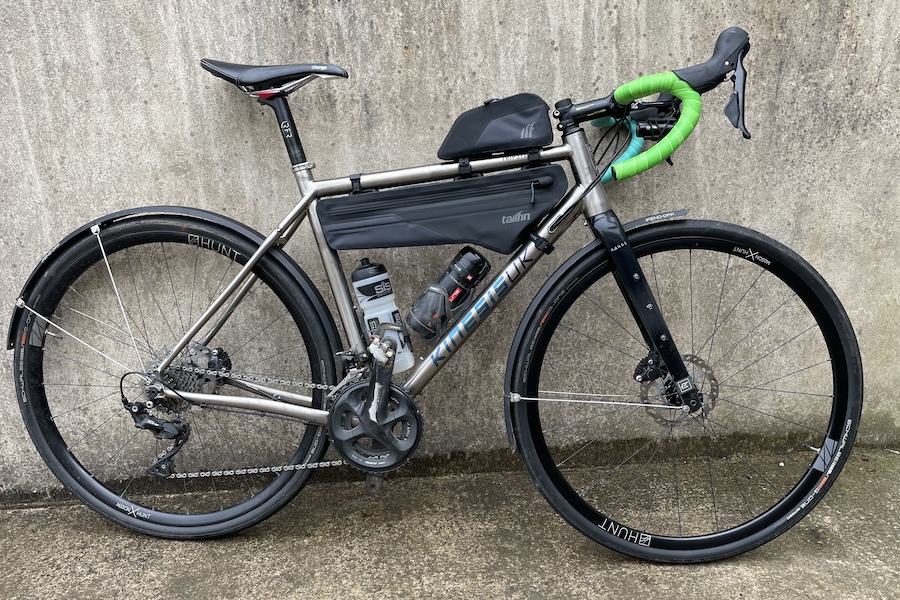
Because gravel bikes rarely come equipped with suspension, they offer tonnes of space for hanging luggage in the front triangle. There are also loads of gravel bikes on the market that come with luggage mounts everywhere, like on the top tube, and along each fork leg.
Then, as gravel bikes typically feature a more conservative geometry (compared to a mountain bike), they’ll also preserve their responsive and agile handling when loaded up with kilos of kit. Thanks to their skinnier tyres and lower system weights, they’ll be easier to pedal around, too.
As you might expect, mountain bikes suit gnarlier terrain better. Though some have lower standovers, which reduces space in the front triangle, so you won’t be able to stow quite as much gear. With slacker head angles and more relaxed geometries, their handling can suffer more when loaded up, so keep that in mind.
Additionally, many mountain bikes come equipped with suspension forks. While they do great things for comfort and traction, you’ll sacrifice the hard mounting points of a rigid fork, so you’ll have fewer places to carry kit. That is, unless you find an adaptor that adds mounts to your suspension fork, like Tailfin’s Carbon Suspension Fork Mount.

But the ace up a mountain bike’s sleeve when it comes to carrying cargo lies in the flat handlebar. Because there are no crazy bends like you’ll find in a drop handlebar, you can strap larger bags onto the front of your bike. Don’t go too heavy, though, or it’ll impact your steering.
Mountain bikes designed with a bit of a bikepacking swing are usually cross-country bikes, as they’re lighter and more efficient to pedal around. But there are a few trail-focused mountain bikes that’ll be happy to carry some bags. Take a look at Surly’s Sorceress and Merida’s Big.Trail.
But then, there are mountain bikes that are built especially for big bikepacking adventures, like Mason’s Macro. It’s an adventure hardtail that throws away any bells and whistles for the sake of simplicity and comfort. You don’t want to be messing around with a broken wireless drivetrain miles from civilisation, after all.
Suspension or rigid?
We’ve already highlighted one drawback of running a suspension fork on a bikepacking bike – if can reduce the amount of cargo you can carry as many suspension forks don’t have mounts along the legs. However, they do pose some very real advantages.
If your bike is loaded to the nines with bags, they’ll flap about as you ride over lumpy terrain. That’ll then transmit all kinds of feedback to you, the rider.
%20002%20copy-1024x683.jpg)
Not only does suspension boost traction and comfort, but it’ll add a level of energy absorption that’ll reduce the impacts of all of those bags rattling around. This’ll make your bike easier to ride up and down a hill.
That said, a suspension fork that can be locked out will be especially useful on the climbs. If you’re able to stop the suspension from compressing as you ride, you’ll claw back extra efficiency, so you’ll be able to tackle climbs with a heavily laden bike a little easier.
Another option to check out is the suspension stem. It won’t have quite an impact on overall weight as a suspension fork, and it won’t bring quite the level of traction but it will add handy comfort, while reducing the feedback that all of those bags can rustle up.
Does bike and overall weight actually matter that much?
I’ve banged on about weight quite a lot in this article, but in practice, it doesn’t mean all that much, unless you’re racing. This is all where power-to-weight ratios come in.
Adding more weight to your bike does affect things, but if you’re a 60kg rider, for example, riding an eight-kilo gravel bike, with an extra eight kilos of kit, if you’re out putting 200W of pure leg power, you’ll achieve a power-to-weight ratio of 2.63W/kg.
If you choose to add four more kilos by choosing a different bike, or just packing more stuff, those additional kilos won’t harm your power-to-weight ratio all that much, reducing it to around 2.5W/kg.
We are getting awfully nerdy here, but what I’m trying to say is that a few more kilos won’t harm your ability to pedal around all that much, especially if your bike is already loaded with weighty bikepacking kit.