


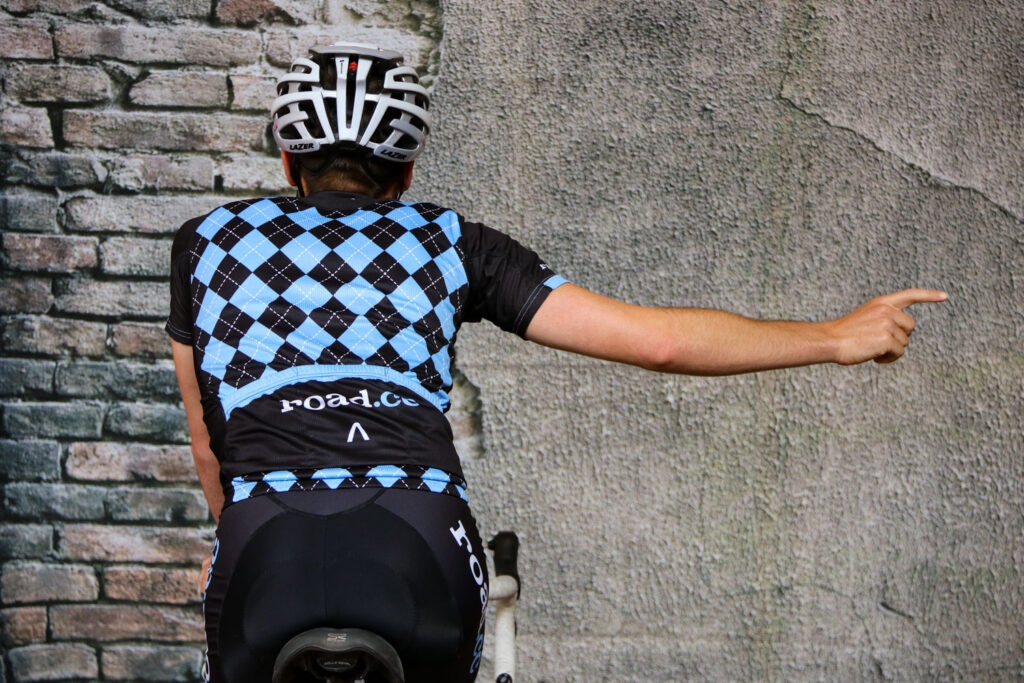

Academics in the US have assessed whether drivers understand cyclists’ communication cues, and looked at the effectiveness of arm signals, head movements, eye contact and road positioning in helping people on bicycles to inform other road users about their intentions.
Arm signals were the most effective form of communication, according to the researchers, who also noted, in news that will surprise few, simulating a mobile phone conversation saw drivers’ accuracy in interpreting cyclists’ signals reduce, something the study concluded “highlighted the dangers of distracted driving”.
One of the study’s authors, Rice University academic Christine Petersen, explained to Medical Xpress that the clearest form of communication was through clear, arm signals, such as holding your arm out straight in the direction a cyclist wishes to turn.
> Know your group riding signals and calls
“Signals that match the direction of movement, pointing where you’re going, are especially important for keeping interactions predictable and safe,” Petersen said. “Hand signals matter, but clarity matters even more.”
The study saw 60 drivers watch video clips of a cyclist performing combinations of different cues, for example head movements, arm signals and utilisation of different positions on the road.

Drivers then expressed what they believed the cyclist’s intended manoeuvre was based on the signal and the researchers collated the results to assess levels of accuracy for different cues.
While the drivers predicted cyclists’ intentions with “above-chance accuracy”, it was only arm signals which “significantly” influenced correct predictions. “Head movement and position on the road had no significant effect,” the study stated.
A post-study questionnaire delved deeper into what the motorists understood of the signals used.
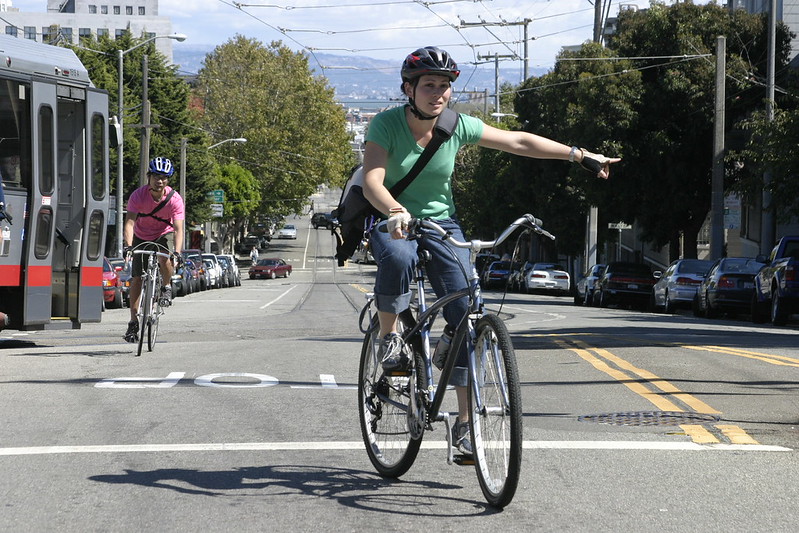
“In the United States, cyclists are required by law to use arm signals to let other road users know they intend to turn or stop (Transportation Code, 1995). To indicate their intentions to turn left, the cyclist is required to extend their left arm straight out. For a right turn, the cyclist can either extend their right arm straight out or bend their left arm at a 90-degree angle and point it upward. To signal slowing down and/or stopping, the cyclist must bend their left arm downward at a 90-degree angle,” the researchers explained.
The questionnaire data found that while all drivers correctly defined straight-arm turn signals, the bent-arm signals were less well known, with less than a quarter of participants understanding them.
The study concluded: “These findings suggest that cyclists should use straight-arm signals and consider adapting the stop/slowing signal to better align with drivers’ expectations. Using communication cues that match drivers’ mental models may reduce confusion, improve situational awareness, and help prevent collisions—especially when driver attention is compromised.”
To simulate distraction, the researchers had some participants complete their task while simulating a phone call. While this was just talking as if on the phone, not using a mobile phone ‘behind the wheel’, the researchers reported a notable drop in accuracy of interpreting cues.
“Distraction isn’t just about looking away,” one of the study’s authors, Petersen, said. “Talking on a cell phone can slow reaction time and make it harder to process what a cyclist is trying to communicate. Cyclists are already at a disadvantage. When a driver isn’t fully attentive, misunderstanding becomes more likely.”




















9 thoughts on “New study suggests arm signals are cyclists’ most effective communication with motorists… as long as drivers aren’t on their phone”
“less than a quarter of [motorists understood the left and slowing signals]”
Sheesh. These are somewhat internationally standardised signals. They are part of the required driver training in a number of jurisdictions in Europe (inc UK and Ireland) and have been for many many many decades.
Basically, it’s official, the vast majority of drivers are just fucking clueless.
In which case, what? Send them a text?
That’s what all those “let drivers know” apps that keep appearing here are for!
Or use those bicycle indicators / helmet or backpack covers with signal lights.
Tech problem? We have a tech solution! (The old woman who swallowed a fly…)
Of course you’ve probably got indicators on your velomobile…
When I was attending primary school (that was a long time ago, sadly), kids aged between 8 and 10 y.o. received basic traffic rules training and bicycle handling and practice provided by none others than motorcycle policemen in their immaculate uniforms. This event took place every year at the end of the academic year. It had the advantage to educate both young cyclists and future motorists.
I have to pass bicycle driwing exam where we were thought the same in 70 and 80ies even in comunistic Yugoslavia
I have found the ‘straight arm’ signals effective on English roads for sixty years.
The’ bent arm’ signals are new to me – are they used only in the USA ?
Unless you’re in a group of riders, then they can’t see your right arm extended!
Despite having had to use hand signals when taking my driving test, I am puzzled by the use of the wrong arm on a bike. Is this just the motorist mentality at work, or do they think drivers can’t see an arm on the nearside?
My motorcycle training emphasised the use of clear hand signals (arm outstretched, palm vertical to turn; no finger pointing!), as they were unexpected & would catch other motorists attention, plus you couldn’t forget to turn them off.
In other news, new study suggests ursine defecation occurs in the woods.