-1024x683.jpg)

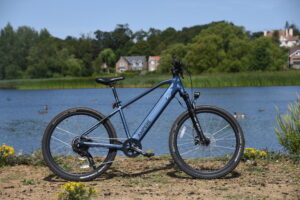
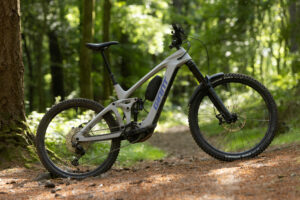
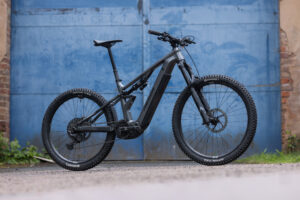
The X-Bolt 120 00 is a full suspension e-MTB with a carbon frame and a powerful Gen 4 Bosch mid-drive motor. I’m not a mountain bike specialist but I have ridden a lot of e-bikes over the years and comparing it to all the bikes I’ve tried, I found it a superb ride. I didn’t just enjoy riding it off-road, where it’s intended to go. I found the combination of big, grippy tyres, a powerful motor and full-sus comfort to be a winner in all conditions.
If you like the sound of this particular model but are baulking at the £5,449 price tag, it’s worth noting that MMR also currently has a big range of 2023 X-Bolts at half price. Premium spec carbon-framed performance off-road machines are more usually priced at £5-6k and upwards, but its 2023 models start at £2,549 and look to be fantastic bargains. The only minor downside is that they lack the Smart System capability of my test model.
Before we get into the bike detail, a quick recap on the brand. As I put it in my review of the E-Woki: it’s clear MMR is serious about producing high performance machines. It specialises in mountain bikes – not surprising when you see that its HQ, where the bikes are designed and hand assembled – is in Avilés near the wonderful-sounding Picos de Europa.
.JPG)
MMR’s other full-sus e-MTB offerings are the 2025 Quercus range, with a Bosch Performance Line CX motor and 800Wh battery (from £4,999) and the lightweight Kaizen range, with Bosch SX power and a 400Wh battery (extendable to 650Wh) with weights starting from around 17kg and prices from £4,999.
Spec
MMR describes the X-Bolt 120’s frame as having, “G2 geometry in intermediate-modulus carbon fibre… for a final weight from 23.5kg.”
Let’s decode this a bit. G2 geometry means MMR looks to make bikes that are both comfortable to ride for an extended time but also high performance. High performance in this case means being able to tackle pretty extreme terrain. Whilst the 120mm front and rear suspension travel on my test model is relatively middling, MMR goes up to 140mm, which should cope with rough terrain at a decent speed. ‘Intermediate modulus’ refers to the stiffness of the frame and again MMR has chosen what looks a good compromise between comfort and performance (high modulus frames are stiffer for better pedal power transfer but transmit more vibration).
.JPG)
I weighed my test bike at 23kg including a 3.6kg removable 625Wh Bosch Powertube battery. That’s a very respectable weight for a full-sus e-MTB with a ‘full-fat’ Bosch mid-drive and a pretty big battery.
The carbon fibre frame may not save as much weight over a similar motor spec alloy bike as you might hope. To give one example that happens to be to hand, the alloy-framed Whyte Kado S that off.road.cc reviewed has a quoted weight of 25.6kg. There are carbon-framed e-MTBs out there with similar motor power and battery capacity that are several kilograms lighter, but only those with cash to burn will be able to afford them. If you want something significantly lighter for similar money, it’s likely you’ll be looking at one of the new breed of less powerful mid-drives that tend to be combined with smaller batteries, like Bosch’s own Performance Line SX or similar offerings from TQ or Fazua.
Worried about tales of carbon fibre frames cracking and being written off? This is not something you tend to read about with alloy. However, the fact that there is a prominent lifetime guarantee sticker on the top of the bike frame should tell you all you need to know about the manufacturer’s confidence in the design.
.JPG)
Given the competitive price of the X-Bolt it’s good to see that it has what MMR describes as “a 4-bar type rear suspension with a pivot point on the chainstays, ensuring excellent sensitivity and independence from braking and acceleration forces.”
As I’ve said, I’m no expert in the technicalities of mountain bike design, but generally speaking the more pivot points you have in a system, the more subtle control the bike’s designers have to play with. In turn, this means that they can design a bike that is suitable for both aggressive riding and longer distance comfort, as the X-Bolt is.
.JPG)
The X-Bolt tested here is model year 2024 and the main difference with the cut-price 2023 X-Bolts is that it features the Bosch Smart system that lets you customise the motor performance. It’s also compatible with Bosch’s ‘plug and play’ 250Wh range extender battery, which the 2023 models are not. Lastly, the 2023 models have Purion and Kiox displays whilst the 2024 models have the newer Intuvia 100 display. However, if these features aren’t critical for you then the fact that the 2023 models feature the same frame and motor/battery setup makes them a massive bargain. Note both model years have Bosch Performance Line CX Motors with 340% pedal assist, 85Nm maximum torque and 600W peak power.
Bang up to date Bosch Gen 5 motors are now available across a number of e-MTB brands offering the ability to tune up torque to 100Nm and peak power to 750W whilst shaving 100g off the motor weight. However, I felt lack of power or torque was never an issue with this bike and I rode over some pretty testing Pennine tracks. I personally would not be tempted to buy a Gen 5 simply for more power, for what would probably be significantly more cash.
.JPG)
There are 12 derailleur gears. The largest 51-tooth sprocket allied with a 34-tooth front chainring delivers an ultra low bottom gear that should go up any gradient, as long as you can stay in the saddle. The Shimano Deore derailleur is a good compromise of quality vs affordability. (I liked the fact it has an adjustable clutch – on when riding to prevent chainslap and off to make it easier to remove the rear wheel).
.JPG)
Like the gear setup, Shimano MT-420 brakes are a great choice in that they offer great performance at a decent price.
.JPG)
Last but certainly not least – as we’ll see in the next section – is a Race Face Aeffect dropper post that lets you drop the seatpost up or down at will via a cable controlled from a handlebar lever.
The ride
.JPG)
This probably isn’t the typical review or use-case scenario for a high performance e-MTB like the X-Bolt, but hopefully it will broaden the appeal of such bikes all the more as they are capable of so much more than giving you an adrenaline top up at your local trail centre. I used the X-Bolt for a regular commuting route taking in some fairly challenging bridleways and hundreds of feet climbing over just a few miles as wella as for local around town style rides. It fared well in both scenarios. (In fact, if your local town’s road conditions are less than ideal, plush full suspension like this really takes the edge off scary-deep potholes and similar urban obstacles.)
In terms of pure climbing, there aren’t many better mid-drives than Bosch’s Performance Line CX – especially when you have low gearing available. Gen 5 Bosch Performance Line CX and other (much pricier) systems like DJI’s Avinox offer more torque and peak power, but as I’ve already noted, I never felt I needed it.
.JPG)
I deliberately chose the photo shoot location to offer a good testing ground with a real mix of terrain: slippy steep mud, hummocky grass and rolling, uneven ground, lacking only rubbly ground and big drop-offs (which I usually avoid if I can help it). The bike offered superb control and plenty of power on tap and the 29in x 2.5in Hutchinson Griffus tyres rolled easily over everything in their path.
.JPG)
I found the main benefit of the the Smart System was the ability to fine tune both responsiveness to pedal pressure and the upper torque limit of all four power levels. This is good for altering the motor performance to suit your style of riding and the local terrain and you can then leave it set like that.
On other test bikes I’ve often thought I could do with a bit less power in lower levels, but here I dialled up Eco and Tour a notch, left eMTB as it was and put Turbo on top level for use in emergency situations! Tuning up to full power in the upper modes is not necessarily an advantage as some riders will no doubt find power delivery a little too choppy.
.JPG)
I did also note that battery consumption was affected quite a lot by increasing the power settings, as you might expect. Testing out what max power in eMTB mode felt like on a largely uphill and often off-road eight mile route, I used 30% of the battery. I ended up lowering the settings again and improving consumption. Full sus e-MTBs with powerful mid-drives are never going to be the most efficient machines though, which is why it’s nice to have the option of a 250Wh range extender that some might need for long and very testing off-road days in the saddle.
Bosch’s eMTB mode is great by the way. Bosch says this mode offers, “dynamic support for eMountain biking with up to 340% rider power. The support moves dynamically, automatically and smoothly between Tour and Turbo riding modes.”
I felt this in the motor feedback and could also see it on the small power meter on the Intuvia 100 display where the power dropped back with gentler, smooth pedalling but topped out at max power during harder pedalling up steeper gradients. This meant that a lot of the time – especially in the hills – it was just a case of selecting eMTB mode and leaving it there.
.JPG)
Another riding highlight was the dropper post. These devices have traditionally been used on more extreme off-road bikes to get your bodyweight over the back wheel on steeper and faster descents, largely for safety and control reasons. However – as quite a few other reviewers have commented – they are a very useful feature for general riding. I found myself dropping the post a little even on moderate descents for extra comfort and dropping it right down at stops. Every bike could do with one!
My only real gripe was the inability to turn on the backlight of the Intuvia 100 display as it only comes on for a preset number of seconds when you change power or display metrics. It would also have been nice if the power selection buttons lit up so you could find them when riding in the dark – but that’s a fault common to the vast majority of e-bikes.
Summary and competitors
I loved my time with the MMR X-Bolt. It convinced me that electric mountain bikes can be used for so much more than off-road fun and at their current level of affordability it’s a great time to invest in one. Okay, they may not do everything a more general touring or city e-bike may, but there are ways and means to kit them out with racks, mudguards and other accessorise to widen their usability. (Look out for a future article on this very subject.)
Having sung the praises of this particular model, it only seems fair to mention competitors. There are a numerous similar offerings in price bracket and motor/battery setup out there, but none seems to quite match the package offered by MMR. Typical examples include these offerings from Marin (£5,299) and Canyon (£5,349).
You could go significantly cheaper – though that will usually mean some compromise on spec. Decathlon produces a full-sus Bosch-powered e-MTB that currently on offer for around £2,500, though this has the 60Nm Performance Line mid-drive, not the CX variant, and so is described as being only for ‘moderately tough trails.’ Even the best discounted CX powered alloy models don’t quite measure up on spec to MMR’s discounted offers despite some attractive discounting – Lapierre and Evans offers page are just a couple of examples that popped up on Google.
All the deals displayed on our review pages are pulled from a constantly updating database feed of the best affiliate deals available. The criteria for deciding on what are the best deals is who is offering the lowest, delivered price. In most cases we will be showing the very best deal available online, but sometimes you may be able to find an item cheaper. If you can please feel free to post a link in the comments box below. To find out more about affiliate links on road.cc click here.