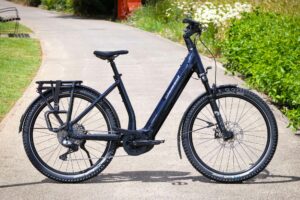
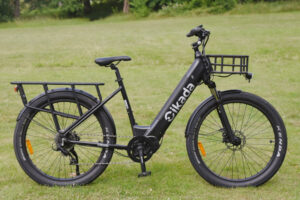
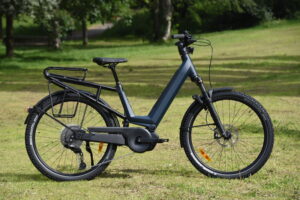
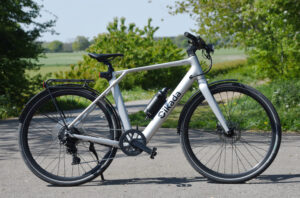
The MMR E-Woki is an unusual e-bike in design terms. It uses the lightweight Mahle X30 rear hub motor with an externally mounted battery more usually seen as a range extender option on Mahle powered bikes that also feature integrated batteries. Whilst at first glance it looks like a hybrid commuter, it’s clearly aimed at being a lightweight ‘do anything’ e-bike, with large volume tyres, front suspension and an enormous gear range courtesy of the mountain bike style 12-speed SRAM derailleur gearing.
You may not have heard of MMR bikes of Spain, as they’ve only this summer launched their e-bike range in the UK. Being as they boast former road racing pro “Chechu” Rubiera (who rode on Lance Armstrong’s Tour de France teams) as part of their design team, it’s clear they are serious about producing high performance machines. Add in the fact their brand ambassadors include Luis Enrique and Fernando Alonso and it’s clear they also have serious financial resources.
Spec

As the electrical assistance system is one of the most interesting aspects of the bike let’s start there. The E-Woki uses Mahle’s eX1 frame-mounted 171Wh battery, XS controller and X30 motor with PAS sensor system.
.JPG)
Mahle SmartBike Systems is an offshoot of the sizeable German automotive supplier so it’s no surprise this system looks very well made and you would expect it to perform reliably for many years. Mahle is more associated with super lightweight, high-performance road and gravel e-bikes so its presence on a £1,899 off-road capable commuter is a real plus.
.JPG)
Whilst this assistance choice is the most basic out of Mahle’s range in technology and battery size terms, it has the strong advantages of simplicity, a relatively low price for well-established tech and good sustainability credentials (which we will get to later).
.JPG)
Not that it is basic compared to most hub motor systems. There is a beautifully small rear hub motor and a removable and very light water bottle style battery. Each weighs around 1kg – electric assist doesn’t come much lighter than this.
It even has a GaN charger – one of a new breed of chargers using gallium nitride semiconductors that allows for relatively fast charging from devices little bigger than a plug. The charger doesn’t plug directly into the battery but into an ‘energy hub’ which that battery then sits in and which also allows for the charging of other devices through it, directly from the battery when it is not on the bike. This is very neat and potentially useful if you want to run a mini-office on the go, but I felt it would have been better to plug straight into the battery and keep the system even more minimal. It perhaps makes more sense on a bigger battery with ‘excess’ power to spare for charging other things.
.JPG)
Also interesting is the gear setup. It’s a 1×12 with a tiny 32-tooth chainring and a largest rear sprocket of 50 teeth. This results in a bottom gear that is suitable for the steepest inclines you can find anywhere in the UK. Whilst this will obviously suit those who live in very hilly areas – especially if they use steep unsealed tracks where even lower gears are needed – I think it’s also a great feature for older riders who may have less leg power or knee joints with wear and tear that react badly to really hard pedalling efforts.
.JPG)
The rest of the spec is in line with my ‘do anything commuter’ billing as you get mudguards, steel sprung front suspension with lockout, large volume 28 x 2in (50 x 622mm) Hutchinson Republic tyres (billed as a tough trekking style tyre), a 25kg rated SKS rear rack, a kickstand (though rather spindly and too short) and SRAM hydraulic disc brakes.
.JPG)
The wiring loom attached to the battery mount has a connector for lights, which is clearly good, but it is a pity they don’t come with them. It would also have been nice to have some kind of chainguard (these can be pretty minimalist and light) and perhaps an adjustable stem to complete the E-Woki’s comfort credentials.
.JPG)
I’m all for sleek design but I do like a display with the basics – the percentage of battery remaining being the most important – so I was quick to note there is no display on the E-Woki.
If you want this, you’ll need to download the app which offers some feedback and control over the motor system via Bluetooth. It worked okay at first but I often had difficulty connecting thereafter. This left me relying on the power button on the top of the battery and having to reach down to it to change power levels. I also had to rely on the light bar on the battery to tell me what power level I was in and very approximately how much battery was left.
Alternatively, you could buy the Mahle Duo handlebar control which allows remote control of the three power levels and also adds walk assist and light control, all at the touch of a button without removing your hands from the bars.
.JPG)
I weighed my large framed test bike at 19.8kg, including 1.1kg of removable battery. That’s a bit heavier than I was expecting but is certainly a few kilograms lighter than most mid-drives and many hub motor models.
How did it ride and who would it suit?
The ride position was comfortable though the seat was much too hard for my liking. The suspension worked well for a basic steel spring and together with the large volume tyres ironed out jolts to the handlebars. A high quality suspension post like the Redshift Shockstop (the best of its type I’ve tried) would have been a big advantage to rear end comfort – but that’s true of just about all hardtails I’ve ridden.
Overall, it was a comfy ride on tarmac and easygoing trails. The rack easily handled a 10kg load regularly and whilst it is rated for 25kg, much more might affect handling on what is a relatively light e-bike.
.JPG)
Power delivery was smooth and reliable even though there is a delay of a second or so from when you start pedalling to when it kicks in, but once you are spinning away the top power level gives superb climbing performance for such a small motor.
Range is very much a ‘how long is a piece of string’ conundrum. If you are heavy or ride with loads up steep hills, you may well be investing in an extra battery.

Conversely, sporty riders over forgiving terrain may get hugely impressive ranges from the bijou 171Wh battery. I comfortably rode 35 miles along the Tweed Valley railpath network, mainly with the power off, and so only made a small impression on battery capacity. This is one of the nicest e-bikes to ride without power that I’ve tested.
.JPG)
So who would it suit? I feel the E-Woki does a good job of catering to two rather different types of rider: those who like a sporty ride, in that they want to be able to feel like they are putting in at least some effort up the hills (in contrast to the most powerful mid-drives which can feel like they are pushing you up the hill), and, as mentioned, older riders who value lower gear ratios and a light bike that’s easy to handle when dismounted. It will also pique the interest of off-road lite and commuter riders.
.JPG)
One last important consideration is inbuilt obsolescence – or rather lack of it. Modern e-bike trends promote as much hidden cabling as possible with frame integrated batteries that are often unique to that brand or even model. This seems a recipe for difficulty of maintenance and a finite lifespan.
In the admittedly unlikely event that Mahle withdrew from the e-bike market and stocks of spares dried up, it would be an easy matter to remove/swap out the electric components and still have a functional bike or e-bike. Mahle and MMR deserve huge credit for this approach.
Value and competition
The most obvious direct competitor to the E-Woki is Estarli’s E28.9 model which offers options such a front suspension and the excellent Redshift seatpost suspension plus a choice of step-through or diamond frame with pricing from £1,850. It uses the excellent Mivice rear hub motor which scores over the Mahle system as it has torque sensing power delivery for an immediate motor response from your pedal effort. I tried it and liked it and the configuration I rode weighed 20.9kg with a battery double the size of the E-Woki.
I also enjoyed Raleigh’s Trace (£2,099) back in 2022 and this is still available but uses the older Mahle X35 motor which offers a little less torque. If I had the bikes side by side I would guess I would find the E-Woki a bit more comfortable and off-road capable with more zip up the hills as well as having a much more usable rear rack.
If you are more road orientated, our reviewer Ian liked the Tenways CGO600 Plus, especially its hill-climbing ability, 20kg weight and £1,799 price tag.
However, despite the stiff competition from these brands that are all well established in the UK, I feel the MMR E-Woki holds its own against them – especially if you think you would value a ride that is enjoyable even without electric motor assistance. It offers a high quality motor system, super low gearing, some off-road ability and an unusual level of sustainability.
All the deals displayed on our review pages are pulled from a constantly updating database feed of the best affiliate deals available. The criteria for deciding on what are the best deals is who is offering the lowest, delivered price. In most cases we will be showing the very best deal available online, but sometimes you may be able to find an item cheaper. If you can please feel free to post a link in the comments box below. To find out more about affiliate links on road.cc click here.