


Commuting to work by bike or even just running errands on two wheels is a great way to get around. It’s often cheaper than using a private car or public transport, and it’ll help to keep you fit and active. Plus, it can even be quicker than other modes of transport as you can avoid traffic jams and it’s far more fun than being packed into a train carriage or bus like a sardine. There is one thing that is crucial for an enjoyable cycle commuting experience and that is the bike. We’ve created this guide to help you choose the best commuting bike for your needs.


You don’t need a specific type of bike for commuting – and the best type for you will depend on a number of factors. You could choose an aero road bike or even a BMX if that’s what will make the journey more palatable. Commuter bikes are not a hard and fast category, and unlike aero bikes or gravel bikes, they’re less about all-out performance and more focused on reliability and comfort. We’ve also looked at the best options in the feature linked below.
To choose the type of commuter bike that is best suited for your needs, we’re going to go through a few different types of bikes first, and explain what the pros and cons of each are for commuting.
Flat bar road bikes
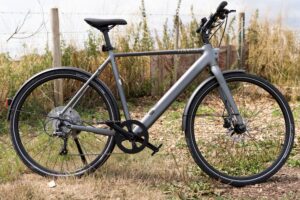
Flat-bar road bikes are essentially road bikes with flat bars instead of drop bars.
A lot of people prefer the vision and control that they get from a bike with a flat handlebar over one with a dropped bar. With a flat bar road bike, you can still get the fast wheels/tyres of a standard road bike and gearing that allows you to commute quickly.
Road bikes
The best road bikes make a fast and sleek commuter option, and are well suited for a long commute. The lower and more aerodynamic riding position will benefit you especially if a lot of your ride is on open, out-of-town roads where speed and efficiency can really count.
If you want to also ride in your free time, then a road bike is ideal for riding sportives, training rides, or just getting out and seeing the country.
Hybrids
A hybrid bike combines the features of a mountain bike with those of a road bike to give you, theoretically, the best of both worlds: a bike that is pretty quick and also tough and durable. In truth, it’s often difficult to tell where the flat bar road bike category ends and hybrids begin – but if you are looking at a flat bar bike with rather skinny tyres compared to those seen on a mountain bike and a suspension fork, that is likely a hybrid bike.
Gravel bikes
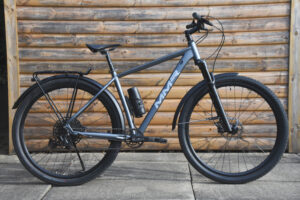
Gravel bikes are designed for mainly riding off-road but the fact that they’re built to be both fast and durable means they can be excellent for everyday commuting, sometimes with some tweaks for the road.
Folding bikes
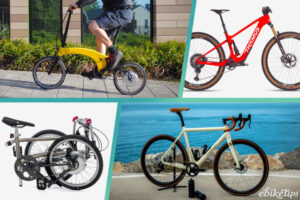
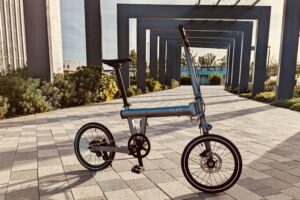
A folding bike is often the best option for multi-modal commuting and for those who might not have much space for storing a full-sized bike. Say you want to ride to the station, take the train, then get off at the other end and ride to the office: a folding could be the ideal bike for you. You don’t need reservations for folding bikes and you can take them even on some buses and inside shops or restaurants which means you don’t have to leave them locked outside. Folding bikes are ideal for people who want something quick and easy to fold and manoeuvrable when packed.
Electric bikes
Electric bikes (e-bikes) make a lot of sense for many commuting cyclists, providing a solid alternative to a car for urban transport. If your commute is a little longer or hillier, then an e-bike can save you from unnecessary sweating and exhausting yourself. You do have to think about the charging of the bike, though, which especially in the winter can be harder as the battery might run out sooner than you expected. That said, e-bikes have come a long way in the last few years and many offer ranges beyond 100km on a single charge.
Single speed / fixies
Perhaps the simplest option for commuting and cutting about town is a single-speed or fixed-gear bike. These bikes don’t have anything unnecessary on them; they simply have one gear and that’s it. Fixed-gear (fixie) bikes require you to pedal at all times as they won’t let you freewheel at all. Unless you enjoy pedalling like mad on downhills, then a single-speed is a little easier option especially when you’re starting out with the one-gear setup. The lack of gears is also the obvious drawback of these bikes – if your commutes are very undulating, then it might be tricky to find the one gear that works for ascents, flats and descents.
For more information on how road.cc does product reviews and how we compile our buyer’s guides, head over to this article. Let’s get into the top picks.





-300x200.jpg "Advanced Offroad Pro Gravel Apex AXS")


20 thoughts on “Looking for a reliable ride to work? Here are our top two-wheeled workhorses, from folders to e-bikes”
From the Ribble stable for
From the Ribble stable for commute purposes I would choose the CGR over endurance, as it has rack mounts. Not that I am biased and have one though obviously.
I have the the Endurance Ti
I have the the Endurance Ti and have a rack (using a seat post clamp with rack mounts and the mudguard points).
Commuter bikes? Where are the
Commuter bikes? Where are the full coverage mudguards?
Yes. Commuting without
Yes. Commuting without mudguards should be illegal.
To be fair, all of the bikes
To be fair, all of the bikes on the list have the mounts to take mudguards, with the road and gravel models accepting full mudguards. They just aren’t supplied by the manufacturer.
The ability to take guards was my number one criteria for each to be considered as a commuting bike, although not everyone is bothered about having them.
Good selection of bikes
Good selection of bikes illustrating the options for commuters.
Love my fast and fun belt-driven hub geared (hydraulic disc braked) commuter. Minimal maintenance and totally weatherproof. Mine’s a BMC Alpenchallenge but the similarly specced and priced Canyon looks great too (and easier to get hold of than a BMC).
Whichever bike you go for; add full mudguards and a rack for year-round commuting.
Then get a spare bike for when it’s being repaired/serviced/awaiting parts.
Maybe make the spare an MTB so it can cope with a bit of snow. Maybe get it some spiked tyres for when it gets icy.
Having tried all kinds of
Having tried all kinds of things (and admittedly not being a racer / doing serious miles) I’ve also slowly gravitated towards something like a “Dutch bike” for most daily use [1] [2]. Because I ride almost every day, might be out after dark or in any weather, carry stuff and don’t want to do all the maintenance that e.g. a racy road bike would need (on Edinburgh’s bad roads and not-very-forgiving climate).
Good call in general on having a backup bike!
Current compromise is a more upright (but still not “Dutch”) Cube Travel Ex (dynamo lights, hub gears, mudguards and racks) and a Dawes Galaxy tourer (old and beaten so not terrified of losing it, does have deraillieurs and rim brakes – but dynamo lights and I am very familiar with maintaining it).
I’d have loved a Shand Levret I think but missed them!
this is nuts- how can a bike
this is nuts- how can a bike that doesn’t have rack mounts be best commuter bike in any category?
Because a lot of people use
Because a lot of people use rucksacks rather than panniers? Because there are various ways to mount racks to bikes that don’t have traditional rack mounts?
In fairness, though, they
In fairness, though, they didn’t ask “how can it be a commuter” – they asked “how can it be the best in that category”.
“Some people don’t need a rack” isn’t really an answer to that.
What might be a reasonable answer is “there are just a dearth of bikes in that category, all of which have other downsides that are at least as big”.
That’s a bit like saying that
That’s a bit like saying that you can make any bike into a race bike, even if it has round frame tubes and weighs 10+ kg. But you wouldn’t describe them as “best race bikes”.
I’d suggest that A UK commuter bike should be able to fit full length mudguards easily (with clearance for decent tyre width too). For the likely intended audience I’d also expect the bikes listed to be inexpensive and have puncture-resistant tyres.
Flat bars are likely to be preferred by a significant number of people and I think seemingly old-fashioned things like chainguards and hub gears are underrated. I commuted for a number of years on a mid-90s rigid steel Kona MTB with 7-speed, canti brakes, mudguards and 26″ road tyres; it was nippy and manoeuvrable in urban traffic yet also coped with winter weather and country lanes strewn with mud and gravel and required very little maintenance A friend of mine has recently bought the Spa Audax Mono and is enjoying it, though you can only fit 25mm tyres under the mudguards.
Last weekend I was out
Last weekend I was out shopping with my Dutch partner here in NL, and she rather randomly commented about someone going past on something like a Van Moof or Cowboy bike that had no pannier rack…”what’s the point of a bike like that if you can’t carry anything on it?”. Both of my commuter bikes have racks, neither get used very often. It’s easier to use a backpack with some proper organisation in it than a one of my Ortleib panniers for the fairly short daily trip to the office. Maybe if I was going further, and didn’t want a hot sweaty back I’d think differently.
There are many things that
There are many things that you can grumble that you may not have, but for me the absolute necessary are fenders, decent lights and D-lock. I have only used rack in recreational rides.
I’m with you, but I have a
I’m with you, but I have a Ribble Endurance (Ti rather than AL) and it can take a rack – using the mudguard points and a seatpost clamp with mudguard mounts. It works perfectly.
Have used racks and a
Have used racks and a backpack and backpack works for me but will not suit everyone. Mirror is another must for me, use a small bar mounted Zefal.
There’s nothing wrong with
There’s nothing wrong with these, but the whole thing does throw up the degree to which the UK’s bike culture tends not to get past sports machinery or detuned sports machinery.
Just back from NL where there’s far more bike commuting and most of it’s on bikes that will let your pal hitch a lift on the rack and that not be a problem. No, they’re not fast, but they tend to need damn all maintenance and you won’t need a shower on arrival, a crash helmet or contrived padded breeks to get to work on them, and sat up bolt upright it’s far easier to look around you in traffic. You’ll want n+1 for the chain gang, but that’s a Good Thing…
The idea of “but what about
The idea of “but what about the ‘practical’ city bikes?” is one I can relate to (running a hub-geared belt-drive bike and having racks, dynamo lights and mudguards on everything currently)…
BUT this is slightly “cart before horse ” – or rather “Dutch bike before Dutch bike infra (and parking)”.
https://aseasyasridingabike.wordpress.com/2013/07/01/where-are-britains-practical-bikes/
It’s not just that UK commuters don’t know what they’re missing / the market *wants* to sell (though there is truth to that).
For one the lack of secure cycle parking provision in the UK (including at home) means that having a cheap clunker can make sense – and in the UK that’s often a “mountain bike” BSO not a Dutch bike. Which tends to have gears but the Dutch equivalent is usually more tolerant of outdoor living, lack of maintenance, will carry another person etc., but is noticeably heavier … different cycling conditions, different bikes.
Completely agree with
Completely agree with pjclinch. We really need to learn from commuting culture on the continent, especially NL and Germany. There, ‘cycle commuting’ is just called getting to work by bike. More people in the UK would commute if they thought it was that simple. And part of making it that simple is having a bike that you just hop on and ride, that simply works.
For that reason, I think we really should adopt the following features for our city bikes:
– full length mudguards (I see SO many commuters in London on road bikes without mudguards, it’s insane)
– rack, maybe with a basket (UK cyclists are gonna laugh at this idea but the convenience of just putting your shopping in a basket is unmatched)
– hub gears. They last forever, chain never comes off, they just work
– fully covered chain or a belt drive. Normal people don’t want to be cleaning oily grime off their chain on a regular basis.
And we can get all this from a British manufacturer! What’s wrong with the Boardman URB 8.9? I would love this bike. boardmanbikes.com/gb_en/products/2344-urb-8.9-2021.html
OT but while Germany are
OT but while Germany are generally ahead of the UK we should aim higher – their cycling conditions are often lacklustre. (We could usefully have a look at their trams and public transport though!)
https://m.youtube.com/watch?v=AjTx2ALomfc&pp=0gcJCRsBo7VqN5tD
eg. Leipzig: https://bicycledutch.wordpress.com/2023/05/31/is-leipzig-leading-the-transition/
Perhaps their major motor industry is something to do with things?
It depends on many things.
It depends on many things. But being a daily commuter (26 km one way) in continental Europe for many years, what I learned -the hard way- to appreciate are:
– Full length mudguards or at least a fast way to mount/unmount them
– Rack
– Dynamo lighting
The casual reader will notice that Pinarello etc drop off the list. I had to get over that too but -trust me on this- after a couple of years you’ll learn to appreciate a practical, reliable bike over a rad race monster with the temperament and maintenance costs of a 21-year old supermodel.. Oh, and you want those heavier but almost unflattable tires.