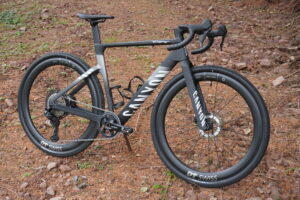
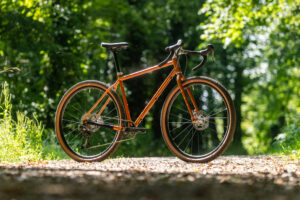
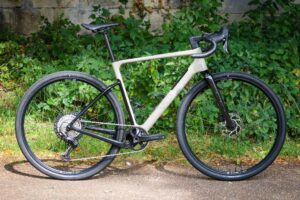
The Ribble Ultra-Grit Apex XPLR AXS is the entry-level model of the company’s ‘fastest gravel bike ever’, taking design cues from its road racing brethren in terms of stiffness and aerodynamics, paired with 50mm tyre clearance enabling you to run huge chunky rubber for muddy or rocky conditions. I found it efficient, with fun handling traits, although, as with some of Ribble’s other latest frame designs, I don’t think the ride quality is as good as others on the market.
Ribble Ultra-Grit Apex XPLR AXS: Ride
In the last 18 months Ribble has released a lot of new bike models, with the All Road, Ultra-Race and this Ultra-Grit all sharing very similar design cues, most noticeably the chunky, flared down tube and the use of M-series carbon fibres integrated into the carbon lay-up.

The issue I’m finding, having ridden all three, is that the ride quality is compromised, bordering on being harsh. Yes, all three of these models are designed as performance bikes, so stiffness is paramount, but that can come at the cost of comfort.
You can create a very stiff frameset that is also compliant by allowing subtle movement or flex of the tubes in specific directions. The byproduct of that is improved ride quality and increased feedback to you as a rider, but that’s not something the Ultra-Grit is offering. If you are racing gravel then this may be of little concern to you – but very few of us need (or have the resources for) a bike that we are just going to compete on.

I’m not necessarily talking about comfort here – the large volume tyres can take care of that – but you can’t hide a ‘non-talkative’ frameset through running soft rubber alone. If you want a fast gravel bike that you can use for all kinds of riding, I’d argue that there are better options out there. I’ll come to those later in the review.
That aside, the Ultra-Grit does have a certain competitive efficiency about it. At 9.21kg in this build, it feels nippy under acceleration and nimble too. Ideal for tackling challenging terrain at speed.

There is nothing outlandish about the geometry. The numbers suggest the Ultra-Grit should be easy to ride on all kinds of surfaces, and that is exactly how things play out in reality. It tracks well through the corners and feels stable when the going is loose or slippery thanks to predictable handling.
I didn’t find the steering as quick as I thought it would be, compared with some race-orientated gravel bikes, but it is no slouch.

And from a performance point of view, the steep seat angle of 74 degrees definitely lets you get the power down while remaining in the saddle, ideal for those punchy, loose climbs.

The main thing I missed when riding the Ultra-Grit, though, is a link between me as a rider and the bike beneath me. While it handles fine, I never felt a real connection between my contact points and what the tyres were doing on the trail. It’s all a little on the vague side, and as the trails have become wet and slippery in the last few weeks, I’ve felt like I was reacting to what the bike was doing – like I was a few milliseconds behind – rather than being completely in sync with what the Ultra-Grit was up to. The old bike and rider as one cliché. Not necessarily what I want from a bike when I’m riding ‘on the rivet’.

Ribble mentions aero optimisation in terms of the tube profiles, but it’s not something that really translates to any noticeable speed benefits when out on the trails because there are way too many variables from the terrain of typical UK gravel routes. Deep-section wheels would make more of a difference if speed is your ultimate goal.

Overall, in terms of the ride it’s a capable machine and its efficiency and rigidity will appeal if you are after all-out speed, but it feels very much like a tool for getting the job done as opposed to a bike that I’d be passionate about riding.
Ribble Ultra-Grit Apex XPLR AXS: Frame & fork
All models in the Ultra-Grit range use the same frame, made from a mixture of Toray’s T1000 grade and M46 carbon fibres. In a nutshell, Toray’s T-series carbons prioritise high tensile strength (resistance to breaking) while the M-series prioritises high tensile modulus – stiffness.

When Ribble’s head of product, Jamie Burrow, spoke to us about how to design a race-winning road bike, he described how using the ultra-high modulus M65 on bikes like the Ultra Race carbon fibres gives excellent stiffness, but due to its lack of elasticity compared with other carbon grades it can only be used in certain areas. The M46 grade used in the Ultra-Grit is less stiff, but still much stiffer than the Toray T1000 surrounding it. It is also less brittle than M65, something you want on a gravel frame which is likely to see things like rock strikes or crashes. Saying that, I’d still like to see some kind of frame protector added to the underneath of the down tube and bottom bracket shell.

Ribble gives a claimed weight of under 900g for a size medium frame, which is respectable.

For a clean look, the brake hoses (all bikes use SRAM AXS, so no gear wires) are run internally from the handlebar right through the frame and fork. An integrated seatpost clamp system also adds to the smooth lines.

The 50mm tyre clearance ties in well with gravel riders running ever wider tyres…

…and Ribble has gone with a 68mm BSA threaded bottom bracket, as well as making the frame compatible with universal derailleur hanger (UDH) mounting.

A removable cover under the bottle cage points reveals some roomy internal frame storage – I found it ideal for stashing a lightweight jacket and a few spares…

…and there are a couple of mounting points underneath the down tube and on the upper face of the top tube, alongside the two standard bottle cage mounts.

The fork is full carbon fibre, but you do get the option of specifying a RockShox Rudy Ultimate suspension fork with 30mm of travel. It’ll add £300 to the overall price.

The Ultra-Grit comes in five sizes, catering for rider heights of 5ft 3in to 6ft 4in.

A medium bike has a top tube length of 570mm and a head tube of 145mm, sitting at 71.5 degrees, which makes it slightly longer in terms of reach (404mm) than a similarly sized road bike. The overall riding position is kept in check with the Ultra-Grit running a shorter stem – 90mm in this case.

The stack is 562mm, and the overall wheelbase is 1,048mm. The fork rake is 50mm and the BB drop is 65mm.
Ribble Ultra-Grit Apex XPLR AXS: Groupset
The Ultra-Grit range comprises five bikes, starting with this SRAM Apex XLPR AXS option (along with a flat bar Sportfit version for the same money) and topping out with the Red XPLR AXS groupset model with Zipp wheels for £7,499.

The Apex groupset is only available as a 1x setup, and here it’s specced as a 12-speed 11-44T wide-ranging cassette with a 40T chainset.

While the majority of SRAM’s XPLR groupsets have had a recent makeover, Apex hasn’t yet, but that’s no big deal as it works well and has decent ergonomics.

The shifting isn’t as crisp as that found on the new Rival and above, but it is quick and always gives a clean gear change even when under load – and surprisingly well, too, across those sprockets at the larger end of the cassette which have quite big jumps between them.

The battery life on the rear mech is pretty much fit and forget, and the clutch mechanism keeps the chain taut and stops any derailment over rough ground.

The brake callipers are 160mm front and rear, and braking performance is spot on for fast gravel work, with good modulation preventing unwanted or uncontrollable lock-ups on loose surfaces.

Ribble Ultra-Grit Apex XPLR AXS: Finishing kit
The more expensive models in the range get fully integrated cockpits, but this one uses a separate alloy riser bar and stem from Ribble’s in-house brand. The default width on a medium bike is 40cm, but you can change various components and their sizes on Ribble’s website. Other bar width options are 38cm or 42cm.


The bar itself rises 20mm either side of the stem clamping area and has a 16-degree flare, which gives a 93mm-wider position in the drops than at the hoods. Ribble also offers a carbon option for an extra £100, and either a road or gravel version of its carbon integrated cockpit for another £350.
Stem-wise you can choose from 70mm to 120mm in 10mm increments.
There are plenty of saddle choices available, with many of them at no extra cost. Our test bike comes with a Selle Italia Model X Superflow which has a good shape overall for me, and decent padding.
The seatpost is carbon and has a D-shaped profile to match the frame.
Ribble Ultra-Grit Apex XPLR AXS: Wheels & tyres
As standard this model comes with DT Swiss G 1800 wheels which I have ridden many times before. They are solid all-rounders with 25mm-deep alloy rims, 24 spokes front and rear, and a maximum weight loading of 130kg. But our test bike has a £350 upgrade to a set of Hope’s RX24s, with a 23mm-deep alloy rim and a 24mm inner width. They have 32 spokes front and rear, and weigh around 1,780g per pair.
The tyres are Schwalbe’s G-One R Performance in a 45mm width. With a mid-depth tread they’ll cover most gravel conditions unless things are really wet and muddy.
Ribble doesn’t set them up tubeless as standard, but they are tubeless ready so a pair of valves and some sealant should see you ready to go.
Ribble Ultra-Grit Apex XPLR AXS: Value
Looking at the Ultra-Grit without the upgraded wheels, at £2,599 it offers pretty good value for money – on paper at least – compared with most of its rivals, though not by the large margin that Ribbles of old used to be. Overall, it comes down to how much the ride quality is worth to you; for me it’s worth paying a bit extra for.
For instance, one of the best racing style gravel bikes I’ve ridden is Scott’s Addict Gravel 10, which I reviewed for off.road.cc last year. It was very nimble, light and agile, and I also described it as being rich in feedback and feel, which the Ultra-Grit isn’t.
That model now costs £4,599, but the Addict Gravel 30, with a Rival XPLR 1x groupset, Scott’s own Syncros wheels and finishing kit, is a bit more expensive at £2,999. If I was keeping a bike for, say, five years, the extra £8.33 a month would be worth it for the superior ride quality.
> Buyer’s Guide: Best gravel bikes
Merida’s Silex range follows some design cues from the mountain bike world, but with a racy nature. Alongside the Ribble I’ve been riding the range-topping Silex 9000 (review up soon) and it’s a very nimble, surefooted gravel machine.
The Silex 7000 is priced at £2,700 and comes with a full-carbon frameset and a 1x, 12-speed Shimano GRX mechanical groupset. If you want the Apex AXS groupset then it’ll cost you £3,600 for the Silex 8000, so the Ribble is cheaper by quite a bit – and the Silex frames also have smaller tyre clearance at 45mm. But like the Addict Gravel, the Silex also has a better ride quality. I reviewed the aluminium-framed Silex 400 recently, if you want to get some info on geometry and so on.
I am yet to ride one of Giant’s new Revolt models, but previous versions were very good. They are gravel bikes but with a racy intention, and the new models have similar geometry to the Ribble, and tyre clearance of 53mm. The Revolt Advanced 1 costs £2,699 and comes with an Apex XPLR 1x groupset, plus the frame gets internal storage and a dropper post is included too, which makes it look great value for money.
Other options include Canyon’s Grail CF 8 (£2,799, 12-speed GRX mechanical), Trek’s Checkpoint SL 5 Gen 3 (£2,900, Apex XPLR AXS) and Specialized’s Crux Comp, which is more expensive at £3,399 and comes with a mechanical GRX groupset, but it’s one of the best-riding gravel framesets out there.
Ribble Ultra-Grit Apex XPLR AXS: Conclusion
So, as I said above, the Ultra-Grit is good value on the whole, and the large tyre clearance and amount of stiffness on offer helps its case as a performance gravel machine. For me, though, a bike’s ride quality and interaction with the rider are massive pieces of the puzzle, and it’s here where the Ultra-Grit comes up short, which lowers its appeal to me.
If that doesn’t bother you, though, and you just want a bike to get you from A to B as fast as possible for a good price, the Ribble is worth considering.
Verdict
Stiff and efficient gravel racer, but lacking the ride quality and rider interaction of some rivals
All the deals displayed on our review pages are pulled from a constantly updating database feed of the best affiliate deals available. The criteria for deciding on what are the best deals is who is offering the lowest, delivered price. In most cases we will be showing the very best deal available online, but sometimes you may be able to find an item cheaper. If you can please feel free to post a link in the comments box below. To find out more about affiliate links on road.cc click here.
road.cc test report
Make and model: Ribble Ultra-Grit Apex XPLR AXS
Size tested: Small
About the bike
List the components used to build up the bike.
Shifters: SRAM Apex AXS
Brakes: SRAM Apex AXS, 160mm Rotors F/R
Chainset: SRAM Apex AXS, 40T
Cassette: SRAM Apex AXS, 11-44T
Chain: SRAM Apex AXS
Bottom Bracket: DUB BSA 68mm
Handlebar: Alloy Gravel Riser
Stem: RS-2
Saddle: Novus Boost EVO Superflow
Tyres: Schwalbe G-One R Performance 45mm
Wheels: Hope RX24 Alloy (£350 upgrade)
Tell us what the bike is for and who it’s aimed at. What do the manufacturers say about it? How does that compare to your own feelings about the bike?
Ribble says, “The ULTRA-GRIT is Ribble’s fastest gravel bike – developed and proven by our pro gravel team, the Ribble Outliers, in the chaos of the world’s toughest off-road races, from Unbound to The Traka to The Dirty Reiver. Weighing just 9.0kg, this race-ready machine is built for riders who embrace the unknown and charge straight into it.”
It’s a quick bike that’s easy to live with thanks to neutral handling.
Where does this model sit in the range? Tell us briefly about the cheaper options and the more expensive options
This is the entry level to the Ultra-Grit line-up. A SRAM Rival XPLR model costs £2,899, Force XPLR £3,999 and Red £7,499.
Frame and fork
Tell us about the build quality and finish of the frame and fork?
A well-built and finished frame and fork.
Tell us about the materials used in the frame and fork?
The Ultra-Grit is created using a blend of Toray’s T1000 and M46 carbon fibre grades.
Tell us about the geometry of the frame and fork?
There is nothing out of the ordinary in terms of the geometry and riding position for a gravel bike.
How was the bike in terms of height and reach? How did it compare to other bikes of the same stated size?
The reach measurement is slightly longer than normal, but the actual riding position is on a par with most as the Ultra-Grit comes with shorter stems than many similarly sized gravel bikes.
Riding the bike
Was the bike comfortable to ride? Tell us how you felt about the ride quality.
It’s comfortable thanks to the tyre volume, but the actual ride quality of the frame is middling.
Did the bike feel stiff in the right places? Did any part of the bike feel too stiff or too flexible?
Stiffness is impressive where it needs to be.
How did the bike transfer power? Did it feel efficient?
Thanks to the stiffness, it’s definitely efficient in terms of power transfer.
Was there any toe-clip overlap with the front wheel? If so was it a problem?
No.
How would you describe the steering? Was it lively neutral or unresponsive? Neutral.
Tell us some more about the handling. How did the bike feel overall? Did it do particular things well or badly?
The handling is easy to live with as it’s not as quick as some race gravel bikes I’ve ridden.
Which components had the most effect (good or bad) on the bike’s comfort? would you recommend any changes?
I got on well with the shape of the saddle.
Which components had the most effect (good or bad) on the bike’s stiffness? would you recommend any changes?
The handlebar and stem are both stiff enough to cope with out-of-the saddle efforts, as are the Hope wheels.
Which components had the most effect (good or bad) on the bike’s efficiency? would you recommend any changes?
The Apex groupset has a wide-ranging ratio setup which helps efficiency on rolling terrain.
The drivetrain
Tell us some more about the drivetrain. Anything you particularly did or didn’t like? Any components which didn’t work well together?
SRAM Apex XPLR is a great groupset, offering precise shifting and loads of braking power.
Wheels and tyres
Tell us some more about the wheels.Did they work well in the conditions you encountered? Would you change the wheels? If so what for?
Well-built, durable wheels, although they aren’t the lightest.
Tell us some more about the tyres. Did they work well in the conditions you encountered? Would you change the tyres? If so what for?
Comfortable tyres, and good tread for all kinds of conditions.
Controls
Tell us some more about the controls. Any particularly good or bad components? How would the controls work for larger or smaller riders?
Decent kit throughout which does the job.
Your summary
Did you enjoy riding the bike? Yes and no.
Would you consider buying the bike? No
Would you recommend the bike to a friend? Possibly
How does the price compare to that of similar bikes in the market, including ones recently tested on road.cc?
The Ultra-Grit is very competitive in terms of pricing compared with many other brands, as illustrated in the main review.
Use this box to explain your overall score
Overall, the Ultra-Grit is a good bike. In fact, in terms of efficiency/performance it’s very good, thanks to a decent weight, loads of stiffness and big tyre clearances. But the ride quality and lack of rider involvement take the edge off the whole experience for me.
About the tester
Age: 46 Height: 180cm Weight: 76kg
I usually ride: This month’s test bike My best bike is: B’Twin Ultra CF draped in the latest bling test components
I’ve been riding for: Over 20 years I ride: Every day I would class myself as: Expert
I regularly do the following types of riding: time trialling, commuting, club rides, sportives, fixed/singlespeed,