



TrainerRoad is a cycling training plan focused software platform built around structured workouts, and it’s refreshingly straightforward to use. You can commit to a full plan or opt for the more flexible TrainNow feature, which suggests sessions based on your recent activity. In practice, a TrainerRoad subscription has proven effective, delivering consistent indoor training and measurable results. Its AI-driven features are evolving quickly and show real promise, although some beta elements still need refinement.
To get the most from TrainerRoad, you’ll need a smart trainer and, ideally, power meters across each bike. The platform is heavily power-focused and largely dismisses heart rate as a meaningful input.
Technical details
TrainerRoad is available across all major desktop and mobile platforms, including Apple and Microsoft operating systems, as well as iOS and Android mobile devices via dedicated apps.
Installation is relatively lightweight at around 400-600MB, depending on the device, with full system requirements listed here, although loading times can be slow, taking up to a minute to activate and load up the latest training information.

It integrates well with other platforms. Workouts can be automatically synced to Zwift (with a separate subscription), and ride data to other training platforms such as Strava and Garmin Connect.
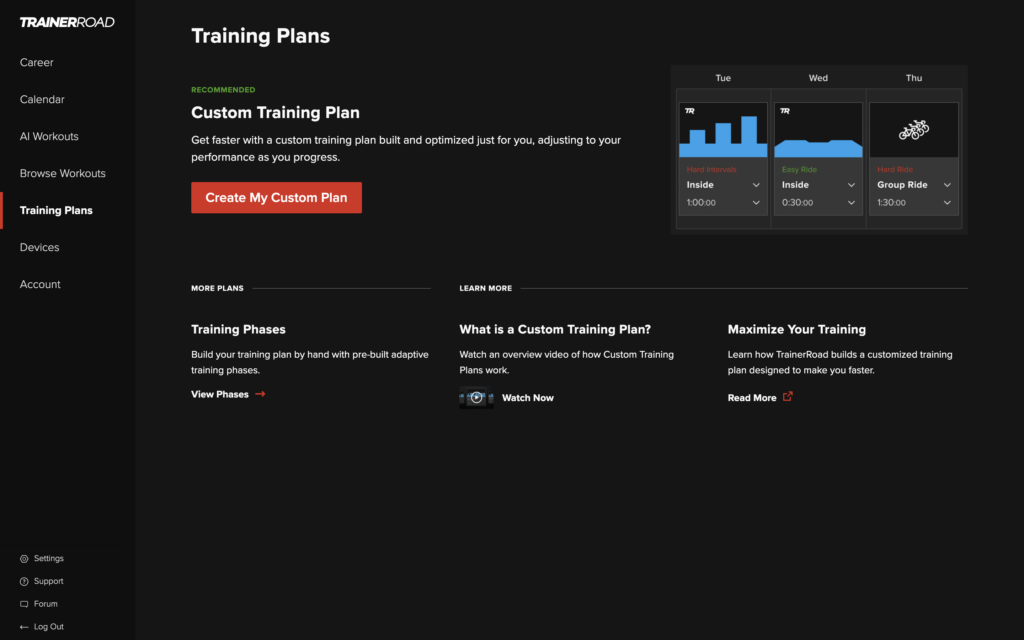
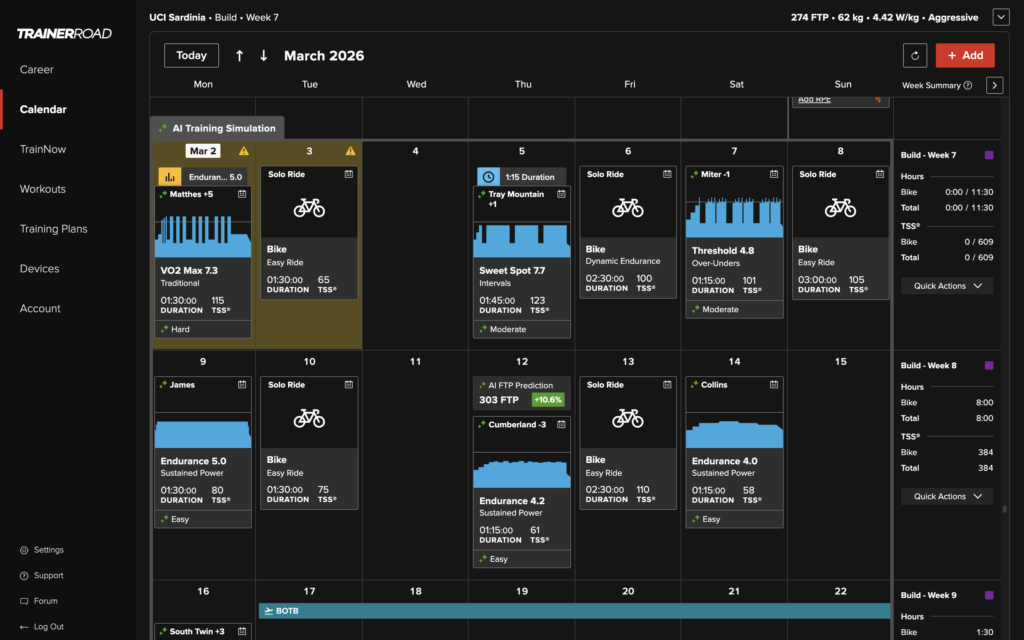
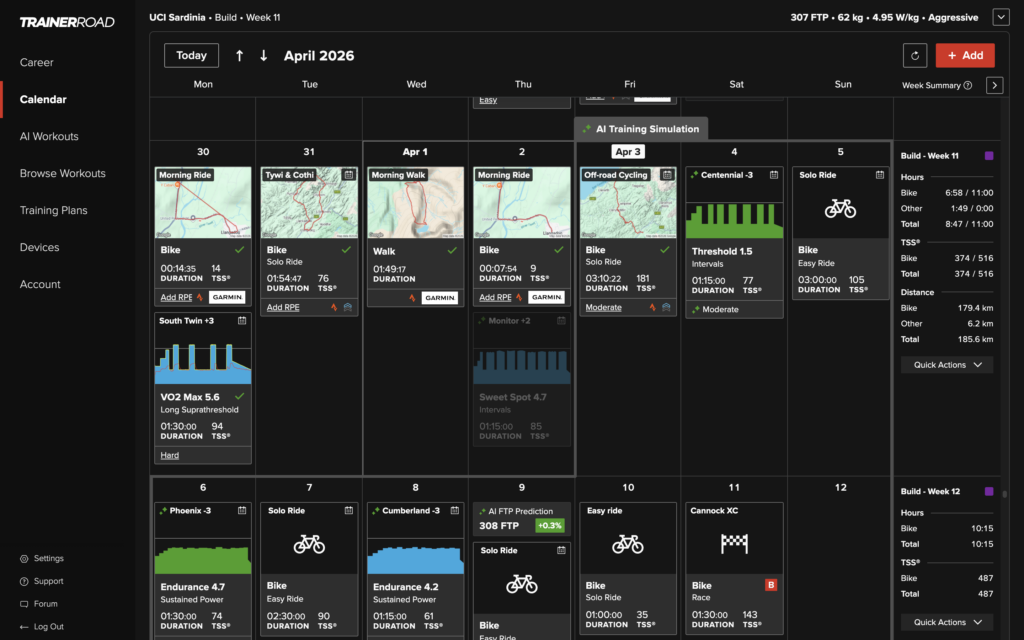
The core of TrainerRoad is its plan builder, which allows you to structure training around a specific event or a general goal. Plans can be tailored to different disciplines, including road, mountain bike and gravel, and incorporate details such as event distance, intensity and priority. Events are categorised as A, B or C, with the key limitation being that A-priority events must be spaced at least six weeks apart to allow for peak performance.
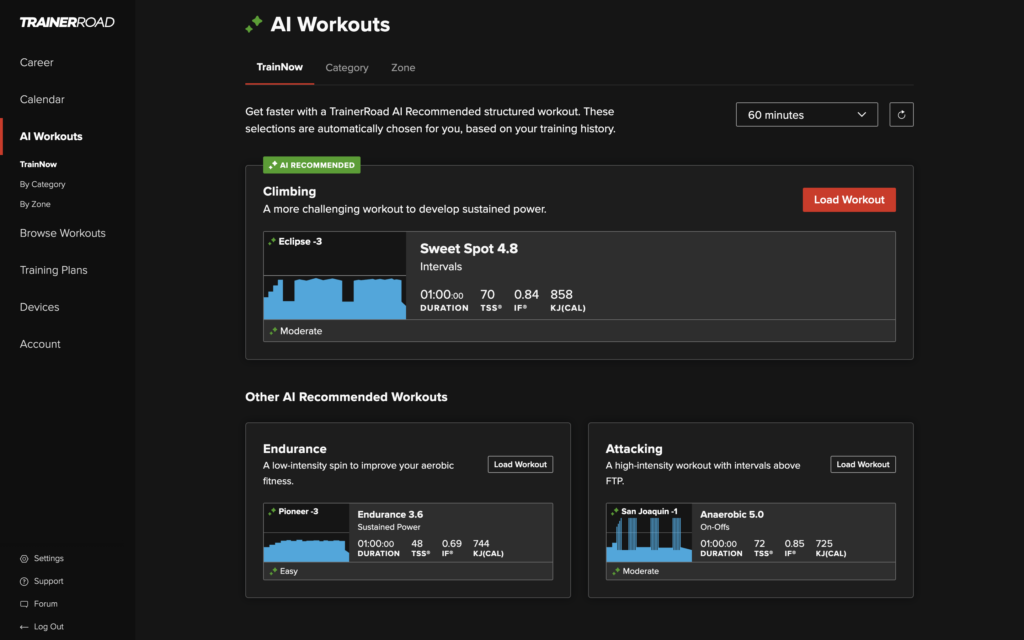
For those with less predictable schedules, the TrainNow feature offers a more ad hoc approach, recommending sessions without committing to a full plan.
Performance
After nearly a year of use, TrainerRoad has seen significant development in its AI features, while its core structure and focus have remained consistent.
Using the plan builder, I’ve created programmes targeting three very different A-goal events: a cross-country MTB race (alongside a 600km audax as a B-category event), a cyclocross championship, and most recently, a UCI gravel race in Sardinia. Building each plan is quick and intuitive, with plenty of flexibility to fit training around your weekly schedule. Additional events can easily be slotted in and prioritised as A, B or C, depending on their importance.
That said, with the current Sardinia-focused plan, I do have some reservations. Despite the event demanding a strong endurance base, the structure appears to favour high-intensity work over longer, steady-state sessions. As a result, I’m not entirely confident in my endurance at present and don’t feel as strong on longer rides as I would expect at this stage. While the intensity-driven approach clearly delivers gains in FTP and top-end performance, it raises questions about how well the plan prepares you for sustained efforts in longer events.
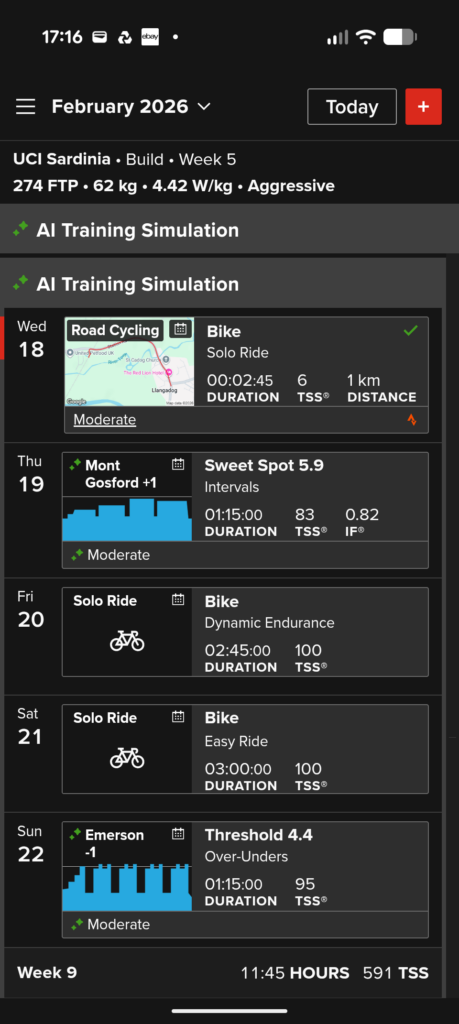
The platform is particularly strong when it comes to adapting to disruption. If you miss sessions or need time off the bike, it adjusts upcoming workouts accordingly. After an enforced week off, for example, my return session was noticeably easier, acting as a sensible reintroduction before progressing back to harder efforts. You can also redo and adjust a training plan if your plans change completely.
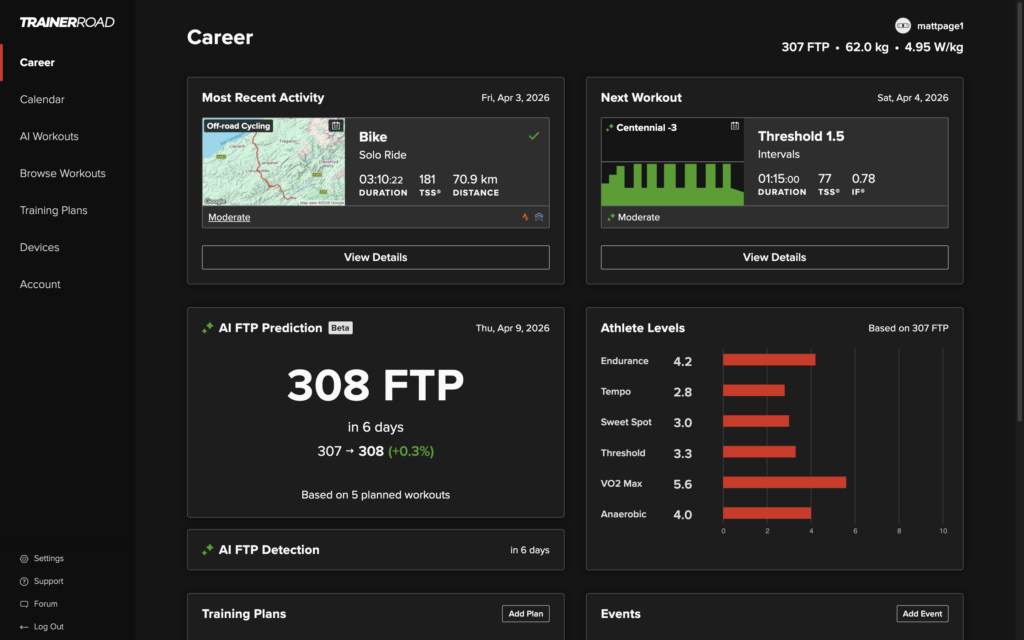
With a power meter or smart trainer, TrainerRoad sets and updates your FTP automatically, typically every 90 days. There’s no requirement for a ramp test, although I would strongly suggest completing one when you are fresh and before starting a plan, as it will help ensure your baseline is accurate. While FTP isn’t a perfect metric for all riding styles, it remains the standard benchmark across most training platforms.
I’ve generally kept TrainerRoad as a dedicated training tool, using an ERG-mode smart trainer indoors and scheduling outdoor rides across road, gravel and MTB. However, one clear limitation is its inability to properly account for rides without power data. On my bikes without a power meter, even significant efforts tracked via heart rate aren’t recognised. For example, a hard two-hour ride completed at near-threshold heart rate won’t trigger adaptations in the same way a power-recorded ride would. Given the amount of personal historical ride data available and the platform’s AI ambitions, this feels like a missed opportunity.
Heart Rate Variability (HRV) is another element that I find personally useful to help give an idea of freshness, and this is another feature that I think might be useful to introduce in the future. If TrainerRoad were able to use HRV from a wearable device and use that to adjust planned sessions to reflect the current state of freshness, it could take this to another level.
Another area for improvement is accounting for discrepancies between power meters. Devices can vary slightly in their readings, and while this is a known issue, there’s currently no way to normalise data within the platform. While it might not be simple, there are tools available to directly compare power meter data and give you a direct comparison – for example, if you know that one power meter or smart trainer under- or overreads by a set percentage.
Where TrainerRoad excels is in its adaptive training. The AI regularly suggests adjustments based on fatigue and recent load. At times I’ve ignored recommendations for an easier session and paid the price by failing the workout, which suggests the system is generally on the right track. That said, it can be less accurate early in a training block, usually being too cautious, perhaps suggesting that it needs time to learn and adapt.
The platform also seems better suited to shorter, more structured disciplines. It handled XC, cyclocross and gravel training well, but struggled to meaningfully incorporate a 600km audax event into the plan. This leans into the broader observation that its default bias is towards intensity rather than pure endurance.
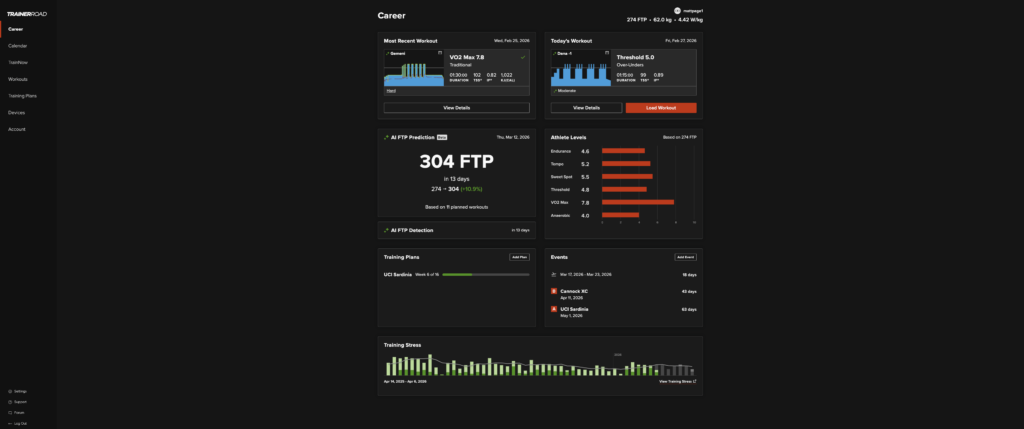
FTP prediction is a newer, still-beta feature. Early on, it produced overly ambitious estimates, moving well above my FTP PB, which was set almost 15 years ago when training full-time, but these fluctuations settled over time. For some, seeing the decrease in FTP prediction might be demoralising, but for me the numbers I am seeing now are far more reflective of where I know I can reach.
Comparison and conclusion
Results ultimately speak for themselves. Over the past year, I’ve won my category at the Welsh MTB cross-country championships, hit my 24-hour time target in the Bryan Chapman Memorial 600km audax, and finished on the podium in my age group at the Welsh cyclocross championships.
From a performance perspective, each training plan phase has delivered gains. The latest plan saw my FTP increase from 270W to 307W in just eight weeks – close to its highest level in over a decade, despite training roughly half the volume I once did.
In terms of value, TrainerRoad is significantly cheaper than hiring a coach. A good coach will always offer a level of personalisation and motivation that software can’t fully replicate, but that comes at a considerable cost, often £150–£400 per month. TrainerRoad narrows that gap with increasingly sophisticated AI, making it a compelling option for most riders. The monthly cost is based on the USD rate, and currently £16.60 plus an exchange rate fee if your bank charges one.
It is completely training-focused, and riders who prefer a more social or immersive experience may find it lacking, and pairing it with something like Zwift could be beneficial, but that adds further to the cost.
Zwift is £17.99 per month or £179.99 annually, and while this includes training plan features, there are no AI elements, and you would follow a simple plan.
Training Peaks is a popular software platform for coaches, which is also usable for athletes, with the ability to set a training plan. This costs $19.95 (approximately £15) per month, or $135 (around £102) annually with training plans added as optional extras. The training plans have been created by coaches, with many to choose from at set prices, although these do not have AI features to adapt as your fitness and actual riding progresses.
> Best cycling training apps — get fit without getting bored
Overall, TrainerRoad delivers excellent results and I will be continuing to use (and pay for) it to train for the UCI Gravel World Championships. It requires commitment and consistency, but its structured approach and evolving AI put it ahead of most training platforms right now, even if there’s still room for improvement. However, for longer endurance-focused events, there is still a question mark over whether its intensity-heavy approach always delivers the most complete preparation.
Test Report
What does the manufacturer say about this product?:
TrainerRoad says:
TrainerRoad is cycling’s most effective training system. Our planning, training, and analysis tools give cyclists and triathletes a guided training experience designed to help them reach their goals. When athletes combine hard work with TrainerRoad’s proven process, they get faster.
Are you the rider who?
• Wastes potential with unfocused training?
• Gets stuck at the same FTP?
• Pushes hard with little reward?
• Struggles to stay motivated?
• Keeps getting dropped?
• Faces doubts at the start line?
• Misses their personal best?
• Watches others surge ahead?
Don’t let your hard work go to waste!
Turn Every Ride Into Progress
Transform your training with cycling’s #1 training app — leave nothing on the table.
Tell us some more about the technical aspects of this product:
TrainerRoad says:
Intelligently Recommended Workouts
TrainNow gives you the flexibility to complete structured training, when and how you want, with intelligently recommended workouts. However you want to ride, TrainNow can help you get faster.
Training On Your Terms
TrainNow is the easiest way to get the benefits of structured workouts when you’re not following a training plan, or when you want to supplement what you already have on the calendar. Powered by TrainerRoad AI, TrainNow gives you the right workout, every time, even if you’re not following a training plan.
No Plan, No Problem
If you don’t want to set a training schedule or aren’t ready for a plan, TrainNow is a great way to take advantage of structured interval training.
The Choice Is Yours
Select how long you have to train and TrainNow recommends workouts based on your abilities: an endurance, climbing or attacking workout so you can choose whichever motivates you the most.
Intelligent Training
Powered by TrainerRoad AI, TrainNow uses machine learning to analyze your recent performances and workout history and recommends a set of three workouts that would be best for you.
Any further comments on quality?:
Reliable software that works well on the devices I have tested it on, including a mobile and desktop computers.
Any further comments on performance?:
In the most simplistic terms, it has helped make me faster, with effective workouts and some AI adaptations that seem to be effective.
How does the price compare to that of similar products in the market, including ones recently tested?:
Zwift costs £17.99 per month or £179.99 annually. Rouvy is priced similarly at £17.99 per month, or £159.96 per year. More affordable options include Wahoo SYSTM at £14.99 per month or £149.99 annually. MyWhoosh follows a comparable model to Zwift but is free to use, with optional in-app purchases. Meanwhile, TrainingPeaks is more focused on structured training plans and costs $19.95 (approximately £15) per month, or $135 (around £102) when billed annually.
Did you enjoy using the product? Yes
Would you consider buying the product?
Yes, I am already signed up and have been using it for over a year.
Would you recommend the product to a friend?
Yes, for those looking for training-focused software.
Use this box to explain your overall score
The software has proven to be very effective, giving positive improvements in fitness and helping deliver some fantastic results, but it isn’t without issues. It seems to ignore heart rate data, which can be problematic if you have a bike without a power meter, and the AI elements are not always correct.
About the tester
Age: 41Height: 168cmWeight: 61kg
I usually ride: Road / Gravel / MTBMy best bike is: Cannondale SystemSix
I’ve been riding for: Over 20 yearsI ride: Every dayI would class myself as: Semi-pro or ex-pro
I regularly do the following types of riding: Cyclocross, Gravel riding, Indoor riding, Bikepacking, Audax, Mountain bike XC




1 thought on “TrainerRoad Subscription (Monthly)”
Trainerroad is fabulous. Platforms like Zwift and FulGaz try to replicate the outside world and that’s why I can’t stand them, they remind me that I’m not outside, I’m in my garage going nowhere. Trainerroad doesn’t pretend and it doesn’t try to make your workout a game. Some people may hate that of course but paired with catch up TV it’s the best indoor training app’ I’ve used. And I get to watch what I want for a change…