
Mavic has a long history of innovation, and an equally long history of annoying bikeshops and owners with a myriad of proprietary parts and questionable availability. I want to get that particular scapegoat outwith the temple door (Leviticus 16, if you’re paying attention) as the perception of Mavic as a brand unconcerned with long-term ownership needs to be banished to the Juniper-berried wilderness.
If you don’t care about long-term maintenance of your e-MTB hoops and are focused specifically on either low cost, light weight, lateral stiffness or vertical compliance, these May Not Be The Wheels You’re Looking For. For everyone else, read on.
Mavic E Deemax S – Technical details
The E Deemax S are designed for the hardest riding folk, being approved to ‘ASTM category 5 : gravity riding focused on the descent’ with a system (ie bike + rider) weight limit of 180kg. Those are enormous numbers, and proof that the wheels are up to the toughest of treatment. There’s literally no harder criteria to pass.
Coming in either 27.5” (35mm) or 29” (30mm), you can ride a matching or mullet setup. You get a choice of centrelock or 6-both rotors, and HG, Microspline or SRAM XD freehub bodies. Should you need to swap freehubs in future, no problem – the hub interface is identical across the three standards.
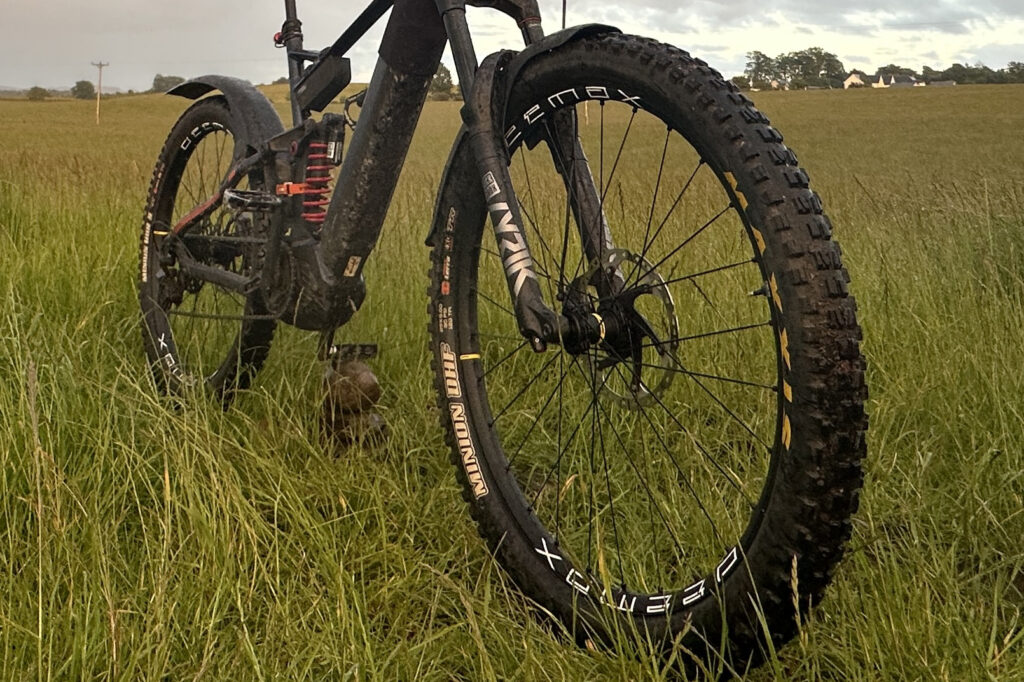
My Decathalon Stilus eMTB is a mullet, so I had the 27.5” on the back with a 2.8” Maxxis Minion DHR, and the 29” up front on a Lyrik Select+ with a 3” Maxxis Minion DHF. The Bosch CX 85Nm motor and 625w battery plus a coil shock, plus liners, plus wired-in Exposure lights makes for a heavy bike – getting on for 27Kg before the rider (95Kg kitted up) gets aboard. This weight is an important context for longevity.
As the founder of the UST tubeless standard, Mavic have led the MTB world in making your tubeless tyre setup faff-free, and the E Deemax S are no exception. The rim walls, hooks and centre channel are optimised for easy setup and subsequent bead retention. The key feature here is that you don’t need any rim tape, as the rim bed is sealed. Once you’ve plugged in the provided tubeless valve, just add sealant, inflate and ride – it’s that easy. Fitting my go-to Maxxis DHR and DHF rubber was a thumbs-only task, and they inflated first pop. Mavic rate the E Deemax S for tyres in the width range of 2”-3”, which covers pretty much every modern option.
The rim is coated in Mavic’s Black Shield, which minimises scratches whilst improving the alloy’s resistance to cracking – think shot peening, I guess. My wheels have yet to show a single scratch or scrape, despite some pretty loud dings and pings from rocks.
The spaces on the rim between the spoke nipples are milled out – which accounts for a chunk of the extra cost and lighter weight compared to the non-S E Deemax wheelset. At the top of the rim walls the surface is wider than usual, spreading the force of any rim-tyre-rock impact and reducing the chance of a pinch flat.
The E Deemax S uses proprietary flat-bladed, external-nipple straight-pull steel spokes. You get a few spares included at purchase, along with a tubeless valve and the (deep breath) proprietary 7-spline Mavic nipple tool which doubles as a tyre lever. That distant sound is a million previous Mavic customers screaming as one “SEE – WE TOLD YOU SO”. But bear with me folks, here be system-thinking wizardry.
The spokes are all the same length per wheel size, drive side or no, making holding and carrying spares on a ride an easy ask. You can buy a bundle of 14 spokes for £40 – so if you were even remotely sceptical about Mavic’s spare part proclivities, you could bag a lifetime’s worth at the outset of ownership for not much.
The party piece and key reason to want the E Deemax S (as opposed to the non-S version) isn’t weight – although who’s going to argue with a bit less of that. The value here is the ability to replace broken or damaged spokes without disturbing the tyre, liner, sealant or rim tape.
I cannot overstate how much of a downer it is with a full enduro liner + tubeless setup, to hear a spoke go ping. You know you’re doomed to at least an hour’s faff replacing sealant and tape, as well as needing to purchase or mill yourself a new spoke, and faff with cassette lockrings, rotors etc. Some Mavic wheels have had the ability to remove spokes without disturbing the cassette or brake rotor for a while now. But the Deemax S does the spokey-cokey in-out dance differently – you need to remove either the cassette, or the disc rotor, as the spokes remove or load in perpendicular to the hub.
Fortunately Mavic have made cassette removal an absolute doddle – you simply pull the cassette off, taking the freehub and retained axle endcap with the cassette. There’s a pressure spring to then remove, that helps keep the two ratcheting rings in contact, and that’s it – you can now swap spokes to your heart’s content.
Or if you want to swap between say a Shimano HG, Microspline or SRAM setup – dead easy. Just buy another £40-ish freehub body and mix away, tool-free.
Once you’ve unthreaded the defunct spoke’s nipple using the provided Mavic 7-spline spoke tool and tyre lever (an anticlockwise thread, ie clockwise to loosen) you then work the broken or damaged remains of the spoke between the remaining spokes. As the spokes don’t touch each other this is pretty easy to do. Once you have the spoke clear of its neighbours, you lie it flat sticking out from the wheel and the head pops out. It takes longer to type than to do in practice.
One of the great things about Bikes In General is they tend to get better over time. Brands generally want to make products more reliable, and to reduce downtime due to failed parts (with the screaming exception of integrated cabling through headsets. That can Get In The Sea, taking a thousand designers and brand managers with it to drown in their own miserable wildly-inflated-maintenance-bill tears. Ahem). So Things Generally Get Better.
Prior to reviewing the E Deemax S wheels I’d put exactly 4351 nasty, muddy, Scottish Highlands full-torque kilometres into the original-spec Sun Ringle Duroc42 wheels my eMTB came with. I was on to my third broken spoke, my third evening removing the entire tubeless system and replacing the tape / sealant along with the defunct spoke. Now over four thousand 85Nm-torqued km is going to tax any wheelset, and spokes have a limited fatigue life – so things were only going to get worse, until I’d replaced the lot. The idea of doing another 30-odd spokes in short order did not appeal – so the decision was going to be about sending that wheelset to The Great Metal Recycling Bin In The Sky and forking out another £400-ish for a reliable E-compatible pair of hoops for the next few years fun.
What I’d much rather do is spend more, and guarantee I never had to needlessly disturb a tubeless setup ever again.
E Deemax S spokes can be had for a few quid each – so even if you end up replacing every single one over the life of a wheel, you’re quids in compared to replacing a whole wheel at half the price but more often. And you haven’t had to spend a penny on rim tape, sealant or faff.
When I replace broken spokes for customers that’s generally at least thirty minutes labour at £65/hour plus tape, sealant and the spoke. So rapidly your forecast maintenance bill adds up to the E Deemax S wheelset justifying the initial outlay – especially if you plan to ride hard and often, and you aren’t married to a mechanic.
Mavic E-Deemax S: Performance
And so to The Ride. With 27-ish Kg of eMTB under you and 2.8 – 3” of rubber to bounce on it’s not that likely that the compliance – or lack thereof – of a decent wheelset is likely to make that much of a noticeable difference as you batter from A to B. But I can hand on heart say the E Deemax S felt more sure-footed through rough lines I’ve ridden a thousand times. One section in particular calls for a quick change of direction dancing through pedal-strike-height rocks, then heavily weighting the front wheel into a line where if you’re off-track you’re either going down into a gully or up into a tree. I reckon the E Deemax S have made me at least a few seconds quicker through there.
Now I’m comparing an £830 wheelset with a stock pair worth maybe £300 – and the original wheels never felt like they were holding me back any. But the fact remains that my confidence to push harder, brake later, weight the front more and lean into corners is boosted.
With an ASTM-5 rating the E-Deemax S are built super-strong – and after 6 months of riding they are still running true as new. I’ve battered them through properly rough stuff, including the 200km Caingorms Inner Loop carrying 7kg of spare battery, charger and overnight stuff on a rear rack bolted to the axle – ie unsuspended. Anyone who’s ridden this loop will know just how hard a few sections are on gear, with many miles of large rocks waiting to punish the wrong line choice. The E-Deemax S ate those miles up.
The Mavic ID360 ratcheting system is two opposing ramped ratchet rings, pushed against each other by a large spring. With 24 teeth the engagement angle is 15 degrees – not the finest or fastest out there, but the freehub never felt laggy in engagement. Unlike most hubs that rely on 4 or 6 small pawls each pushed outwards by a tiny spring of its own, the Mavic ID360 design is much more robust – but there are reports that if neglected the ramped ring that moves against the spring can gum up on the compressed stroke, meaning the freehub then just spins. I never experienced this, and I imagine you’d have to be pretty neglectful for things to get to this point. After 1300km and six months of winter riding the freehub body was quite stiff to pull off the axle and there were signs of corrosion where the bearing inners sat on the axle, so regular – maybe every few months – fettling would be recommended to keep everything working smoothly. As that’s a tool-free experience, no drama and even the least-mechanically-minded rider could manage it. Mavic recommend using their own ID360 grease sold only in 1.5g sachets for £5 – pretty expensive stuff if you’re regulary riding and relubing. As usual the Internet abounds with people trying other options like Shimano Freehub Grease, DT Swiss Special Grease or others. I’ve gone for the Shimano stuff as I had some open, and everything works fine. All Mavic ID360 hub parts are easily available.
The bearings all feel as-new-smooth when spun with fingers, axles out – the hardest test. And this is after the bike being thoroughly jetwashed (because Scotland) after every ride – ie about 40 times over the review period. There was plenty of grease under the caps and seals, so no concerns there. The grease on the ratchets was a bit mucky mind – so clearly the sealing isn’t perfect.
Mavic E-Deemax S: Verdict
1300km of reds and blacks later, I’m sold. I swapped a spoke just to try the process out, not because one had pinged – and I’m now happy that should the inevitable happen, I’ll be back up and running in literally a few minutes. Even trailside or on a weekend away I can easily carry the needful in a backpack or framebag to effect a quick repair. And when I head off overnight into the glens for a spot of bothy bothering, I can ride assured that should a spoke meet its maker, sealant / tape / faff-free restitution is at hand.
And so to the competition. I’m not sure there is any.
Asking around mechanic forums, there wasn’t a single brand making ASTM-5-rated, external-nippled, sealed-rimbed, tool-free freehub-removable wheels. This couldn’t possibly be an exhaustive exercise and I’m open to having missed a comparable brand – please add thoughts in the comments.
Based on my experience and inquiry, the Mavic E Deemax S wheelset exists in a category of one. Uniquely easy to repair, very strong, relatively light, hard-wearing, quiet, easy to set up and maintain, good-looking, swappable freehubs and not silly money. What’s not to like?
All the deals displayed on our review pages are pulled from a constantly updating database feed of the best affiliate deals available. The criteria for deciding on what are the best deals is who is offering the lowest, delivered price. In most cases we will be showing the very best deal available online, but sometimes you may be able to find an item cheaper. If you can please feel free to post a link in the comments box below. To find out more about affiliate links on road.cc click here.